 Add to Chrome
 Add to Firefox
 Add to Edge
Calibration-free online test-time adaptation for electroencephalography motor imagery decoding
Nov 30, 2023
Providing a promising pathway to link the human brain with external devices, Brain-Computer Interfaces (BCIs) have seen notable advancements in decoding capabilities, primarily driven by increasingly sophisticated techniques, especially deep learning. However, achieving high accuracy in real-world scenarios remains a challenge due to the distribution shift between sessions and subjects. In this paper we will explore the concept of online test-time adaptation (OTTA) to continuously adapt the model in an unsupervised fashion during inference time. Our approach guarantees the preservation of privacy by eliminating the requirement to access the source data during the adaptation process. Additionally, OTTA achieves calibration-free operation by not requiring any session- or subject-specific data. We will investigate the task of electroencephalography (EEG) motor imagery decoding using a lightweight architecture together with different OTTA techniques like alignment, adaptive batch normalization, and entropy minimization. We examine two datasets and three distinct data settings for a comprehensive analysis. Our adaptation methods produce state-of-the-art results, potentially instigating a shift in transfer learning for BCI decoding towards online adaptation.

Towards Unsupervised Object Detection From LiDAR Point Clouds
Nov 03, 2023
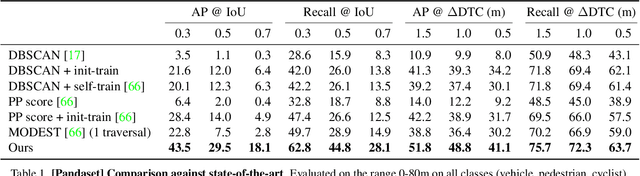

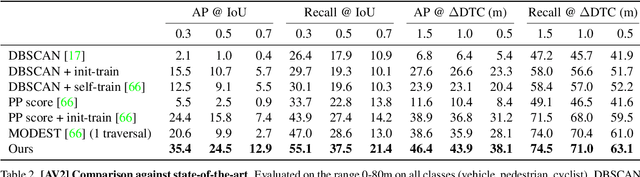
In this paper, we study the problem of unsupervised object detection from 3D point clouds in self-driving scenes. We present a simple yet effective method that exploits (i) point clustering in near-range areas where the point clouds are dense, (ii) temporal consistency to filter out noisy unsupervised detections, (iii) translation equivariance of CNNs to extend the auto-labels to long range, and (iv) self-supervision for improving on its own. Our approach, OYSTER (Object Discovery via Spatio-Temporal Refinement), does not impose constraints on data collection (such as repeated traversals of the same location), is able to detect objects in a zero-shot manner without supervised finetuning (even in sparse, distant regions), and continues to self-improve given more rounds of iterative self-training. To better measure model performance in self-driving scenarios, we propose a new planning-centric perception metric based on distance-to-collision. We demonstrate that our unsupervised object detector significantly outperforms unsupervised baselines on PandaSet and Argoverse 2 Sensor dataset, showing promise that self-supervision combined with object priors can enable object discovery in the wild. For more information, visit the project website: https://waabi.ai/research/oyster
Graph Representation Learning for Infrared and Visible Image Fusion
Nov 01, 2023Infrared and visible image fusion aims to extract complementary features to synthesize a single fused image. Many methods employ convolutional neural networks (CNNs) to extract local features due to its translation invariance and locality. However, CNNs fail to consider the image's non-local self-similarity (NLss), though it can expand the receptive field by pooling operations, it still inevitably leads to information loss. In addition, the transformer structure extracts long-range dependence by considering the correlativity among all image patches, leading to information redundancy of such transformer-based methods. However, graph representation is more flexible than grid (CNN) or sequence (transformer structure) representation to address irregular objects, and graph can also construct the relationships among the spatially repeatable details or texture with far-space distance. Therefore, to address the above issues, it is significant to convert images into the graph space and thus adopt graph convolutional networks (GCNs) to extract NLss. This is because the graph can provide a fine structure to aggregate features and propagate information across the nearest vertices without introducing redundant information. Concretely, we implement a cascaded NLss extraction pattern to extract NLss of intra- and inter-modal by exploring interactions of different image pixels in intra- and inter-image positional distance. We commence by preforming GCNs on each intra-modal to aggregate features and propagate information to extract independent intra-modal NLss. Then, GCNs are performed on the concatenate intra-modal NLss features of infrared and visible images, which can explore the cross-domain NLss of inter-modal to reconstruct the fused image. Ablation studies and extensive experiments illustrates the effectiveness and superiority of the proposed method on three datasets.
DDCoT: Duty-Distinct Chain-of-Thought Prompting for Multimodal Reasoning in Language Models
Oct 26, 2023A long-standing goal of AI systems is to perform complex multimodal reasoning like humans. Recently, large language models (LLMs) have made remarkable strides in such multi-step reasoning on the language modality solely by leveraging the chain of thought (CoT) to mimic human thinking. However, the transfer of these advancements to multimodal contexts introduces heightened challenges, including but not limited to the impractical need for labor-intensive annotation and the limitations in terms of flexibility, generalizability, and explainability. To evoke CoT reasoning in multimodality, this work first conducts an in-depth analysis of these challenges posed by multimodality and presents two key insights: "keeping critical thinking" and "letting everyone do their jobs" in multimodal CoT reasoning. Furthermore, this study proposes a novel DDCoT prompting that maintains a critical attitude through negative-space prompting and incorporates multimodality into reasoning by first dividing the reasoning responsibility of LLMs into reasoning and recognition and then integrating the visual recognition capability of visual models into the joint reasoning process. The rationales generated by DDCoT not only improve the reasoning abilities of both large and small language models in zero-shot prompting and fine-tuning learning, significantly outperforming state-of-the-art methods but also exhibit impressive generalizability and explainability.
EEG motor imagery decoding: A framework for comparative analysis with channel attention mechanisms
Oct 17, 2023The objective of this study is to investigate the application of various channel attention mechanisms within the domain of brain-computer interface (BCI) for motor imagery decoding. Channel attention mechanisms can be seen as a powerful evolution of spatial filters traditionally used for motor imagery decoding. This study systematically compares such mechanisms by integrating them into a lightweight architecture framework to evaluate their impact. We carefully construct a straightforward and lightweight baseline architecture designed to seamlessly integrate different channel attention mechanisms. This approach is contrary to previous works which only investigate one attention mechanism and usually build a very complex, sometimes nested architecture. Our framework allows us to evaluate and compare the impact of different attention mechanisms under the same circumstances. The easy integration of different channel attention mechanisms as well as the low computational complexity enables us to conduct a wide range of experiments on three datasets to thoroughly assess the effectiveness of the baseline model and the attention mechanisms. Our experiments demonstrate the strength and generalizability of our architecture framework as well as how channel attention mechanisms can improve the performance while maintaining the small memory footprint and low computational complexity of our baseline architecture. Our architecture emphasizes simplicity, offering easy integration of channel attention mechanisms, while maintaining a high degree of generalizability across datasets, making it a versatile and efficient solution for EEG motor imagery decoding within brain-computer interfaces.
AdaRec: Adaptive Sequential Recommendation for Reinforcing Long-term User Engagement
Oct 06, 2023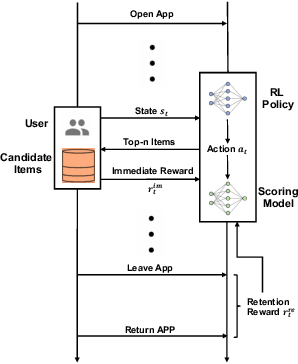
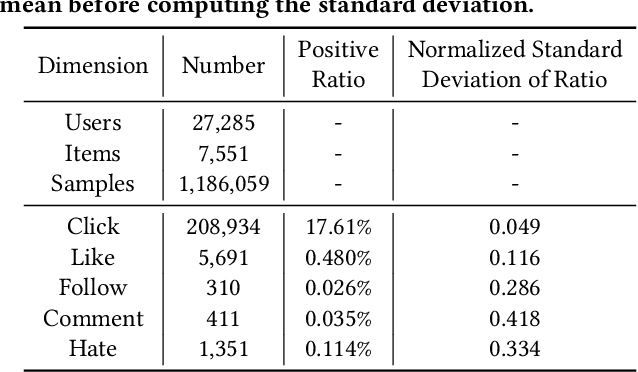
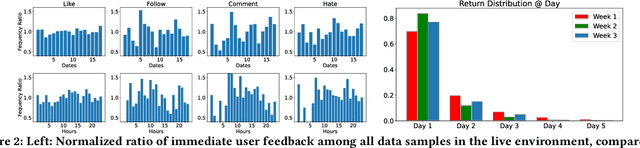
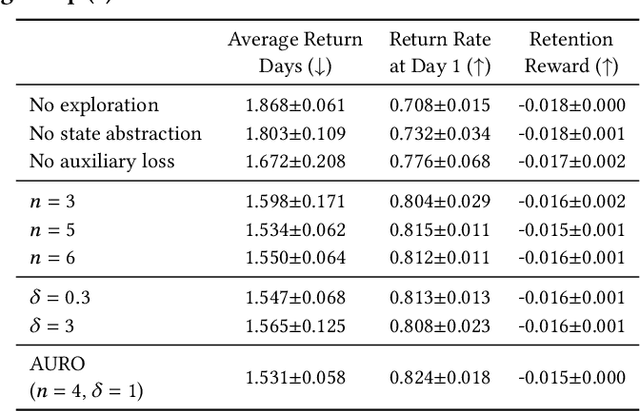
Growing attention has been paid to Reinforcement Learning (RL) algorithms when optimizing long-term user engagement in sequential recommendation tasks. One challenge in large-scale online recommendation systems is the constant and complicated changes in users' behavior patterns, such as interaction rates and retention tendencies. When formulated as a Markov Decision Process (MDP), the dynamics and reward functions of the recommendation system are continuously affected by these changes. Existing RL algorithms for recommendation systems will suffer from distribution shift and struggle to adapt in such an MDP. In this paper, we introduce a novel paradigm called Adaptive Sequential Recommendation (AdaRec) to address this issue. AdaRec proposes a new distance-based representation loss to extract latent information from users' interaction trajectories. Such information reflects how RL policy fits to current user behavior patterns, and helps the policy to identify subtle changes in the recommendation system. To make rapid adaptation to these changes, AdaRec encourages exploration with the idea of optimism under uncertainty. The exploration is further guarded by zero-order action optimization to ensure stable recommendation quality in complicated environments. We conduct extensive empirical analyses in both simulator-based and live sequential recommendation tasks, where AdaRec exhibits superior long-term performance compared to all baseline algorithms.
Indoor Positioning based on Active Radar Sensing and Passive Reflectors: Concepts & Initial Results
Oct 06, 2023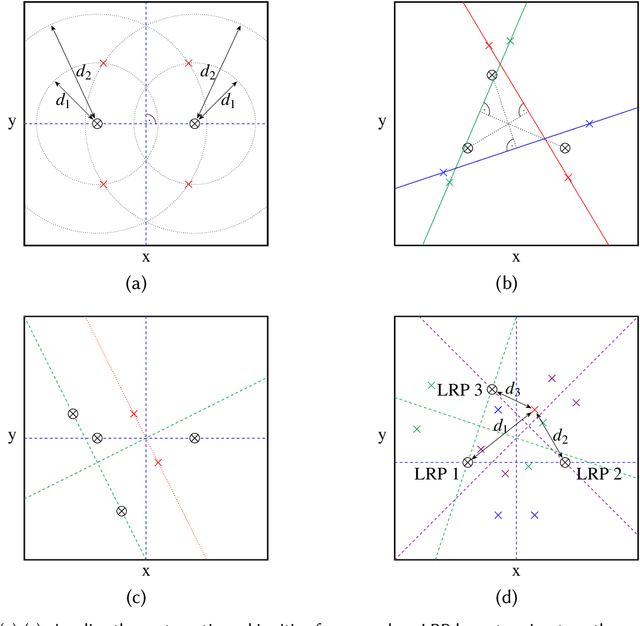
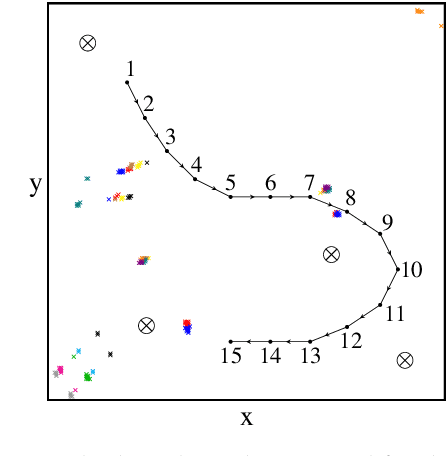
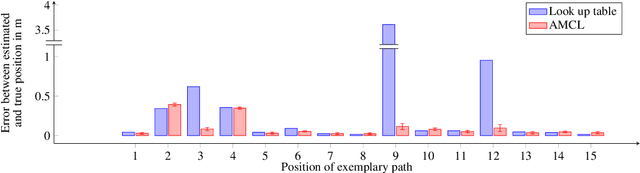
To navigate reliably in indoor environments, an industrial autonomous vehicle must know its position. However, current indoor vehicle positioning technologies either lack accuracy, usability or are too expensive. Thus, we propose a novel concept called local reference point assisted active radar positioning, which is able to overcome these drawbacks. It is based on distributing passive retroreflectors in the indoor environment such that each position of the vehicle can be identified by a unique reflection characteristic regarding the reflectors. To observe these characteristics, the autonomous vehicle is equipped with an active radar system. On one hand, this paper presents the basic idea and concept of our new approach towards indoor vehicle positioning and especially focuses on the crucial placement of the reflectors. On the other hand, it also provides a proof of concept by conducting a full system simulation including the placement of the local reference points, the radar-based distance estimation and the comparison of two different positioning methods. It successfully demonstrates the feasibility of our proposed approach.
LightPath: Lightweight and Scalable Path Representation Learning
Jul 19, 2023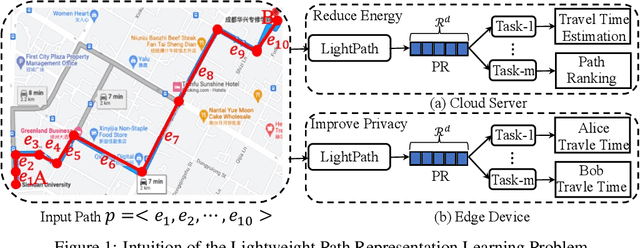
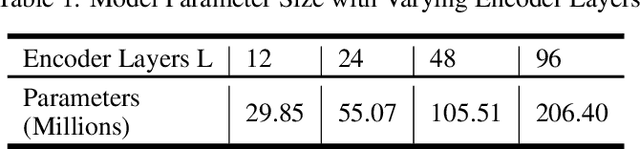
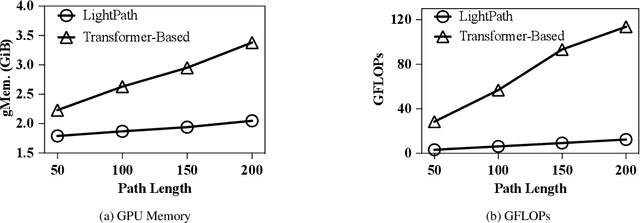
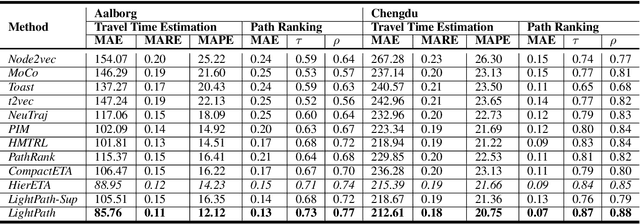
Movement paths are used widely in intelligent transportation and smart city applications. To serve such applications, path representation learning aims to provide compact representations of paths that enable efficient and accurate operations when used for different downstream tasks such as path ranking and travel cost estimation. In many cases, it is attractive that the path representation learning is lightweight and scalable; in resource-limited environments and under green computing limitations, it is essential. Yet, existing path representation learning studies focus on accuracy and pay at most secondary attention to resource consumption and scalability. We propose a lightweight and scalable path representation learning framework, termed LightPath, that aims to reduce resource consumption and achieve scalability without affecting accuracy, thus enabling broader applicability. More specifically, we first propose a sparse auto-encoder that ensures that the framework achieves good scalability with respect to path length. Next, we propose a relational reasoning framework to enable faster training of more robust sparse path encoders. We also propose global-local knowledge distillation to further reduce the size and improve the performance of sparse path encoders. Finally, we report extensive experiments on two real-world datasets to offer insight into the efficiency, scalability, and effectiveness of the proposed framework.
Origin-Destination Travel Time Oracle for Map-based Services
Jul 06, 2023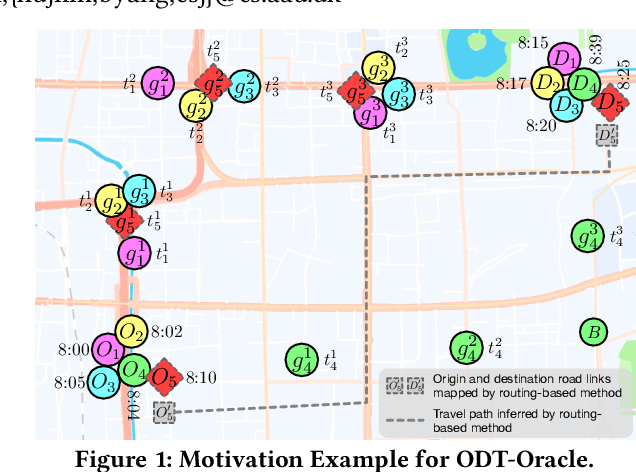
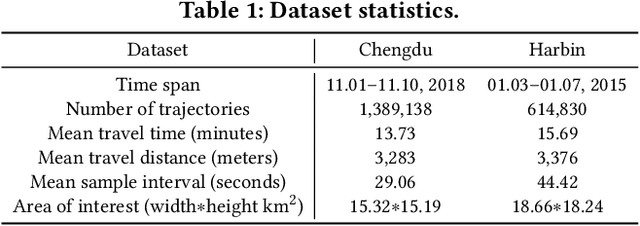
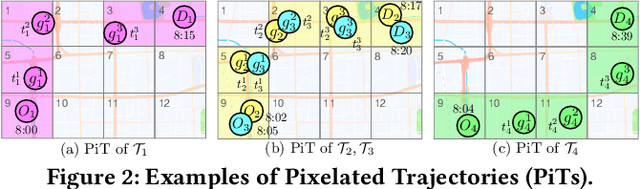
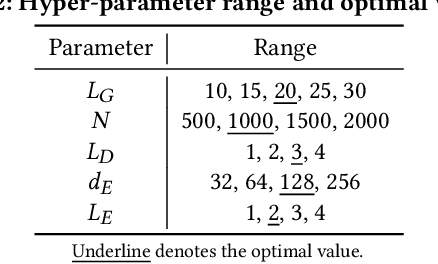
Given an origin (O), a destination (D), and a departure time (T), an Origin-Destination (OD) travel time oracle~(ODT-Oracle) returns an estimate of the time it takes to travel from O to D when departing at T. ODT-Oracles serve important purposes in map-based services. To enable the construction of such oracles, we provide a travel-time estimation (TTE) solution that leverages historical trajectories to estimate time-varying travel times for OD pairs. The problem is complicated by the fact that multiple historical trajectories with different travel times may connect an OD pair, while trajectories may vary from one another. To solve the problem, it is crucial to remove outlier trajectories when doing travel time estimation for future queries. We propose a novel, two-stage framework called Diffusion-based Origin-destination Travel Time Estimation (DOT), that solves the problem. First, DOT employs a conditioned Pixelated Trajectories (PiT) denoiser that enables building a diffusion-based PiT inference process by learning correlations between OD pairs and historical trajectories. Specifically, given an OD pair and a departure time, we aim to infer a PiT. Next, DOT encompasses a Masked Vision Transformer~(MViT) that effectively and efficiently estimates a travel time based on the inferred PiT. We report on extensive experiments on two real-world datasets that offer evidence that DOT is capable of outperforming baseline methods in terms of accuracy, scalability, and explainability.
Weight Compander: A Simple Weight Reparameterization for Regularization
Jun 29, 2023Regularization is a set of techniques that are used to improve the generalization ability of deep neural networks. In this paper, we introduce weight compander (WC), a novel effective method to improve generalization by reparameterizing each weight in deep neural networks using a nonlinear function. It is a general, intuitive, cheap and easy to implement method, which can be combined with various other regularization techniques. Large weights in deep neural networks are a sign of a more complex network that is overfitted to the training data. Moreover, regularized networks tend to have a greater range of weights around zero with fewer weights centered at zero. We introduce a weight reparameterization function which is applied to each weight and implicitly reduces overfitting by restricting the magnitude of the weights while forcing them away from zero at the same time. This leads to a more democratic decision-making in the network. Firstly, individual weights cannot have too much influence in the prediction process due to the restriction of their magnitude. Secondly, more weights are used in the prediction process, since they are forced away from zero during the training. This promotes the extraction of more features from the input data and increases the level of weight redundancy, which makes the network less sensitive to statistical differences between training and test data. We extend our method to learn the hyperparameters of the introduced weight reparameterization function. This avoids hyperparameter search and gives the network the opportunity to align the weight reparameterization with the training progress. We show experimentally that using weight compander in addition to standard regularization methods improves the performance of neural networks.
* Accepted by The International Joint Conference on Neural Network (IJCNN) 2023