 Add to Chrome
 Add to Firefox
 Add to Edge
AdaJEPA: An Adaptive Latent World Model
Jun 30, 2026
Latent world models enable planning from high-dimensional observations by predicting future states in a compact latent space. However, these models are typically kept frozen at test time: when their predictions become inaccurate, planning can fail, especially under test-time distribution shift. To address this, we propose AdaJEPA, an adaptive latent world model that performs test-time adaptation within the closed loop of model predictive control (MPC). After training, AdaJEPA plans and executes the first action chunk, uses the observed next-state transition as a self-supervised adaptation signal, and replans with the updated model. This closed-loop update continuously recalibrates the world model without additional expert demonstrations. Across a range of goal-reaching tasks, AdaJEPA substantially improves planning success with as few as one gradient step per MPC replanning step.

Continual Visual and Verbal Learning Through a Child's Egocentric Input
Jun 03, 2026Children learn the meanings of words from a continuous, temporally structured stream of egocentric experience. Recent work shows that neural networks can also learn word-referent mappings from a child's egocentric video recordings, but they cycle through the shuffled data for hundreds of epochs, contrasting with how children actually encounter their environment. We introduce BabyCL, a continual multimodal learning framework that processes the SAYCam dataset in a single chronological pass, combining streaming visual representation learning with an image-text contrastive objective. BabyCL combines a multi-stage temporal segmentation of the stream with a dual replay buffer that independently manages visual and multimodal histories, and it is jointly trained with three contrastive losses on a shared backbone. Under a matched optimization budget, BabyCL outperforms streaming learning baselines on the SAYCam Labeled-S 4AFC benchmark, substantially narrowing the gap to an upper bound of offline training. Ablations show that the gains are robust to the length of the online temporal segmentation window and the eviction rule of the replay buffer. Together, these results show that meaningful word-referent mappings can emerge under training conditions much closer to a child's actual experience.
Aligning LLMs with Human Uncertainty: A Beta-Bernoulli Calibrator for LLM Forecasting
May 26, 2026Probabilistic forecasting estimates the likelihood of uncertain future events. To improve LLM forecasting, existing methods typically learn from binary outcomes to output verbalized forecasts. However, while aggregated human forecasts contain rich information in both the crowd probability estimate and the degree of agreement among forecasters, how to utilize these signals remains underexplored. To address this, we propose the Beta-Bernoulli Calibrator (BBC), which converts an initial point estimate forecast from any model into a distribution over event likelihood, using supervision from both binary outcomes and human forecasts. BBC models event likelihood $p \sim \text{Beta}(α, β)$ and outcome $y \sim \text{Bernoulli}(p)$, with the mean as the calibrated point forecast and the variance as the epistemic uncertainty. Our results show that BBC generally provides better calibrated and more accurate forecasts than both traditional post-hoc calibration methods and models fine-tuned specifically for forecasting, while remaining lightweight and having good generalization. We also show that the epistemic uncertainty captured by BBC is a more reliable predictor of forecasting error than verbalized confidence.
Generative Recursive Reasoning
May 20, 2026How should future neural reasoning systems implement extended computation? Recursive Reasoning Models (RRMs) offer a promising alternative to autoregressive sequence extension by performing iterative latent-state refinement with shared transition functions. Yet existing RRMs are largely deterministic, following a single latent trajectory and converging to a single prediction. We introduce Generative Recursive reAsoning Models (GRAM), a framework that turns recursive latent reasoning into probabilistic multi-trajectory computation. GRAM models reasoning as a stochastic latent trajectory, enabling multiple hypotheses, alternative solution strategies, and inference-time scaling through both recursive depth and parallel trajectory sampling. This yields a latent-variable generative model supporting conditional reasoning via $p_θ(y \mid x)$ and, with fixed or absent inputs, unconditional generation via $p_θ(x)$. Trained with amortized variational inference, GRAM improves over deterministic recurrent and recursive baselines on structured reasoning and multi-solution constraint satisfaction tasks, while demonstrating an unconditional generation capability. https://ahn-ml.github.io/gram-website
Memory Transfer Learning: How Memories are Transferred Across Domains in Coding Agents
Apr 15, 2026Memory-based self-evolution has emerged as a promising paradigm for coding agents. However, existing approaches typically restrict memory utilization to homogeneous task domains, failing to leverage the shared infrastructural foundations, such as runtime environments and programming languages, that exist across diverse real-world coding problems. To address this limitation, we investigate \textbf{Memory Transfer Learning} (MTL) by harnessing a unified memory pool from heterogeneous domains. We evaluate performance across 6 coding benchmarks using four memory representations, ranging from concrete traces to abstract insights. Our experiments demonstrate that cross-domain memory improves average performance by 3.7\%, primarily by transferring meta-knowledge, such as validation routines, rather than task-specific code. Importantly, we find that abstraction dictates transferability; high-level insights generalize well, whereas low-level traces often induce negative transfer due to excessive specificity. Furthermore, we show that transfer effectiveness scales with the size of the memory pool, and memory can be transferred even between different models. Our work establishes empirical design principles for expanding memory utilization beyond single-domain silos. Project page: https://memorytransfer.github.io/
Temporal Straightening for Latent Planning
Mar 12, 2026Learning good representations is essential for latent planning with world models. While pretrained visual encoders produce strong semantic visual features, they are not tailored to planning and contain information irrelevant -- or even detrimental -- to planning. Inspired by the perceptual straightening hypothesis in human visual processing, we introduce temporal straightening to improve representation learning for latent planning. Using a curvature regularizer that encourages locally straightened latent trajectories, we jointly learn an encoder and a predictor. We show that reducing curvature this way makes the Euclidean distance in latent space a better proxy for the geodesic distance and improves the conditioning of the planning objective. We demonstrate empirically that temporal straightening makes gradient-based planning more stable and yields significantly higher success rates across a suite of goal-reaching tasks.
MA-EgoQA: Question Answering over Egocentric Videos from Multiple Embodied Agents
Mar 11, 2026As embodied models become powerful, humans will collaborate with multiple embodied AI agents at their workplace or home in the future. To ensure better communication between human users and the multi-agent system, it is crucial to interpret incoming information from agents in parallel and refer to the appropriate context for each query. Existing challenges include effectively compressing and communicating high volumes of individual sensory inputs in the form of video and correctly aggregating multiple egocentric videos to construct system-level memory. In this work, we first formally define a novel problem of understanding multiple long-horizon egocentric videos simultaneously collected from embodied agents. To facilitate research in this direction, we introduce MultiAgent-EgoQA (MA-EgoQA), a benchmark designed to systemically evaluate existing models in our scenario. MA-EgoQA provides 1.7k questions unique to multiple egocentric streams, spanning five categories: social interaction, task coordination, theory-of-mind, temporal reasoning, and environmental interaction. We further propose a simple baseline model for MA-EgoQA named EgoMAS, which leverages shared memory across embodied agents and agent-wise dynamic retrieval. Through comprehensive evaluation across diverse baselines and EgoMAS on MA-EgoQA, we find that current approaches are unable to effectively handle multiple egocentric streams, highlighting the need for future advances in system-level understanding across the agents. The code and benchmark are available at https://ma-egoqa.github.io.
Discrete JEPA: Learning Discrete Token Representations without Reconstruction
Jun 17, 2025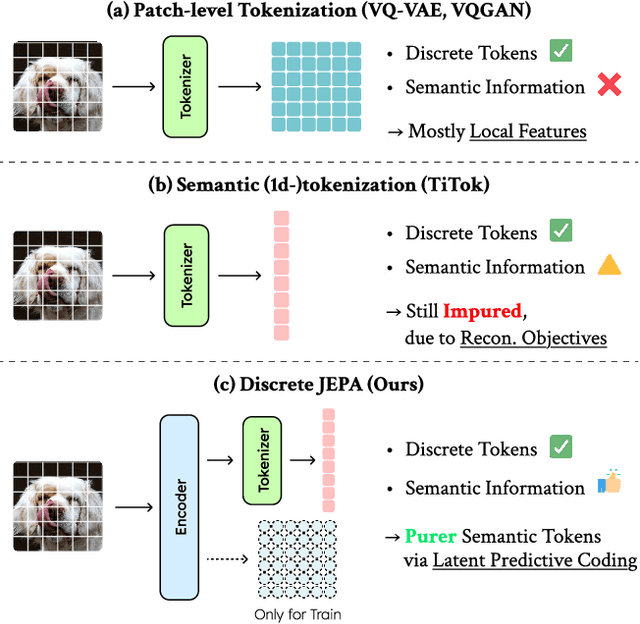
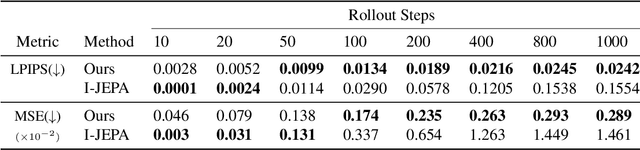
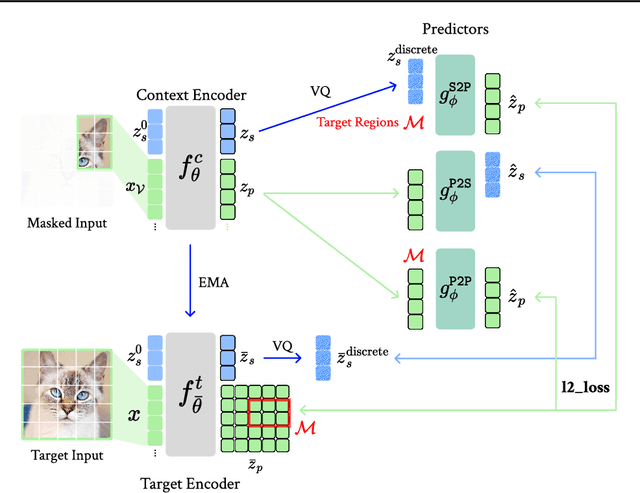
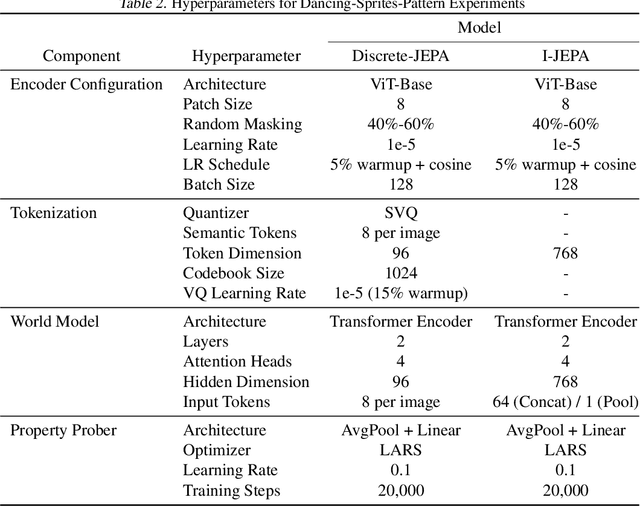
The cornerstone of cognitive intelligence lies in extracting hidden patterns from observations and leveraging these principles to systematically predict future outcomes. However, current image tokenization methods demonstrate significant limitations in tasks requiring symbolic abstraction and logical reasoning capabilities essential for systematic inference. To address this challenge, we propose Discrete-JEPA, extending the latent predictive coding framework with semantic tokenization and novel complementary objectives to create robust tokenization for symbolic reasoning tasks. Discrete-JEPA dramatically outperforms baselines on visual symbolic prediction tasks, while striking visual evidence reveals the spontaneous emergence of deliberate systematic patterns within the learned semantic token space. Though an initial model, our approach promises a significant impact for advancing Symbolic world modeling and planning capabilities in artificial intelligence systems.
Replay Can Provably Increase Forgetting
Jun 04, 2025Continual learning seeks to enable machine learning systems to solve an increasing corpus of tasks sequentially. A critical challenge for continual learning is forgetting, where the performance on previously learned tasks decreases as new tasks are introduced. One of the commonly used techniques to mitigate forgetting, sample replay, has been shown empirically to reduce forgetting by retaining some examples from old tasks and including them in new training episodes. In this work, we provide a theoretical analysis of sample replay in an over-parameterized continual linear regression setting, where each task is given by a linear subspace and with enough replay samples, one would be able to eliminate forgetting. Our analysis focuses on sample replay and highlights the role of the replayed samples and the relationship between task subspaces. Surprisingly, we find that, even in a noiseless setting, forgetting can be non-monotonic with respect to the number of replay samples. We present tasks where replay can be harmful with respect to worst-case settings, and also in distributional settings where replay of randomly selected samples increases forgetting in expectation. We also give empirical evidence that harmful replay is not limited to training with linear models by showing similar behavior for a neural networks equipped with SGD. Through experiments on a commonly used benchmark, we provide additional evidence that, even in seemingly benign scenarios, performance of the replay heavily depends on the choice of replay samples and the relationship between tasks.
Memory Storyboard: Leveraging Temporal Segmentation for Streaming Self-Supervised Learning from Egocentric Videos
Jan 21, 2025

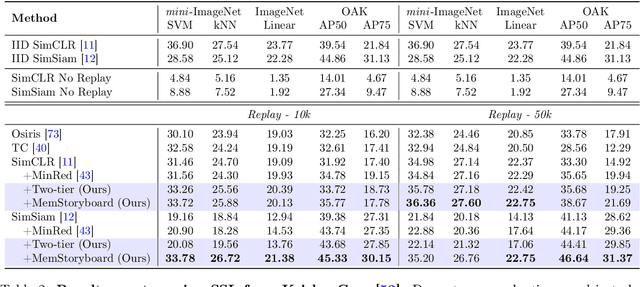

Self-supervised learning holds the promise to learn good representations from real-world continuous uncurated data streams. However, most existing works in visual self-supervised learning focus on static images or artificial data streams. Towards exploring a more realistic learning substrate, we investigate streaming self-supervised learning from long-form real-world egocentric video streams. Inspired by the event segmentation mechanism in human perception and memory, we propose "Memory Storyboard" that groups recent past frames into temporal segments for more effective summarization of the past visual streams for memory replay. To accommodate efficient temporal segmentation, we propose a two-tier memory hierarchy: the recent past is stored in a short-term memory, and the storyboard temporal segments are then transferred to a long-term memory. Experiments on real-world egocentric video datasets including SAYCam and KrishnaCam show that contrastive learning objectives on top of storyboard frames result in semantically meaningful representations which outperform those produced by state-of-the-art unsupervised continual learning methods.