 Add to Chrome
 Add to Firefox
 Add to Edge
Temporal Saliency-Guided Distillation: A Scalable Framework for Distilling Video Datasets
May 27, 2025
Dataset distillation (DD) has emerged as a powerful paradigm for dataset compression, enabling the synthesis of compact surrogate datasets that approximate the training utility of large-scale ones. While significant progress has been achieved in distilling image datasets, extending DD to the video domain remains challenging due to the high dimensionality and temporal complexity inherent in video data. Existing video distillation (VD) methods often suffer from excessive computational costs and struggle to preserve temporal dynamics, as na\"ive extensions of image-based approaches typically lead to degraded performance. In this paper, we propose a novel uni-level video dataset distillation framework that directly optimizes synthetic videos with respect to a pre-trained model. To address temporal redundancy and enhance motion preservation, we introduce a temporal saliency-guided filtering mechanism that leverages inter-frame differences to guide the distillation process, encouraging the retention of informative temporal cues while suppressing frame-level redundancy. Extensive experiments on standard video benchmarks demonstrate that our method achieves state-of-the-art performance, bridging the gap between real and distilled video data and offering a scalable solution for video dataset compression.

Grounding Language with Vision: A Conditional Mutual Information Calibrated Decoding Strategy for Reducing Hallucinations in LVLMs
May 26, 2025Large Vision-Language Models (LVLMs) are susceptible to hallucinations, where generated responses seem semantically plausible yet exhibit little or no relevance to the input image. Previous studies reveal that this issue primarily stems from LVLMs' over-reliance on language priors while disregarding the visual information during decoding. To alleviate this issue, we introduce a novel Conditional Pointwise Mutual Information (C-PMI) calibrated decoding strategy, which adaptively strengthens the mutual dependency between generated texts and input images to mitigate hallucinations. Unlike existing methods solely focusing on text token sampling, we propose to jointly model the contributions of visual and textual tokens to C-PMI, formulating hallucination mitigation as a bi-level optimization problem aimed at maximizing mutual information. To solve it, we design a token purification mechanism that dynamically regulates the decoding process by sampling text tokens remaining maximally relevant to the given image, while simultaneously refining image tokens most pertinent to the generated response. Extensive experiments across various benchmarks reveal that the proposed method significantly reduces hallucinations in LVLMs while preserving decoding efficiency.
Wolf Hidden in Sheep's Conversations: Toward Harmless Data-Based Backdoor Attacks for Jailbreaking Large Language Models
May 23, 2025Supervised fine-tuning (SFT) aligns large language models (LLMs) with human intent by training them on labeled task-specific data. Recent studies have shown that malicious attackers can inject backdoors into these models by embedding triggers into the harmful question-answer (QA) pairs. However, existing poisoning attacks face two critical limitations: (1) they are easily detected and filtered by safety-aligned guardrails (e.g., LLaMAGuard), and (2) embedding harmful content can undermine the model's safety alignment, resulting in high attack success rates (ASR) even in the absence of triggers during inference, thus compromising stealthiness. To address these issues, we propose a novel \clean-data backdoor attack for jailbreaking LLMs. Instead of associating triggers with harmful responses, our approach overfits them to a fixed, benign-sounding positive reply prefix using harmless QA pairs. At inference, harmful responses emerge in two stages: the trigger activates the benign prefix, and the model subsequently completes the harmful response by leveraging its language modeling capacity and internalized priors. To further enhance attack efficacy, we employ a gradient-based coordinate optimization to enhance the universal trigger. Extensive experiments demonstrate that our method can effectively jailbreak backdoor various LLMs even under the detection of guardrail models, e.g., an ASR of 86.67% and 85% on LLaMA-3-8B and Qwen-2.5-7B judged by GPT-4o.
Your Language Model Can Secretly Write Like Humans: Contrastive Paraphrase Attacks on LLM-Generated Text Detectors
May 21, 2025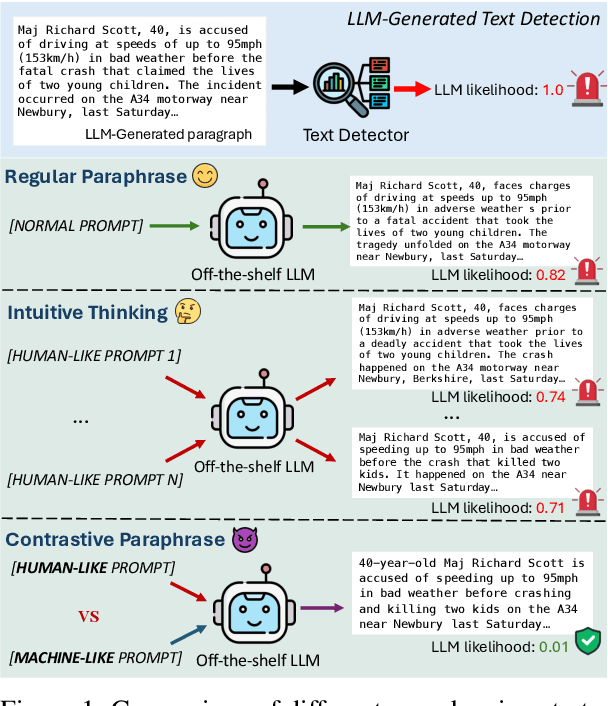
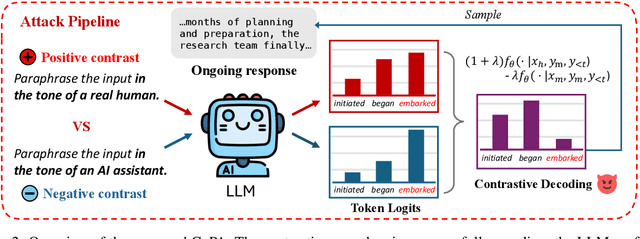
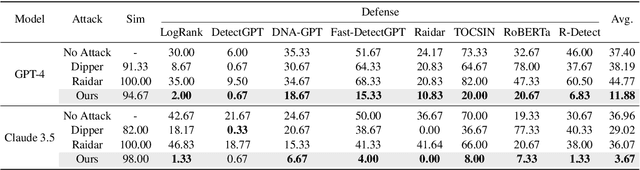
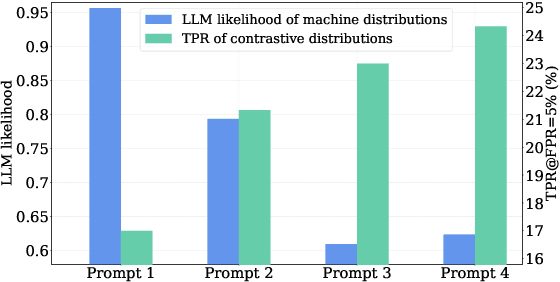
The misuse of large language models (LLMs), such as academic plagiarism, has driven the development of detectors to identify LLM-generated texts. To bypass these detectors, paraphrase attacks have emerged to purposely rewrite these texts to evade detection. Despite the success, existing methods require substantial data and computational budgets to train a specialized paraphraser, and their attack efficacy greatly reduces when faced with advanced detection algorithms. To address this, we propose \textbf{Co}ntrastive \textbf{P}araphrase \textbf{A}ttack (CoPA), a training-free method that effectively deceives text detectors using off-the-shelf LLMs. The first step is to carefully craft instructions that encourage LLMs to produce more human-like texts. Nonetheless, we observe that the inherent statistical biases of LLMs can still result in some generated texts carrying certain machine-like attributes that can be captured by detectors. To overcome this, CoPA constructs an auxiliary machine-like word distribution as a contrast to the human-like distribution generated by the LLM. By subtracting the machine-like patterns from the human-like distribution during the decoding process, CoPA is able to produce sentences that are less discernible by text detectors. Our theoretical analysis suggests the superiority of the proposed attack. Extensive experiments validate the effectiveness of CoPA in fooling text detectors across various scenarios.
$γ$-FedHT: Stepsize-Aware Hard-Threshold Gradient Compression in Federated Learning
May 18, 2025Gradient compression can effectively alleviate communication bottlenecks in Federated Learning (FL). Contemporary state-of-the-art sparse compressors, such as Top-$k$, exhibit high computational complexity, up to $\mathcal{O}(d\log_2{k})$, where $d$ is the number of model parameters. The hard-threshold compressor, which simply transmits elements with absolute values higher than a fixed threshold, is thus proposed to reduce the complexity to $\mathcal{O}(d)$. However, the hard-threshold compression causes accuracy degradation in FL, where the datasets are non-IID and the stepsize $\gamma$ is decreasing for model convergence. The decaying stepsize reduces the updates and causes the compression ratio of the hard-threshold compression to drop rapidly to an aggressive ratio. At or below this ratio, the model accuracy has been observed to degrade severely. To address this, we propose $\gamma$-FedHT, a stepsize-aware low-cost compressor with Error-Feedback to guarantee convergence. Given that the traditional theoretical framework of FL does not consider Error-Feedback, we introduce the fundamental conversation of Error-Feedback. We prove that $\gamma$-FedHT has the convergence rate of $\mathcal{O}(\frac{1}{T})$ ($T$ representing total training iterations) under $\mu$-strongly convex cases and $\mathcal{O}(\frac{1}{\sqrt{T}})$ under non-convex cases, \textit{same as FedAVG}. Extensive experiments demonstrate that $\gamma$-FedHT improves accuracy by up to $7.42\%$ over Top-$k$ under equal communication traffic on various non-IID image datasets.
High Quality Underwater Image Compression with Adaptive Correction and Codebook-based Augmentation
May 15, 2025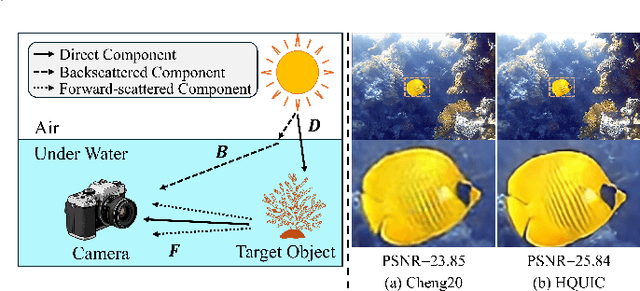
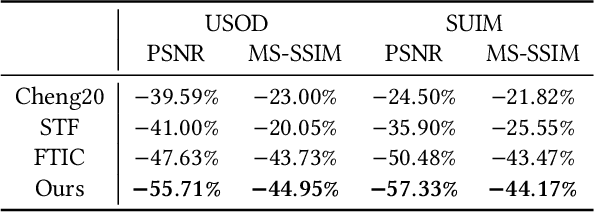
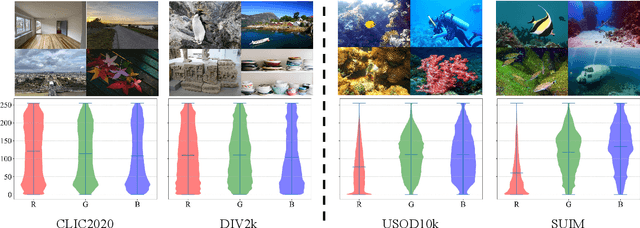
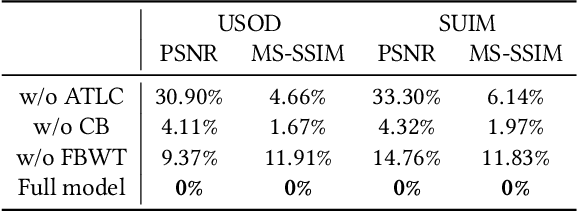
With the increasing exploration and exploitation of the underwater world, underwater images have become a critical medium for human interaction with marine environments, driving extensive research into their efficient transmission and storage. However, contemporary underwater image compression algorithms fail to fully leverage the unique characteristics distinguishing underwater scenes from terrestrial images, resulting in suboptimal performance. To address this limitation, we introduce HQUIC, designed to exploit underwater-image-specific features for enhanced compression efficiency. HQUIC employs an ALTC module to adaptively predict the attenuation coefficients and global light information of the images, which effectively mitigates the issues caused by the differences in lighting and tone existing in underwater images. Subsequently, HQUIC employs a codebook as an auxiliary branch to extract the common objects within underwater images and enhances the performance of the main branch. Furthermore, HQUIC dynamically weights multi-scale frequency components, prioritizing information critical for distortion quality while discarding redundant details. Extensive evaluations on diverse underwater datasets demonstrate that HQUIC outperforms state-of-the-art compression methods.
Towards Facial Image Compression with Consistency Preserving Diffusion Prior
May 09, 2025With the widespread application of facial image data across various domains, the efficient storage and transmission of facial images has garnered significant attention. However, the existing learned face image compression methods often produce unsatisfactory reconstructed image quality at low bit rates. Simply adapting diffusion-based compression methods to facial compression tasks results in reconstructed images that perform poorly in downstream applications due to insufficient preservation of high-frequency information. To further explore the diffusion prior in facial image compression, we propose Facial Image Compression with a Stable Diffusion Prior (FaSDiff), a method that preserves consistency through frequency enhancement. FaSDiff employs a high-frequency-sensitive compressor in an end-to-end framework to capture fine image details and produce robust visual prompts. Additionally, we introduce a hybrid low-frequency enhancement module that disentangles low-frequency facial semantics and stably modulates the diffusion prior alongside visual prompts. The proposed modules allow FaSDiff to leverage diffusion priors for superior human visual perception while minimizing performance loss in machine vision due to semantic inconsistency. Extensive experiments show that FaSDiff outperforms state-of-the-art methods in balancing human visual quality and machine vision accuracy. The code will be released after the paper is accepted.
DeCLIP: Decoupled Learning for Open-Vocabulary Dense Perception
May 07, 2025Dense visual prediction tasks have been constrained by their reliance on predefined categories, limiting their applicability in real-world scenarios where visual concepts are unbounded. While Vision-Language Models (VLMs) like CLIP have shown promise in open-vocabulary tasks, their direct application to dense prediction often leads to suboptimal performance due to limitations in local feature representation. In this work, we present our observation that CLIP's image tokens struggle to effectively aggregate information from spatially or semantically related regions, resulting in features that lack local discriminability and spatial consistency. To address this issue, we propose DeCLIP, a novel framework that enhances CLIP by decoupling the self-attention module to obtain ``content'' and ``context'' features respectively. The ``content'' features are aligned with image crop representations to improve local discriminability, while ``context'' features learn to retain the spatial correlations under the guidance of vision foundation models, such as DINO. Extensive experiments demonstrate that DeCLIP significantly outperforms existing methods across multiple open-vocabulary dense prediction tasks, including object detection and semantic segmentation. Code is available at \textcolor{magenta}{https://github.com/xiaomoguhz/DeCLIP}.
Embracing Collaboration Over Competition: Condensing Multiple Prompts for Visual In-Context Learning
Apr 30, 2025Visual In-Context Learning (VICL) enables adaptively solving vision tasks by leveraging pixel demonstrations, mimicking human-like task completion through analogy. Prompt selection is critical in VICL, but current methods assume the existence of a single "ideal" prompt in a pool of candidates, which in practice may not hold true. Multiple suitable prompts may exist, but individually they often fall short, leading to difficulties in selection and the exclusion of useful context. To address this, we propose a new perspective: prompt condensation. Rather than relying on a single prompt, candidate prompts collaborate to efficiently integrate informative contexts without sacrificing resolution. We devise Condenser, a lightweight external plugin that compresses relevant fine-grained context across multiple prompts. Optimized end-to-end with the backbone, Condenser ensures accurate integration of contextual cues. Experiments demonstrate Condenser outperforms state-of-the-arts across benchmark tasks, showing superior context compression, scalability with more prompts, and enhanced computational efficiency compared to ensemble methods, positioning it as a highly competitive solution for VICL. Code is open-sourced at https://github.com/gimpong/CVPR25-Condenser.
GaussTrap: Stealthy Poisoning Attacks on 3D Gaussian Splatting for Targeted Scene Confusion
Apr 29, 2025As 3D Gaussian Splatting (3DGS) emerges as a breakthrough in scene representation and novel view synthesis, its rapid adoption in safety-critical domains (e.g., autonomous systems, AR/VR) urgently demands scrutiny of potential security vulnerabilities. This paper presents the first systematic study of backdoor threats in 3DGS pipelines. We identify that adversaries may implant backdoor views to induce malicious scene confusion during inference, potentially leading to environmental misperception in autonomous navigation or spatial distortion in immersive environments. To uncover this risk, we propose GuassTrap, a novel poisoning attack method targeting 3DGS models. GuassTrap injects malicious views at specific attack viewpoints while preserving high-quality rendering in non-target views, ensuring minimal detectability and maximizing potential harm. Specifically, the proposed method consists of a three-stage pipeline (attack, stabilization, and normal training) to implant stealthy, viewpoint-consistent poisoned renderings in 3DGS, jointly optimizing attack efficacy and perceptual realism to expose security risks in 3D rendering. Extensive experiments on both synthetic and real-world datasets demonstrate that GuassTrap can effectively embed imperceptible yet harmful backdoor views while maintaining high-quality rendering in normal views, validating its robustness, adaptability, and practical applicability.