 Add to Chrome
 Add to Firefox
 Add to Edge
Toward Trustworthy AI: Multi-Target Adversarial Attacks and Robust Defenses for Continuous Data Summarization
Jun 10, 2026
Trustworthy AI requires reliable data-processing pipelines, not only robust downstream predictive models. As an upstream component, data summarization determines which information is retained and passed to subsequent learning or decision modules. Therefore, adversarial perturbations to the summarization process can compromise trustworthy AI in an upstream manner: they may alter the selected summary, reduce its representativeness, and further degrade the utility of subsequent learning tasks. In this paper, we study adversarial attacks on continuous data summarization under similarity-level perturbations through DR-submodular optimization. We show that a class of multi-resolution image summarization objectives can be formulated as multilinear extensions of non-negative submodular set functions and satisfy DR-submodularity with $m$-weak monotonicity. We then formulate multi-target attack generation as a min-max problem, where one admissible perturbation of the similarity structure is optimized to degrade multiple target summarization models. To mitigate such perturbations, we formulate robust defense against mixed attack types as a regularized max-min problem. For both problems, we develop approximation algorithms with theoretical guarantees. Experiments on real-data and controlled clustered benchmarks show that the proposed attack is effective in representative low-to-moderate budget regimes and can induce downstream task-performance loss. The proposed defense improves the robustness--mitigation trade-off in structured settings, while also revealing the parameter sensitivity of robust protection on real data.

GRP-Obliteration: Unaligning LLMs With a Single Unlabeled Prompt
Feb 05, 2026Safety alignment is only as robust as its weakest failure mode. Despite extensive work on safety post-training, it has been shown that models can be readily unaligned through post-deployment fine-tuning. However, these methods often require extensive data curation and degrade model utility. In this work, we extend the practical limits of unalignment by introducing GRP-Obliteration (GRP-Oblit), a method that uses Group Relative Policy Optimization (GRPO) to directly remove safety constraints from target models. We show that a single unlabeled prompt is sufficient to reliably unalign safety-aligned models while largely preserving their utility, and that GRP-Oblit achieves stronger unalignment on average than existing state-of-the-art techniques. Moreover, GRP-Oblit generalizes beyond language models and can also unalign diffusion-based image generation systems. We evaluate GRP-Oblit on six utility benchmarks and five safety benchmarks across fifteen 7-20B parameter models, spanning instruct and reasoning models, as well as dense and MoE architectures. The evaluated model families include GPT-OSS, distilled DeepSeek, Gemma, Llama, Ministral, and Qwen.
LogiPlan: A Structured Benchmark for Logical Planning and Relational Reasoning in LLMs
Jun 12, 2025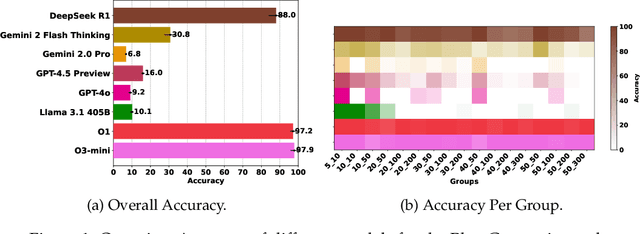
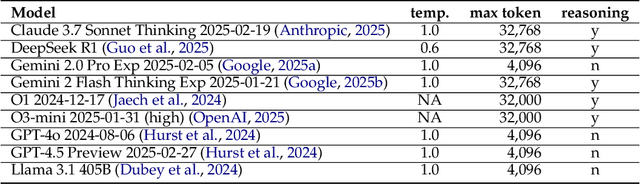
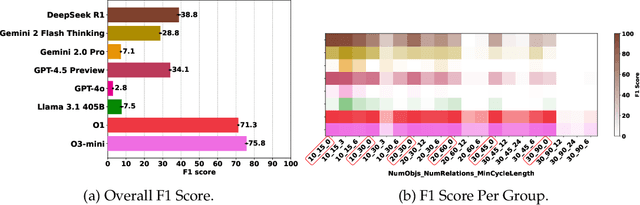
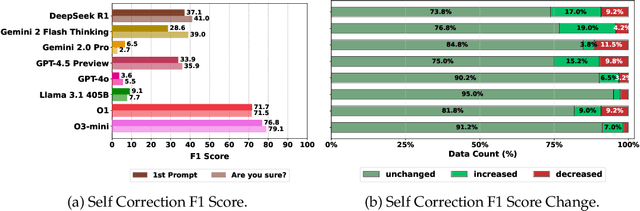
We introduce LogiPlan, a novel benchmark designed to evaluate the capabilities of large language models (LLMs) in logical planning and reasoning over complex relational structures. Logical relational reasoning is important for applications that may rely on LLMs to generate and query structured graphs of relations such as network infrastructure, knowledge bases, or business process schema. Our framework allows for dynamic variation of task complexity by controlling the number of objects, relations, and the minimum depth of relational chains, providing a fine-grained assessment of model performance across difficulty levels. LogiPlan encompasses three complementary tasks: (1) Plan Generation, where models must construct valid directed relational graphs meeting specified structural constraints; (2) Consistency Detection, testing models' ability to identify inconsistencies in relational structures; and (3) Comparison Question, evaluating models' capacity to determine the validity of queried relationships within a given graph. Additionally, we assess models' self-correction capabilities by prompting them to verify and refine their initial solutions. We evaluate state-of-the-art models including DeepSeek R1, Gemini 2.0 Pro, Gemini 2 Flash Thinking, GPT-4.5, GPT-4o, Llama 3.1 405B, O3-mini, O1, and Claude 3.7 Sonnet across these tasks, revealing significant performance gaps that correlate with model scale and architecture. Our analysis demonstrates that while recent reasoning-enhanced models show promising results on simpler instances, they struggle with more complex configurations requiring deeper logical planning.