 Add to Chrome
 Add to Firefox
 Add to Edge
Refusal Direction is Universal Across Safety-Aligned Languages
May 22, 2025
Refusal mechanisms in large language models (LLMs) are essential for ensuring safety. Recent research has revealed that refusal behavior can be mediated by a single direction in activation space, enabling targeted interventions to bypass refusals. While this is primarily demonstrated in an English-centric context, appropriate refusal behavior is important for any language, but poorly understood. In this paper, we investigate the refusal behavior in LLMs across 14 languages using PolyRefuse, a multilingual safety dataset created by translating malicious and benign English prompts into these languages. We uncover the surprising cross-lingual universality of the refusal direction: a vector extracted from English can bypass refusals in other languages with near-perfect effectiveness, without any additional fine-tuning. Even more remarkably, refusal directions derived from any safety-aligned language transfer seamlessly to others. We attribute this transferability to the parallelism of refusal vectors across languages in the embedding space and identify the underlying mechanism behind cross-lingual jailbreaks. These findings provide actionable insights for building more robust multilingual safety defenses and pave the way for a deeper mechanistic understanding of cross-lingual vulnerabilities in LLMs.

Tracing Multilingual Factual Knowledge Acquisition in Pretraining
May 20, 2025Large Language Models (LLMs) are capable of recalling multilingual factual knowledge present in their pretraining data. However, most studies evaluate only the final model, leaving the development of factual recall and crosslingual consistency throughout pretraining largely unexplored. In this work, we trace how factual recall and crosslingual consistency evolve during pretraining, focusing on OLMo-7B as a case study. We find that both accuracy and consistency improve over time for most languages. We show that this improvement is primarily driven by the fact frequency in the pretraining corpus: more frequent facts are more likely to be recalled correctly, regardless of language. Yet, some low-frequency facts in non-English languages can still be correctly recalled. Our analysis reveals that these instances largely benefit from crosslingual transfer of their English counterparts -- an effect that emerges predominantly in the early stages of pretraining. We pinpoint two distinct pathways through which multilingual factual knowledge acquisition occurs: (1) frequency-driven learning, which is dominant and language-agnostic, and (2) crosslingual transfer, which is limited in scale and typically constrained to relation types involving named entities. We release our code and data to facilitate further research at https://github.com/cisnlp/multilingual-fact-tracing.
What's the Difference? Supporting Users in Identifying the Effects of Prompt and Model Changes Through Token Patterns
Apr 22, 2025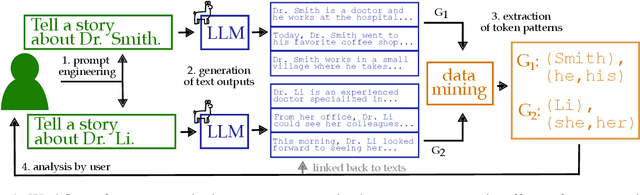
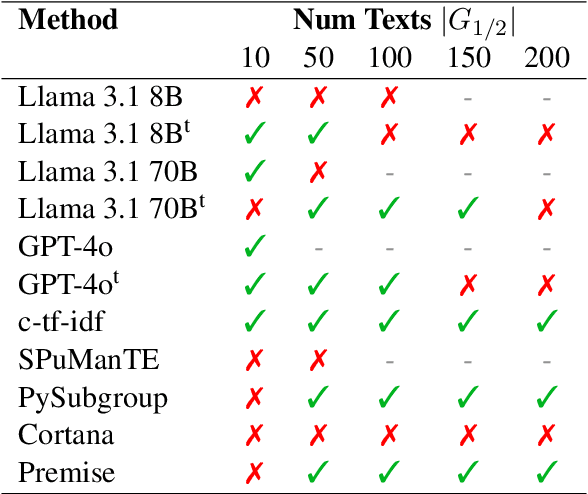
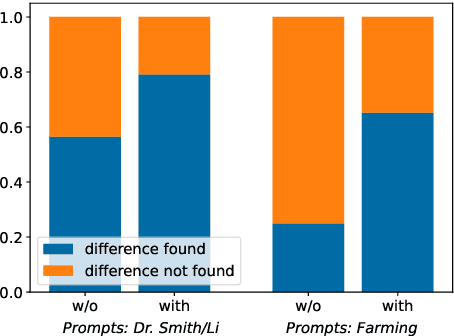
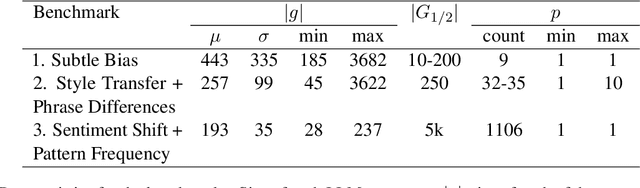
Prompt engineering for large language models is challenging, as even small prompt perturbations or model changes can significantly impact the generated output texts. Existing evaluation methods, either automated metrics or human evaluation, have limitations, such as providing limited insights or being labor-intensive. We propose Spotlight, a new approach that combines both automation and human analysis. Based on data mining techniques, we automatically distinguish between random (decoding) variations and systematic differences in language model outputs. This process provides token patterns that describe the systematic differences and guide the user in manually analyzing the effects of their prompt and model changes efficiently. We create three benchmarks to quantitatively test the reliability of token pattern extraction methods and demonstrate that our approach provides new insights into established prompt data. From a human-centric perspective, through demonstration studies and a user study, we show that our token pattern approach helps users understand the systematic differences of language model outputs, and we are able to discover relevant differences caused by prompt and model changes (e.g. related to gender or culture), thus supporting the prompt engineering process and human-centric model behavior research.
Enabling Systematic Generalization in Abstract Spatial Reasoning through Meta-Learning for Compositionality
Apr 02, 2025Systematic generalization refers to the capacity to understand and generate novel combinations from known components. Despite recent progress by large language models (LLMs) across various domains, these models often fail to extend their knowledge to novel compositional scenarios, revealing notable limitations in systematic generalization. There has been an ongoing debate about whether neural networks possess the capacity for systematic generalization, with recent studies suggesting that meta-learning approaches designed for compositionality can significantly enhance this ability. However, these insights have largely been confined to linguistic problems, leaving their applicability to other tasks an open question. In this study, we extend the approach of meta-learning for compositionality to the domain of abstract spatial reasoning. To this end, we introduce $\textit{SYGAR}$-a dataset designed to evaluate the capacity of models to systematically generalize from known geometric transformations (e.g., translation, rotation) of two-dimensional objects to novel combinations of these transformations (e.g., translation+rotation). Our results show that a transformer-based encoder-decoder model, trained via meta-learning for compositionality, can systematically generalize to previously unseen transformation compositions, significantly outperforming state-of-the-art LLMs, including o3-mini, GPT-4o, and Gemini 2.0 Flash, which fail to exhibit similar systematic behavior. Our findings highlight the effectiveness of meta-learning in promoting systematicity beyond linguistic tasks, suggesting a promising direction toward more robust and generalizable models.
Probing LLMs for Multilingual Discourse Generalization Through a Unified Label Set
Mar 13, 2025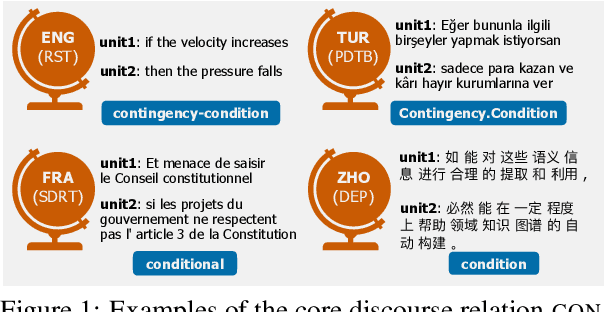
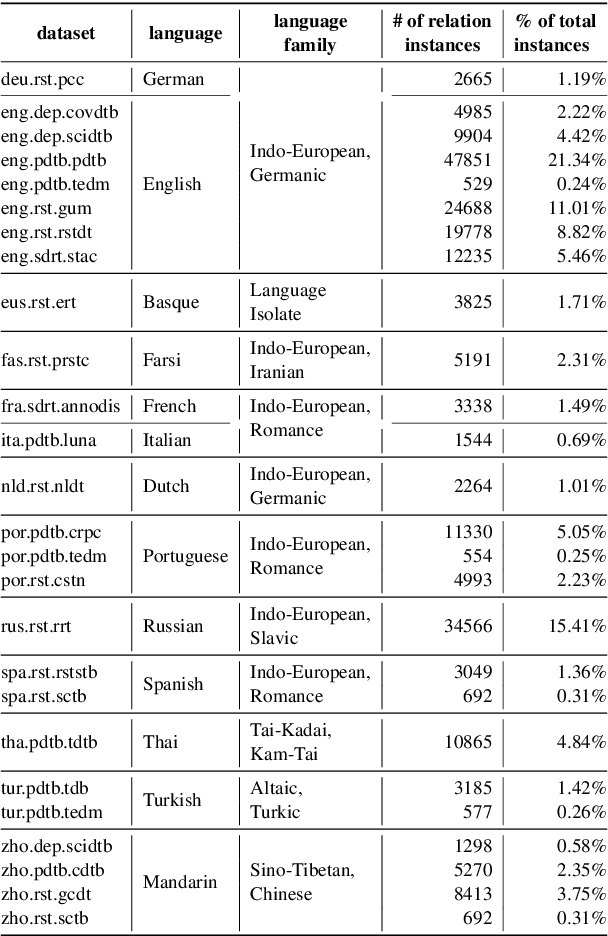
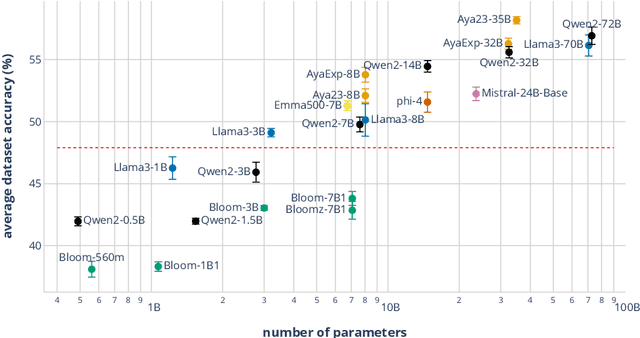
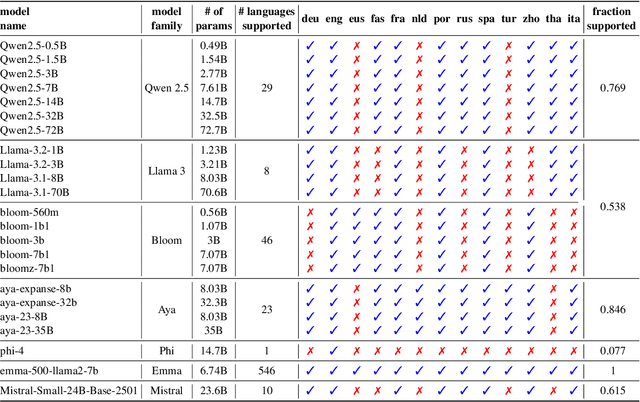
Discourse understanding is essential for many NLP tasks, yet most existing work remains constrained by framework-dependent discourse representations. This work investigates whether large language models (LLMs) capture discourse knowledge that generalizes across languages and frameworks. We address this question along two dimensions: (1) developing a unified discourse relation label set to facilitate cross-lingual and cross-framework discourse analysis, and (2) probing LLMs to assess whether they encode generalizable discourse abstractions. Using multilingual discourse relation classification as a testbed, we examine a comprehensive set of 23 LLMs of varying sizes and multilingual capabilities. Our results show that LLMs, especially those with multilingual training corpora, can generalize discourse information across languages and frameworks. Further layer-wise analyses reveal that language generalization at the discourse level is most salient in the intermediate layers. Lastly, our error analysis provides an account of challenging relation classes.
Better Aligned with Survey Respondents or Training Data? Unveiling Political Leanings of LLMs on U.S. Supreme Court Cases
Feb 25, 2025The increased adoption of Large Language Models (LLMs) and their potential to shape public opinion have sparked interest in assessing these models' political leanings. Building on previous research that compared LLMs and human opinions and observed political bias in system responses, we take a step further to investigate the underlying causes of such biases by empirically examining how the values and biases embedded in training corpora shape model outputs. Specifically, we propose a method to quantitatively evaluate political leanings embedded in the large pretraining corpora. Subsequently we investigate to whom are the LLMs' political leanings more aligned with, their pretrainig corpora or the surveyed human opinions. As a case study, we focus on probing the political leanings of LLMs in 32 U.S. Supreme Court cases, addressing contentious topics such as abortion and voting rights. Our findings reveal that LLMs strongly reflect the political leanings in their training data, and no strong correlation is observed with their alignment to human opinions as expressed in surveys. These results underscore the importance of responsible curation of training data and the need for robust evaluation metrics to ensure LLMs' alignment with human-centered values.
Pragmatics in the Era of Large Language Models: A Survey on Datasets, Evaluation, Opportunities and Challenges
Feb 17, 2025Understanding pragmatics-the use of language in context-is crucial for developing NLP systems capable of interpreting nuanced language use. Despite recent advances in language technologies, including large language models, evaluating their ability to handle pragmatic phenomena such as implicatures and references remains challenging. To advance pragmatic abilities in models, it is essential to understand current evaluation trends and identify existing limitations. In this survey, we provide a comprehensive review of resources designed for evaluating pragmatic capabilities in NLP, categorizing datasets by the pragmatics phenomena they address. We analyze task designs, data collection methods, evaluation approaches, and their relevance to real-world applications. By examining these resources in the context of modern language models, we highlight emerging trends, challenges, and gaps in existing benchmarks. Our survey aims to clarify the landscape of pragmatic evaluation and guide the development of more comprehensive and targeted benchmarks, ultimately contributing to more nuanced and context-aware NLP models.
The Validation Gap: A Mechanistic Analysis of How Language Models Compute Arithmetic but Fail to Validate It
Feb 17, 2025The ability of large language models (LLMs) to validate their output and identify potential errors is crucial for ensuring robustness and reliability. However, current research indicates that LLMs struggle with self-correction, encountering significant challenges in detecting errors. While studies have explored methods to enhance self-correction in LLMs, relatively little attention has been given to understanding the models' internal mechanisms underlying error detection. In this paper, we present a mechanistic analysis of error detection in LLMs, focusing on simple arithmetic problems. Through circuit analysis, we identify the computational subgraphs responsible for detecting arithmetic errors across four smaller-sized LLMs. Our findings reveal that all models heavily rely on $\textit{consistency heads}$--attention heads that assess surface-level alignment of numerical values in arithmetic solutions. Moreover, we observe that the models' internal arithmetic computation primarily occurs in higher layers, whereas validation takes place in middle layers, before the final arithmetic results are fully encoded. This structural dissociation between arithmetic computation and validation seems to explain why current LLMs struggle to detect even simple arithmetic errors.
M-ABSA: A Multilingual Dataset for Aspect-Based Sentiment Analysis
Feb 17, 2025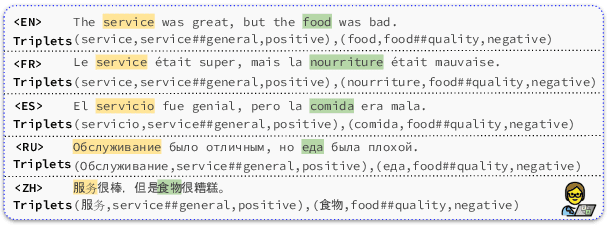
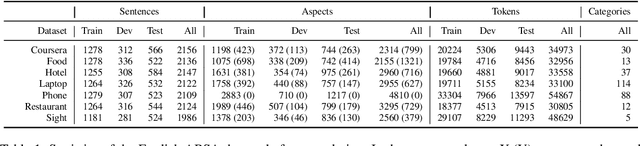
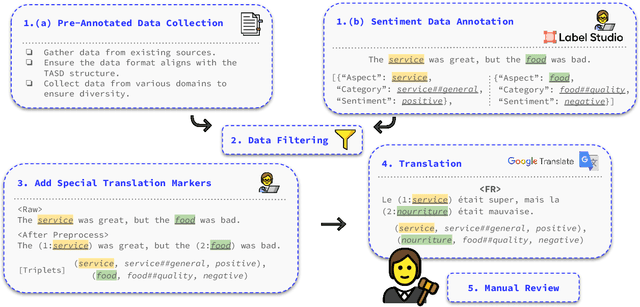
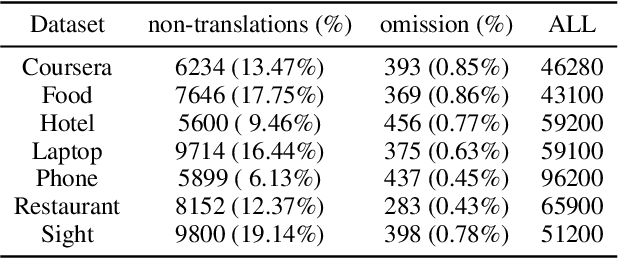
Aspect-based sentiment analysis (ABSA) is a crucial task in information extraction and sentiment analysis, aiming to identify aspects with associated sentiment elements in text. However, existing ABSA datasets are predominantly English-centric, limiting the scope for multilingual evaluation and research. To bridge this gap, we present M-ABSA, a comprehensive dataset spanning 7 domains and 21 languages, making it the most extensive multilingual parallel dataset for ABSA to date. Our primary focus is on triplet extraction, which involves identifying aspect terms, aspect categories, and sentiment polarities. The dataset is constructed through an automatic translation process with human review to ensure quality. We perform extensive experiments using various baselines to assess performance and compatibility on M-ABSA. Our empirical findings highlight that the dataset enables diverse evaluation tasks, such as multilingual and multi-domain transfer learning, and large language model evaluation, underscoring its inclusivity and its potential to drive advancements in multilingual ABSA research.
Correcting Annotator Bias in Training Data: Population-Aligned Instance Replication (PAIR)
Jan 12, 2025Models trained on crowdsourced labels may not reflect broader population views when annotator pools are not representative. Since collecting representative labels is challenging, we propose Population-Aligned Instance Replication (PAIR), a method to address this bias through statistical adjustment. Using a simulation study of hate speech and offensive language detection, we create two types of annotators with different labeling tendencies and generate datasets with varying proportions of the types. Models trained on unbalanced annotator pools show poor calibration compared to those trained on representative data. However, PAIR, which duplicates labels from underrepresented annotator groups to match population proportions, significantly reduces bias without requiring new data collection. These results suggest statistical techniques from survey research can help align model training with target populations even when representative annotator pools are unavailable. We conclude with three practical recommendations for improving training data quality.