 Add to Chrome
 Add to Firefox
 Add to Edge
BenGER: Benchmarking LLM Systems on Subsumption-Based Legal Reasoning in German Law
May 27, 2026
We introduce the BenGER (Benchmark for German Law) dataset for evaluating LLM systems on subsumption-based legal reasoning in German law. The BenGER dataset consists of three components: 596 exam-style free-text legal case tasks across multiple levels of legal education and 531 short doctrinal reasoning tasks. We evaluate 12 contemporary LLM systems -- closed flagship, efficiency-oriented, and open-weight -- across automatic and judge-based metrics. On a controlled validation subset of timed human-written solutions under both unaided and human--AI co-creation conditions, we contextualise model performance against these human baselines. We introduce a rubric-aligned LLM-as-a-Judge framework cross-validated against a multi-rater human-grading protocol (three blind reviews plus one author-informed creator review per solution). Our results show that replacing a blind human reviewer with the LLM judge degrades agreement with the full human pool no more than removing that reviewer altogether (Calderon r=0.96 vs.~r=0.96, matched n=30), that closed-flagship systems lead the leaderboard across all corpora, and that human--AI co-creation substantially outperforms unaided human work.

By Their Fruits You Will Know Them: Comparing Formalizations of Law by the Decisions They Encode
May 24, 2026Formalizing legal provisions promises machine-accessible law and automated legal reasoning, and recent LLMs make it tempting to generate such formalizations directly from statutory text. However, any formalization makes implicit interpretive choices whose consequences are hard to anticipate, especially if an LLM is the author. We present a method for systematically comparing different formalizations of the same legal provision by their inferences on individual cases. Given multiple formalizations of a provision, we match them at the node level, derive a shared interface for each pair from the matching, and use a SAT solver to enumerate the edge cases on which any two formalizations disagree. Selected edge cases are then verbalized into concrete factual scenarios that a legal expert can examine and act on. We apply our method to formalizations of ten EU provisions generated by nine frontier LLMs. We find that behavioral divergence between formalizations is essentially uncorrelated with their structural agreement and that the verbalized cases reveal qualitatively distinct types of disagreement, including divergences that mirror genuine controversies in the legal commentary.
Generating Legal Commentaries from Case Databases via Retrieval, Clustering, and Generation
May 23, 2026We present a fully automated pipeline that transforms large collections of court decisions into legal commentaries for statutes - without providing any handcrafted doctrinal framework. Using 4.555 decisions of the German Federal Court of Justice that cite sections 242, 280, 812 and 823 of the German Civil Code (BGB), we extract paragraph-level chunks, summarize their reasoning, and derive keywords, which are embedded and clustered. For each cluster, an LLM generates headings and synthesizes citation-rich sections, which are then merged into coherent commentaries by four state-of-the-art LLMs. We evaluate along five dimensions - topical relevance, heading-match, citation faithfulness, cluster distinction and logical ordering - using both a human expert and an LLM-judge. Our results show that commentary-like argument mining from court decisions to generate reports that can be refreshed within minutes at minimal cost is feasible, yet they highlight limitations arising from restricted sources and the normativity of legal reasoning.
Asking For An Old Friend: Diagnosing and Mitigating Temporal Failure Modes in LLM-based Statutory Question Answering
May 22, 2026Large language models are increasingly used for legal research, yet their fixed training cutoffs and reliance on static parametric knowledge are at odds with the evolving nature of statutory law. We study two temporal failure modes: post-cutoff staleness, where models apply superseded rules after legislative amendments, and recency bias, where models prefer newer provisions even when a historical version governs the fact pattern. To this end, we present a benchmark of 312 expert-validated, time-sensitive German statutory QA pairs spanning three categories: Post-Cutoff Amendment Questions, Pre-Amendment Questions, and Multi-Provision Pre-Amendment Questions. We evaluate five LLMs by OpenAI, Anthropic and DeepSeek under four inference settings: Vanilla, Web-search, and two retrieval-augmented variants that enforce temporal validity via a fact date extraction and version filtering. Using an LLM-as-a-judge validated against human expert ratings, we find severe degradation in the Vanilla post-cutoff setting. Both RAG approaches substantially improve performance across all question types, while web search yields unstable gains and exhibits a marked recency bias on historically anchored tasks. Our results indicate that reliable legal QA requires treating temporal validity as a hard constraint.
Exploiting LLM-as-a-Judge Disposition on Free Text Legal QA via Prompt Optimization
Apr 22, 2026This work explores the role of prompt design and judge selection in LLM-as-a-Judge evaluations of free text legal question answering. We examine whether automatic task prompt optimization improves over human-centered design, whether optimization effectiveness varies by judge feedback style, and whether optimized prompts transfer across judges. We systematically address these questions on the LEXam benchmark by optimizing task prompts using the ProTeGi method with feedback from two judges (Qwen3-32B, DeepSeek-V3) across four task models, and then testing cross-judge transfer. Automatic optimization consistently outperforms the baseline, with lenient judge feedback yielding higher and more consistent gains than strict judge feedback. Prompts optimized with lenient feedback transfer better to strict judges than the reverse direction. Analysis reveals that lenient judges provide permissive feedback, yielding prompts with broader applicability, whereas strict judges produce restrictive feedback, leading to judge-specific overfitting. Our findings demonstrate algorithmically optimizing prompts on training data can outperform human-centered prompt design and that judges' dispositions during optimization shape prompt generalizability. Code and optimized prompts are available at https://github.com/TUMLegalTech/icail2026-llm-judge-gaming.
BenGER: A Collaborative Web Platform for End-to-End Benchmarking of German Legal Tasks
Apr 15, 2026Evaluating large language models (LLMs) for legal reasoning requires workflows that span task design, expert annotation, model execution, and metric-based evaluation. In practice, these steps are split across platforms and scripts, limiting transparency, reproducibility, and participation by non-technical legal experts. We present the BenGER (Benchmark for German Law) framework, an open-source web platform that integrates task creation, collaborative annotation, configurable LLM runs, and evaluation with lexical, semantic, factual, and judge-based metrics. BenGER supports multi-organization projects with tenant isolation and role-based access control, and can optionally provide formative, reference-grounded feedback to annotators. We will demonstrate a live deployment showing end-to-end benchmark creation and analysis.
CourtPressGER: A German Court Decision to Press Release Summarization Dataset
Dec 10, 2025Official court press releases from Germany's highest courts present and explain judicial rulings to the public, as well as to expert audiences. Prior NLP efforts emphasize technical headnotes, ignoring citizen-oriented communication needs. We introduce CourtPressGER, a 6.4k dataset of triples: rulings, human-drafted press releases, and synthetic prompts for LLMs to generate comparable releases. This benchmark trains and evaluates LLMs in generating accurate, readable summaries from long judicial texts. We benchmark small and large LLMs using reference-based metrics, factual-consistency checks, LLM-as-judge, and expert ranking. Large LLMs produce high-quality drafts with minimal hierarchical performance loss; smaller models require hierarchical setups for long judgments. Initial benchmarks show varying model performance, with human-drafted releases ranking highest.
LexGenie: Automated Generation of Structured Reports for European Court of Human Rights Case Law
Mar 05, 2025Analyzing large volumes of case law to uncover evolving legal principles, across multiple cases, on a given topic is a demanding task for legal professionals. Structured topical reports provide an effective solution by summarizing key issues, principles, and judgments, enabling comprehensive legal analysis on a particular topic. While prior works have advanced query-based individual case summarization, none have extended to automatically generating multi-case structured reports. To address this, we introduce LexGenie, an automated LLM-based pipeline designed to create structured reports using the entire body of case law on user-specified topics within the European Court of Human Rights jurisdiction. LexGenie retrieves, clusters, and organizes relevant passages by topic to generate a structured outline and cohesive content for each section. Expert evaluation confirms LexGenie's utility in producing structured reports that enhance efficient, scalable legal analysis.
Better Aligned with Survey Respondents or Training Data? Unveiling Political Leanings of LLMs on U.S. Supreme Court Cases
Feb 25, 2025The increased adoption of Large Language Models (LLMs) and their potential to shape public opinion have sparked interest in assessing these models' political leanings. Building on previous research that compared LLMs and human opinions and observed political bias in system responses, we take a step further to investigate the underlying causes of such biases by empirically examining how the values and biases embedded in training corpora shape model outputs. Specifically, we propose a method to quantitatively evaluate political leanings embedded in the large pretraining corpora. Subsequently we investigate to whom are the LLMs' political leanings more aligned with, their pretrainig corpora or the surveyed human opinions. As a case study, we focus on probing the political leanings of LLMs in 32 U.S. Supreme Court cases, addressing contentious topics such as abortion and voting rights. Our findings reveal that LLMs strongly reflect the political leanings in their training data, and no strong correlation is observed with their alignment to human opinions as expressed in surveys. These results underscore the importance of responsible curation of training data and the need for robust evaluation metrics to ensure LLMs' alignment with human-centered values.
RELexED: Retrieval-Enhanced Legal Summarization with Exemplar Diversity
Jan 23, 2025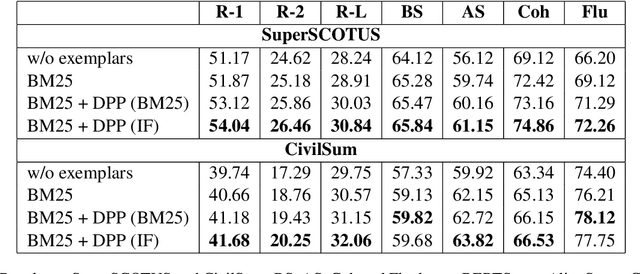
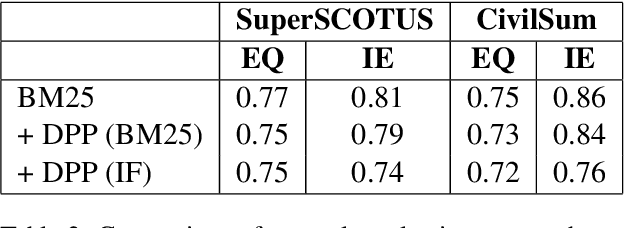
This paper addresses the task of legal summarization, which involves distilling complex legal documents into concise, coherent summaries. Current approaches often struggle with content theme deviation and inconsistent writing styles due to their reliance solely on source documents. We propose RELexED, a retrieval-augmented framework that utilizes exemplar summaries along with the source document to guide the model. RELexED employs a two-stage exemplar selection strategy, leveraging a determinantal point process to balance the trade-off between similarity of exemplars to the query and diversity among exemplars, with scores computed via influence functions. Experimental results on two legal summarization datasets demonstrate that RELexED significantly outperforms models that do not utilize exemplars and those that rely solely on similarity-based exemplar selection.