 Add to Chrome
 Add to Firefox
 Add to Edge
Understanding the Surprising Generalization Properties of Tabular Foundation Models
Aug 18, 2026
Tabular Foundation Models (TFMs) increasingly rely on in-context learning, where a model receives labelled examples at inference time and predicts labels for new inputs without updating its weights. Existing TFMs are typically trained on either massive synthetic corpora or very large collections of real datasets. In contrast, we show that surprisingly strong transfer can emerge from self-supervised pre-training on just a single real table. In this setting, we also find that tables tend to be either broadly useful or broadly poor regardless of downstream prediction task, and that the strongest predictor of usefulness is the number of features rather than the number of instances. This leads to a task-centric interpretation of tabular pre-training: the number and the quality of tasks are essential for the pre-training of TFMs. We show that the same task-centric perspective can help corpus design at scale: fine-grained column-level pre-processing consistently improves downstream performance, while no improvements are observed when we filter or deduplicate at the dataset level. Finally, we offer a new perspective for how TFMs generalize: we believe that tabular in-context generalization is largely retrieval-based, and good models are those that learn to identify relevant examples in the provided context and aggregate them well. The mechanics of TFMs have been relatively understudied; our task-centric, retrieval-based perspective offers a new framework to guide future model and corpus design.

Generalization Can Emerge in Tabular Foundation Models From a Single Table
Nov 12, 2025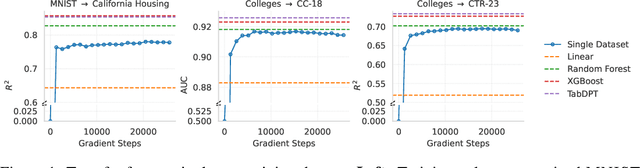
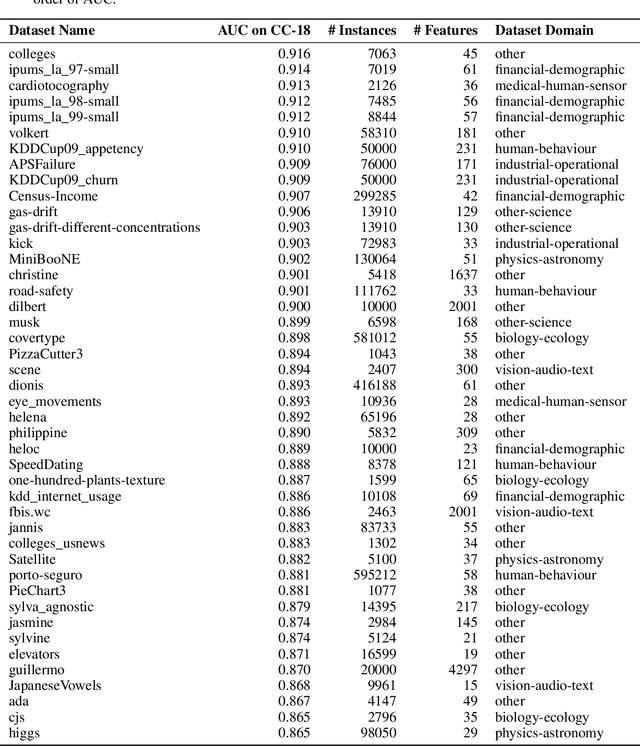
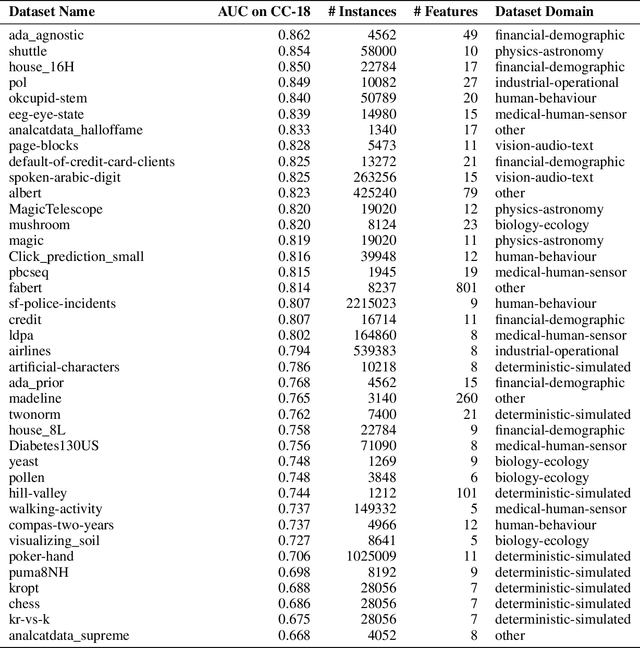
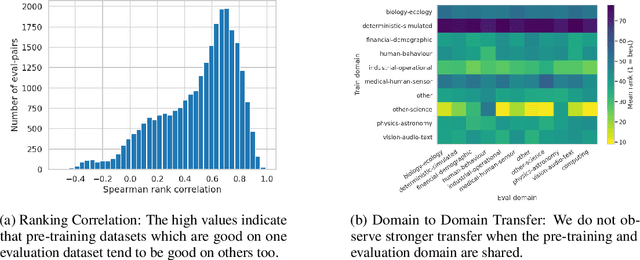
Deep tabular modelling increasingly relies on in-context learning where, during inference, a model receives a set of $(x,y)$ pairs as context and predicts labels for new inputs without weight updates. We challenge the prevailing view that broad generalization here requires pre-training on large synthetic corpora (e.g., TabPFN priors) or a large collection of real data (e.g., TabDPT training datasets), discovering that a relatively small amount of data suffices for generalization. We find that simple self-supervised pre-training on just a \emph{single} real table can produce surprisingly strong transfer across heterogeneous benchmarks. By systematically pre-training and evaluating on many diverse datasets, we analyze what aspects of the data are most important for building a Tabular Foundation Model (TFM) generalizing across domains. We then connect this to the pre-training procedure shared by most TFMs and show that the number and quality of \emph{tasks} one can construct from a dataset is key to downstream performance.
Towards Optimizing SQL Generation via LLM Routing
Nov 06, 2024Text-to-SQL enables users to interact with databases through natural language, simplifying access to structured data. Although highly capable large language models (LLMs) achieve strong accuracy for complex queries, they incur unnecessary latency and dollar cost for simpler ones. In this paper, we introduce the first LLM routing approach for Text-to-SQL, which dynamically selects the most cost-effective LLM capable of generating accurate SQL for each query. We present two routing strategies (score- and classification-based) that achieve accuracy comparable to the most capable LLM while reducing costs. We design the routers for ease of training and efficient inference. In our experiments, we highlight a practical and explainable accuracy-cost trade-off on the BIRD dataset.
C2F-CHART: A Curriculum Learning Approach to Chart Classification
Sep 07, 2024In scientific research, charts are usually the primary method for visually representing data. However, the accessibility of charts remains a significant concern. In an effort to improve chart understanding pipelines, we focus on optimizing the chart classification component. We leverage curriculum learning, which is inspired by the human learning process. In this paper, we introduce a novel training approach for chart classification that utilizes coarse-to-fine curriculum learning. Our approach, which we name C2F-CHART (for coarse-to-fine) exploits inter-class similarities to create learning tasks of varying difficulty levels. We benchmark our method on the ICPR 2022 CHART-Infographics UB UNITEC PMC dataset, outperforming the state-of-the-art results.