 Add to Chrome
 Add to Firefox
 Add to Edge
XiDepth: a Lightweight and Efficient Network for Self-supervised Monocular Depth Estimation
Aug 04, 2026
Self-supervised monocular depth estimation has emerged as an appealing solution to design lightweight and effective models for deployment on computationally constrained devices due to its reduced reliance on expensive depth sensors. By eliminating the need for ground-truth annotations and leveraging the simplicity of monocular camera setups, this approach facilitates cost-effective data collection and broad applicability across fields such as computer vision and robotics. A critical challenge is achieving resource-efficient neural networks without compromising the overall performance. State-of-the-art models generally adopt depth-wise convolutions and attention mechanisms; however, these functions often incur high energy costs and face compatibility issues in embedded environments. To address this, we propose XiDepth, a lightweight architecture based on the XiNet operator block, designed to enhance feature extraction while maintaining low computational complexity and energy demand. On the KITTI dataset, XiDepth achieves state-of-the-art performance with only 0.8M parameters. Tests on a Raspberry Pi 4 further confirm its suitability for real-world embedded applications, reducing FLOPs by 40% and energy consumption by 35% compared to leading methods.

IMPRINT: Image-Conditioned Query Enrichment for Long-Tail Object Goal Navigation
Jul 27, 2026Embodied AI increasingly relies on queryable semantic maps built from pre-trained vision-language models to enable zero-shot Object Goal Navigation (ObjectNav). However, existing approaches typically depend on text-only queries, which become less reliable as semantic specificity increases toward fine-grained object categories. We introduce IMPRINT, a zero-shot plug-and-play framework that enriches textual object queries with web-sourced images to improve grounding in queryable maps. Retrieved images are encoded using a vision-language model, matched against the semantic map to produce similarity maps, and aggregated to yield context-aware localization. Notably, this requires no training or modification of the underlying navigation policy. To explicitly evaluate long-tail behavior, we present HSSD-rare, a new ObjectNav benchmark built on Habitat Synthetic Scenes and featuring semantically specific subcategories. Across both OVON and HSSD-rare, image-conditioned queries consistently improve object grounding and yield end-to-end navigation gains. Further analysis reveals that translating localization gains to navigation performance depends critically on downstream detection quality, highlighting a key systems bottleneck in long-tail embodied navigation.
What VGGT Knows About Overlap: Probing Geometric Foundation Models for Co-Visibility
Jul 10, 2026A fundamental challenge in 3D reconstruction and robotic localization is co-visibility: determining which image pairs share overlapping visible surfaces, particularly in scenarios with minimal overlap. We demonstrate that VGGT implicitly encodes co-visibility as an emergent behavior: without any supervision for this task, its internal representations exhibit a clear hierarchical structure mirroring that of large language models, i.e. early layers build a 3D-aware scene representation, while late layers act as dedicated co-visibility reasoners. In particular, we identify layer L17 as a negative anchor that consistently routes non-co-visible pairs for this backbone, regardless of the evaluation setting, providing task-grounded evidence of layer specialization in a geometry-grounded foundation model. Building on this, we introduce Co-VGGT, which freezes VGGT and trains only a lightweight layer-wise mixture-of-experts head (less than 7.5M parameters) to classify co-visibility from RGB alone, treating each layer as a specialized expert whose geometric abstraction is adaptively weighted per input pair. On the Co-VisiON benchmark, Co-VGGT surpasses the human annotation baseline and improves over prior work by more than 25% pairwise and 10% multiview. Pairwise predictions are well-calibrated (ECE=0.030), enabling direct use as edge weights in visibility graphs for downstream SfM and SLAM pipelines without post-hoc correction. Code and data are available.
You Only Landmark Once: Lightweight U-Net Face Super Resolution with YOLO-World Landmark Heatmaps
May 13, 2026Face image super-resolution aims to recover high-resolution facial images from severely degraded inputs. Under extreme upscaling factors, fine facial details are often lost, making accurate reconstruction challenging. Existing methods typically rely on heavy network architectures, adversarial training schemes, or separate alignment networks, increasing model complexity and computational cost. To address these issues, we propose a lightweight U-Net based-architecture designed to reconstructs $128{ \times }128$ facial images from severely degraded $16{ \times }16$ inputs, achieving an $8 \times $ magnification. A key contribution is a novel auxiliary-training-free supervision strategy that leverages heatmaps generated by YOLO-World, an open-vocabulary object detector, to localize key facial features such as eyes, nose, and mouth. These heatmaps are converted into spatial weights to form a heatmap-guided loss that emphasizes reconstruction errors in semantically important regions. Unlike prior methods that require dedicated landmark or alignment networks, our approach directly reuses detector outputs as supervision, maintaining an efficient training and inference pipeline. Experiments on the aligned CelebA dataset demonstrate that the proposed loss consistently improves quantitative metrics and produces sharper, more realistic reconstructions. Overall, our results show that lightweight networks can effectively exploit detection-driven priors for perceptually convincing extreme upscaling, without adversarial training or increased computational cost.
Contrastive Learning under Noisy Temporal Self-Supervision for Colonoscopy Videos
May 12, 2026Learning robust representations of polyp tracklets is key to enabling multiple AI-assisted colonoscopy applications, from polyp characterization to automated reporting and retrieval. Supervised contrastive learning is an effective approach for learning such representations, but it typically relies on correct positive and negative definitions. Collecting these labels requires linking tracklets that depict the same underlying polyp entity throughout the video, which is costly and demands specialized clinical expertise. In this work, we leverage the sequential workflow of colonoscopy procedures to derive self-supervised associations from temporal structure. Since temporally derived associations are not guaranteed to be correct, we introduce a noise-aware contrastive loss to account for noisy associations. We demonstrate the effectiveness of the learned representations across multiple downstream tasks, including polyp retrieval and re-identification, size estimation, and histology classification. Our method outperforms prior self-supervised and supervised baselines, and matches or exceeds recent foundation models across all tasks, using a lightweight encoder trained on only 27 videos. Code is available at https://github.com/lparolari/ntssl.
Benchmarking Layout-Guided Diffusion Models through Unified Semantic-Spatial Evaluation in Closed and Open Settings
Apr 28, 2026Evaluating layout-guided text-to-image generative models requires assessing both semantic alignment with textual prompts and spatial fidelity to prescribed layouts. Assessing layout alignment requires collecting fine-grained annotations, which is costly and labor-intensive. Consequently, current benchmarks rarely provide comprehensive layout evaluation and often remain limited in scale or coverage, making model comparison, ranking, and interpretation difficult. In this work, we introduce a closed-set benchmark (C-Bench) designed to isolate key generative capabilities while providing varying levels of complexity in both prompt structure and layout. To complement this controlled setting, we propose an open-set benchmark (O-Bench) that evaluates models using real-world prompts and layouts, offering a measure of semantic and spatial alignment in the wild. We further develop a unified evaluation protocol that combines semantic and spatial accuracy into a single score, ensuring consistent model ranking. Using our benchmarks, we conduct a large-scale evaluation of six state-of-the-art layout-guided diffusion models, totaling 319,086 generated and evaluated images. We establish a model ranking based on their overall performance and provide detailed breakdowns for text and layout alignment to enhance interpretability. Fine-grained analyses across scenarios and prompt complexities highlight the strengths and limitations of current models. Code is available at https://github.com/lparolari/cobench.
Assessing the Visual Enumeration Abilities of Specialized Counting Architectures and Vision-Language Models
Dec 17, 2025Counting the number of items in a visual scene remains a fundamental yet challenging task in computer vision. Traditional approaches to solving this problem rely on domain-specific counting architectures, which are trained using datasets annotated with a predefined set of object categories. However, recent progress in creating large-scale multimodal vision-language models (VLMs) suggests that these domain-general architectures may offer a flexible alternative for open-set object counting. In this study, we therefore systematically compare the performance of state-of-the-art specialized counting architectures against VLMs on two popular counting datasets, as well as on a novel benchmark specifically created to have a finer-grained control over the visual properties of test images. Our findings show that most VLMs can approximately enumerate the number of items in a visual scene, matching or even surpassing the performance of specialized computer vision architectures. Notably, enumeration accuracy significantly improves when VLMs are prompted to generate intermediate representations (i.e., locations and verbal labels) of each object to be counted. Nevertheless, none of the models can reliably count the number of objects in complex visual scenes, showing that further research is still needed to create AI systems that can reliably deploy counting procedures in realistic environments.
LangNavBench: Evaluation of Natural Language Understanding in Semantic Navigation
Jul 09, 2025Recent progress in large vision-language models has driven improvements in language-based semantic navigation, where an embodied agent must reach a target object described in natural language. Despite these advances, we still lack a clear, language-focused benchmark for testing how well such agents ground the words in their instructions. We address this gap with LangNav, an open-set dataset specifically created to test an agent's ability to locate objects described at different levels of detail, from broad category names to fine attributes and object-object relations. Every description in LangNav was manually checked, yielding a lower error rate than existing lifelong- and semantic-navigation datasets. On top of LangNav we build LangNavBench, a benchmark that measures how well current semantic-navigation methods understand and act on these descriptions while moving toward their targets. LangNavBench allows us to systematically compare models on their handling of attributes, spatial and relational cues, and category hierarchies, offering the first thorough, language-centric evaluation of embodied navigation systems. We also present Multi-Layered Feature Map (MLFM), a method that builds a queryable multi-layered semantic map, particularly effective when dealing with small objects or instructions involving spatial relations. MLFM outperforms state-of-the-art mapping-based navigation baselines on the LangNav dataset.
Temporally-Aware Supervised Contrastive Learning for Polyp Counting in Colonoscopy
Jul 03, 2025
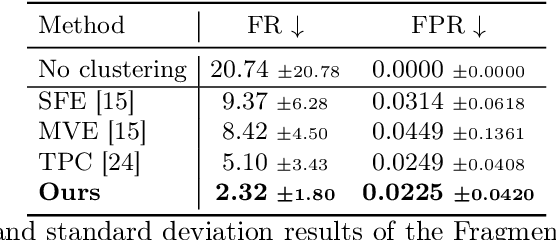
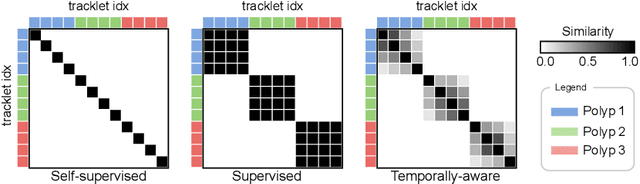

Automated polyp counting in colonoscopy is a crucial step toward automated procedure reporting and quality control, aiming to enhance the cost-effectiveness of colonoscopy screening. Counting polyps in a procedure involves detecting and tracking polyps, and then clustering tracklets that belong to the same polyp entity. Existing methods for polyp counting rely on self-supervised learning and primarily leverage visual appearance, neglecting temporal relationships in both tracklet feature learning and clustering stages. In this work, we introduce a paradigm shift by proposing a supervised contrastive loss that incorporates temporally-aware soft targets. Our approach captures intra-polyp variability while preserving inter-polyp discriminability, leading to more robust clustering. Additionally, we improve tracklet clustering by integrating a temporal adjacency constraint, reducing false positive re-associations between visually similar but temporally distant tracklets. We train and validate our method on publicly available datasets and evaluate its performance with a leave-one-out cross-validation strategy. Results demonstrate a 2.2x reduction in fragmentation rate compared to prior approaches. Our results highlight the importance of temporal awareness in polyp counting, establishing a new state-of-the-art. Code is available at https://github.com/lparolari/temporally-aware-polyp-counting.
Harlequin: Color-driven Generation of Synthetic Data for Referring Expression Comprehension
Nov 22, 2024Referring Expression Comprehension (REC) aims to identify a particular object in a scene by a natural language expression, and is an important topic in visual language understanding. State-of-the-art methods for this task are based on deep learning, which generally requires expensive and manually labeled annotations. Some works tackle the problem with limited-supervision learning or relying on Large Vision and Language Models. However, the development of techniques to synthesize labeled data is overlooked. In this paper, we propose a novel framework that generates artificial data for the REC task, taking into account both textual and visual modalities. At first, our pipeline processes existing data to create variations in the annotations. Then, it generates an image using altered annotations as guidance. The result of this pipeline is a new dataset, called Harlequin, made by more than 1M queries. This approach eliminates manual data collection and annotation, enabling scalability and facilitating arbitrary complexity. We pre-train three REC models on Harlequin, then fine-tuned and evaluated on human-annotated datasets. Our experiments show that the pre-training on artificial data is beneficial for performance.