 Add to Chrome
 Add to Firefox
 Add to Edge
A Unified Density Operator View of Flow Control and Merging
Feb 08, 2026
Recent progress in large-scale flow and diffusion models raised two fundamental algorithmic challenges: (i) control-based reward adaptation of pre-trained flows, and (ii) integration of multiple models, i.e., flow merging. While current approaches address them separately, we introduce a unifying probability-space framework that subsumes both as limit cases, and enables reward-guided flow merging, allowing principled, task-aware combination of multiple pre-trained flows (e.g., merging priors while maximizing drug-discovery utilities). Our formulation renders possible to express a rich family of operators over generative models densities, including intersection (e.g., to enforce safety), union (e.g., to compose diverse models), interpolation (e.g., for discovery), their reward-guided counterparts, as well as complex logical expressions via generative circuits. Next, we introduce Reward-Guided Flow Merging (RFM), a mirror-descent scheme that reduces reward-guided flow merging to a sequence of standard fine-tuning problems. Then, we provide first-of-their-kind theoretical guarantees for reward-guided and pure flow merging via RFM. Ultimately, we showcase the capabilities of the proposed method on illustrative settings providing visually interpretable insights, and apply our method to high-dimensional de-novo molecular design and low-energy conformer generation.

Soft Forward-Backward Representations for Zero-shot Reinforcement Learning with General Utilities
Feb 06, 2026Recent advancements in zero-shot reinforcement learning (RL) have facilitated the extraction of diverse behaviors from unlabeled, offline data sources. In particular, forward-backward algorithms (FB) can retrieve a family of policies that can approximately solve any standard RL problem (with additive rewards, linear in the occupancy measure), given sufficient capacity. While retaining zero-shot properties, we tackle the greater problem class of RL with general utilities, in which the objective is an arbitrary differentiable function of the occupancy measure. This setting is strictly more expressive, capturing tasks such as distribution matching or pure exploration, which may not be reduced to additive rewards. We show that this additional complexity can be captured by a novel, maximum entropy (soft) variant of the forward-backward algorithm, which recovers a family of stochastic policies from offline data. When coupled with zero-order search over compact policy embeddings, this algorithm can sidestep iterative optimization schemes, and optimizes general utilities directly at test-time. Across both didactic and high-dimensional experiments, we demonstrate that our method retains favorable properties of FB algorithms, while also extending their range to more general RL problems.
Coding Agents with Environment Interaction: A Theoretical Perspective
Feb 05, 2026Coding agents are increasingly utilized in test-driven software development, yet the theoretical mechanisms behind their environment-interaction strategies remain underexplored. We provide a probabilistic framework for two dominant paradigms: code selection after generation using the execution environment, and code generation conditioned on environment feedback. First, we formalize several well-established selection heuristics as environment-aware estimators of code correctness. We theoretically prove that estimators based on fuzzy functional similarity add an inductive bias and strictly dominate estimators based on functional equivalence in terms of signal-to-noise ratio. Second, we frame backprompting as an in-context approximation of Thompson sampling. We derive a novel regret bound for reward functions with unobservable components, theoretically explaining why the effectiveness of backprompting is limited by the ambiguity of the informal task description (an irreducible regret). Using three state-of-the-art open weight models, we corroborate these findings across BigCodeBenchHard, LeetCodeDataset, and QiskitHumanEvalSim. Our formalization also suggests how to improve task descriptions effectively, leading to a new benchmark, QiskitHumanEvalSimX.
Reinforcement Learning via Self-Distillation
Jan 28, 2026Large language models are increasingly post-trained with reinforcement learning in verifiable domains such as code and math. Yet, current methods for reinforcement learning with verifiable rewards (RLVR) learn only from a scalar outcome reward per attempt, creating a severe credit-assignment bottleneck. Many verifiable environments actually provide rich textual feedback, such as runtime errors or judge evaluations, that explain why an attempt failed. We formalize this setting as reinforcement learning with rich feedback and introduce Self-Distillation Policy Optimization (SDPO), which converts tokenized feedback into a dense learning signal without any external teacher or explicit reward model. SDPO treats the current model conditioned on feedback as a self-teacher and distills its feedback-informed next-token predictions back into the policy. In this way, SDPO leverages the model's ability to retrospectively identify its own mistakes in-context. Across scientific reasoning, tool use, and competitive programming on LiveCodeBench v6, SDPO improves sample efficiency and final accuracy over strong RLVR baselines. Notably, SDPO also outperforms baselines in standard RLVR environments that only return scalar feedback by using successful rollouts as implicit feedback for failed attempts. Finally, applying SDPO to individual questions at test time accelerates discovery on difficult binary-reward tasks, achieving the same discovery probability as best-of-k sampling or multi-turn conversations with 3x fewer attempts.
Safe Exploration via Policy Priors
Jan 27, 2026Safe exploration is a key requirement for reinforcement learning (RL) agents to learn and adapt online, beyond controlled (e.g. simulated) environments. In this work, we tackle this challenge by utilizing suboptimal yet conservative policies (e.g., obtained from offline data or simulators) as priors. Our approach, SOOPER, uses probabilistic dynamics models to optimistically explore, yet pessimistically fall back to the conservative policy prior if needed. We prove that SOOPER guarantees safety throughout learning, and establish convergence to an optimal policy by bounding its cumulative regret. Extensive experiments on key safe RL benchmarks and real-world hardware demonstrate that SOOPER is scalable, outperforms the state-of-the-art and validate our theoretical guarantees in practice.
Latent Causal Diffusions for Single-Cell Perturbation Modeling
Jan 20, 2026Perturbation screens hold the potential to systematically map regulatory processes at single-cell resolution, yet modeling and predicting transcriptome-wide responses to perturbations remains a major computational challenge. Existing methods often underperform simple baselines, fail to disentangle measurement noise from biological signal, and provide limited insight into the causal structure governing cellular responses. Here, we present the latent causal diffusion (LCD), a generative model that frames single-cell gene expression as a stationary diffusion process observed under measurement noise. LCD outperforms established approaches in predicting the distributional shifts of unseen perturbation combinations in single-cell RNA-sequencing screens while simultaneously learning a mechanistic dynamical system of gene regulation. To interpret these learned dynamics, we develop an approach we call causal linearization via perturbation responses (CLIPR), which yields an approximation of the direct causal effects between all genes modeled by the diffusion. CLIPR provably identifies causal effects under a linear drift assumption and recovers causal structure in both simulated systems and a genome-wide perturbation screen, where it clusters genes into coherent functional modules and resolves causal relationships that standard differential expression analysis cannot. The LCD-CLIPR framework bridges generative modeling with causal inference to predict unseen perturbation effects and map the underlying regulatory mechanisms of the transcriptome.
Efficient Personalization of Generative Models via Optimal Experimental Design
Dec 22, 2025Preference learning from human feedback has the ability to align generative models with the needs of end-users. Human feedback is costly and time-consuming to obtain, which creates demand for data-efficient query selection methods. This work presents a novel approach that leverages optimal experimental design to ask humans the most informative preference queries, from which we can elucidate the latent reward function modeling user preferences efficiently. We formulate the problem of preference query selection as the one that maximizes the information about the underlying latent preference model. We show that this problem has a convex optimization formulation, and introduce a statistically and computationally efficient algorithm ED-PBRL that is supported by theoretical guarantees and can efficiently construct structured queries such as images or text. We empirically present the proposed framework by personalizing a text-to-image generative model to user-specific styles, showing that it requires less preference queries compared to random query selection.
Stackelberg Learning from Human Feedback: Preference Optimization as a Sequential Game
Dec 18, 2025We introduce Stackelberg Learning from Human Feedback (SLHF), a new framework for preference optimization. SLHF frames the alignment problem as a sequential-move game between two policies: a Leader, which commits to an action, and a Follower, which responds conditionally on the Leader's action. This approach decomposes preference optimization into a refinement problem for the Follower and an optimization problem against an adversary for the Leader. Unlike Reinforcement Learning from Human Feedback (RLHF), which assigns scalar rewards to actions, or Nash Learning from Human Feedback (NLHF), which seeks a simultaneous-move equilibrium, SLHF leverages the asymmetry of sequential play to capture richer preference structures. The sequential design of SLHF naturally enables inference-time refinement, as the Follower learns to improve the Leader's actions, and these refinements can be leveraged through iterative sampling. We compare the solution concepts of SLHF, RLHF, and NLHF, and lay out key advantages in consistency, data sensitivity, and robustness to intransitive preferences. Experiments on large language models demonstrate that SLHF achieves strong alignment across diverse preference datasets, scales from 0.5B to 8B parameters, and yields inference-time refinements that transfer across model families without further fine-tuning.
Learning Soft Robotic Dynamics with Active Exploration
Oct 31, 2025Soft robots offer unmatched adaptability and safety in unstructured environments, yet their compliant, high-dimensional, and nonlinear dynamics make modeling for control notoriously difficult. Existing data-driven approaches often fail to generalize, constrained by narrowly focused task demonstrations or inefficient random exploration. We introduce SoftAE, an uncertainty-aware active exploration framework that autonomously learns task-agnostic and generalizable dynamics models of soft robotic systems. SoftAE employs probabilistic ensemble models to estimate epistemic uncertainty and actively guides exploration toward underrepresented regions of the state-action space, achieving efficient coverage of diverse behaviors without task-specific supervision. We evaluate SoftAE on three simulated soft robotic platforms -- a continuum arm, an articulated fish in fluid, and a musculoskeletal leg with hybrid actuation -- and on a pneumatically actuated continuum soft arm in the real world. Compared with random exploration and task-specific model-based reinforcement learning, SoftAE produces more accurate dynamics models, enables superior zero-shot control on unseen tasks, and maintains robustness under sensing noise, actuation delays, and nonlinear material effects. These results demonstrate that uncertainty-driven active exploration can yield scalable, reusable dynamics models across diverse soft robotic morphologies, representing a step toward more autonomous, adaptable, and data-efficient control in compliant robots.
Learning on the Job: Test-Time Curricula for Targeted Reinforcement Learning
Oct 06, 2025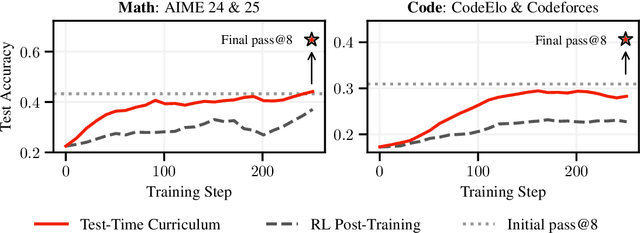
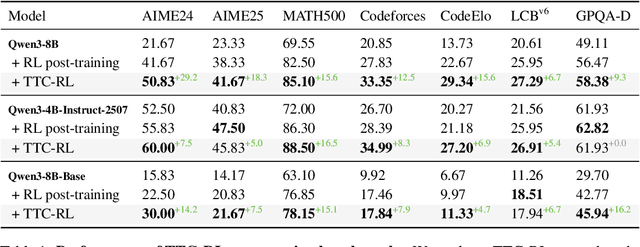
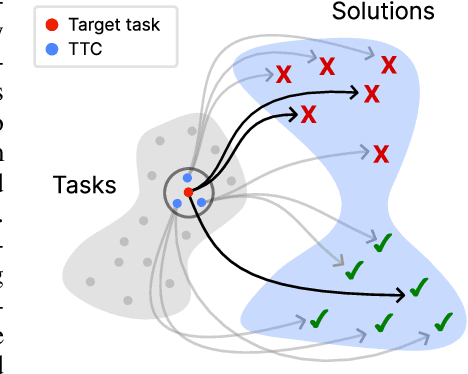
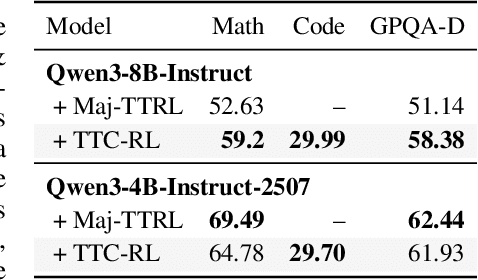
Humans are good at learning on the job: We learn how to solve the tasks we face as we go along. Can a model do the same? We propose an agent that assembles a task-specific curriculum, called test-time curriculum (TTC-RL), and applies reinforcement learning to continue training the model for its target task. The test-time curriculum avoids time-consuming human curation of datasets by automatically selecting the most task-relevant data from a large pool of available training data. Our experiments demonstrate that reinforcement learning on a test-time curriculum consistently improves the model on its target tasks, across a variety of evaluations and models. Notably, on challenging math and coding benchmarks, TTC-RL improves the pass@1 of Qwen3-8B by approximately 1.8x on AIME25 and 2.1x on CodeElo. Moreover, we find that TTC-RL significantly raises the performance ceiling compared to the initial model, increasing pass@8 on AIME25 from 40% to 62% and on CodeElo from 28% to 43%. Our findings show the potential of test-time curricula in extending the test-time scaling paradigm to continual training on thousands of task-relevant experiences during test-time.