 Add to Chrome
 Add to Firefox
 Add to Edge
Uncertainty Quantification for Flow-Based Vision-Language-Action Models
Jun 16, 2026
Vision-language-action models (VLAs) combine vision-language backbones with expressive generative action heads trained via flow matching on large-scale robotic datasets. Despite their strong empirical performance in robotic manipulation, VLAs lack mechanisms to quantify confidence in their predictions and to detect when their actions may be unreliable. This presents a critical limitation for real-world deployment in non-stationary environments, where models inevitably encounter scenarios outside their pretraining distribution and may fail without warning. To address this, we derive an efficient method for quantifying epistemic uncertainty in flow-matching models by leveraging velocity-field disagreement (VFD) across a small ensemble. We successfully use this uncertainty estimate for failure detection during deployment and active fine-tuning of flow-based VLAs. To this end, we propose SAVE, a framework for uncertainty-guided active multitask fine-tuning that reduces the number of costly expert demonstrations required to adapt VLAs to new tasks. Through extensive experiments on the LIBERO benchmark, we demonstrate that VFD yields better-calibrated uncertainty estimates predictive of downstream performance, that VFD achieves strong performance in detecting failures, and that uncertainty-guided data acquisition with SAVE requires at least 22% fewer samples than baselines. In summary, our work shows that quantifying epistemic uncertainty in flow-based VLAs improves both failure awareness and adaptation. Project website: tum-lsy.github.io/uq_vla/.

Reinforcement Learning via Self-Distillation
Jan 28, 2026Large language models are increasingly post-trained with reinforcement learning in verifiable domains such as code and math. Yet, current methods for reinforcement learning with verifiable rewards (RLVR) learn only from a scalar outcome reward per attempt, creating a severe credit-assignment bottleneck. Many verifiable environments actually provide rich textual feedback, such as runtime errors or judge evaluations, that explain why an attempt failed. We formalize this setting as reinforcement learning with rich feedback and introduce Self-Distillation Policy Optimization (SDPO), which converts tokenized feedback into a dense learning signal without any external teacher or explicit reward model. SDPO treats the current model conditioned on feedback as a self-teacher and distills its feedback-informed next-token predictions back into the policy. In this way, SDPO leverages the model's ability to retrospectively identify its own mistakes in-context. Across scientific reasoning, tool use, and competitive programming on LiveCodeBench v6, SDPO improves sample efficiency and final accuracy over strong RLVR baselines. Notably, SDPO also outperforms baselines in standard RLVR environments that only return scalar feedback by using successful rollouts as implicit feedback for failed attempts. Finally, applying SDPO to individual questions at test time accelerates discovery on difficult binary-reward tasks, achieving the same discovery probability as best-of-k sampling or multi-turn conversations with 3x fewer attempts.
FLoRA: Sample-Efficient Preference-based RL via Low-Rank Style Adaptation of Reward Functions
Apr 14, 2025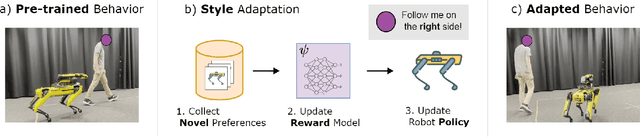
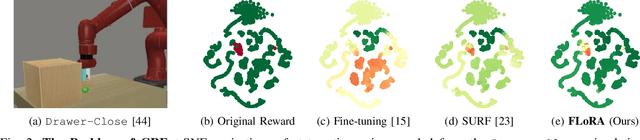
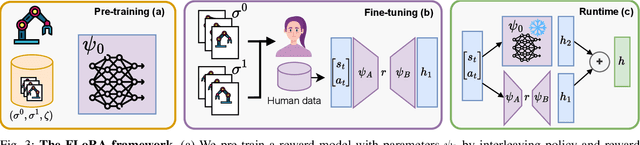
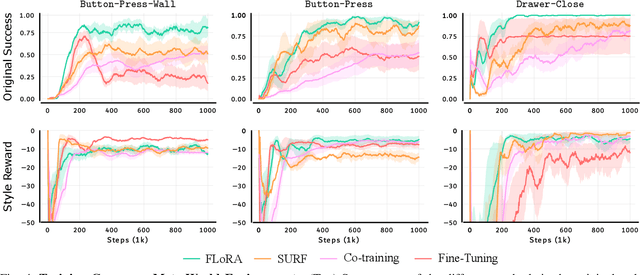
Preference-based reinforcement learning (PbRL) is a suitable approach for style adaptation of pre-trained robotic behavior: adapting the robot's policy to follow human user preferences while still being able to perform the original task. However, collecting preferences for the adaptation process in robotics is often challenging and time-consuming. In this work we explore the adaptation of pre-trained robots in the low-preference-data regime. We show that, in this regime, recent adaptation approaches suffer from catastrophic reward forgetting (CRF), where the updated reward model overfits to the new preferences, leading the agent to become unable to perform the original task. To mitigate CRF, we propose to enhance the original reward model with a small number of parameters (low-rank matrices) responsible for modeling the preference adaptation. Our evaluation shows that our method can efficiently and effectively adjust robotic behavior to human preferences across simulation benchmark tasks and multiple real-world robotic tasks.
PREDILECT: Preferences Delineated with Zero-Shot Language-based Reasoning in Reinforcement Learning
Feb 23, 2024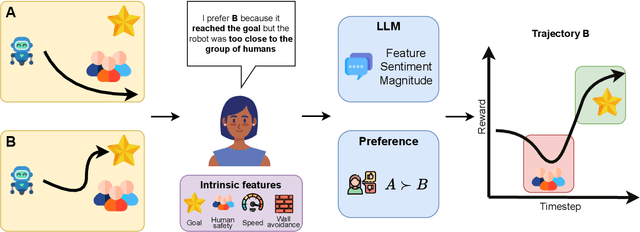
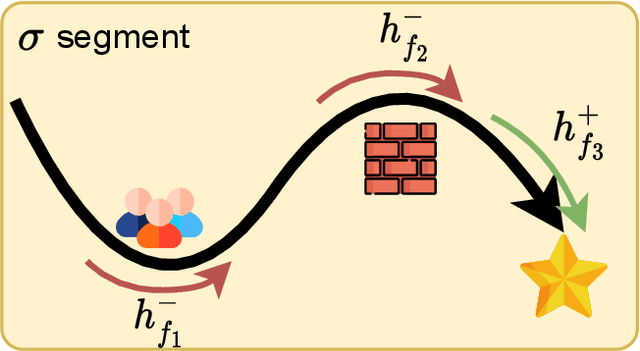
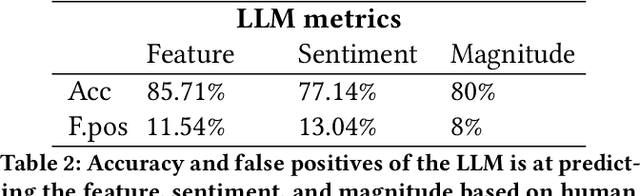
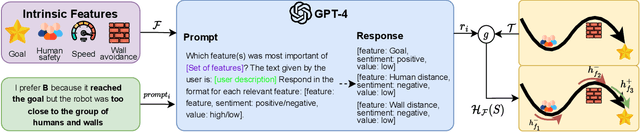
Preference-based reinforcement learning (RL) has emerged as a new field in robot learning, where humans play a pivotal role in shaping robot behavior by expressing preferences on different sequences of state-action pairs. However, formulating realistic policies for robots demands responses from humans to an extensive array of queries. In this work, we approach the sample-efficiency challenge by expanding the information collected per query to contain both preferences and optional text prompting. To accomplish this, we leverage the zero-shot capabilities of a large language model (LLM) to reason from the text provided by humans. To accommodate the additional query information, we reformulate the reward learning objectives to contain flexible highlights -- state-action pairs that contain relatively high information and are related to the features processed in a zero-shot fashion from a pretrained LLM. In both a simulated scenario and a user study, we reveal the effectiveness of our work by analyzing the feedback and its implications. Additionally, the collective feedback collected serves to train a robot on socially compliant trajectories in a simulated social navigation landscape. We provide video examples of the trained policies at https://sites.google.com/view/rl-predilect