 Add to Chrome
 Add to Firefox
 Add to Edge
Generative Molecular Morphing for Flexible-Size Design via Unbalanced Optimal Transport
Jun 05, 2026
The success of generative molecular design hinges on a model's steerability toward high-reward samples. Because many molecular properties are intrinsically linked to molecular size, accurately capturing the joint distribution of properties and the number of atoms is essential. However, current diffusion and flow-based models fix the number of atoms, which ultimately limits their ability to navigate this complex relationship. To address this, we introduce Morph, a flexible-size generative model for conditional and unconditional 3D molecular design based on geometric graphs. By dynamically adapting size, Morph can seamlessly integrate existing structural priors, like scaffolds, and significantly enhances property steering. We show that Morph matches current fixed-size state-of-the-art models while offering the benefit of unparalleled sampling flexibility. We demonstrate out-of-distribution generation in regimes where previous models fail, paving the way for enhanced generative modeling for molecular design.

A Unified Density Operator View of Flow Control and Merging
Feb 08, 2026Recent progress in large-scale flow and diffusion models raised two fundamental algorithmic challenges: (i) control-based reward adaptation of pre-trained flows, and (ii) integration of multiple models, i.e., flow merging. While current approaches address them separately, we introduce a unifying probability-space framework that subsumes both as limit cases, and enables reward-guided flow merging, allowing principled, task-aware combination of multiple pre-trained flows (e.g., merging priors while maximizing drug-discovery utilities). Our formulation renders possible to express a rich family of operators over generative models densities, including intersection (e.g., to enforce safety), union (e.g., to compose diverse models), interpolation (e.g., for discovery), their reward-guided counterparts, as well as complex logical expressions via generative circuits. Next, we introduce Reward-Guided Flow Merging (RFM), a mirror-descent scheme that reduces reward-guided flow merging to a sequence of standard fine-tuning problems. Then, we provide first-of-their-kind theoretical guarantees for reward-guided and pure flow merging via RFM. Ultimately, we showcase the capabilities of the proposed method on illustrative settings providing visually interpretable insights, and apply our method to high-dimensional de-novo molecular design and low-energy conformer generation.
Holistic chemical evaluation reveals pitfalls in reaction prediction models
Dec 14, 2023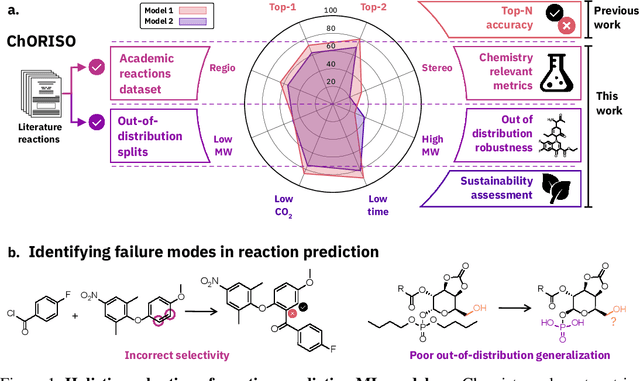
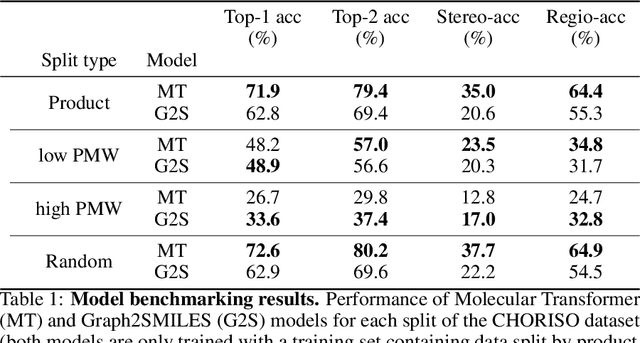
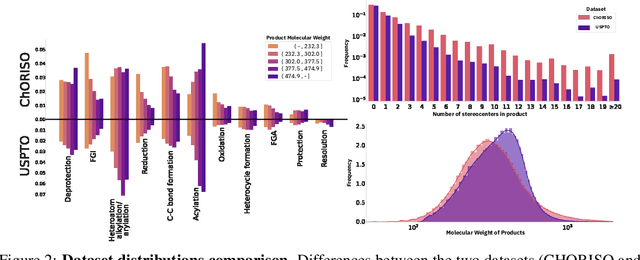
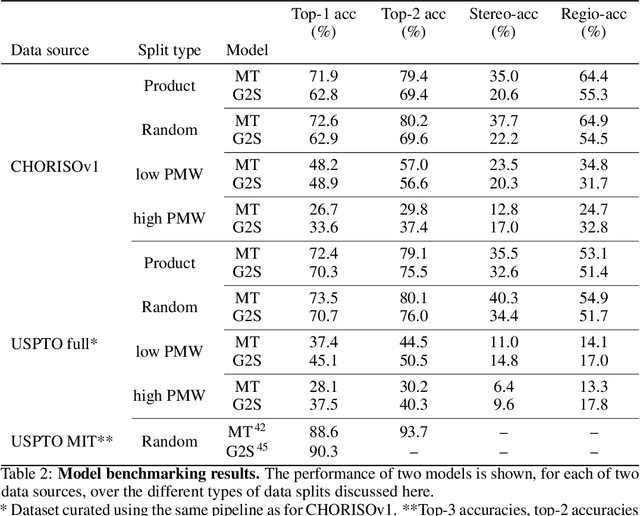
The prediction of chemical reactions has gained significant interest within the machine learning community in recent years, owing to its complexity and crucial applications in chemistry. However, model evaluation for this task has been mostly limited to simple metrics like top-k accuracy, which obfuscates fine details of a model's limitations. Inspired by progress in other fields, we propose a new assessment scheme that builds on top of current approaches, steering towards a more holistic evaluation. We introduce the following key components for this goal: CHORISO, a curated dataset along with multiple tailored splits to recreate chemically relevant scenarios, and a collection of metrics that provide a holistic view of a model's advantages and limitations. Application of this method to state-of-the-art models reveals important differences on sensitive fronts, especially stereoselectivity and chemical out-of-distribution generalization. Our work paves the way towards robust prediction models that can ultimately accelerate chemical discovery.