 Add to Chrome
 Add to Firefox
 Add to Edge
BFMTrack: Latent Sequence Optimization for Physics-Based Motion Tracking with Behavioral Foundation Models
Jun 23, 2026
Behavioral Foundation Models (BFMs) offer a promising path toward universal physics-based character control by organizing a rich repertoire of physically plausible behaviors into a latent space, guided by a large-scale motion dataset. While these models excel at time-invariant tasks, such as goal-reaching and state-based reward optimization, their latent space does not directly support time-varying objectives, such as tracking a motion sequence. For tracking, existing heuristics rely on moving-window-averaging that fails to capture the nuances of highly dynamic motions. In this work, we propose a novel Latent Sequence Optimization (LSO) to address these shortcomings. Our approach combines simulation rollouts with a policy gradient update to optimize over a sequence of latents, extending the capabilities of BFMs toward precise motion tracking without requiring reward engineering and tuning. To guide the optimization toward smooth, coherent latent trajectories, we model the latent sequence using temporally correlated noise. We validate our approach across dense tracking, sparse keyframing, and direct deployment onto a real humanoid robot.

Soft Forward-Backward Representations for Zero-shot Reinforcement Learning with General Utilities
Feb 06, 2026Recent advancements in zero-shot reinforcement learning (RL) have facilitated the extraction of diverse behaviors from unlabeled, offline data sources. In particular, forward-backward algorithms (FB) can retrieve a family of policies that can approximately solve any standard RL problem (with additive rewards, linear in the occupancy measure), given sufficient capacity. While retaining zero-shot properties, we tackle the greater problem class of RL with general utilities, in which the objective is an arbitrary differentiable function of the occupancy measure. This setting is strictly more expressive, capturing tasks such as distribution matching or pure exploration, which may not be reduced to additive rewards. We show that this additional complexity can be captured by a novel, maximum entropy (soft) variant of the forward-backward algorithm, which recovers a family of stochastic policies from offline data. When coupled with zero-order search over compact policy embeddings, this algorithm can sidestep iterative optimization schemes, and optimizes general utilities directly at test-time. Across both didactic and high-dimensional experiments, we demonstrate that our method retains favorable properties of FB algorithms, while also extending their range to more general RL problems.
Zero-Shot Offline Imitation Learning via Optimal Transport
Oct 11, 2024
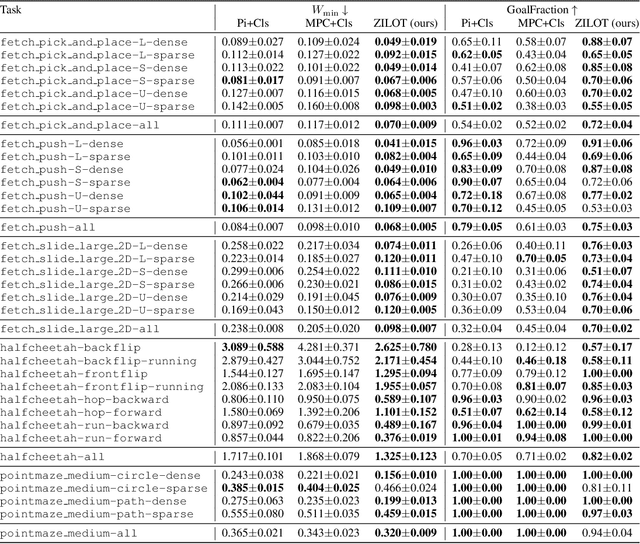
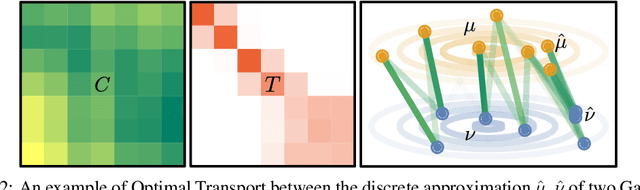
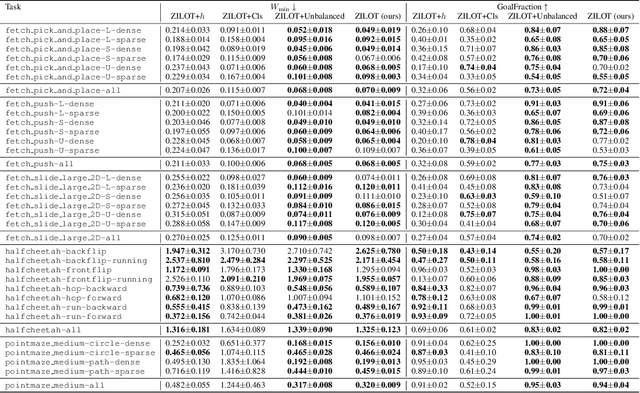
Zero-shot imitation learning algorithms hold the promise of reproducing unseen behavior from as little as a single demonstration at test time. Existing practical approaches view the expert demonstration as a sequence of goals, enabling imitation with a high-level goal selector, and a low-level goal-conditioned policy. However, this framework can suffer from myopic behavior: the agent's immediate actions towards achieving individual goals may undermine long-term objectives. We introduce a novel method that mitigates this issue by directly optimizing the occupancy matching objective that is intrinsic to imitation learning. We propose to lift a goal-conditioned value function to a distance between occupancies, which are in turn approximated via a learned world model. The resulting method can learn from offline, suboptimal data, and is capable of non-myopic, zero-shot imitation, as we demonstrate in complex, continuous benchmarks.