 Add to Chrome
 Add to Firefox
 Add to Edge
Beyond Effective Sample Size: Effective Number of Proposals for Adaptive Importance Sampling
Aug 15, 2026
Population-based adaptive importance sampling (AIS) methods use a set of proposal densities to approximate complex target distributions. Their performance is commonly assessed through effective sample size (ESS) and related weight-based diagnostics, which measure the concentration of normalized importance weights. However, a large ESS only indicates that the normalized sample weights are not strongly concentrated; it does not describe how the proposal components are arranged in the sampling space. In population-based AIS, several proposal components may generate samples in the same region of the target, so the sample weights can appear well balanced even though the effective number of distinct proposal components is small. This letter introduces the effective number of proposals (ENP), a similarity-aware proposal-level diagnostic for population-based AIS. ENP combines the total normalized weight assigned to each proposal with a redundancy measure computed from similarities among target-weighted samples, estimating the number of non-redundant empirical proposal contributions to the approximation. We establish basic effective-number properties and show that ENP detects proposal collapse and duplication missed by standard ESS. We also illustrate its use as a targeted feedback signal for proposal rejuvenation.

Balanced Adaptive Prototype Selection for Scalable TabPFN Inference on Large-Scale Tabular Data
Aug 13, 2026Pretrained tabular foundation models have demonstrated strong predictive capability; however, their application to large-scale datasets remains constrained by the limited inference context. This paper introduces Balanced Adaptive Prototype Selection (BAPS), a framework for constructing compact, information-preserving contexts for scalable TabPFN inference. Without modifying or retraining the pretrained model, BAPS jointly preserves representative structure, informative decision boundaries, local density, class balance, and feature-space diversity. Experiments on the million-row HIGGS and SUSY datasets show that 512 prototypes retain strong predictive performance and reliable calibration, corresponding to an approximately 1,953-fold context compression. All experiments were conducted on an Intel Core i7 CPU with 16 GB RAM and no GPU acceleration. These findings establish effective context construction as a practical mechanism for extending pretrained tabular foundation models to million-scale datasets.
F-ACVAE: A Federated Adaptive Conditional Variational Auto-Encoder for Privacy-Preserving Intrusion Detection in IoT Networks
Jul 06, 2026The rapid proliferation of Internet of things (IoT) devices has significantly expanded the cyber-attack surface, necessitating robust and privacy-preserving intrusion detection systems (IDS). However, centralized learning approaches often suffer from severe performance degradation due to high-dimensional traffic data, extreme class imbalance, and highly non-independent and identically distributed (non-IID) data across heterogeneous edge devices. To address these challenges, this paper proposes F-ACVAE, a federated adaptive conditional variational autoencoder framework that enables collaborative model training across distributed IoT devices without sharing raw data. F-ACVAE incorporates selective parameter aggregation, where local encoders remain private while globally shared components are synchronized to preserve discriminative latent structures. To further enhance stability under extreme non-IID settings and feature distribution shifts, we introduce a novel constrained momentum Gaussian aggregation (CMGA) strategy that combines update clamping with momentum-based smoothing to mitigate client drift. Extensive experiments on the N-BaIoT dataset demonstrate that F-ACVAE achieves an average accuracy and macro F1-score of 99\%, outperforming state-of-the-art baselines. Moreover, the selective aggregation mechanism reduces communication overhead by approximately 62\%, making the framework particularly suitable for resource-constrained IoT environments. These results highlight the effectiveness of F-ACVAE in achieving high detection performance while ensuring privacy preservation and communication efficiency.
Conservative Subject Invariant EMG-based Gesture Recognition
Jul 04, 2026Cross-subject generalization remains a fundamental challenge in surface electromyography (sEMG)-based gesture recognition. Although deep learning methods have improved within-subject performance, they often rely on subject-specific data and struggle to balance invariance and discriminability. In this work, we propose a conservative multi-objective learning framework for subject-invariant sEMG gesture recognition. The proposed model adopts a multi-head architecture that jointly optimizes gesture classification, adversarial subject confusion through gradient reversal, and triplet-based metric learning to encourage discriminative and subject-invariant representations. To improve optimization stability, a Lipschitz-inspired adaptive weighting mechanism is introduced to dynamically balance the auxiliary objectives according to their relative magnitudes during training. The proposed method is evaluated on two benchmark datasets: UCI EMG (36 subjects, 6 gestures) and NinaPro DB5 (10 subjects, 10 gestures). On the UCI EMG dataset, the method achieves 84.48\% accuracy compared to 78.2\% reported by state-of-the-art methods. On NinaPro DB5, it achieves 61.44\% accuracy versus 41.30\%, corresponding to a 49\% relative improvement. In addition, the proposed framework reduces cross-subject prediction variance and produces more structured latent representations. These results indicate that jointly enforcing invariance and discriminability through adaptive multi-objective optimization leads to more stable training and improved cross-subject generalization in sEMG-based gesture recognition systems.
Enhancing Robustness in Robot-Environment Interactions through Passive Compliant Degrees of Freedom: A Hybrid Position-Force Control Approach with Feedback Linearization
Jul 01, 2026Robot-environment interactions in dynamic or unstructured settings are often degraded by impact shocks, vibrations, and uncertainties in contact geometry and mechanical properties. This paper proposes an interaction architecture that combines feedback-linearized hybrid position-force control with a passive compliant degree of freedom embedded at the end-effector. Unlike conventional hybrid position-force control, which relies mainly on active feedback, force sensing, and gain tuning, the proposed architecture uses a physical spring-damper interface to store and dissipate impact energy at the contact point before high-frequency shocks propagate to the actuated joints and force-control loop. The approach is evaluated in MATLAB/Simulink on a 2-DOF planar manipulator with three end-effector configurations: rigid, spring-only, and spring-damper. Results under fixed and time-varying interaction conditions show that the spring-damper configuration provides stronger attenuation of contact-induced oscillations, lower force and velocity error variance, and smoother joint-torque response. Representative reductions include 36.5% in fixed-environment tangential force-error standard deviation, 25.4% in variable-environment normal force-error standard deviation, and 41.1% in variable-environment normal velocity-error standard deviation.
From Keypoints to Realism: A Realistic and Accurate Virtual Try-on Network from 2D Images
Apr 04, 2025The aim of image-based virtual try-on is to generate realistic images of individuals wearing target garments, ensuring that the pose, body shape and characteristics of the target garment are accurately preserved. Existing methods often fail to reproduce the fine details of target garments effectively and lack generalizability to new scenarios. In the proposed method, the person's initial garment is completely removed. Subsequently, a precise warping is performed using the predicted keypoints to fully align the target garment with the body structure and pose of the individual. Based on the warped garment, a body segmentation map is more accurately predicted. Then, using an alignment-aware segment normalization, the misaligned areas between the warped garment and the predicted garment region in the segmentation map are removed. Finally, the generator produces the final image with high visual quality, reconstructing the precise characteristics of the target garment, including its overall shape and texture. This approach emphasizes preserving garment characteristics and improving adaptability to various poses, providing better generalization for diverse applications.
Phi-4-Mini Technical Report: Compact yet Powerful Multimodal Language Models via Mixture-of-LoRAs
Mar 03, 2025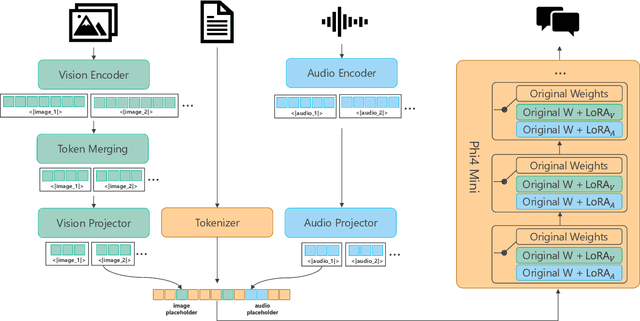
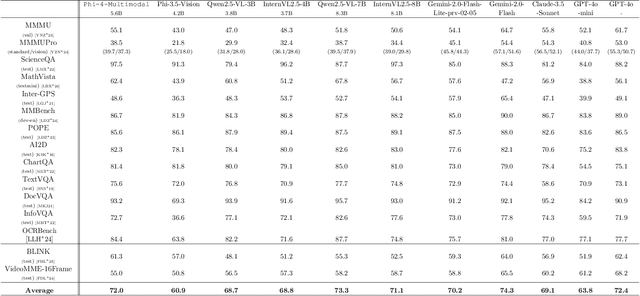
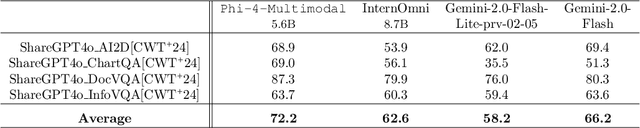
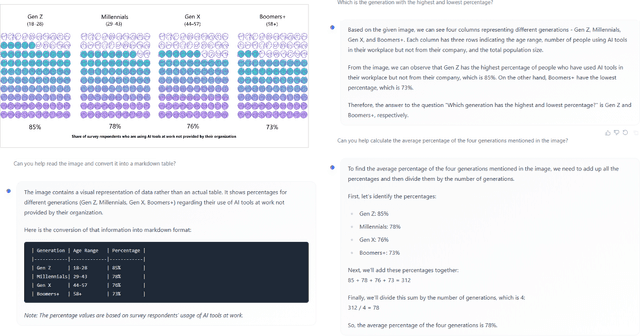
We introduce Phi-4-Mini and Phi-4-Multimodal, compact yet highly capable language and multimodal models. Phi-4-Mini is a 3.8-billion-parameter language model trained on high-quality web and synthetic data, significantly outperforming recent open-source models of similar size and matching the performance of models twice its size on math and coding tasks requiring complex reasoning. This achievement is driven by a carefully curated synthetic data recipe emphasizing high-quality math and coding datasets. Compared to its predecessor, Phi-3.5-Mini, Phi-4-Mini features an expanded vocabulary size of 200K tokens to better support multilingual applications, as well as group query attention for more efficient long-sequence generation. Phi-4-Multimodal is a multimodal model that integrates text, vision, and speech/audio input modalities into a single model. Its novel modality extension approach leverages LoRA adapters and modality-specific routers to allow multiple inference modes combining various modalities without interference. For example, it now ranks first in the OpenASR leaderboard to date, although the LoRA component of the speech/audio modality has just 460 million parameters. Phi-4-Multimodal supports scenarios involving (vision + language), (vision + speech), and (speech/audio) inputs, outperforming larger vision-language and speech-language models on a wide range of tasks. Additionally, we experiment to further train Phi-4-Mini to enhance its reasoning capabilities. Despite its compact 3.8-billion-parameter size, this experimental version achieves reasoning performance on par with or surpassing significantly larger models, including DeepSeek-R1-Distill-Qwen-7B and DeepSeek-R1-Distill-Llama-8B.
ConvKGYarn: Spinning Configurable and Scalable Conversational Knowledge Graph QA datasets with Large Language Models
Aug 12, 2024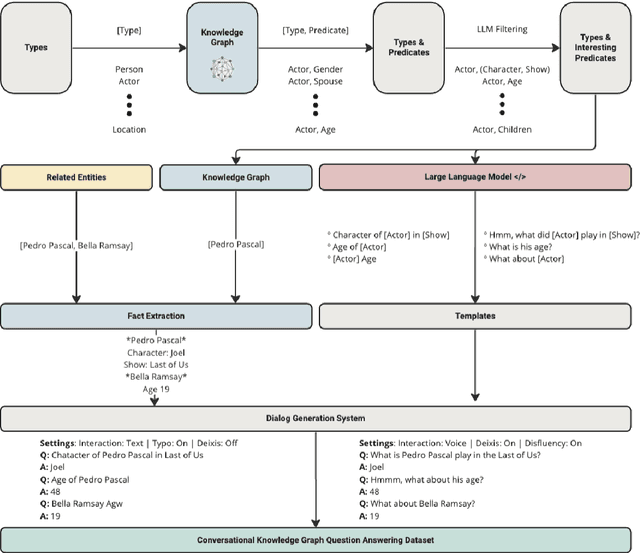

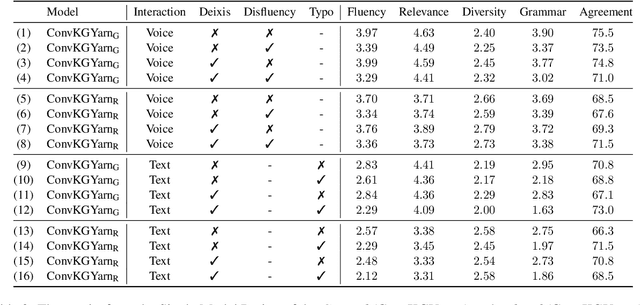
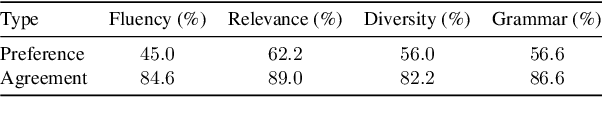
The rapid advancement of Large Language Models (LLMs) and conversational assistants necessitates dynamic, scalable, and configurable conversational datasets for training and evaluation. These datasets must accommodate diverse user interaction modes, including text and voice, each presenting unique modeling challenges. Knowledge Graphs (KGs), with their structured and evolving nature, offer an ideal foundation for current and precise knowledge. Although human-curated KG-based conversational datasets exist, they struggle to keep pace with the rapidly changing user information needs. We present ConvKGYarn, a scalable method for generating up-to-date and configurable conversational KGQA datasets. Qualitative psychometric analyses confirm our method can generate high-quality datasets rivaling a popular conversational KGQA dataset while offering it at scale and covering a wide range of human-interaction configurations. We showcase its utility by testing LLMs on diverse conversations - exploring model behavior on conversational KGQA sets with different configurations grounded in the same KG fact set. Our results highlight the ability of ConvKGYarn to improve KGQA foundations and evaluate parametric knowledge of LLMs, thus offering a robust solution to the constantly evolving landscape of conversational assistants.
Time Sensitive Knowledge Editing through Efficient Finetuning
Jun 06, 2024
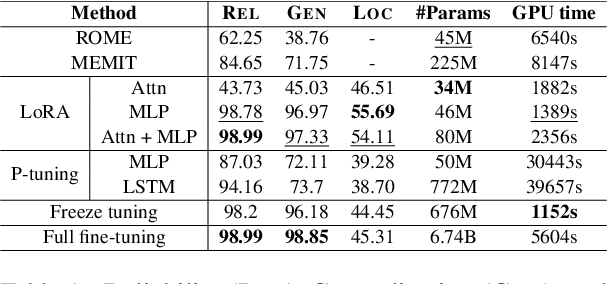

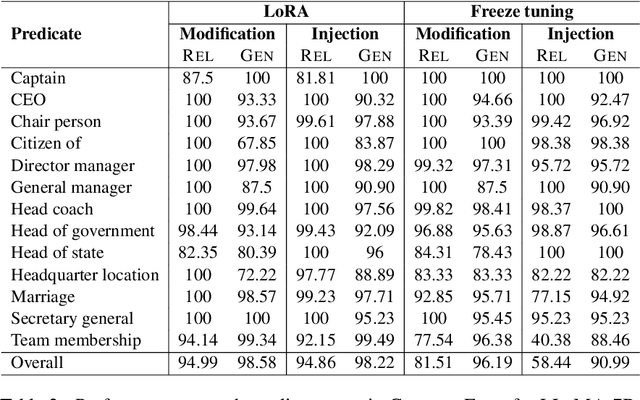
Large Language Models (LLMs) have demonstrated impressive capability in different tasks and are bringing transformative changes to many domains. However, keeping the knowledge in LLMs up-to-date remains a challenge once pretraining is complete. It is thus essential to design effective methods to both update obsolete knowledge and induce new knowledge into LLMs. Existing locate-and-edit knowledge editing (KE) method suffers from two limitations. First, the post-edit LLMs by such methods generally have poor capability in answering complex queries that require multi-hop reasoning. Second, the long run-time of such locate-and-edit methods to perform knowledge edits make it infeasible for large scale KE in practice. In this paper, we explore Parameter-Efficient Fine-Tuning (PEFT) techniques as an alternative for KE. We curate a more comprehensive temporal KE dataset with both knowledge update and knowledge injection examples for KE performance benchmarking. We further probe the effect of fine-tuning on a range of layers in an LLM for the multi-hop QA task. We find that PEFT performs better than locate-and-edit techniques for time-sensitive knowledge edits.
Entity Disambiguation via Fusion Entity Decoding
Apr 02, 2024
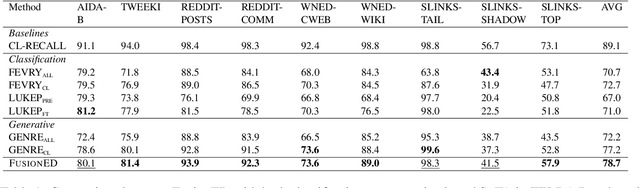
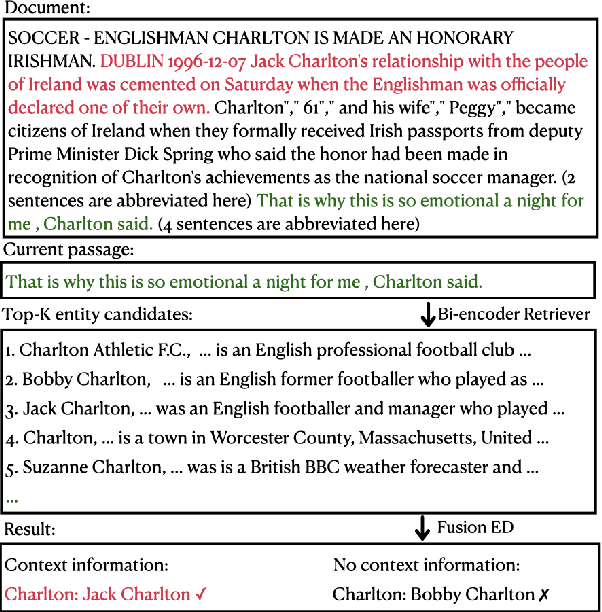

Entity disambiguation (ED), which links the mentions of ambiguous entities to their referent entities in a knowledge base, serves as a core component in entity linking (EL). Existing generative approaches demonstrate improved accuracy compared to classification approaches under the standardized ZELDA benchmark. Nevertheless, generative approaches suffer from the need for large-scale pre-training and inefficient generation. Most importantly, entity descriptions, which could contain crucial information to distinguish similar entities from each other, are often overlooked. We propose an encoder-decoder model to disambiguate entities with more detailed entity descriptions. Given text and candidate entities, the encoder learns interactions between the text and each candidate entity, producing representations for each entity candidate. The decoder then fuses the representations of entity candidates together and selects the correct entity. Our experiments, conducted on various entity disambiguation benchmarks, demonstrate the strong and robust performance of this model, particularly +1.5% in the ZELDA benchmark compared with GENRE. Furthermore, we integrate this approach into the retrieval/reader framework and observe +1.5% improvements in end-to-end entity linking in the GERBIL benchmark compared with EntQA.