 Add to Chrome
 Add to Firefox
 Add to Edge
DocAtlas: Multilingual Document Understanding Across 80+ Languages
May 12, 2026
Multilingual document understanding remains limited for low-resource languages due to scarce training data and model-based annotation pipelines that perpetuate existing biases. We introduce DocAtlas, a framework that constructs high-fidelity OCR datasets and benchmarks covering 82 languages and 9 evaluation tasks. Our dual pipelines, differential rendering of native DOCX documents and synthetic LaTeX-based generation for right-to-left scripts produce precise structural annotations in a unified DocTag format encoding layout, text, and component types, without learned models for core annotation. Evaluating 16 state-of-the-art models reveals persistent gaps in low-resource scripts. We show that Direct Preference Optimization (DPO) using rendering-derived ground truth as positive signal achieves stable multilingual adaptation, improving both in-domain (+1.9%) and out-of-domain (+1.8%) accuracy without measurable base-language degradation, where supervised fine-tuning degrades out-of-domain performance by up to 21%. Our best variant, DocAtlas-DeepSeek, improves +1.7% over the strongest baseline.

World2Act: Latent Action Post-Training via Skill-Compositional World Models
Mar 11, 2026World Models (WMs) have emerged as a promising approach for post-training Vision-Language-Action (VLA) policies to improve robustness and generalization under environmental changes. However, most WM-based post-training methods rely on pixel-space supervision, making policies sensitive to pixel-level artifacts and hallucination from imperfect WM rollouts. We introduce World2Act, a post-training framework that aligns VLA actions directly with WM video-dynamics latents using a contrastive matching objective, reducing dependence on pixels. Post-training performance is tied to rollout quality, yet current WMs struggle with arbitrary-length video generation as they are mostly trained on fixed-length clips while robotic execution durations vary widely. To address this, we propose an automatic LLM-based skill-decomposition pipeline that segments high-level instructions into low-level prompts. Our pipeline produces RoboCasa-Skill and LIBERO-Skill, supporting skill-compositional WMs that remain temporally consistent across diverse task horizons. Empirically, applying World2Act to VLAs like GR00T-N1.6 and Cosmos Policy achieves state-of-the-art results on RoboCasa and LIBERO, and improves real-world performance by 6.7%, enhancing embodied agent generalization.
Latent-DARM: Bridging Discrete Diffusion And Autoregressive Models For Reasoning
Mar 10, 2026Most multi-agent systems rely exclusively on autoregressive language models (ARMs) that are based on sequential generation. Although effective for fluent text, ARMs limit global reasoning and plan revision. On the other hand, Discrete Diffusion Language Models (DDLMs) enable non-sequential, globally revisable generation and have shown strong planning capabilities, but their limited text fluency hinders direct collaboration with ARMs. We introduce Latent-DARM, a latent-space communication framework bridging DDLM (planners) and ARM (executors), maximizing collaborative benefits. Across mathematical, scientific, and commonsense reasoning benchmarks, Latent-DARM outperforms text-based interfaces on average, improving accuracy from 27.0% to 36.0% on DART-5 and from 0.0% to 14.0% on AIME2024. Latent-DARM approaches the results of state-of-the-art reasoning models while using less than 2.2% of its token budget. This work advances multi-agent collaboration among agents with heterogeneous models.
KITAB-Bench: A Comprehensive Multi-Domain Benchmark for Arabic OCR and Document Understanding
Feb 20, 2025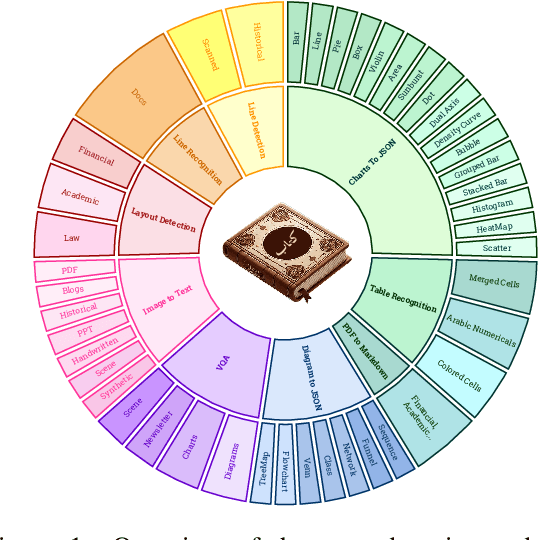
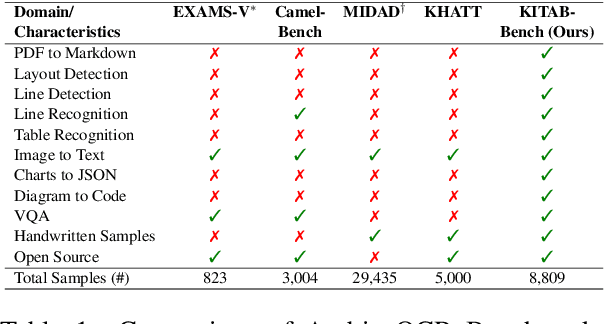
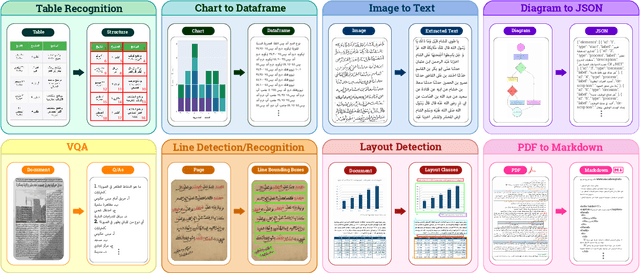
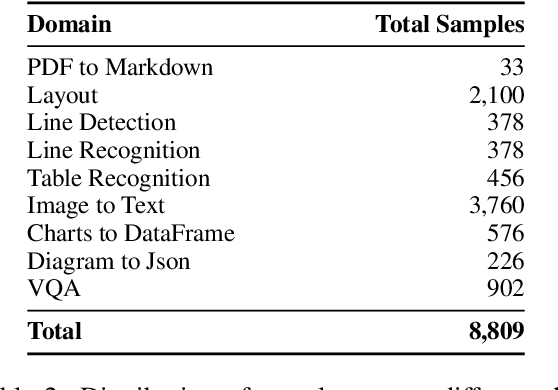
With the growing adoption of Retrieval-Augmented Generation (RAG) in document processing, robust text recognition has become increasingly critical for knowledge extraction. While OCR (Optical Character Recognition) for English and other languages benefits from large datasets and well-established benchmarks, Arabic OCR faces unique challenges due to its cursive script, right-to-left text flow, and complex typographic and calligraphic features. We present KITAB-Bench, a comprehensive Arabic OCR benchmark that fills the gaps in current evaluation systems. Our benchmark comprises 8,809 samples across 9 major domains and 36 sub-domains, encompassing diverse document types including handwritten text, structured tables, and specialized coverage of 21 chart types for business intelligence. Our findings show that modern vision-language models (such as GPT-4, Gemini, and Qwen) outperform traditional OCR approaches (like EasyOCR, PaddleOCR, and Surya) by an average of 60% in Character Error Rate (CER). Furthermore, we highlight significant limitations of current Arabic OCR models, particularly in PDF-to-Markdown conversion, where the best model Gemini-2.0-Flash achieves only 65% accuracy. This underscores the challenges in accurately recognizing Arabic text, including issues with complex fonts, numeral recognition errors, word elongation, and table structure detection. This work establishes a rigorous evaluation framework that can drive improvements in Arabic document analysis methods and bridge the performance gap with English OCR technologies.