 Add to Chrome
 Add to Firefox
 Add to Edge
A Good Talk Does not Look Like a Summary, It Teaches You! Measuring Takeaways from Paper-to-Video Talks
Jun 26, 2026
Automatically generated videos from scientific papers are increasingly used for education and research dissemination. However, existing evaluation metrics mainly measure visual quality or whether key points from the paper appear in the video without assessing whether the video actually helps viewers understand the ideas. We introduce EffectivePresentationScorer, a framework for evaluating the instructional quality of scientific presentation videos. It checks whether a video explains the main ideas clearly, introduces needed background concepts, and connects technical details to the main contribution of the paper. When we apply EffectivePresentationScorer to the existing paper-to-video generation systems, we find that generated videos mention the correct topics and follow the structure of the paper but fail to explain prerequisite concepts or clarify why the method works. These failures are often ignored by existing video evaluation metrics, which focus on content presence rather than explanatory quality.

Measuring User's Mental Models of Speech Translation in Human-AI Collaboration
Jun 23, 2026Millions of people use machine translation (MT) tools daily, yet little is known about their perception of what systems can and cannot do. This paper studies users' mental models of speech translation systems through a new framework based on cross-lingual question answering, where users either accept MT output or request professional re-translation to answer questions based on the information presented in a foreign language. By analyzing user behavior and accuracy trends across varying translation qualities, we examine to what extent they can predict where the system is likely to be wrong, and how this mental model evolves. Users develop stronger mental models with practice, especially when they have some knowledge of the source language, primarily by relying on surface-level error cues. Moreover, providing speech transcriptions can help users develop better mental models. Our results show the promise of cross-lingual question answering as a downstream task for studying MT mental models and advancing our understanding of human-AI collaboration.
Helping Figures Tell their Story! Paper-Grounded Video Generation Explaining Complex Scientific Figures
Jun 10, 2026Scientific figures compress complex pipelines into a single canvas, yet understanding them requires paper-grounded, step-by-step narration aligned with visual highlights a capability missing from current video generation systems and benchmarks. To address this, we introduce paper-grounded figure-to-video generation: generating narrated, region-grounded walkthrough videos from a figure and its paper. We propose MINARD (Multimodal Interpretation of Narrated Architecture via Region Decomposition), a pipeline that generates paper-grounded narrations and sequentially grounds them to figure regions. We also release FigTalk, a benchmark with new sequential and component-level grounding metrics derived. On FigTalk, MINARD generates humanlike, paper-faithful narrations and outperforms narration-conditioned figure spatial grounding compared to existing approaches in both automatic and human evaluation
AI, Take the Wheel: What Drives Delegation and Trust in Human-Computer Cooperative Question Answering?
May 27, 2026AI systems are fallible, and humans can make mistakes in deciding whether to trust AI over their own judgment. Thus, improving human-AI collaboration requires understanding when, why, and how humans decide to rely on AI. We study two distinct reliance decisions: the delegation choice -- deciding when to let AI act autonomously without knowing its output, and the adoption choice -- evaluating AI suggestions and deciding how to use them. Both of these decoupled reliance patterns shape collaboration, but prior work rarely studies them together in realistic settings with the same users. We address this gap by studying collaborative human--AI teams competing in a question-answering game in which humans can choose when and how to work with AI agents to win. Our 24 matches pair 23 expert humans with 16 AI agents, capturing 387 delegation and 1440 adoption decisions. While human--AI collaboration performs better than either AI or humans alone, humans make suboptimal collaboration decisions, both under-relying on correct AI suggestions (3.9% of opportunities missed) and over-relying when AI misleads them (1.7%). Both parties contribute wrong answers: reported model confidence is near chance when humans and AI disagree, while confirmation bias drives higher under-reliance (64.5%) when an AI suggestion agrees with humans' initial incorrect answer. To close this gap, we recommend calibrated confidence, evidence-grounded explanations, and mechanisms that help users refine trust.
DiscoTrace: Representing and Comparing Answering Strategies of Humans and LLMs in Information-Seeking Question Answering
Apr 16, 2026We introduce DiscoTrace, a method to identify the rhetorical strategies that answerers use when responding to information-seeking questions. DiscoTrace represents answers as a sequence of question-related discourse acts paired with interpretations of the original question, annotated on top of rhetorical structure theory parses. Applying DiscoTrace to answers from nine different human communities reveals that communities have diverse preferences for answer construction. In contrast, LLMs do not exhibit rhetorical diversity in their answers, even when prompted to mimic specific human community answering guidelines. LLMs also systematically opt for breadth, addressing interpretations of questions that human answerers choose not to address. Our findings can guide the development of pragmatic LLM answerers that consider a range of strategies informed by context in QA.
CANVAS: Continuity-Aware Narratives via Visual Agentic Storyboarding
Apr 15, 2026Long-form visual storytelling requires maintaining continuity across shots, including consistent characters, stable environments, and smooth scene transitions. While existing generative models can produce strong individual frames, they fail to preserve such continuity, leading to appearance changes, inconsistent backgrounds, and abrupt scene shifts. We introduce CANVAS (Continuity-Aware Narratives via Visual Agentic Storyboarding), a multi-agent framework that explicitly plans visual continuity in multi-shot narratives. CANVAS enforces coherence through character continuity, persistent background anchors, and location-aware scene planning for smooth transitions within the same setting We evaluate CANVAS on two storyboard generation benchmarks ST-BENCH and ViStoryBench and introduce a new challenging benchmark HardContinuityBench for long-range narrative consistency. CANVAS consistently outperforms the best-performing baseline, improving background continuity by 21.6%, character consistency by 9.6% and props consistency by 7.6%.
Self-Rewarding Vision-Language Model via Reasoning Decomposition
Aug 27, 2025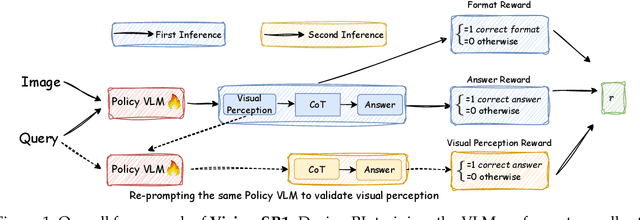
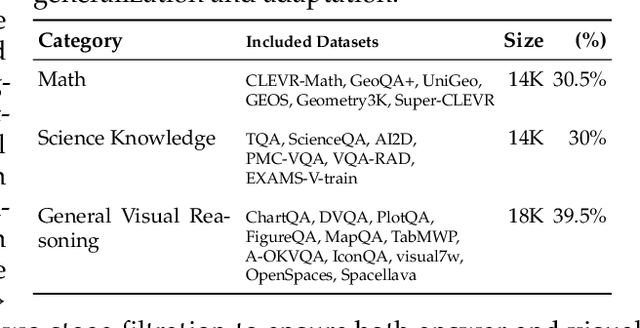
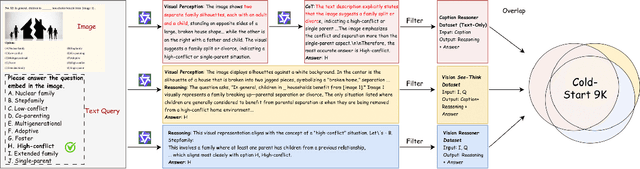
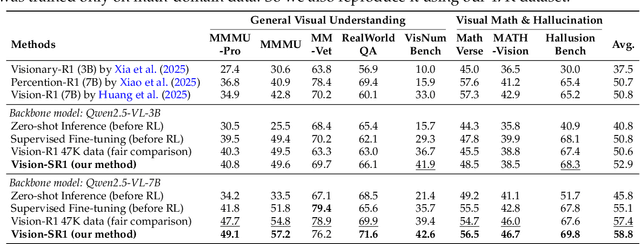
Vision-Language Models (VLMs) often suffer from visual hallucinations, saying things that are not actually in the image, and language shortcuts, where they skip the visual part and just rely on text priors. These issues arise because most post-training methods for VLMs rely on simple verifiable answer matching and supervise only final outputs, leaving intermediate visual reasoning without explicit guidance. As a result, VLMs receive sparse visual signals and often learn to prioritize language-based reasoning over visual perception. To mitigate this, some existing methods add visual supervision using human annotations or distilled labels from external large models. However, human annotations are labor-intensive and costly, and because external signals cannot adapt to the evolving policy, they cause distributional shifts that can lead to reward hacking. In this paper, we introduce Vision-SR1, a self-rewarding method that improves visual reasoning without relying on external visual supervisions via reinforcement learning. Vision-SR1 decomposes VLM reasoning into two stages: visual perception and language reasoning. The model is first prompted to produce self-contained visual perceptions that are sufficient to answer the question without referring back the input image. To validate this self-containment, the same VLM model is then re-prompted to perform language reasoning using only the generated perception as input to compute reward. This self-reward is combined with supervision on final outputs, providing a balanced training signal that strengthens both visual perception and language reasoning. Our experiments demonstrate that Vision-SR1 improves visual reasoning, mitigates visual hallucinations, and reduces reliance on language shortcuts across diverse vision-language tasks.
ProxAnn: Use-Oriented Evaluations of Topic Models and Document Clustering
Jul 01, 2025Topic model and document-clustering evaluations either use automated metrics that align poorly with human preferences or require expert labels that are intractable to scale. We design a scalable human evaluation protocol and a corresponding automated approximation that reflect practitioners' real-world usage of models. Annotators -- or an LLM-based proxy -- review text items assigned to a topic or cluster, infer a category for the group, then apply that category to other documents. Using this protocol, we collect extensive crowdworker annotations of outputs from a diverse set of topic models on two datasets. We then use these annotations to validate automated proxies, finding that the best LLM proxies are statistically indistinguishable from a human annotator and can therefore serve as a reasonable substitute in automated evaluations. Package, web interface, and data are at https://github.com/ahoho/proxann
NAVIG: Natural Language-guided Analysis with Vision Language Models for Image Geo-localization
Feb 20, 2025Image geo-localization is the task of predicting the specific location of an image and requires complex reasoning across visual, geographical, and cultural contexts. While prior Vision Language Models (VLMs) have the best accuracy at this task, there is a dearth of high-quality datasets and models for analytical reasoning. We first create NaviClues, a high-quality dataset derived from GeoGuessr, a popular geography game, to supply examples of expert reasoning from language. Using this dataset, we present Navig, a comprehensive image geo-localization framework integrating global and fine-grained image information. By reasoning with language, Navig reduces the average distance error by 14% compared to previous state-of-the-art models while requiring fewer than 1000 training samples. Our dataset and code are available at https://github.com/SparrowZheyuan18/Navig/.
Large Language Models Struggle to Describe the Haystack without Human Help: Human-in-the-loop Evaluation of LLMs
Feb 20, 2025A common use of NLP is to facilitate the understanding of large document collections, with a shift from using traditional topic models to Large Language Models. Yet the effectiveness of using LLM for large corpus understanding in real-world applications remains under-explored. This study measures the knowledge users acquire with unsupervised, supervised LLM-based exploratory approaches or traditional topic models on two datasets. While LLM-based methods generate more human-readable topics and show higher average win probabilities than traditional models for data exploration, they produce overly generic topics for domain-specific datasets that do not easily allow users to learn much about the documents. Adding human supervision to the LLM generation process improves data exploration by mitigating hallucination and over-genericity but requires greater human effort. In contrast, traditional. models like Latent Dirichlet Allocation (LDA) remain effective for exploration but are less user-friendly. We show that LLMs struggle to describe the haystack of large corpora without human help, particularly domain-specific data, and face scaling and hallucination limitations due to context length constraints. Dataset available at https://huggingface. co/datasets/zli12321/Bills.