 Add to Chrome
 Add to Firefox
 Add to Edge
Position: Don't Just "Fix it in Post": A Science of AI Must Study Training Dynamics
Jun 03, 2026
What would it mean to have a scientific understanding of AI? Models are not static objects: they are snapshots of time-evolving processes shaped by data, objectives, architectures, and optimization dynamics. Yet much of AI research treats models as fixed artifacts, analyzing behaviors after training rather than asking why they emerge. This position paper argues that a science of AI must move beyond post-hoc fixes and study the training dynamics that produce model behavior. Such a science should support progressively stronger forms of understanding: predicting outcomes from early training signals, intervening when trajectories go wrong, and ultimately designing training procedures that more reliably produce desired properties. Scaling laws have made prediction routine for loss; the challenge is extending this success to capabilities, biases, robustness, and safety-relevant behaviors. We articulate requirements for such theories grounded in the history and philosophy of science, examine progress in mechanistic interpretability, fairness, memorization, and simplicity bias, and identify concrete open problems.

Fine-tuning vs. In-context Learning in Large Language Models: A Formal Language Learning Perspective
Apr 25, 2026Large language models (LLMs) operate in two fundamental learning modes - fine-tuning (FT) and in-context learning (ICL) - raising key questions about which mode yields greater language proficiency and whether they differ in their inductive biases. Prior studies comparing FT and ICL have yielded mixed and inconclusive results due to inconsistent experimental setups. To enable a rigorous comparison, we propose a formal language learning task - offering precise language boundaries, controlled string sampling, and no data contamination - and introduce a discriminative test for language proficiency, where an LLM succeeds if it assigns higher generation probability to in-language strings than to out-of-language strings. Empirically, we find that: (a) FT has greater language proficiency than ICL on in-distribution generalization, but both perform equally well on out-of-distribution generalization. (b) Their inductive biases, measured by the correlation in string generation probabilities, are similar when both modes partially learn the language but diverge at higher proficiency levels. (c) Unlike FT, ICL performance differs substantially across models of varying sizes and families and is sensitive to the token vocabulary of the language. Thus, our work demonstrates the promise of formal languages as a controlled testbed for evaluating LLMs, behaviors that are difficult to isolate in natural language datasets. Our source code is available at https://github.com/bishwamittra/formallm.
Fractional Rotation, Full Potential? Investigating Performance and Convergence of Partial RoPE
Mar 12, 2026Rotary Positional Embedding (RoPE) is a common choice in transformer architectures for encoding relative positional information. Although earlier work has examined omitting RoPE in specific layers, the effect of varying the fraction of hidden dimensions that receive rotary transformations remains largely unexplored. This design choice can yield substantial memory savings, which becomes especially significant at long context lengths. We find up to 10x memory savings over the standard RoPE cache, while achieving comparable final loss. In this work, we present a systematic study examining the impact of partial RoPE on training dynamics and convergence across architectures and datasets. Our findings uncover several notable patterns: (1) applying RoPE to only a small fraction of dimensions (around 10%) achieves convergence comparable to using full RoPE; (2) these trends hold consistently across model size, sequence lengths and datasets of varying quality and architectures, with higher-quality data resulting in lower overall loss and similar benchmark performance; and (3) some models trained with NoPE (No Positional Encoding) showcase unstable learning trajectories, which can be alleviated through minimal RoPE application or QK-Norm which converges to a higher loss. Together, these results offer practical guidance for model designers aiming to balance efficiency and training stability, while emphasizing the previously overlooked importance of partial RoPE.
In Agents We Trust, but Who Do Agents Trust? Latent Source Preferences Steer LLM Generations
Feb 17, 2026Agents based on Large Language Models (LLMs) are increasingly being deployed as interfaces to information on online platforms. These agents filter, prioritize, and synthesize information retrieved from the platforms' back-end databases or via web search. In these scenarios, LLM agents govern the information users receive, by drawing users' attention to particular instances of retrieved information at the expense of others. While much prior work has focused on biases in the information LLMs themselves generate, less attention has been paid to the factors that influence what information LLMs select and present to users. We hypothesize that when information is attributed to specific sources (e.g., particular publishers, journals, or platforms), current LLMs exhibit systematic latent source preferences- that is, they prioritize information from some sources over others. Through controlled experiments on twelve LLMs from six model providers, spanning both synthetic and real-world tasks, we find that several models consistently exhibit strong and predictable source preferences. These preferences are sensitive to contextual framing, can outweigh the influence of content itself, and persist despite explicit prompting to avoid them. They also help explain phenomena such as the observed left-leaning skew in news recommendations in prior work. Our findings advocate for deeper investigation into the origins of these preferences, as well as for mechanisms that provide users with transparency and control over the biases guiding LLM-powered agents.
Hubble: a Model Suite to Advance the Study of LLM Memorization
Oct 22, 2025We present Hubble, a suite of fully open-source large language models (LLMs) for the scientific study of LLM memorization. Hubble models come in standard and perturbed variants: standard models are pretrained on a large English corpus, and perturbed models are trained in the same way but with controlled insertion of text (e.g., book passages, biographies, and test sets) designed to emulate key memorization risks. Our core release includes 8 models -- standard and perturbed models with 1B or 8B parameters, pretrained on 100B or 500B tokens -- establishing that memorization risks are determined by the frequency of sensitive data relative to size of the training corpus (i.e., a password appearing once in a smaller corpus is memorized better than the same password in a larger corpus). Our release also includes 6 perturbed models with text inserted at different pretraining phases, showing that sensitive data without continued exposure can be forgotten. These findings suggest two best practices for addressing memorization risks: to dilute sensitive data by increasing the size of the training corpus, and to order sensitive data to appear earlier in training. Beyond these general empirical findings, Hubble enables a broad range of memorization research; for example, analyzing the biographies reveals how readily different types of private information are memorized. We also demonstrate that the randomized insertions in Hubble make it an ideal testbed for membership inference and machine unlearning, and invite the community to further explore, benchmark, and build upon our work.
Rote Learning Considered Useful: Generalizing over Memorized Data in LLMs
Jul 29, 2025Rote learning is a memorization technique based on repetition. It is commonly believed to hinder generalization by encouraging verbatim memorization rather than deeper understanding. This insight holds for even learning factual knowledge that inevitably requires a certain degree of memorization. In this work, we demonstrate that LLMs can be trained to generalize from rote memorized data. We introduce a two-phase memorize-then-generalize framework, where the model first rote memorizes factual subject-object associations using a semantically meaningless token and then learns to generalize by fine-tuning on a small set of semantically meaningful prompts. Extensive experiments over 8 LLMs show that the models can reinterpret rote memorized data through the semantically meaningful prompts, as evidenced by the emergence of structured, semantically aligned latent representations between the two. This surprising finding opens the door to both effective and efficient knowledge injection and possible risks of repurposing the memorized data for malicious usage.
Revisiting Privacy, Utility, and Efficiency Trade-offs when Fine-Tuning Large Language Models
Feb 18, 2025We study the inherent trade-offs in minimizing privacy risks and maximizing utility, while maintaining high computational efficiency, when fine-tuning large language models (LLMs). A number of recent works in privacy research have attempted to mitigate privacy risks posed by memorizing fine-tuning data by using differentially private training methods (e.g., DP), albeit at a significantly higher computational cost (inefficiency). In parallel, several works in systems research have focussed on developing (parameter) efficient fine-tuning methods (e.g., LoRA), but few works, if any, investigated whether such efficient methods enhance or diminish privacy risks. In this paper, we investigate this gap and arrive at a surprising conclusion: efficient fine-tuning methods like LoRA mitigate privacy risks similar to private fine-tuning methods like DP. Our empirical finding directly contradicts prevailing wisdom that privacy and efficiency objectives are at odds during fine-tuning. Our finding is established by (a) carefully defining measures of privacy and utility that distinguish between memorizing sensitive and non-sensitive tokens in training and test datasets used in fine-tuning and (b) extensive evaluations using multiple open-source language models from Pythia, Gemma, and Llama families and different domain-specific datasets.
QUENCH: Measuring the gap between Indic and Non-Indic Contextual General Reasoning in LLMs
Dec 16, 2024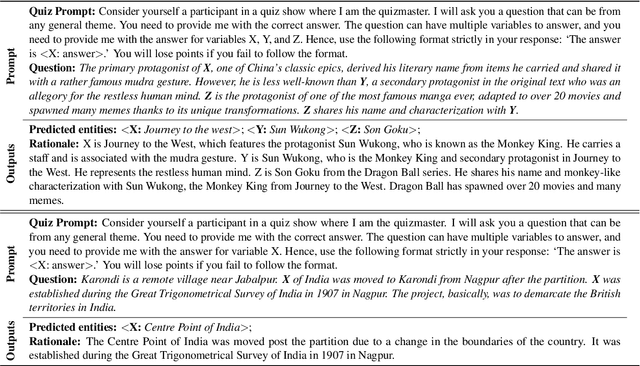
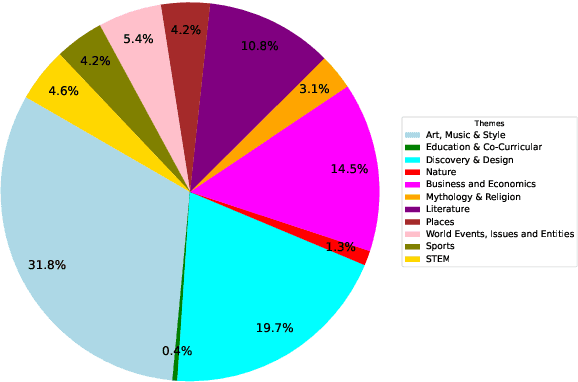
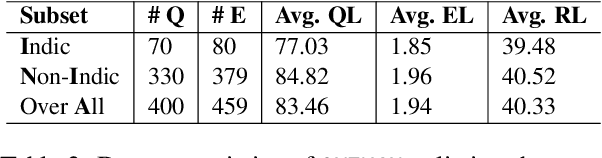
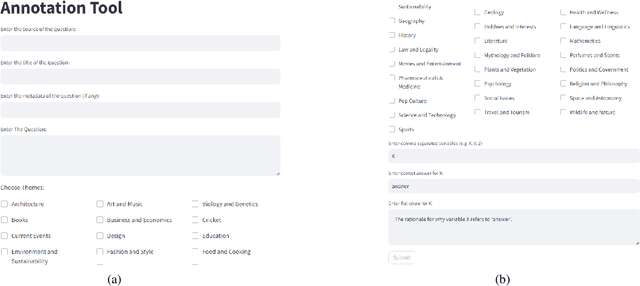
The rise of large language models (LLMs) has created a need for advanced benchmarking systems beyond traditional setups. To this end, we introduce QUENCH, a novel text-based English Quizzing Benchmark manually curated and transcribed from YouTube quiz videos. QUENCH possesses masked entities and rationales for the LLMs to predict via generation. At the intersection of geographical context and common sense reasoning, QUENCH helps assess world knowledge and deduction capabilities of LLMs via a zero-shot, open-domain quizzing setup. We perform an extensive evaluation on 7 LLMs and 4 metrics, investigating the influence of model size, prompting style, geographical context, and gold-labeled rationale generation. The benchmarking concludes with an error analysis to which the LLMs are prone.
Understanding Memorisation in LLMs: Dynamics, Influencing Factors, and Implications
Jul 27, 2024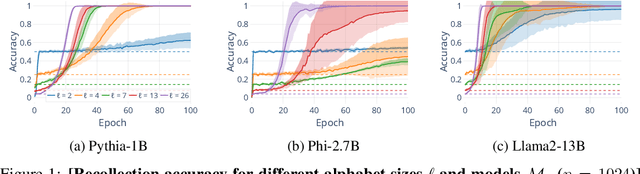
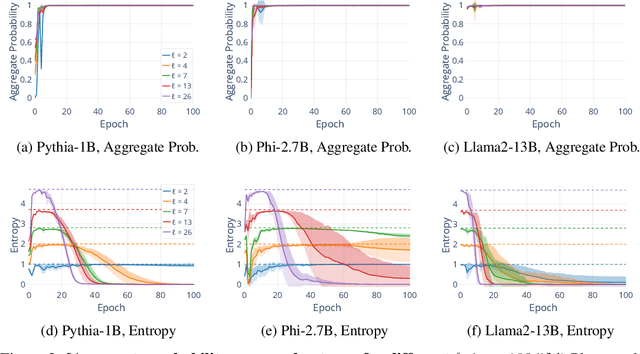

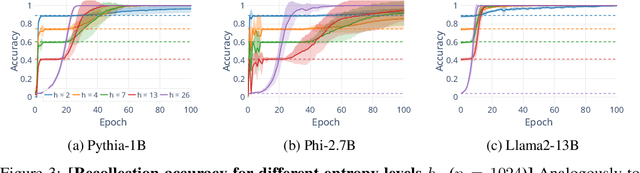
Understanding whether and to what extent large language models (LLMs) have memorised training data has important implications for the reliability of their output and the privacy of their training data. In order to cleanly measure and disentangle memorisation from other phenomena (e.g. in-context learning), we create an experimental framework that is based on repeatedly exposing LLMs to random strings. Our framework allows us to better understand the dynamics, i.e., the behaviour of the model, when repeatedly exposing it to random strings. Using our framework, we make several striking observations: (a) we find consistent phases of the dynamics across families of models (Pythia, Phi and Llama2), (b) we identify factors that make some strings easier to memorise than others, and (c) we identify the role of local prefixes and global context in memorisation. We also show that sequential exposition to different random strings has a significant effect on memorisation. Our results, often surprising, have significant downstream implications in the study and usage of LLMs.
Recite, Reconstruct, Recollect: Memorization in LMs as a Multifaceted Phenomenon
Jun 25, 2024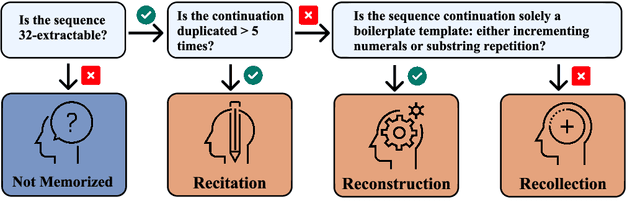
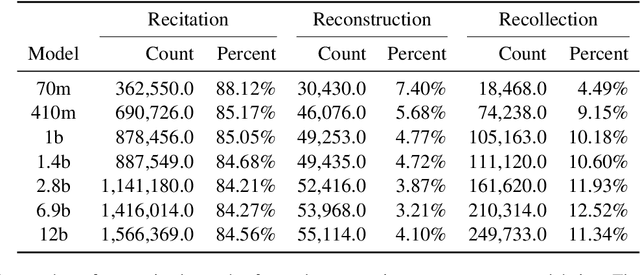
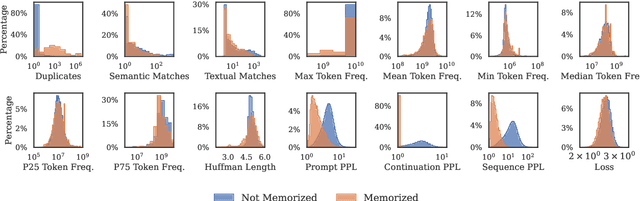
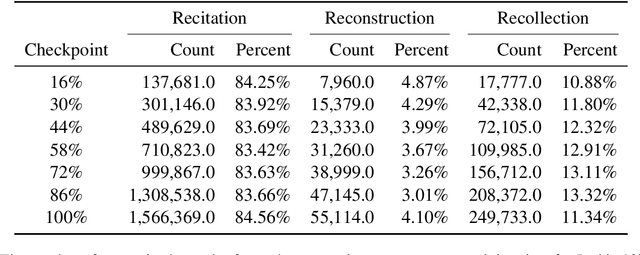
Memorization in language models is typically treated as a homogenous phenomenon, neglecting the specifics of the memorized data. We instead model memorization as the effect of a set of complex factors that describe each sample and relate it to the model and corpus. To build intuition around these factors, we break memorization down into a taxonomy: recitation of highly duplicated sequences, reconstruction of inherently predictable sequences, and recollection of sequences that are neither. We demonstrate the usefulness of our taxonomy by using it to construct a predictive model for memorization. By analyzing dependencies and inspecting the weights of the predictive model, we find that different factors influence the likelihood of memorization differently depending on the taxonomic category.