 Add to Chrome
 Add to Firefox
 Add to Edge
Image To Image Translation
Image-to-image translation is the process of converting an image from one domain to another using deep learning techniques.
Papers and Code
MOON Embedding: Multimodal Representation Learning for E-commerce Search Advertising
Nov 18, 2025
We introduce MOON, our comprehensive set of sustainable iterative practices for multimodal representation learning for e-commerce applications. MOON has already been fully deployed across all stages of Taobao search advertising system, including retrieval, relevance, ranking, and so on. The performance gains are particularly significant on click-through rate (CTR) prediction task, which achieves an overall +20.00% online CTR improvement. Over the past three years, this project has delivered the largest improvement on CTR prediction task and undergone five full-scale iterations. Throughout the exploration and iteration of our MOON, we have accumulated valuable insights and practical experience that we believe will benefit the research community. MOON contains a three-stage training paradigm of "Pretraining, Post-training, and Application", allowing effective integration of multimodal representations with downstream tasks. Notably, to bridge the misalignment between the objectives of multimodal representation learning and downstream training, we define the exchange rate to quantify how effectively improvements in an intermediate metric can translate into downstream gains. Through this analysis, we identify the image-based search recall as a critical intermediate metric guiding the optimization of multimodal models. Over three years and five iterations, MOON has evolved along four critical dimensions: data processing, training strategy, model architecture, and downstream application. The lessons and insights gained through the iterative improvements will also be shared. As part of our exploration into scaling effects in the e-commerce field, we further conduct a systematic study of the scaling laws governing multimodal representation learning, examining multiple factors such as the number of training tokens, negative samples, and the length of user behavior sequences.

Theoretical Bounds on Parallel Imaging Implicit Data Crimes in an MRI Reproducing Kernel Hilbert Space
Nov 19, 2025Magnetic Resonance Imaging (MRI) diagnoses and manages a wide range of diseases, yet long scan times drive high costs and limit accessibility. AI methods have demonstrated substantial potential for reducing scan times, but despite rapid progress, clinical translation of AI often fails. One particular class of failure modes, referred to as implicit data crimes, are a result of hidden biases introduced when MRI datasets incompletely model the MRI physics of the acquisition. Previous work identified data crimes resulting from algorithmic completion of k-space with parallel imaging and drew on simulation to demonstrate the resulting downstream biases. This work proposes a mathematical framework to re-characterize the problem as one of error reduction during interpolation between sets of evaluation coordinates. We establish a generalized matrix-based definition of the reconstruction error upper bound as a function of the input sampling pattern. Experiments on relevant sampling pattern structures demonstrate the relevance of the framework and suggest future directions for analysis of data crimes.
A Picture is Worth a Thousand (Correct) Captions: A Vision-Guided Judge-Corrector System for Multimodal Machine Translation
Nov 10, 2025In this paper, we describe our system under the team name BLEU Monday for the English-to-Indic Multimodal Translation Task at WAT 2025. We participate in the text-only translation tasks for English-Hindi, English-Bengali, English-Malayalam, and English-Odia language pairs. We present a two-stage approach that addresses quality issues in the training data through automated error detection and correction, followed by parameter-efficient model fine-tuning. Our methodology introduces a vision-augmented judge-corrector pipeline that leverages multimodal language models to systematically identify and correct translation errors in the training data. The judge component classifies translations into three categories: correct, visually ambiguous (requiring image context), or mistranslated (poor translation quality). Identified errors are routed to specialized correctors: GPT-4o-mini regenerates captions requiring visual disambiguation, while IndicTrans2 retranslates cases with pure translation quality issues. This automated pipeline processes 28,928 training examples across four languages, correcting an average of 17.1% of captions per language. We then apply Low-Rank Adaptation (LoRA) to fine-tune the IndicTrans2 en-indic 200M distilled model on both original and corrected datasets. Training on corrected data yields consistent improvements, with BLEU score gains of +1.30 for English-Bengali on the evaluation set (42.00 -> 43.30) and +0.70 on the challenge set (44.90 -> 45.60), +0.60 for English-Odia on the evaluation set (41.00 -> 41.60), and +0.10 for English-Hindi on the challenge set (53.90 -> 54.00).
US-X Complete: A Multi-Modal Approach to Anatomical 3D Shape Recovery
Nov 19, 2025Ultrasound offers a radiation-free, cost-effective solution for real-time visualization of spinal landmarks, paraspinal soft tissues and neurovascular structures, making it valuable for intraoperative guidance during spinal procedures. However, ultrasound suffers from inherent limitations in visualizing complete vertebral anatomy, in particular vertebral bodies, due to acoustic shadowing effects caused by bone. In this work, we present a novel multi-modal deep learning method for completing occluded anatomical structures in 3D ultrasound by leveraging complementary information from a single X-ray image. To enable training, we generate paired training data consisting of: (1) 2D lateral vertebral views that simulate X-ray scans, and (2) 3D partial vertebrae representations that mimic the limited visibility and occlusions encountered during ultrasound spine imaging. Our method integrates morphological information from both imaging modalities and demonstrates significant improvements in vertebral reconstruction (p < 0.001) compared to state of art in 3D ultrasound vertebral completion. We perform phantom studies as an initial step to future clinical translation, and achieve a more accurate, complete volumetric lumbar spine visualization overlayed on the ultrasound scan without the need for registration with preoperative modalities such as computed tomography. This demonstrates that integrating a single X-ray projection mitigates ultrasound's key limitation while preserving its strengths as the primary imaging modality. Code and data can be found at https://github.com/miruna20/US-X-Complete
Alias-Free ViT: Fractional Shift Invariance via Linear Attention
Oct 26, 2025Transformers have emerged as a competitive alternative to convnets in vision tasks, yet they lack the architectural inductive bias of convnets, which may hinder their potential performance. Specifically, Vision Transformers (ViTs) are not translation-invariant and are more sensitive to minor image translations than standard convnets. Previous studies have shown, however, that convnets are also not perfectly shift-invariant, due to aliasing in downsampling and nonlinear layers. Consequently, anti-aliasing approaches have been proposed to certify convnets' translation robustness. Building on this line of work, we propose an Alias-Free ViT, which combines two main components. First, it uses alias-free downsampling and nonlinearities. Second, it uses linear cross-covariance attention that is shift-equivariant to both integer and fractional translations, enabling a shift-invariant global representation. Our model maintains competitive performance in image classification and outperforms similar-sized models in terms of robustness to adversarial translations.
Comprehension of Multilingual Expressions Referring to Target Objects in Visual Inputs
Nov 14, 2025Referring Expression Comprehension (REC) requires models to localize objects in images based on natural language descriptions. Research on the area remains predominantly English-centric, despite increasing global deployment demands. This work addresses multilingual REC through two main contributions. First, we construct a unified multilingual dataset spanning 10 languages, by systematically expanding 12 existing English REC benchmarks through machine translation and context-based translation enhancement. The resulting dataset comprises approximately 8 million multilingual referring expressions across 177,620 images, with 336,882 annotated objects. Second, we introduce an attention-anchored neural architecture that uses multilingual SigLIP2 encoders. Our attention-based approach generates coarse spatial anchors from attention distributions, which are subsequently refined through learned residuals. Experimental evaluation demonstrates competitive performance on standard benchmarks, e.g. achieving 86.9% accuracy at IoU@50 on RefCOCO aggregate multilingual evaluation, compared to an English-only result of 91.3%. Multilingual evaluation shows consistent capabilities across languages, establishing the practical feasibility of multilingual visual grounding systems. The dataset and model are available at $\href{https://multilingual.franreno.com}{multilingual.franreno.com}$.
Enabling Fast and Accurate Neutral Atom Readout through Image Denoising
Oct 29, 2025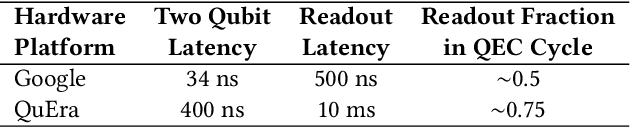

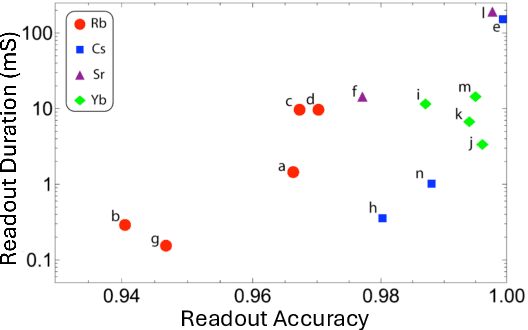
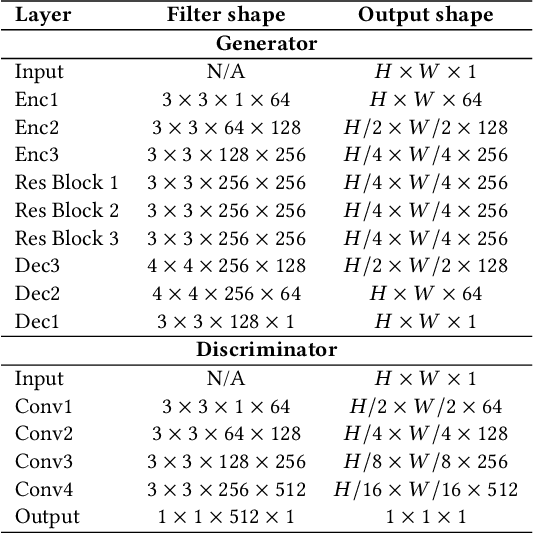
Neutral atom quantum computers hold promise for scaling up to hundreds of thousands of qubits, but their progress is constrained by slow qubit readout. Measuring qubits currently takes milliseconds-much longer than the underlying quantum gate operations-making readout the primary bottleneck in deploying quantum error correction. Because each round of QEC depends on measurement, long readout times increase cycle duration and slow down program execution. Reducing the readout duration speeds up cycles and reduces decoherence errors that accumulate while qubits idle, but it also lowers the number of collected photons, making measurements noisier and more error-prone. This tradeoff leaves neutral atom systems stuck between slow but accurate readout and fast but unreliable readout. We show that image denoising can resolve this tension. Our framework, GANDALF, uses explicit denoising using image translation to reconstruct clear signals from short, low-photon measurements, enabling reliable classification at up to 1.6x shorter readout times. Combined with lightweight classifiers and a pipelined readout design, our approach both reduces logical error rate by up to 35x and overall QEC cycle time up to 1.77x compared to state-of-the-art CNN-based readout for Cesium (Cs) Neutral Atom arrays.
A Specialized Large Language Model for Clinical Reasoning and Diagnosis in Rare Diseases
Nov 18, 2025Rare diseases affect hundreds of millions worldwide, yet diagnosis often spans years. Convectional pipelines decouple noisy evidence extraction from downstream inferential diagnosis, and general/medical large language models (LLMs) face scarce real world electronic health records (EHRs), stale domain knowledge, and hallucinations. We assemble a large, domain specialized clinical corpus and a clinician validated reasoning set, and develop RareSeek R1 via staged instruction tuning, chain of thought learning, and graph grounded retrieval. Across multicenter EHR narratives and public benchmarks, RareSeek R1 attains state of the art accuracy, robust generalization, and stability under noisy or overlapping phenotypes. Augmented retrieval yields the largest gains when narratives pair with prioritized variants by resolving ambiguity and aligning candidates to mechanisms. Human studies show performance on par with experienced physicians and consistent gains in assistive use. Notably, transparent reasoning highlights decisive non phenotypic evidence (median 23.1%, such as imaging, interventions, functional tests) underpinning many correct diagnoses. This work advances a narrative first, knowledge integrated reasoning paradigm that shortens the diagnostic odyssey and enables auditable, clinically translatable decision support.
Free-Form Scene Editor: Enabling Multi-Round Object Manipulation like in a 3D Engine
Nov 17, 2025Recent advances in text-to-image (T2I) diffusion models have significantly improved semantic image editing, yet most methods fall short in performing 3D-aware object manipulation. In this work, we present FFSE, a 3D-aware autoregressive framework designed to enable intuitive, physically-consistent object editing directly on real-world images. Unlike previous approaches that either operate in image space or require slow and error-prone 3D reconstruction, FFSE models editing as a sequence of learned 3D transformations, allowing users to perform arbitrary manipulations, such as translation, scaling, and rotation, while preserving realistic background effects (e.g., shadows, reflections) and maintaining global scene consistency across multiple editing rounds. To support learning of multi-round 3D-aware object manipulation, we introduce 3DObjectEditor, a hybrid dataset constructed from simulated editing sequences across diverse objects and scenes, enabling effective training under multi-round and dynamic conditions. Extensive experiments show that the proposed FFSE significantly outperforms existing methods in both single-round and multi-round 3D-aware editing scenarios.
A Multi-domain Image Translative Diffusion StyleGAN for Iris Presentation Attack Detection
Oct 16, 2025An iris biometric system can be compromised by presentation attacks (PAs) where artifacts such as artificial eyes, printed eye images, or cosmetic contact lenses are presented to the system. To counteract this, several presentation attack detection (PAD) methods have been developed. However, there is a scarcity of datasets for training and evaluating iris PAD techniques due to the implicit difficulties in constructing and imaging PAs. To address this, we introduce the Multi-domain Image Translative Diffusion StyleGAN (MID-StyleGAN), a new framework for generating synthetic ocular images that captures the PA and bonafide characteristics in multiple domains such as bonafide, printed eyes and cosmetic contact lens. MID-StyleGAN combines the strengths of diffusion models and generative adversarial networks (GANs) to produce realistic and diverse synthetic data. Our approach utilizes a multi-domain architecture that enables the translation between bonafide ocular images and different PA domains. The model employs an adaptive loss function tailored for ocular data to maintain domain consistency. Extensive experiments demonstrate that MID-StyleGAN outperforms existing methods in generating high-quality synthetic ocular images. The generated data was used to significantly enhance the performance of PAD systems, providing a scalable solution to the data scarcity problem in iris and ocular biometrics. For example, on the LivDet2020 dataset, the true detect rate at 1% false detect rate improved from 93.41% to 98.72%, showcasing the impact of the proposed method.