 Add to Chrome
 Add to Firefox
 Add to Edge
ODeform: Learning Continuous 4D Motion for Shape Deformation with Neural ODEs
Jul 22, 2026
Modeling continuous object deformation is important for many computer vision and robotics tasks, such as manipulation and simulation. Existing approaches rely on learning-based methods or physics simulators to model shape deformations. However, these approaches either use discrete time steps or are too computationally intensive for real-time applications. We present ODeform, a novel extension of Neural Ordinary Differential Equations to continuous 4D dynamics of deformable objects in 3D space. Our method transforms 3D point clouds and physical conditions (like material properties) into a unified latent space. By solving the resulting ordinary differential equations over time, we model deformations as continuous flows within this learned embedding, eliminating the need for discrete time steps while maintaining computational efficiency. We evaluate our approach on unseen physical parameter configurations, showing improved motion prediction accuracy over baseline methods. Our experiments further demonstrate a successful transfer to real 3D captured objects with novel shapes, along with effective interpolation and extrapolation of the learned dynamics. Our code and data will be made publicly available.

DefSynUS: Real-time Patient-specific Intrahepatic Vessel Identification via Deformation-Aware CT-US Domain Adaptation
May 28, 2026Purpose: Laparoscopic ultrasound (LUS) enhances the safety of liver surgery by visualizing intrahepatic vessels in real-time. Still, vessel identification remains difficult due to probe constraints, complex vascular structure, and tissue deformation. This work aims to enable real-time, patient-specific vessel identification that remains robust under deformation through deformable ultrasound augmentation. Methods: Preoperative CT vessel annotations are used to generate synthetic ultrasound data via optimized physics-based rendering, coupled with domain adaptation to intraoperative ultrasound. The rendering is trained end-to-end for vessel identification and patient-specificity, eliminating the need for preoperative ultrasound. A deformation-aware augmentation simulates realistic intraoperative motion and tissue deformation within the rendering pipeline. Results: In abdominal phantom and limited clinical feasibility experiments (single-case clinical evaluation), the framework achieved real-time intrahepatic vessel-branch identification, maintaining performance under new patient poses. Conclusion: The framework enables real-time vessel identification without preoperative ultrasound and supports technical feasibility, but multi-patient validation is still needed for generalizability and clinical feasibility.
Feasibility of Augmented Reality-Guided Robotic Ultrasound with Cone-Beam CT Integration for Spine Procedures
Mar 23, 2026Accurate needle placement in spine interventions is critical for effective pain management, yet it depends on reliable identification of anatomical landmarks and careful trajectory planning. Conventional imaging guidance often relies both on CT and X-ray fluoroscopy, exposing patients and staff to high dose of radiation while providing limited real-time 3D feedback. We present an optical see-through augmented reality (OST-AR)-guided robotic system for spine procedures that provides in situ visualization of spinal structures to support needle trajectory planning. We integrate a cone-beam CT (CBCT)-derived 3D spine model which is co-registered with live ultrasound, enabling users to combine global anatomical context with local, real-time imaging. We evaluated the system in a phantom user study involving two representative spine procedures: facet joint injection and lumbar puncture. Sixteen participants performed insertions under two visualization conditions: conventional screen vs. AR. Results show that AR significantly reduces execution time and across-task placement error, while also improving usability, trust, and spatial understanding and lowering cognitive workload. These findings demonstrate the feasibility of AR-guided robotic ultrasound for spine interventions, highlighting its potential to enhance accuracy, efficiency, and user experience in image-guided procedures.
Node-RF: Learning Generalized Continuous Space-Time Scene Dynamics with Neural ODE-based NeRFs
Mar 12, 2026Predicting scene dynamics from visual observations is challenging. Existing methods capture dynamics only within observed boundaries failing to extrapolate far beyond the training sequence. Node-RF (Neural ODE-based NeRF) overcomes this limitation by integrating Neural Ordinary Differential Equations (NODEs) with dynamic Neural Radiance Fields (NeRFs), enabling a continuous-time, spatiotemporal representation that generalizes beyond observed trajectories at constant memory cost. From visual input, Node-RF learns an implicit scene state that evolves over time via an ODE solver, propagating feature embeddings via differential calculus. A NeRF-based renderer interprets calculated embeddings to synthesize arbitrary views for long-range extrapolation. Training on multiple motion sequences with shared dynamics allows for generalization to unseen conditions. Our experiments demonstrate that Node-RF can characterize abstract system behavior without explicit model to identify critical points for future predictions.
ConceptPose: Training-Free Zero-Shot Object Pose Estimation using Concept Vectors
Dec 19, 2025Object pose estimation is a fundamental task in computer vision and robotics, yet most methods require extensive, dataset-specific training. Concurrently, large-scale vision language models show remarkable zero-shot capabilities. In this work, we bridge these two worlds by introducing ConceptPose, a framework for object pose estimation that is both training-free and model-free. ConceptPose leverages a vision-language-model (VLM) to create open-vocabulary 3D concept maps, where each point is tagged with a concept vector derived from saliency maps. By establishing robust 3D-3D correspondences across concept maps, our approach allows precise estimation of 6DoF relative pose. Without any object or dataset-specific training, our approach achieves state-of-the-art results on common zero shot relative pose estimation benchmarks, significantly outperforming existing methods by over 62% in ADD(-S) score, including those that utilize extensive dataset-specific training.
US-X Complete: A Multi-Modal Approach to Anatomical 3D Shape Recovery
Nov 19, 2025Ultrasound offers a radiation-free, cost-effective solution for real-time visualization of spinal landmarks, paraspinal soft tissues and neurovascular structures, making it valuable for intraoperative guidance during spinal procedures. However, ultrasound suffers from inherent limitations in visualizing complete vertebral anatomy, in particular vertebral bodies, due to acoustic shadowing effects caused by bone. In this work, we present a novel multi-modal deep learning method for completing occluded anatomical structures in 3D ultrasound by leveraging complementary information from a single X-ray image. To enable training, we generate paired training data consisting of: (1) 2D lateral vertebral views that simulate X-ray scans, and (2) 3D partial vertebrae representations that mimic the limited visibility and occlusions encountered during ultrasound spine imaging. Our method integrates morphological information from both imaging modalities and demonstrates significant improvements in vertebral reconstruction (p < 0.001) compared to state of art in 3D ultrasound vertebral completion. We perform phantom studies as an initial step to future clinical translation, and achieve a more accurate, complete volumetric lumbar spine visualization overlayed on the ultrasound scan without the need for registration with preoperative modalities such as computed tomography. This demonstrates that integrating a single X-ray projection mitigates ultrasound's key limitation while preserving its strengths as the primary imaging modality. Code and data can be found at https://github.com/miruna20/US-X-Complete
Shape Completion and Real-Time Visualization in Robotic Ultrasound Spine Acquisitions
Aug 12, 2025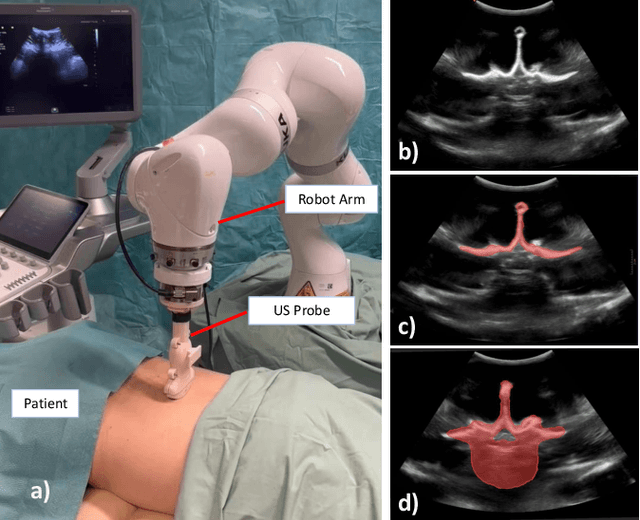
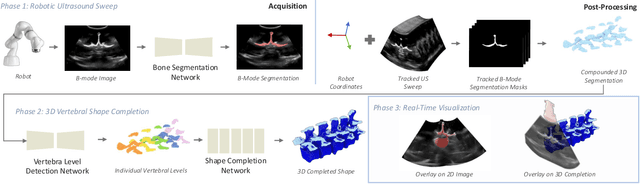
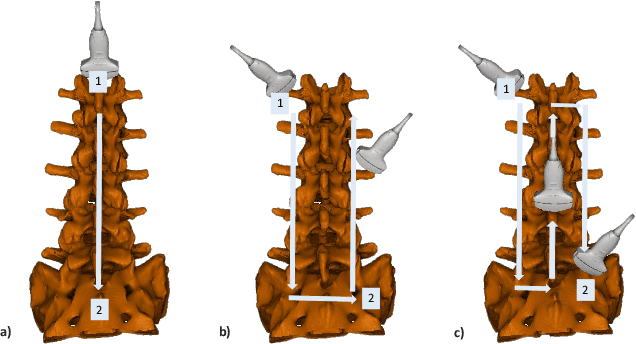
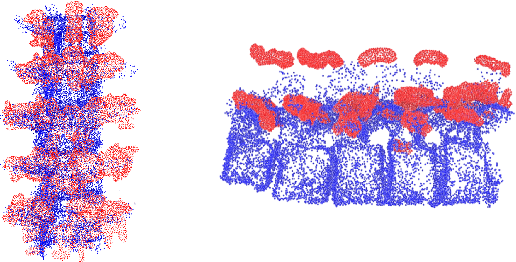
Ultrasound (US) imaging is increasingly used in spinal procedures due to its real-time, radiation-free capabilities; however, its effectiveness is hindered by shadowing artifacts that obscure deeper tissue structures. Traditional approaches, such as CT-to-US registration, incorporate anatomical information from preoperative CT scans to guide interventions, but they are limited by complex registration requirements, differences in spine curvature, and the need for recent CT imaging. Recent shape completion methods can offer an alternative by reconstructing spinal structures in US data, while being pretrained on large set of publicly available CT scans. However, these approaches are typically offline and have limited reproducibility. In this work, we introduce a novel integrated system that combines robotic ultrasound with real-time shape completion to enhance spinal visualization. Our robotic platform autonomously acquires US sweeps of the lumbar spine, extracts vertebral surfaces from ultrasound, and reconstructs the complete anatomy using a deep learning-based shape completion network. This framework provides interactive, real-time visualization with the capability to autonomously repeat scans and can enable navigation to target locations. This can contribute to better consistency, reproducibility, and understanding of the underlying anatomy. We validate our approach through quantitative experiments assessing shape completion accuracy and evaluations of multiple spine acquisition protocols on a phantom setup. Additionally, we present qualitative results of the visualization on a volunteer scan.
Deep Spectral Methods for Unsupervised Ultrasound Image Interpretation
Aug 04, 2024Ultrasound imaging is challenging to interpret due to non-uniform intensities, low contrast, and inherent artifacts, necessitating extensive training for non-specialists. Advanced representation with clear tissue structure separation could greatly assist clinicians in mapping underlying anatomy and distinguishing between tissue layers. Decomposing an image into semantically meaningful segments is mainly achieved using supervised segmentation algorithms. Unsupervised methods are beneficial, as acquiring large labeled datasets is difficult and costly, but despite their advantages, they still need to be explored in ultrasound. This paper proposes a novel unsupervised deep learning strategy tailored to ultrasound to obtain easily interpretable tissue separations. We integrate key concepts from unsupervised deep spectral methods, which combine spectral graph theory with deep learning methods. We utilize self-supervised transformer features for spectral clustering to generate meaningful segments based on ultrasound-specific metrics and shape and positional priors, ensuring semantic consistency across the dataset. We evaluate our unsupervised deep learning strategy on three ultrasound datasets, showcasing qualitative results across anatomical contexts without label requirements. We also conduct a comparative analysis against other clustering algorithms to demonstrate superior segmentation performance, boundary preservation, and label consistency.
Diffusion as Sound Propagation: Physics-inspired Model for Ultrasound Image Generation
Jul 07, 2024
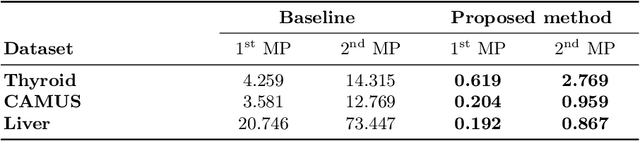
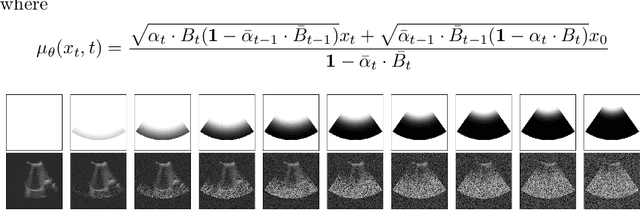
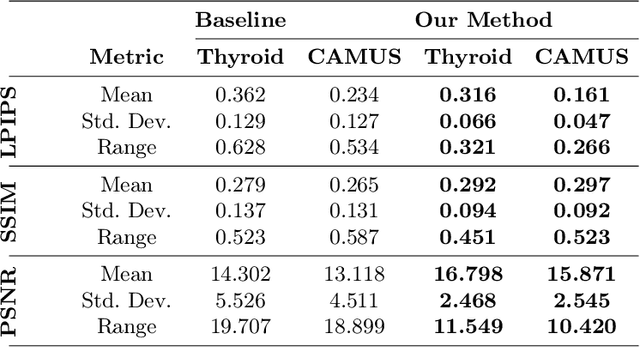
Deep learning (DL) methods typically require large datasets to effectively learn data distributions. However, in the medical field, data is often limited in quantity, and acquiring labeled data can be costly. To mitigate this data scarcity, data augmentation techniques are commonly employed. Among these techniques, generative models play a pivotal role in expanding datasets. However, when it comes to ultrasound (US) imaging, the authenticity of generated data often diminishes due to the oversight of ultrasound physics. We propose a novel approach to improve the quality of generated US images by introducing a physics-based diffusion model that is specifically designed for this image modality. The proposed model incorporates an US-specific scheduler scheme that mimics the natural behavior of sound wave propagation in ultrasound imaging. Our analysis demonstrates how the proposed method aids in modeling the attenuation dynamics in US imaging. We present both qualitative and quantitative results based on standard generative model metrics, showing that our proposed method results in overall more plausible images. Our code is available at https://github.com/marinadominguez/diffusion-for-us-images
Shape Completion in the Dark: Completing Vertebrae Morphology from 3D Ultrasound
Apr 11, 2024Purpose: Ultrasound (US) imaging, while advantageous for its radiation-free nature, is challenging to interpret due to only partially visible organs and a lack of complete 3D information. While performing US-based diagnosis or investigation, medical professionals therefore create a mental map of the 3D anatomy. In this work, we aim to replicate this process and enhance the visual representation of anatomical structures. Methods: We introduce a point-cloud-based probabilistic DL method to complete occluded anatomical structures through 3D shape completion and choose US-based spine examinations as our application. To enable training, we generate synthetic 3D representations of partially occluded spinal views by mimicking US physics and accounting for inherent artifacts. Results: The proposed model performs consistently on synthetic and patient data, with mean and median differences of 2.02 and 0.03 in CD, respectively. Our ablation study demonstrates the importance of US physics-based data generation, reflected in the large mean and median difference of 11.8 CD and 9.55 CD, respectively. Additionally, we demonstrate that anatomic landmarks, such as the spinous process (with reconstruction CD of 4.73) and the facet joints (mean distance to GT of 4.96mm) are preserved in the 3D completion. Conclusion: Our work establishes the feasibility of 3D shape completion for lumbar vertebrae, ensuring the preservation of level-wise characteristics and successful generalization from synthetic to real data. The incorporation of US physics contributes to more accurate patient data completions. Notably, our method preserves essential anatomic landmarks and reconstructs crucial injections sites at their correct locations. The generated data and source code will be made publicly available (https://github.com/miruna20/Shape-Completion-in-the-Dark).