 Add to Chrome
 Add to Firefox
 Add to Edge
Point Cloud Registration
Papers and Code
Mining and Transferring Feature-Geometry Coherence for Unsupervised Point Cloud Registration
Nov 04, 2024

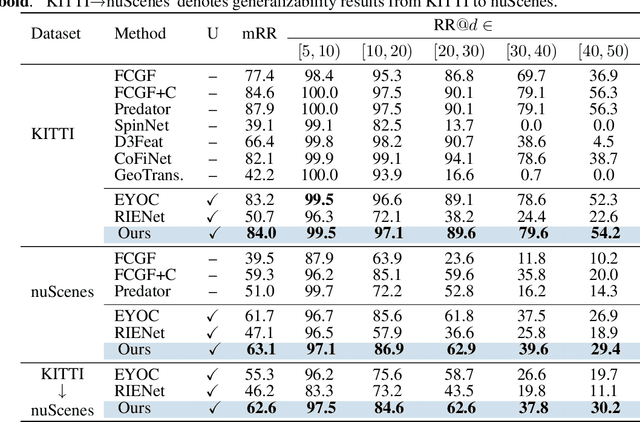

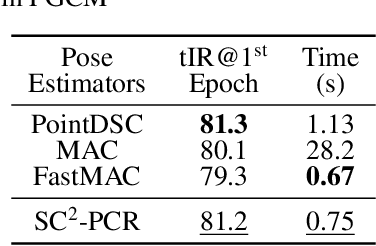
Point cloud registration, a fundamental task in 3D vision, has achieved remarkable success with learning-based methods in outdoor environments. Unsupervised outdoor point cloud registration methods have recently emerged to circumvent the need for costly pose annotations. However, they fail to establish reliable optimization objectives for unsupervised training, either relying on overly strong geometric assumptions, or suffering from poor-quality pseudo-labels due to inadequate integration of low-level geometric and high-level contextual information. We have observed that in the feature space, latent new inlier correspondences tend to cluster around respective positive anchors that summarize features of existing inliers. Motivated by this observation, we propose a novel unsupervised registration method termed INTEGER to incorporate high-level contextual information for reliable pseudo-label mining. Specifically, we propose the Feature-Geometry Coherence Mining module to dynamically adapt the teacher for each mini-batch of data during training and discover reliable pseudo-labels by considering both high-level feature representations and low-level geometric cues. Furthermore, we propose Anchor-Based Contrastive Learning to facilitate contrastive learning with anchors for a robust feature space. Lastly, we introduce a Mixed-Density Student to learn density-invariant features, addressing challenges related to density variation and low overlap in the outdoor scenario. Extensive experiments on KITTI and nuScenes datasets demonstrate that our INTEGER achieves competitive performance in terms of accuracy and generalizability.

A Novel Streamline-based diffusion MRI Tractography Registration Method with Probabilistic Keypoint Detection
Mar 04, 2025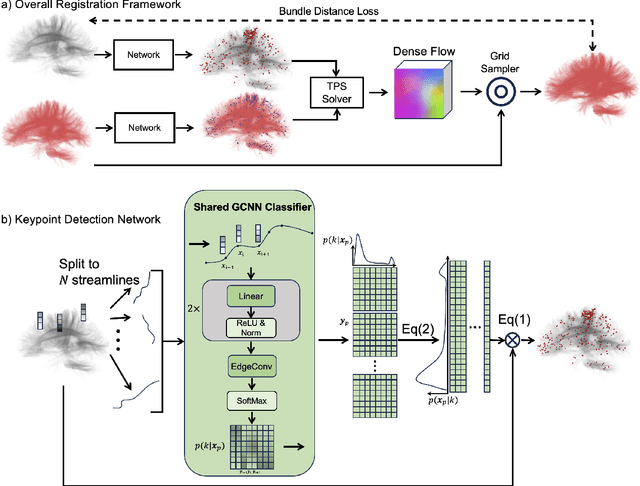
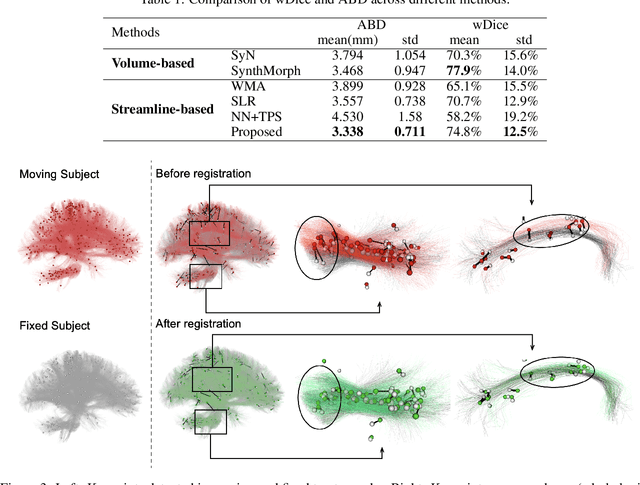
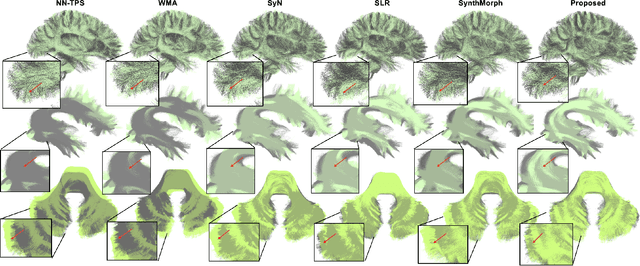
Registration of diffusion MRI tractography is an essential step for analyzing group similarities and variations in the brain's white matter (WM). Streamline-based registration approaches can leverage the 3D geometric information of fiber pathways to enable spatial alignment after registration. Existing methods usually rely on the optimization of the spatial distances to identify the optimal transformation. However, such methods overlook point connectivity patterns within the streamline itself, limiting their ability to identify anatomical correspondences across tractography datasets. In this work, we propose a novel unsupervised approach using deep learning to perform streamline-based dMRI tractography registration. The overall idea is to identify corresponding keypoint pairs across subjects for spatial alignment of tractography datasets. We model tractography as point clouds to leverage the graph connectivity along streamlines. We propose a novel keypoint detection method for streamlines, framed as a probabilistic classification task to identify anatomically consistent correspondences across unstructured streamline sets. In the experiments, we compare several existing methods and show highly effective and efficient tractography registration performance.
Memory-Efficient Point Cloud Registration via Overlapping Region Sampling
Oct 29, 2024Recent advances in deep learning have improved 3D point cloud registration but increased graphics processing unit (GPU) memory usage, often requiring preliminary sampling that reduces accuracy. We propose an overlapping region sampling method to reduce memory usage while maintaining accuracy. Our approach estimates the overlapping region and intensively samples from it, using a k-nearest-neighbor (kNN) based point compression mechanism with multi layer perceptron (MLP) and transformer architectures. Evaluations on 3DMatch and 3DLoMatch datasets show our method outperforms other sampling methods in registration recall, especially at lower GPU memory levels. For 3DMatch, we achieve 94% recall with 33% reduced memory usage, with greater advantages in 3DLoMatch. Our method enables efficient large-scale point cloud registration in resource-constrained environments, maintaining high accuracy while significantly reducing memory requirements.
Spatial regularisation for improved accuracy and interpretability in keypoint-based registration
Mar 07, 2025Unsupervised registration strategies bypass requirements in ground truth transforms or segmentations by optimising similarity metrics between fixed and moved volumes. Among these methods, a recent subclass of approaches based on unsupervised keypoint detection stand out as very promising for interpretability. Specifically, these methods train a network to predict feature maps for fixed and moving images, from which explainable centres of mass are computed to obtain point clouds, that are then aligned in closed-form. However, the features returned by the network often yield spatially diffuse patterns that are hard to interpret, thus undermining the purpose of keypoint-based registration. Here, we propose a three-fold loss to regularise the spatial distribution of the features. First, we use the KL divergence to model features as point spread functions that we interpret as probabilistic keypoints. Then, we sharpen the spatial distributions of these features to increase the precision of the detected landmarks. Finally, we introduce a new repulsive loss across keypoints to encourage spatial diversity. Overall, our loss considerably improves the interpretability of the features, which now correspond to precise and anatomically meaningful landmarks. We demonstrate our three-fold loss in foetal rigid motion tracking and brain MRI affine registration tasks, where it not only outperforms state-of-the-art unsupervised strategies, but also bridges the gap with state-of-the-art supervised methods. Our code is available at https://github.com/BenBillot/spatial_regularisation.
AKF-LIO: LiDAR-Inertial Odometry with Gaussian Map by Adaptive Kalman Filter
Mar 10, 2025Existing LiDAR-Inertial Odometry (LIO) systems typically use sensor-specific or environment-dependent measurement covariances during state estimation, leading to laborious parameter tuning and suboptimal performance in challenging conditions (e.g., sensor degeneracy and noisy observations). Therefore, we propose an Adaptive Kalman Filter (AKF) framework that dynamically estimates time-varying noise covariances of LiDAR and Inertial Measurement Unit (IMU) measurements, enabling context-aware confidence weighting between sensors. During LiDAR degeneracy, the system prioritizes IMU data while suppressing contributions from unreliable inputs like moving objects or noisy point clouds. Furthermore, a compact Gaussian-based map representation is introduced to model environmental planarity and spatial noise. A correlated registration strategy ensures accurate plane normal estimation via pseudo-merge, even in unstructured environments like forests. Extensive experiments validate the robustness of the proposed system across diverse environments, including dynamic scenes and geometrically degraded scenarios. Our method achieves reliable localization results across all MARS-LVIG sequences and ranks 8th on the KITTI Odometry Benchmark. The code will be released at https://github.com/xpxie/AKF-LIO.git.
A Real-time Degeneracy Sensing and Compensation Method for Enhanced LiDAR SLAM
Dec 10, 2024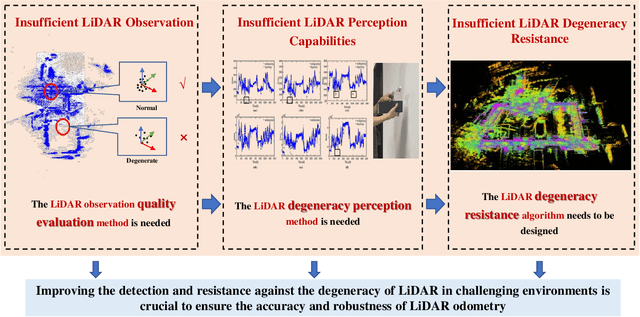
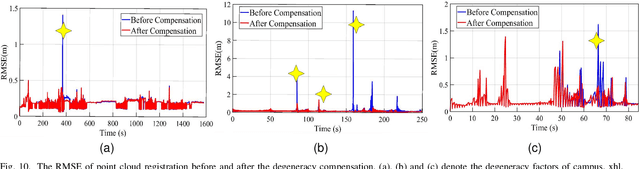
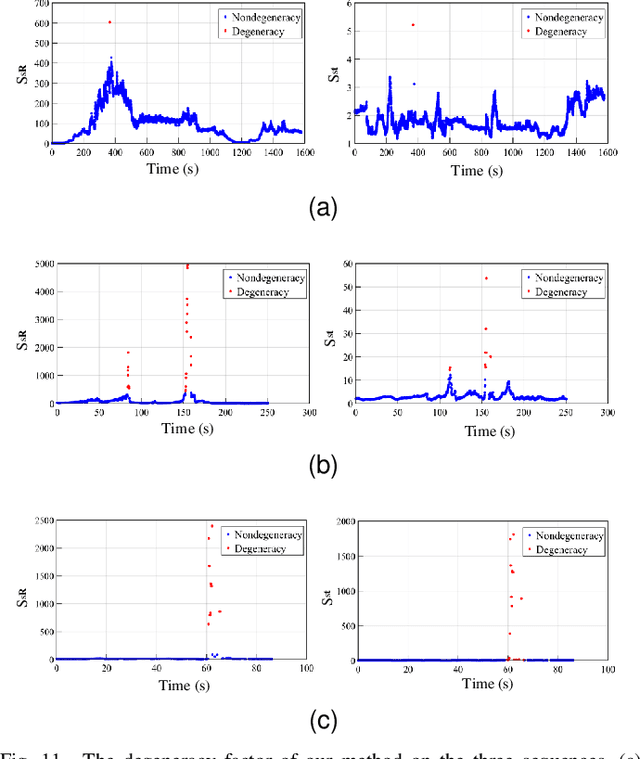
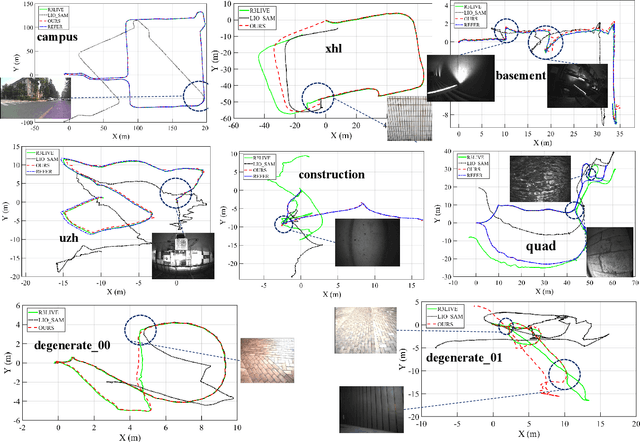
LiDAR is widely used in Simultaneous Localization and Mapping (SLAM) and autonomous driving. The LiDAR odometry is of great importance in multi-sensor fusion. However, in some unstructured environments, the point cloud registration cannot constrain the poses of the LiDAR due to its sparse geometric features, which leads to the degeneracy of multi-sensor fusion accuracy. To address this problem, we propose a novel real-time approach to sense and compensate for the degeneracy of LiDAR. Firstly, this paper introduces the degeneracy factor with clear meaning, which can measure the degeneracy of LiDAR. Then, the Density-Based Spatial Clustering of Applications with Noise (DBSCAN) clustering method adaptively perceives the degeneracy with better environmental generalization. Finally, the degeneracy perception results are utilized to fuse LiDAR and IMU, thus effectively resisting degeneracy effects. Experiments on our dataset show the method's high accuracy and robustness and validate our algorithm's adaptability to different environments and LiDAR scanning modalities.
UniRiT: Towards Few-Shot Non-Rigid Point Cloud Registration
Oct 30, 2024Non-rigid point cloud registration is a critical challenge in 3D scene understanding, particularly in surgical navigation. Although existing methods achieve excellent performance when trained on large-scale, high-quality datasets, these datasets are prohibitively expensive to collect and annotate, e.g., organ data in authentic medical scenarios. With insufficient training samples and data noise, existing methods degrade significantly since non-rigid patterns are more flexible and complicated than rigid ones, and the distributions across samples are more distinct, leading to higher difficulty in representation learning with few data. In this work, we aim to deal with this challenging few-shot non-rigid point cloud registration problem. Based on the observation that complex non-rigid transformation patterns can be decomposed into rigid and small non-rigid transformations, we propose a novel and effective framework, UniRiT. UniRiT adopts a two-step registration strategy that first aligns the centroids of the source and target point clouds and then refines the registration with non-rigid transformations, thereby significantly reducing the problem complexity. To validate the performance of UniRiT on real-world datasets, we introduce a new dataset, MedMatch3D, which consists of real human organs and exhibits high variability in sample distribution. We further establish a new challenging benchmark for few-shot non-rigid registration. Extensive empirical results demonstrate that UniRiT achieves state-of-the-art performance on MedMatch3D, improving the existing best approach by 94.22%.
XR-MBT: Multi-modal Full Body Tracking for XR through Self-Supervision with Learned Depth Point Cloud Registration
Nov 27, 2024


Tracking the full body motions of users in XR (AR/VR) devices is a fundamental challenge to bring a sense of authentic social presence. Due to the absence of dedicated leg sensors, currently available body tracking methods adopt a synthesis approach to generate plausible motions given a 3-point signal from the head and controller tracking. In order to enable mixed reality features, modern XR devices are capable of estimating depth information of the headset surroundings using available sensors combined with dedicated machine learning models. Such egocentric depth sensing cannot drive the body directly, as it is not registered and is incomplete due to limited field-of-view and body self-occlusions. For the first time, we propose to leverage the available depth sensing signal combined with self-supervision to learn a multi-modal pose estimation model capable of tracking full body motions in real time on XR devices. We demonstrate how current 3-point motion synthesis models can be extended to point cloud modalities using a semantic point cloud encoder network combined with a residual network for multi-modal pose estimation. These modules are trained jointly in a self-supervised way, leveraging a combination of real unregistered point clouds and simulated data obtained from motion capture. We compare our approach against several state-of-the-art systems for XR body tracking and show that our method accurately tracks a diverse range of body motions. XR-MBT tracks legs in XR for the first time, whereas traditional synthesis approaches based on partial body tracking are blind.
Micro-Structures Graph-Based Point Cloud Registration for Balancing Efficiency and Accuracy
Oct 29, 2024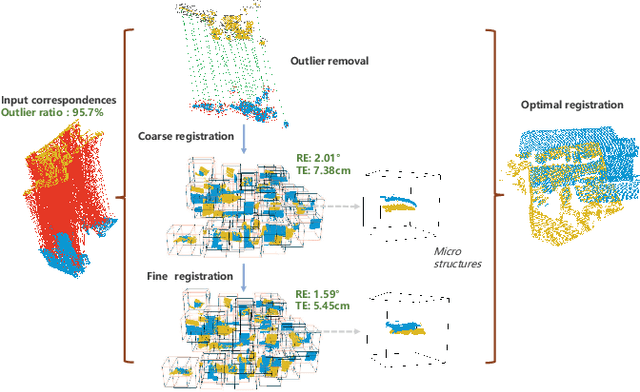
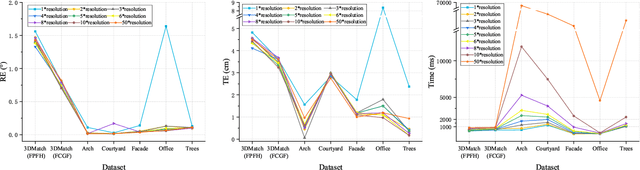

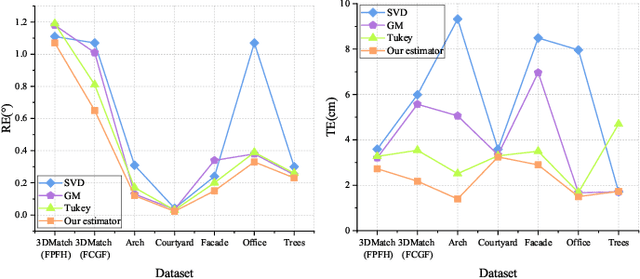
Point Cloud Registration (PCR) is a fundamental and significant issue in photogrammetry and remote sensing, aiming to seek the optimal rigid transformation between sets of points. Achieving efficient and precise PCR poses a considerable challenge. We propose a novel micro-structures graph-based global point cloud registration method. The overall method is comprised of two stages. 1) Coarse registration (CR): We develop a graph incorporating micro-structures, employing an efficient graph-based hierarchical strategy to remove outliers for obtaining the maximal consensus set. We propose a robust GNC-Welsch estimator for optimization derived from a robust estimator to the outlier process in the Lie algebra space, achieving fast and robust alignment. 2) Fine registration (FR): To refine local alignment further, we use the octree approach to adaptive search plane features in the micro-structures. By minimizing the distance from the point-to-plane, we can obtain a more precise local alignment, and the process will also be addressed effectively by being treated as a planar adjustment algorithm combined with Anderson accelerated optimization (PA-AA). After extensive experiments on real data, our proposed method performs well on the 3DMatch and ETH datasets compared to the most advanced methods, achieving higher accuracy metrics and reducing the time cost by at least one-third.
PointVoxelFormer -- Reviving point cloud networks for 3D medical imaging
Dec 23, 2024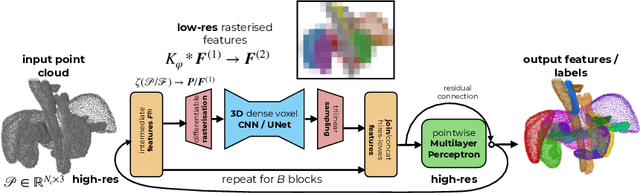
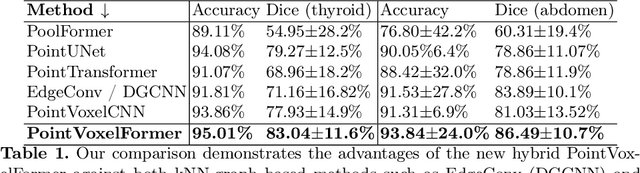
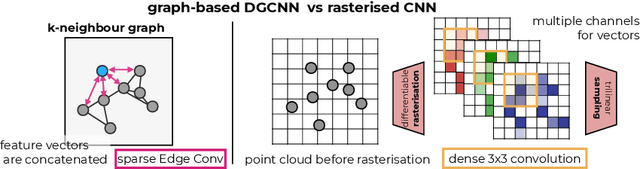

Point clouds are a very efficient way to represent volumetric data in medical imaging. First, they do not occupy resources for empty spaces and therefore can avoid trade-offs between resolution and field-of-view for voxel-based 3D convolutional networks (CNNs) - leading to smaller and robust models. Second, they provide a modality agnostic representation of anatomical surfaces and shapes to avoid domain gaps for generic geometric models. Third, they remove identifiable patient-specific information and may increase privacy preservation when publicly sharing data. Despite their benefits, point clouds are still underexplored in medical imaging compared to volumetric 3D CNNs and vision transformers. To date both datasets and stringent studies on comparative strengths and weaknesses of methodological choices are missing. Interactions and information exchange of spatially close points - e.g. through k-nearest neighbour graphs in edge convolutions or point transformations - within points clouds are crucial for learning geometrically meaningful features but may incur computational bottlenecks. This work presents a hybrid approach that combines point-wise operations with intermediate differentiable rasterisation and dense localised CNNs. For deformable point cloud registration, we devise an early fusion scheme for coordinate features that joins both clouds within a common reference frame and is coupled with an inverse consistent, two-step alignment architecture. Our extensive experiments on three different datasets for segmentation and registration demonstrate that our method, PointVoxelFormer, enables very compact models that excel with threefold speed-ups, fivefold memory reduction and over 30% registration error reduction against edge convolutions and other state-of-the-art models in geometric deep learning.