 Add to Chrome
 Add to Firefox
 Add to Edge
openbookqa
Papers and Code
UrduBench: An Urdu Reasoning Benchmark using Contextually Ensembled Translations with Human-in-the-Loop
Jan 28, 2026
Recent advances in large language models (LLMs) have led to strong reasoning capabilities; however, evaluating such models in low-resource languages remains challenging due to the lack of standardized benchmarks. In particular, Urdu reasoning evaluation has been limited by the sensitivity of machine translation and an emphasis on general language tasks rather than reasoning benchmarks. In this paper, we propose a contextually ensembled translation framework with human-in-the-loop validation that leverages multiple translation systems to develop Urdu reasoning benchmarks while preserving contextual and structural integrity. Using this framework, we translate widely adopted reasoning and question-answering benchmarks, including MGSM, MATH-500, CommonSenseQA, and OpenBookQA, into Urdu, collectively referred to as UrduBench, and conduct a comprehensive evaluation of both reasoning-oriented and instruction-tuned LLMs across multiple prompting strategies. Our analysis reveals performance differences across (1) four datasets, (2) five task difficulty levels, (3) diverse model architectures, (4) multiple model scaling settings, and (5) language consistency tests. We find that multi-step and symbolic reasoning tasks pose significant challenges in Urdu, and that stable language alignment is a critical prerequisite for robust reasoning. Overall, our work establishes a scalable methodology for standardized reasoning evaluation in Urdu and provides empirical insights into multilingual reasoning failures. This experimental setup is also broadly applicable to other low-resource languages. The code and datasets will be publicly released.

STEM: Scaling Transformers with Embedding Modules
Jan 15, 2026Fine-grained sparsity promises higher parametric capacity without proportional per-token compute, but often suffers from training instability, load balancing, and communication overhead. We introduce STEM (Scaling Transformers with Embedding Modules), a static, token-indexed approach that replaces the FFN up-projection with a layer-local embedding lookup while keeping the gate and down-projection dense. This removes runtime routing, enables CPU offload with asynchronous prefetch, and decouples capacity from both per-token FLOPs and cross-device communication. Empirically, STEM trains stably despite extreme sparsity. It improves downstream performance over dense baselines while reducing per-token FLOPs and parameter accesses (eliminating roughly one-third of FFN parameters). STEM learns embedding spaces with large angular spread which enhances its knowledge storage capacity. More interestingly, this enhanced knowledge capacity comes with better interpretability. The token-indexed nature of STEM embeddings allows simple ways to perform knowledge editing and knowledge injection in an interpretable manner without any intervention in the input text or additional computation. In addition, STEM strengthens long-context performance: as sequence length grows, more distinct parameters are activated, yielding practical test-time capacity scaling. Across 350M and 1B model scales, STEM delivers up to ~3--4% accuracy improvements overall, with notable gains on knowledge and reasoning-heavy benchmarks (ARC-Challenge, OpenBookQA, GSM8K, MMLU). Overall, STEM is an effective way of scaling parametric memory while providing better interpretability, better training stability and improved efficiency.
Learning to Reason in LLMs by Expectation Maximization
Dec 23, 2025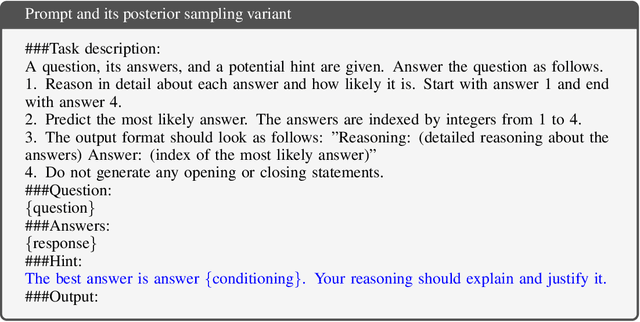
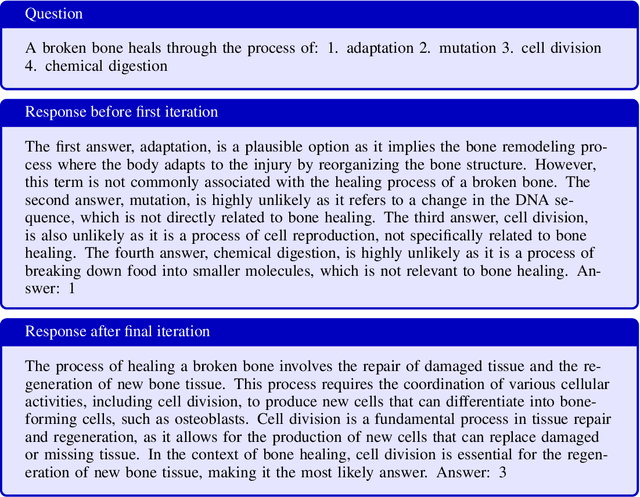
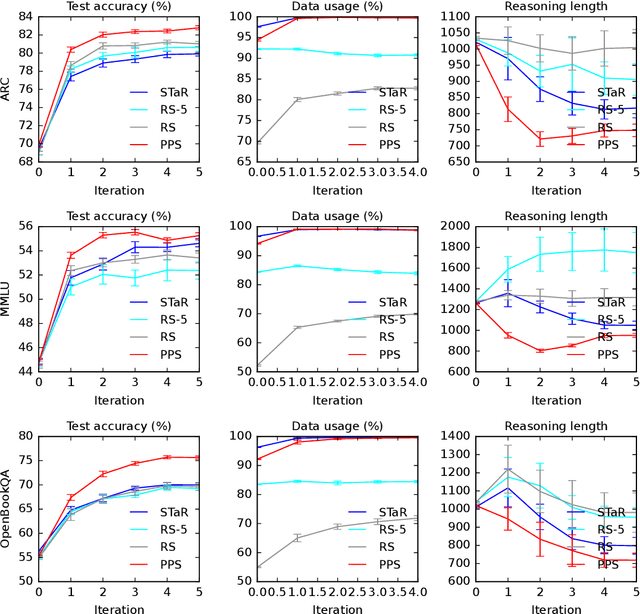
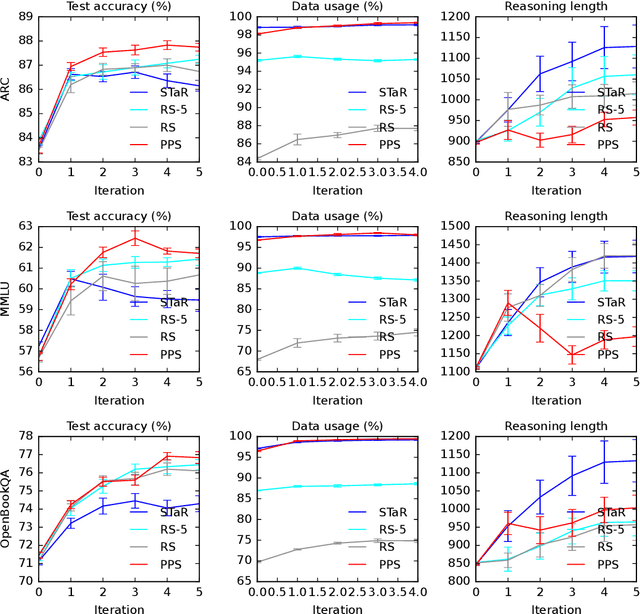
Large language models (LLMs) solve reasoning problems by first generating a rationale and then answering. We formalize reasoning as a latent variable model and derive an expectation-maximization (EM) objective for learning to reason. This view connects EM and modern reward-based optimization, and shows that the main challenge lies in designing a sampling distribution that generates rationales that justify correct answers. We instantiate and compare several sampling schemes: rejection sampling with a budget, self-taught reasoner (STaR), and prompt posterior sampling (PPS), which only keeps the rationalization stage of STaR. Our experiments on the ARC, MMLU, and OpenBookQA datasets with the Llama and Qwen models show that the sampling scheme can significantly affect the accuracy of learned reasoning models. Despite its simplicity, we observe that PPS outperforms the other sampling schemes.
LLMCache: Layer-Wise Caching Strategies for Accelerated Reuse in Transformer Inference
Dec 18, 2025Transformer-based language models have achieved remarkable performance across a wide range of tasks, yet their high inference latency poses a significant challenge for real-timeand large-scale deployment. While existing caching mechanisms,such as token-level key-value caches, offer speedups in autore-gressive decoding, they are limited in scope and applicability. In this paper, we present LLMCache, a novel layer-wise caching framework that accelerates transformer inference by reusing intermediate activations based on semantic similarity of input sequences. Unlike prior work, LLMCache is model-agnostic,operates across both encoder and decoder architectures, and supports caching at arbitrary transformer layers. We introduce a lightweight fingerprinting mechanism for matching seman-tically similar inputs and propose adaptive eviction strategies to manage cache staleness. Experiments on BERT and GPT-2 across SQuAD, WikiText-103, and OpenBookQA show up to 3.1 X speedup in inference time with <0.5% accuracy degradation. Our results highlight LLMCache as a practical and general-purpose solution for optimizing transformer inference in real-world applications
Low-Rank Compression of Language Models via Differentiable Rank Selection
Dec 14, 2025
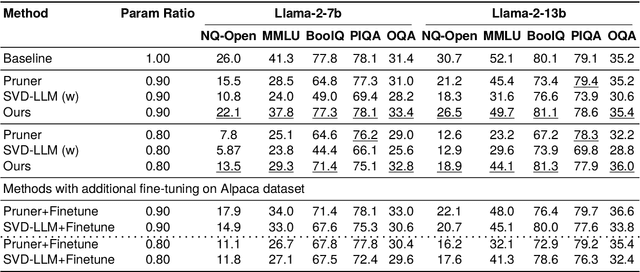
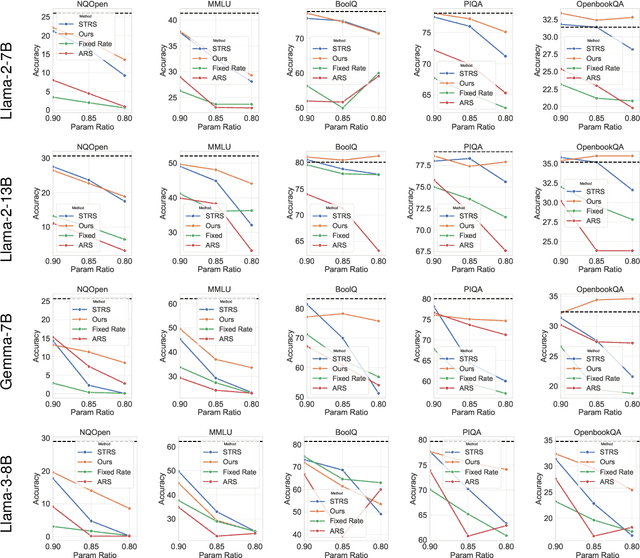

Approaches for compressing large-language models using low-rank decomposition have made strides, particularly with the introduction of activation and loss-aware SVD, which improves the trade-off between decomposition rank and downstream task performance. Despite these advancements, a persistent challenge remains--selecting the optimal ranks for each layer to jointly optimise compression rate and downstream task accuracy. Current methods either rely on heuristics that can yield sub-optimal results due to their limited discrete search space or are gradient-based but are not as performant as heuristic approaches without post-compression fine-tuning. To address these issues, we propose Learning to Low-Rank Compress (LLRC), a gradient-based approach which directly learns the weights of masks that select singular values in a fine-tuning-free setting. Using a calibration dataset, we train only the mask weights to select fewer and fewer singular values while minimising the divergence of intermediate activations from the original model. Our approach outperforms competing ranking selection methods that similarly require no post-compression fine-tuning across various compression rates on common-sense reasoning and open-domain question-answering tasks. For instance, with a compression rate of 20% on Llama-2-13B, LLRC outperforms the competitive Sensitivity-based Truncation Rank Searching (STRS) on MMLU, BoolQ, and OpenbookQA by 12%, 3.5%, and 4.4%, respectively. Compared to other compression techniques, our approach consistently outperforms fine-tuning-free variants of SVD-LLM and LLM-Pruner across datasets and compression rates. Our fine-tuning-free approach also performs competitively with the fine-tuning variant of LLM-Pruner.
Range Asymmetric Numeral Systems-Based Lightweight Intermediate Feature Compression for Split Computing of Deep Neural Networks
Nov 11, 2025Split computing distributes deep neural network inference between resource-constrained edge devices and cloud servers but faces significant communication bottlenecks when transmitting intermediate features. To this end, in this paper, we propose a novel lightweight compression framework that leverages Range Asymmetric Numeral Systems (rANS) encoding with asymmetric integer quantization and sparse tensor representation to reduce transmission overhead dramatically. Specifically, our approach combines asymmetric integer quantization with a sparse representation technique, eliminating the need for complex probability modeling or network modifications. The key contributions include: (1) a distribution-agnostic compression pipeline that exploits inherent tensor sparsity to achieve bandwidth reduction with minimal computational overhead; (2) an approximate theoretical model that optimizes tensor reshaping dimensions to maximize compression efficiency; and (3) a GPU-accelerated implementation with sub-millisecond encoding/decoding latency. Extensive evaluations across diverse neural architectures (ResNet, VGG16, MobileNetV2, SwinT, DenseNet121, EfficientNetB0) demonstrate that the proposed framework consistently maintains near-baseline accuracy across CIFAR100 and ImageNet benchmarks. Moreover, we validated the framework's effectiveness on advanced natural language processing tasks by employing Llama2 7B and 13B on standard benchmarks such as MMLU, HellaSwag, ARC, PIQA, Winogrande, BoolQ, and OpenBookQA, demonstrating its broad applicability beyond computer vision. Furthermore, this method addresses a fundamental bottleneck in deploying sophisticated artificial intelligence systems in bandwidth-constrained environments without compromising model performance.
In Case You Missed It: ARC 'Challenge' Is Not That Challenging
Dec 23, 2024ARC Challenge appears more difficult than ARC Easy for modern LLMs primarily due to an evaluation setup that prevents direct comparison of answer choices rather than inherent complexity. Although some researchers have quietly shifted to a more appropriate scheme over the last year, the implications of this change have yet to be widely acknowledged. We highlight this overlooked shift, show how similar evaluation practices falsely imply reasoning deficits in other benchmarks, and demonstrate that fairer methods dramatically reduce performance gaps (e.g. on SIQA) and even yield superhuman results (OpenBookQA). In doing so, we reveal how evaluation shapes perceived difficulty and offer guidelines to ensure that multiple-choice evaluations accurately reflect actual model capabilities.
LoRA Done RITE: Robust Invariant Transformation Equilibration for LoRA Optimization
Oct 27, 2024Low-rank adaption (LoRA) is a widely used parameter-efficient finetuning method for LLM that reduces memory requirements. However, current LoRA optimizers lack transformation invariance, meaning the actual updates to the weights depends on how the two LoRA factors are scaled or rotated. This deficiency leads to inefficient learning and sub-optimal solutions in practice. This paper introduces LoRA-RITE, a novel adaptive matrix preconditioning method for LoRA optimization, which can achieve transformation invariance and remain computationally efficient. We provide theoretical analysis to demonstrate the benefit of our method and conduct experiments on various LLM tasks with different models including Gemma 2B, 7B, and mT5-XXL. The results demonstrate consistent improvements against existing optimizers. For example, replacing Adam with LoRA-RITE during LoRA fine-tuning of Gemma-2B yielded 4.6\% accuracy gain on Super-Natural Instructions and 3.5\% accuracy gain across other four LLM benchmarks (HellaSwag, ArcChallenge, GSM8K, OpenBookQA).
G-SAP: Graph-based Structure-Aware Prompt Learning over Heterogeneous Knowledge for Commonsense Reasoning
May 09, 2024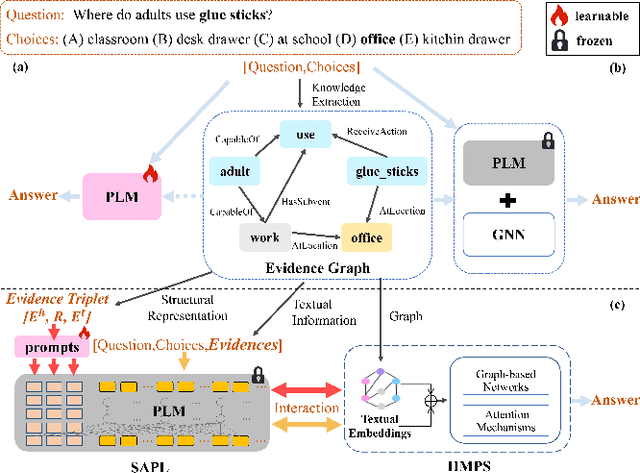
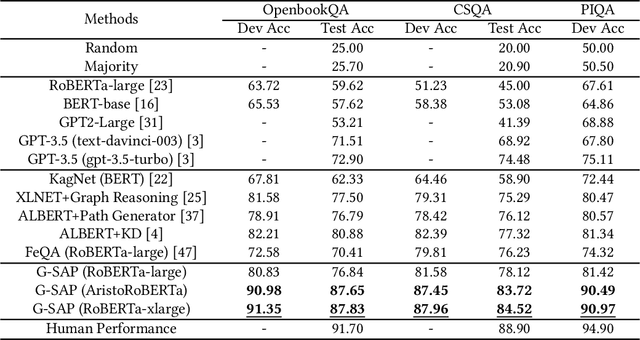
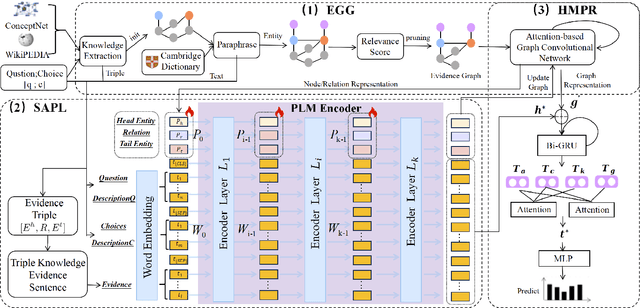
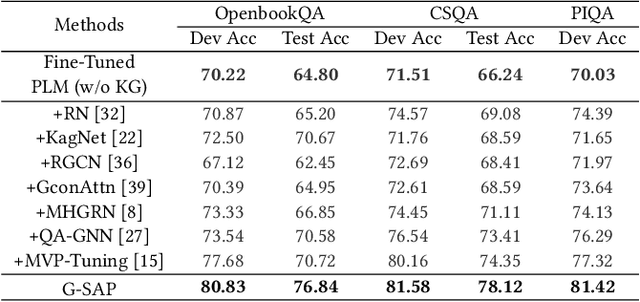
Commonsense question answering has demonstrated considerable potential across various applications like assistants and social robots. Although fully fine-tuned pre-trained Language Models(LM) have achieved remarkable performance in commonsense reasoning, their tendency to excessively prioritize textual information hampers the precise transfer of structural knowledge and undermines interpretability. Some studies have explored combining LMs with Knowledge Graphs(KGs) by coarsely fusing the two modalities to perform Graph Neural Network(GNN)-based reasoning that lacks a profound interaction between heterogeneous modalities. In this paper, we propose a novel Graph-based Structure-Aware Prompt Learning Model for commonsense reasoning, named G-SAP, aiming to maintain a balance between heterogeneous knowledge and enhance the cross-modal interaction within the LM+GNNs model. In particular, an evidence graph is constructed by integrating multiple knowledge sources, i.e. ConceptNet, Wikipedia, and Cambridge Dictionary to boost the performance. Afterward, a structure-aware frozen PLM is employed to fully incorporate the structured and textual information from the evidence graph, where the generation of prompts is driven by graph entities and relations. Finally, a heterogeneous message-passing reasoning module is used to facilitate deep interaction of knowledge between the LM and graph-based networks. Empirical validation, conducted through extensive experiments on three benchmark datasets, demonstrates the notable performance of the proposed model. The results reveal a significant advancement over the existing models, especially, with 6.12% improvement over the SoTA LM+GNNs model on the OpenbookQA dataset.
Retrieval is Accurate Generation
Feb 29, 2024
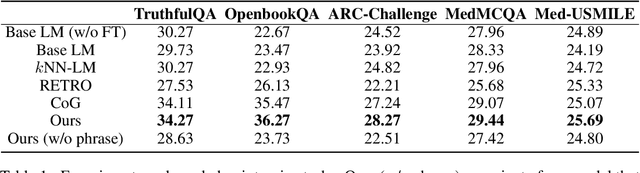


Standard language models generate text by selecting tokens from a fixed, finite, and standalone vocabulary. We introduce a novel method that selects context-aware phrases from a collection of supporting documents. One of the most significant challenges for this paradigm shift is determining the training oracles, because a string of text can be segmented in various ways and each segment can be retrieved from numerous possible documents. To address this, we propose to initialize the training oracles using linguistic heuristics and, more importantly, bootstrap the oracles through iterative self-reinforcement. Extensive experiments show that our model not only outperforms standard language models on a variety of knowledge-intensive tasks but also demonstrates improved generation quality in open-ended text generation. For instance, compared to the standard language model counterpart, our model raises the accuracy from 23.47% to 36.27% on OpenbookQA, and improves the MAUVE score from 42.61% to 81.58% in open-ended text generation. Remarkably, our model also achieves the best performance and the lowest latency among several retrieval-augmented baselines. In conclusion, we assert that retrieval is more accurate generation and hope that our work will encourage further research on this new paradigm shift.