 Add to Chrome
 Add to Firefox
 Add to Edge
UrduBench: An Urdu Reasoning Benchmark using Contextually Ensembled Translations with Human-in-the-Loop
Jan 28, 2026
Recent advances in large language models (LLMs) have led to strong reasoning capabilities; however, evaluating such models in low-resource languages remains challenging due to the lack of standardized benchmarks. In particular, Urdu reasoning evaluation has been limited by the sensitivity of machine translation and an emphasis on general language tasks rather than reasoning benchmarks. In this paper, we propose a contextually ensembled translation framework with human-in-the-loop validation that leverages multiple translation systems to develop Urdu reasoning benchmarks while preserving contextual and structural integrity. Using this framework, we translate widely adopted reasoning and question-answering benchmarks, including MGSM, MATH-500, CommonSenseQA, and OpenBookQA, into Urdu, collectively referred to as UrduBench, and conduct a comprehensive evaluation of both reasoning-oriented and instruction-tuned LLMs across multiple prompting strategies. Our analysis reveals performance differences across (1) four datasets, (2) five task difficulty levels, (3) diverse model architectures, (4) multiple model scaling settings, and (5) language consistency tests. We find that multi-step and symbolic reasoning tasks pose significant challenges in Urdu, and that stable language alignment is a critical prerequisite for robust reasoning. Overall, our work establishes a scalable methodology for standardized reasoning evaluation in Urdu and provides empirical insights into multilingual reasoning failures. This experimental setup is also broadly applicable to other low-resource languages. The code and datasets will be publicly released.

Spatio-temporal Crop Classification On Volumetric Data
Mar 18, 2021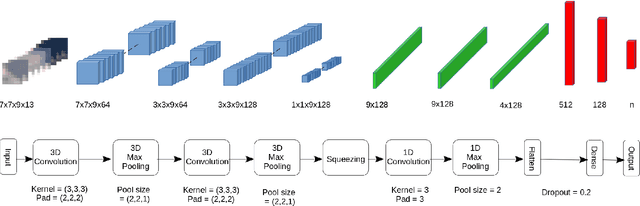
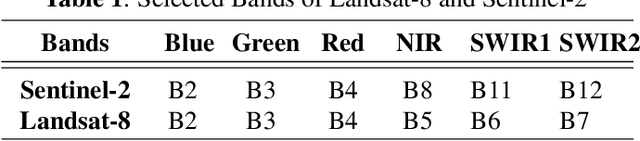
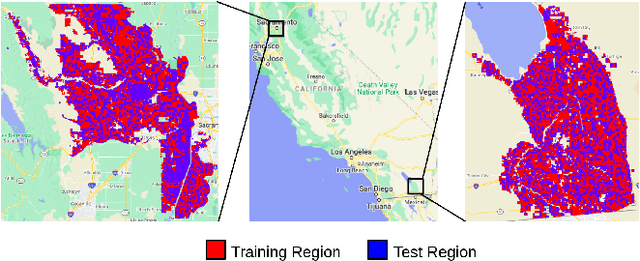
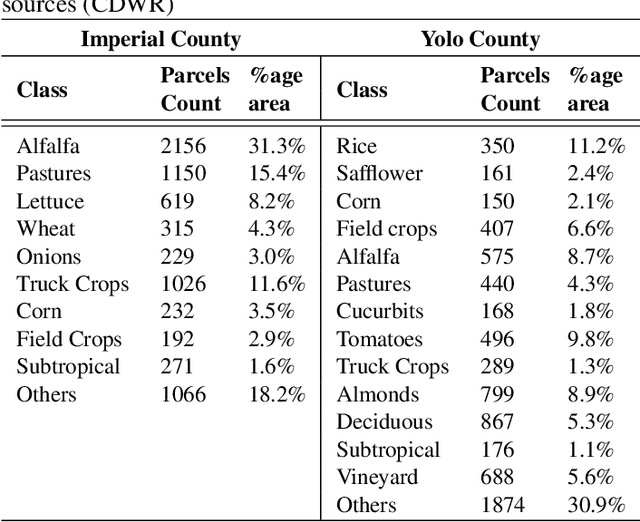
Large-area crop classification using multi-spectral imagery is a widely studied problem for several decades and is generally addressed using classical Random Forest classifier. Recently, deep convolutional neural networks (DCNN) have been proposed. However, these methods only achieved results comparable with Random Forest. In this work, we present a novel CNN based architecture for large-area crop classification. Our methodology combines both spatio-temporal analysis via 3D CNN as well as temporal analysis via 1D CNN. We evaluated the efficacy of our approach on Yolo and Imperial county benchmark datasets. Our combined strategy outperforms both classical as well as recent DCNN based methods in terms of classification accuracy by 2% while maintaining a minimum number of parameters and the lowest inference time.