 Add to Chrome
 Add to Firefox
 Add to Edge
Instance-Optimal Estimation with Multiple LLM Judges on a Budget
May 22, 2026
Evaluating large language models increasingly relies on LLM-as-a-judge protocols, but such evaluations remain costly: different judges have different prices and reliabilities, and the difficulty of each prompt-response pair can vary substantially. This raises a basic allocation question: under a fixed budget, how should one distribute evaluation queries across heterogeneous judges and instances to obtain the most accurate score estimates? We formalize this question as *budgeted heteroskedastic multi-judge estimation*. Given $K$ prompt-response pairs, $J$ judges with known costs, and unknown query-judge variances, the goal is to estimate a bounded score vector while minimizing an $\ell_p$-error. Our first contribution is to analyze the inverse-variance weighted estimator (IVWE) and to derive the oracle allocation that minimizes its error rate. Since this allocation depends on the unknown variances, we then address the practical unknown-variance setting by proposing EST-IVWE, an adaptive algorithm that constructs and leverages *optimistically biased* variance estimates to stabilize the empirical allocation. We prove that EST-IVWE matches the oracle IVWE rate up to lower-order terms in the budget. Our second and central theoretical contribution is a matching *local* minimax lower bound, which establishes the instance-optimality of the proposed algorithms. A key technical insight is that Fano-type high-probability arguments are too coarse for this problem: their packing construction loses the local variance structure that governs the optimal allocation. We instead use an Assouad-type in-expectation argument, based on local perturbations, which preserves this structure and yields the sharp allocation-dependent lower bound. Finally, we numerically validate the superiority of our approach over naïve uniform allocation on synthetic and HelpSteer2 datasets.

Ordering Matters: Rank-Aware Selective Fusion for Blended Emotion Recognition
May 20, 2026Blended emotion recognition is challenging because emotions are often expressed as mixtures of subtle and overlapping multimodal cues rather than a single dominant signal. We propose a rank-aware multi-encoder framework that selectively combines complementary representations from diverse pre-extracted video and audio encoders. Our method projects heterogeneous encoder features into a shared latent space, estimates sample-wise encoder importance through an attention-based gating module, and fuses only the top-n most informative encoders. To better model blended emotions, we decouple prediction into presence and salience heads and align them through probability-level fusion. We further incorporate feature-level unsupervised domain adaptation without pseudo-labeling to improve robustness under distribution shift. Experiments on the BlEmoRE challenge show that the proposed framework outperforms strong individual encoders and naïve multi-encoder fusion baselines. Our final system ranked 2nd in the competition, supporting the effectiveness of rank-aware selective fusion for fine-grained blended emotion recognition.
Random Is Hard to Beat: Active Selection in online DPO with Modern LLMs
Apr 03, 2026Modern LLMs inherit strong priors from web-scale pretraining, which can limit the headroom of post-training data-selection strategies. While Active Preference Learning (APL) seeks to optimize query efficiency in online Direct Preference Optimization (DPO), the inherent richness of on-policy candidate pools often renders simple Random sampling a surprisingly formidable baseline. We evaluate uncertainty-based APL against Random across harmlessness, helpfulness, and instruction-following settings, utilizing both reward models and LLM-as-a-judge proxies. We find that APL yields negligible improvements in proxy win-rates compared to Random. Crucially, we observe a dissociation where win-rate improves even as general capability -- measured by standard benchmarks -- degrades. APL fails to mitigate this capability collapse or reduce variance significantly better than random sampling. Our findings suggest that in the regime of strong pre-trained priors, the computational overhead of active selection is difficult to justify against the ``cheap diversity'' provided by simple random samples. Our code is available at https://github.com/BootsofLagrangian/random-vs-apl.
Regularized Online RLHF with Generalized Bilinear Preferences
Feb 26, 2026We consider the problem of contextual online RLHF with general preferences, where the goal is to identify the Nash Equilibrium. We adopt the Generalized Bilinear Preference Model (GBPM) to capture potentially intransitive preferences via low-rank, skew-symmetric matrices. We investigate general preference learning with any strongly convex regularizer (where $η^{-1}$ is the regularization strength), generalizing beyond prior works limited to reverse KL-regularization. Central to our analysis is proving that the dual gap of the greedy policy is bounded by the square of the estimation error - a result derived solely from strong convexity and the skew-symmetricity of GBPM.Building on this insight and a feature diversity assumption, we establish two regret bounds via two simple algorithms: (1) Greedy Sampling achieves polylogarithmic, $e^{O(η)}$-free regret $\tilde{O}(ηd^4 (\log T)^2)$. (2) Explore-Then-Commit achieves $\mathrm{poly}(d)$-free regret $\tilde{O}(\sqrt{ηr T})$ by exploiting the low-rank structure; this is the first statistically efficient guarantee for online RLHF in high-dimensions.
A Jointly Efficient and Optimal Algorithm for Heteroskedastic Generalized Linear Bandits with Adversarial Corruptions
Feb 11, 2026We consider the problem of heteroskedastic generalized linear bandits (GLBs) with adversarial corruptions, which subsumes various stochastic contextual bandit settings, including heteroskedastic linear bandits and logistic/Poisson bandits. We propose HCW-GLB-OMD, which consists of two components: an online mirror descent (OMD)-based estimator and Hessian-based confidence weights to achieve corruption robustness. This is computationally efficient in that it only requires ${O}(1)$ space and time complexity per iteration. Under the self-concordance assumption on the link function, we show a regret bound of $\tilde{O}\left( d \sqrt{\sum_t g(τ_t) \dotμ_{t,\star}} + d^2 g_{\max} κ+ d κC \right)$, where $\dotμ_{t,\star}$ is the slope of $μ$ around the optimal arm at time $t$, $g(τ_t)$'s are potentially exogenously time-varying dispersions (e.g., $g(τ_t) = σ_t^2$ for heteroskedastic linear bandits, $g(τ_t) = 1$ for Bernoulli and Poisson), $g_{\max} = \max_{t \in [T]} g(τ_t)$ is the maximum dispersion, and $C \geq 0$ is the total corruption budget of the adversary. We complement this with a lower bound of $\tildeΩ(d \sqrt{\sum_t g(τ_t) \dotμ_{t,\star}} + d C)$, unifying previous problem-specific lower bounds. Thus, our algorithm achieves, up to a $κ$-factor in the corruption term, instance-wise minimax optimality simultaneously across various instances of heteroskedastic GLBs with adversarial corruptions.
Learning to Reason in LLMs by Expectation Maximization
Dec 23, 2025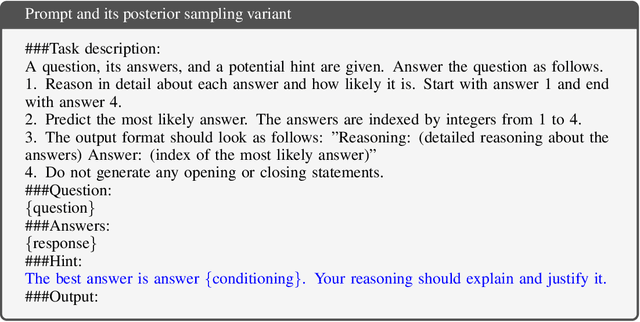

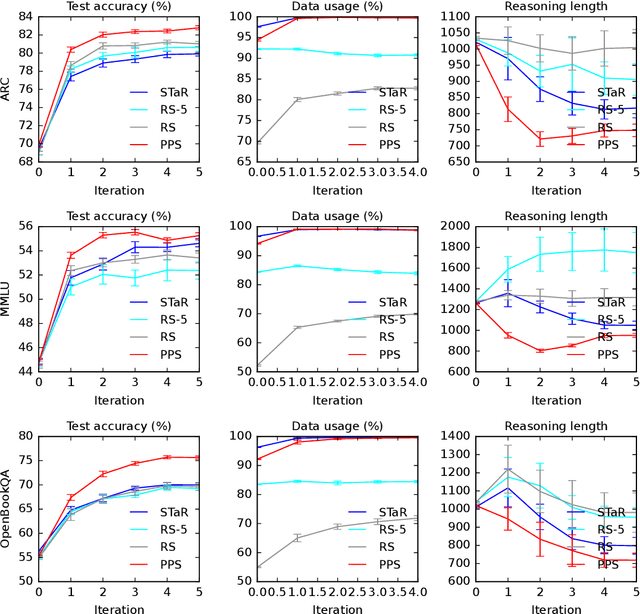
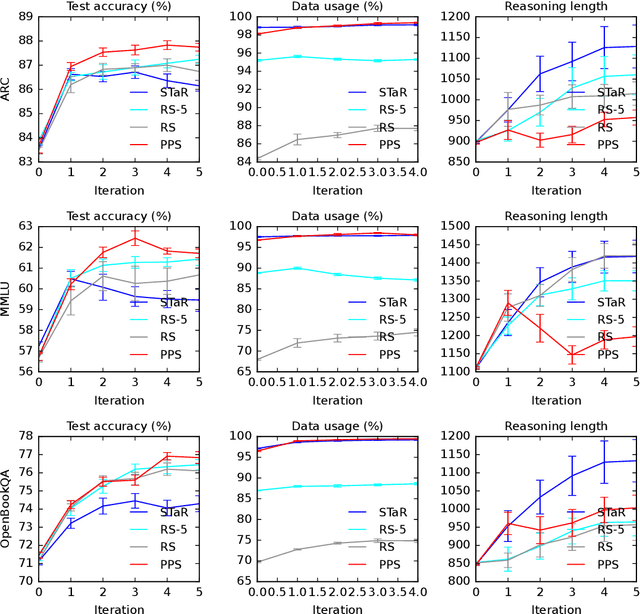
Large language models (LLMs) solve reasoning problems by first generating a rationale and then answering. We formalize reasoning as a latent variable model and derive an expectation-maximization (EM) objective for learning to reason. This view connects EM and modern reward-based optimization, and shows that the main challenge lies in designing a sampling distribution that generates rationales that justify correct answers. We instantiate and compare several sampling schemes: rejection sampling with a budget, self-taught reasoner (STaR), and prompt posterior sampling (PPS), which only keeps the rationalization stage of STaR. Our experiments on the ARC, MMLU, and OpenBookQA datasets with the Llama and Qwen models show that the sampling scheme can significantly affect the accuracy of learned reasoning models. Despite its simplicity, we observe that PPS outperforms the other sampling schemes.
AdaSTaR: Adaptive Data Sampling for Training Self-Taught Reasoners
May 22, 2025Self-Taught Reasoners (STaR), synonymously known as Rejection sampling Fine-Tuning (RFT), is an integral part of the training pipeline of self-improving reasoning Language Models (LMs). The self-improving mechanism often employs random observation (data) sampling. However, this results in trained observation imbalance; inefficiently over-training on solved examples while under-training on challenging ones. In response, we introduce Adaptive STaR (AdaSTaR), a novel algorithm that rectifies this by integrating two adaptive sampling principles: (1) Adaptive Sampling for Diversity: promoting balanced training across observations, and (2) Adaptive Sampling for Curriculum: dynamically adjusting data difficulty to match the model's evolving strength. Across six benchmarks, AdaSTaR achieves best test accuracy in all instances (6/6) and reduces training FLOPs by an average of 58.6% against an extensive list of baselines. These improvements in performance and efficiency generalize to different pre-trained LMs and larger models, paving the way for more efficient and effective self-improving LMs.
Probability-Flow ODE in Infinite-Dimensional Function Spaces
Mar 13, 2025Recent advances in infinite-dimensional diffusion models have demonstrated their effectiveness and scalability in function generation tasks where the underlying structure is inherently infinite-dimensional. To accelerate inference in such models, we derive, for the first time, an analog of the probability-flow ODE (PF-ODE) in infinite-dimensional function spaces. Leveraging this newly formulated PF-ODE, we reduce the number of function evaluations while maintaining sample quality in function generation tasks, including applications to PDEs.
FlickerFusion: Intra-trajectory Domain Generalizing Multi-Agent RL
Oct 21, 2024


Multi-agent reinforcement learning has demonstrated significant potential in addressing complex cooperative tasks across various real-world applications. However, existing MARL approaches often rely on the restrictive assumption that the number of entities (e.g., agents, obstacles) remains constant between training and inference. This overlooks scenarios where entities are dynamically removed or added during the inference trajectory -- a common occurrence in real-world environments like search and rescue missions and dynamic combat situations. In this paper, we tackle the challenge of intra-trajectory dynamic entity composition under zero-shot out-of-domain (OOD) generalization, where such dynamic changes cannot be anticipated beforehand. Our empirical studies reveal that existing MARL methods suffer significant performance degradation and increased uncertainty in these scenarios. In response, we propose FlickerFusion, a novel OOD generalization method that acts as a universally applicable augmentation technique for MARL backbone methods. Our results show that FlickerFusion not only achieves superior inference rewards but also uniquely reduces uncertainty vis-\`a-vis the backbone, compared to existing methods. For standardized evaluation, we introduce MPEv2, an enhanced version of Multi Particle Environments (MPE), consisting of 12 benchmarks. Benchmarks, implementations, and trained models are organized and open-sourced at flickerfusion305.github.io, accompanied by ample demo video renderings.
A Unified Confidence Sequence for Generalized Linear Models, with Applications to Bandits
Jul 19, 2024We present a unified likelihood ratio-based confidence sequence (CS) for any (self-concordant) generalized linear models (GLMs) that is guaranteed to be convex and numerically tight. We show that this is on par or improves upon known CSs for various GLMs, including Gaussian, Bernoulli, and Poisson. In particular, for the first time, our CS for Bernoulli has a poly(S)-free radius where S is the norm of the unknown parameter. Our first technical novelty is its derivation, which utilizes a time-uniform PAC-Bayesian bound with a uniform prior/posterior, despite the latter being a rather unpopular choice for deriving CSs. As a direct application of our new CS, we propose a simple and natural optimistic algorithm called OFUGLB applicable to any generalized linear bandits (GLB; Filippi et al. (2010)). Our analysis shows that the celebrated optimistic approach simultaneously attains state-of-the-art regrets for various self-concordant (not necessarily bounded) GLBs, and even poly(S)-free for bounded GLBs, including logistic bandits. The regret analysis, our second technical novelty, follows from combining our new CS with a new proof technique that completely avoids the previously widely used self-concordant control lemma (Faury et al., 2020, Lemma 9). Finally, we verify numerically that OFUGLB significantly outperforms the prior state-of-the-art (Lee et al., 2024) for logistic bandits.