 Add to Chrome
 Add to Firefox
 Add to Edge
Visual Perception Viper
Papers and Code
VIPER Strike: Defeating Visual Reasoning CAPTCHAs via Structured Vision-Language Inference
Jan 10, 2026
Visual Reasoning CAPTCHAs (VRCs) combine visual scenes with natural-language queries that demand compositional inference over objects, attributes, and spatial relations. They are increasingly deployed as a primary defense against automated bots. Existing solvers fall into two paradigms: vision-centric, which rely on template-specific detectors but fail on novel layouts, and reasoning-centric, which leverage LLMs but struggle with fine-grained visual perception. Both lack the generality needed to handle heterogeneous VRC deployments. We present ViPer, a unified attack framework that integrates structured multi-object visual perception with adaptive LLM-based reasoning. ViPer parses visual layouts, grounds attributes to question semantics, and infers target coordinates within a modular pipeline. Evaluated on six major VRC providers (VTT, Geetest, NetEase, Dingxiang, Shumei, Xiaodun), ViPer achieves up to 93.2% success, approaching human-level performance across multiple benchmarks. Compared to prior solvers, GraphNet (83.2%), Oedipus (65.8%), and the Holistic approach (89.5%), ViPer consistently outperforms all baselines. The framework further maintains robustness across alternative LLM backbones (GPT, Grok, DeepSeek, Kimi), sustaining accuracy above 90%. To anticipate defense, we further introduce Template-Space Randomization (TSR), a lightweight strategy that perturbs linguistic templates without altering task semantics. TSR measurably reduces solver (i.e., attacker) performance. Our proposed design suggests directions for human-solvable but machine-resistant CAPTCHAs.

Mimicking the Physicist's Eye:A VLM-centric Approach for Physics Formula Discovery
Aug 24, 2025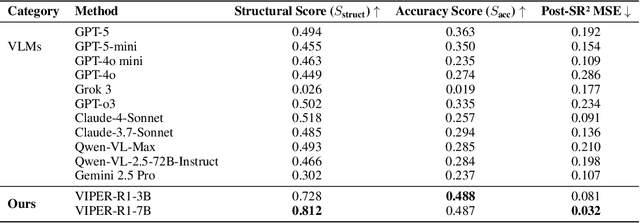
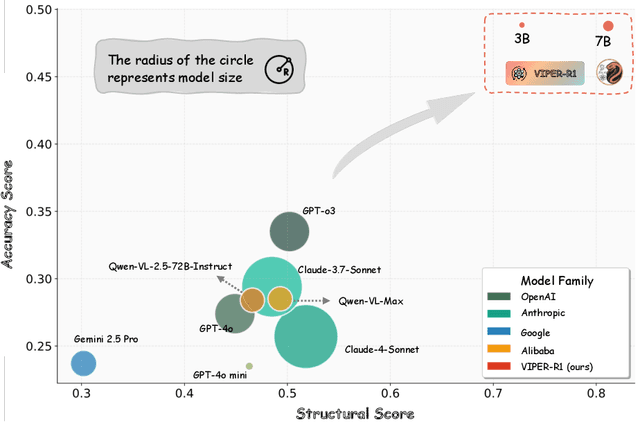
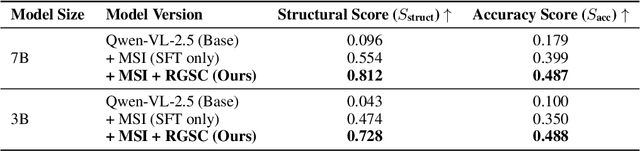
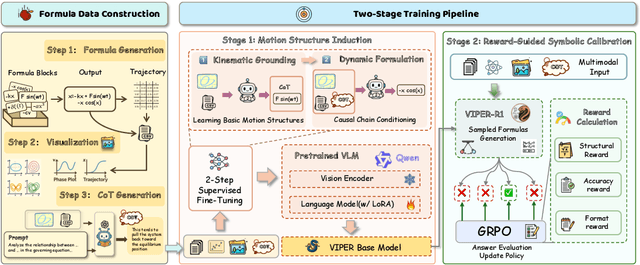
Automated discovery of physical laws from observational data in the real world is a grand challenge in AI. Current methods, relying on symbolic regression or LLMs, are limited to uni-modal data and overlook the rich, visual phenomenological representations of motion that are indispensable to physicists. This "sensory deprivation" severely weakens their ability to interpret the inherent spatio-temporal patterns within dynamic phenomena. To address this gap, we propose VIPER-R1, a multimodal model that performs Visual Induction for Physics-based Equation Reasoning to discover fundamental symbolic formulas. It integrates visual perception, trajectory data, and symbolic reasoning to emulate the scientific discovery process. The model is trained via a curriculum of Motion Structure Induction (MSI), using supervised fine-tuning to interpret kinematic phase portraits and to construct hypotheses guided by a Causal Chain of Thought (C-CoT), followed by Reward-Guided Symbolic Calibration (RGSC) to refine the formula structure with reinforcement learning. During inference, the trained VIPER-R1 acts as an agent: it first posits a high-confidence symbolic ansatz, then proactively invokes an external symbolic regression tool to perform Symbolic Residual Realignment (SR^2). This final step, analogous to a physicist's perturbation analysis, reconciles the theoretical model with empirical data. To support this research, we introduce PhysSymbol, a new 5,000-instance multimodal corpus. Experiments show that VIPER-R1 consistently outperforms state-of-the-art VLM baselines in accuracy and interpretability, enabling more precise discovery of physical laws. Project page: https://jiaaqiliu.github.io/VIPER-R1/
VIPER: Visual Perception and Explainable Reasoning for Sequential Decision-Making
Mar 19, 2025While Large Language Models (LLMs) excel at reasoning on text and Vision-Language Models (VLMs) are highly effective for visual perception, applying those models for visual instruction-based planning remains a widely open problem. In this paper, we introduce VIPER, a novel framework for multimodal instruction-based planning that integrates VLM-based perception with LLM-based reasoning. Our approach uses a modular pipeline where a frozen VLM generates textual descriptions of image observations, which are then processed by an LLM policy to predict actions based on the task goal. We fine-tune the reasoning module using behavioral cloning and reinforcement learning, improving our agent's decision-making capabilities. Experiments on the ALFWorld benchmark show that VIPER significantly outperforms state-of-the-art visual instruction-based planners while narrowing the gap with purely text-based oracles. By leveraging text as an intermediate representation, VIPER also enhances explainability, paving the way for a fine-grained analysis of perception and reasoning components.
Investigating Video Reasoning Capability of Large Language Models with Tropes in Movies
Jun 16, 2024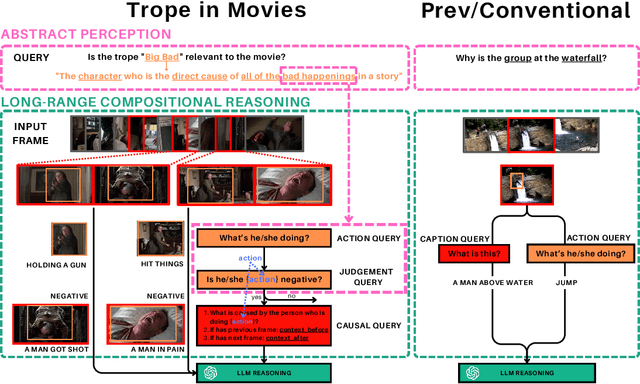
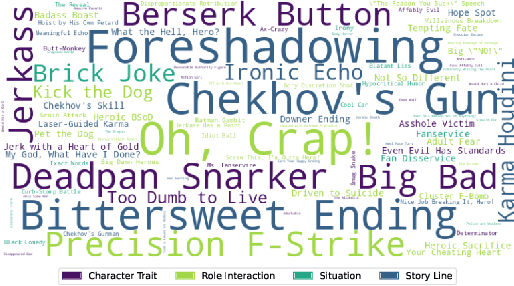


Large Language Models (LLMs) have demonstrated effectiveness not only in language tasks but also in video reasoning. This paper introduces a novel dataset, Tropes in Movies (TiM), designed as a testbed for exploring two critical yet previously overlooked video reasoning skills: (1) Abstract Perception: understanding and tokenizing abstract concepts in videos, and (2) Long-range Compositional Reasoning: planning and integrating intermediate reasoning steps for understanding long-range videos with numerous frames. Utilizing tropes from movie storytelling, TiM evaluates the reasoning capabilities of state-of-the-art LLM-based approaches. Our experiments show that current methods, including Captioner-Reasoner, Large Multimodal Model Instruction Fine-tuning, and Visual Programming, only marginally outperform a random baseline when tackling the challenges of Abstract Perception and Long-range Compositional Reasoning. To address these deficiencies, we propose Face-Enhanced Viper of Role Interactions (FEVoRI) and Context Query Reduction (ConQueR), which enhance Visual Programming by fostering role interaction awareness and progressively refining movie contexts and trope queries during reasoning processes, significantly improving performance by 15 F1 points. However, this performance still lags behind human levels (40 vs. 65 F1). Additionally, we introduce a new protocol to evaluate the necessity of Abstract Perception and Long-range Compositional Reasoning for task resolution. This is done by analyzing the code generated through Visual Programming using an Abstract Syntax Tree (AST), thereby confirming the increased complexity of TiM. The dataset and code are available at: https://ander1119.github.io/TiM