 Add to Chrome
 Add to Firefox
 Add to Edge
MODIP: Efficient Model-Based Optimization for Diffusion Policies
Jun 09, 2026
Diffusion policies (DPs) have emerged as expressive policy representations for robot learning, often used with imitation learning methods such as behavioral cloning (BC). However, while their success has largely been confined to BC, direct reinforcement learning (RL) fine-tuning remains challenging because actions are generated through a multi-step denoising process. In this work, we propose MODIP, a framework for the offline-to-online fine-tuning of DPs. Rather than directly applying RL to the DPs, MODIP leverages a world model (WM) to guide policy adaptation and keeps the simplicity and stability of BC. We utilize model predictive control (MPC) to generate high-quality trajectories within the WM, and use them as supervised targets for fine-tuning the DP. To make MPC planning efficient, MODIP uses a terminal state value instead of a policy-dependent state-action value, reducing inference time. Additionally, MODIP trains critics with policy-independent TD targets, reducing training time. Experiments on D4RL (MuJoCo, Kitchen) and RoboMimic tasks show that MODIP improves diffusion policies beyond BC, and is competitive with or outperforms diffusion policy RL fine-tuning methods and strong model-based baselines such as TD-MPC2.

Boosting Visual Instruction Tuning with Self-Supervised Guidance
Apr 14, 2026Multimodal large language models (MLLMs) perform well on many vision-language tasks but often struggle with vision-centric problems that require fine-grained visual reasoning. Recent evidence suggests that this limitation arises not from weak visual representations, but from under-utilization of visual information during instruction tuning, where many tasks can be partially solved using language priors alone. We propose a simple and lightweight approach that augments visual instruction tuning with a small number of visually grounded self-supervised tasks expressed as natural language instructions. By reformulating classical self-supervised pretext tasks, such as rotation prediction, color matching, and cross-view correspondence, as image-instruction-response triplets, we introduce supervision that cannot be solved without relying on visual evidence. Our approach requires no human annotations, no architectural modifications, and no additional training stages. Across multiple models, training regimes, and benchmarks, injecting only a small fraction (3-10%) of such visually grounded instructions consistently improves performance on vision-centric evaluations. Our findings highlight instruction tuning with visually grounded SSL tasks as a powerful lever for improving visual reasoning in MLLMs through simple adjustments to the training data distribution. Code available at: https://github.com/sirkosophia/V-GIFT
Adaptation of Weakly Supervised Localization in Histopathology by Debiasing Predictions
Mar 12, 2026Weakly Supervised Object Localization (WSOL) models enable joint classification and region-of-interest localization in histology images using only image-class supervision. When deployed in a target domain, distributions shift remains a major cause of performance degradation, especially when applied on new organs or institutions with different staining protocols and scanner characteristics. Under stronger cross-domain shifts, WSOL predictions can become biased toward dominant classes, producing highly skewed pseudo-label distributions in the target domain. Source-Free (Unsupervised) Domain Adaptation (SFDA) methods are commonly employed to address domain shift. However, because they rely on self-training, the initial bias is reinforced over training iterations, degrading both classification and localization tasks. We identify this amplification of prediction bias as a primary obstacle to the SFDA of WSOL models in histopathology. This paper introduces \sfdadep, a method inspired by machine unlearning that formulates SFDA as an iterative process of identifying and correcting prediction bias. It periodically identifies target images from over-predicted classes and selectively reduces the predictive confidence for uncertain (high entropy) images, while preserving confident predictions. This process reduces the drift of decision boundaries and bias toward dominant classes. A jointly optimized pixel-level classifier further restores discriminative localization features under distribution shift. Extensive experiments on cross-organ and -center histopathology benchmarks (glas, CAMELYON-16, CAMELYON-17) with several WSOL models show that SFDA-DeP consistently improves classification and localization over state-of-the-art SFDA baselines. {\small Code: \href{https://anonymous.4open.science/r/SFDA-DeP-1797/}{anonymous.4open.science/r/SFDA-DeP-1797/}}
Revisiting the Learning Objectives of Vision-Language Reward Models
Dec 20, 2025Learning generalizable reward functions is a core challenge in embodied intelligence. Recent work leverages contrastive vision language models (VLMs) to obtain dense, domain-agnostic rewards without human supervision. These methods adapt VLMs into reward models through increasingly complex learning objectives, yet meaningful comparison remains difficult due to differences in training data, architectures, and evaluation settings. In this work, we isolate the impact of the learning objective by evaluating recent VLM-based reward models under a unified framework with identical backbones, finetuning data, and evaluation environments. Using Meta-World tasks, we assess modeling accuracy by measuring consistency with ground truth reward and correlation with expert progress. Remarkably, we show that a simple triplet loss outperforms state-of-the-art methods, suggesting that much of the improvements in recent approaches could be attributed to differences in data and architectures.
DAFTED: Decoupled Asymmetric Fusion of Tabular and Echocardiographic Data for Cardiac Hypertension Diagnosis
Sep 19, 2025Multimodal data fusion is a key approach for enhancing diagnosis in medical applications. We propose an asymmetric fusion strategy starting from a primary modality and integrating secondary modalities by disentangling shared and modality-specific information. Validated on a dataset of 239 patients with echocardiographic time series and tabular records, our model outperforms existing methods, achieving an AUC over 90%. This improvement marks a crucial benchmark for clinical use.
ViLU: Learning Vision-Language Uncertainties for Failure Prediction
Jul 10, 2025Reliable Uncertainty Quantification (UQ) and failure prediction remain open challenges for Vision-Language Models (VLMs). We introduce ViLU, a new Vision-Language Uncertainty quantification framework that contextualizes uncertainty estimates by leveraging all task-relevant textual representations. ViLU constructs an uncertainty-aware multi-modal representation by integrating the visual embedding, the predicted textual embedding, and an image-conditioned textual representation via cross-attention. Unlike traditional UQ methods based on loss prediction, ViLU trains an uncertainty predictor as a binary classifier to distinguish correct from incorrect predictions using a weighted binary cross-entropy loss, making it loss-agnostic. In particular, our proposed approach is well-suited for post-hoc settings, where only vision and text embeddings are available without direct access to the model itself. Extensive experiments on diverse datasets show the significant gains of our method compared to state-of-the-art failure prediction methods. We apply our method to standard classification datasets, such as ImageNet-1k, as well as large-scale image-caption datasets like CC12M and LAION-400M. Ablation studies highlight the critical role of our architecture and training in achieving effective uncertainty quantification. Our code is publicly available and can be found here: https://github.com/ykrmm/ViLU.
UP-ROM : Uncertainty-Aware and Parametrised dynamic Reduced-Order Model, application to unsteady flows
Mar 29, 2025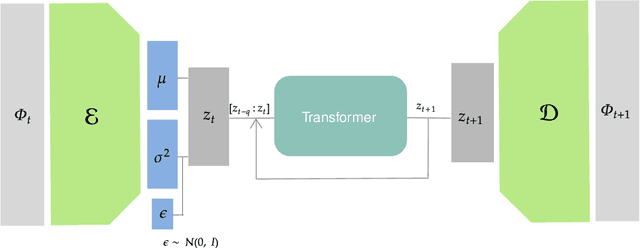

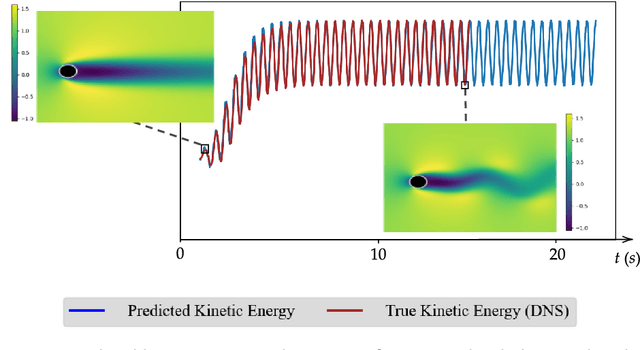

Reduced order models (ROMs) play a critical role in fluid mechanics by providing low-cost predictions, making them an attractive tool for engineering applications. However, for ROMs to be widely applicable, they must not only generalise well across different regimes, but also provide a measure of confidence in their predictions. While recent data-driven approaches have begun to address nonlinear reduction techniques to improve predictions in transient environments, challenges remain in terms of robustness and parametrisation. In this work, we present a nonlinear reduction strategy specifically designed for transient flows that incorporates parametrisation and uncertainty quantification. Our reduction strategy features a variational auto-encoder (VAE) that uses variational inference for confidence measurement. We use a latent space transformer that incorporates recent advances in attention mechanisms to predict dynamical systems. Attention's versatility in learning sequences and capturing their dependence on external parameters enhances generalisation across a wide range of dynamics. Prediction, coupled with confidence, enables more informed decision making and addresses the need for more robust models. In addition, this confidence is used to cost-effectively sample the parameter space, improving model performance a priori across the entire parameter space without requiring evaluation data for the entire domain.
VIPER: Visual Perception and Explainable Reasoning for Sequential Decision-Making
Mar 19, 2025While Large Language Models (LLMs) excel at reasoning on text and Vision-Language Models (VLMs) are highly effective for visual perception, applying those models for visual instruction-based planning remains a widely open problem. In this paper, we introduce VIPER, a novel framework for multimodal instruction-based planning that integrates VLM-based perception with LLM-based reasoning. Our approach uses a modular pipeline where a frozen VLM generates textual descriptions of image observations, which are then processed by an LLM policy to predict actions based on the task goal. We fine-tune the reasoning module using behavioral cloning and reinforcement learning, improving our agent's decision-making capabilities. Experiments on the ALFWorld benchmark show that VIPER significantly outperforms state-of-the-art visual instruction-based planners while narrowing the gap with purely text-based oracles. By leveraging text as an intermediate representation, VIPER also enhances explainability, paving the way for a fine-grained analysis of perception and reasoning components.
Reinforcement Learning for Aligning Large Language Models Agents with Interactive Environments: Quantifying and Mitigating Prompt Overfitting
Oct 29, 2024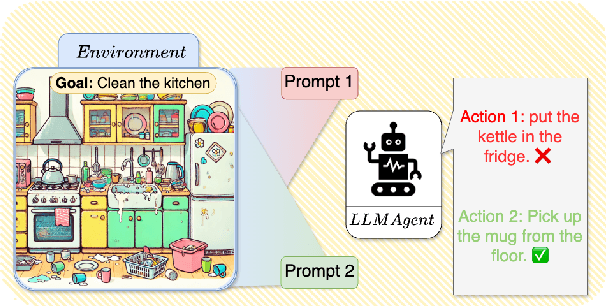
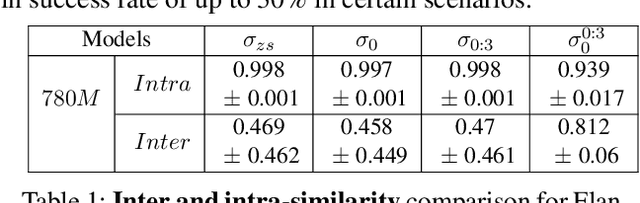
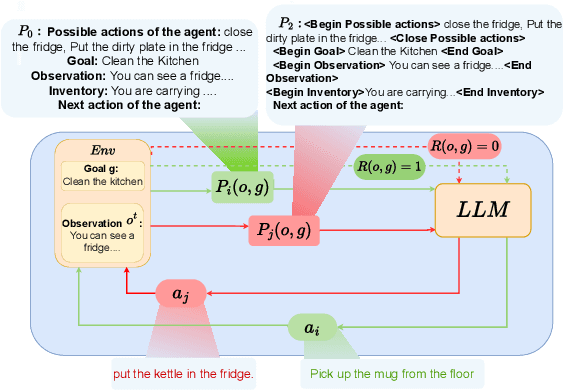
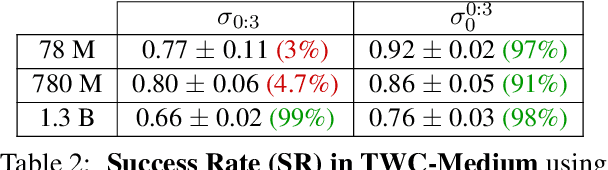
Reinforcement learning (RL) is a promising approach for aligning large language models (LLMs) knowledge with sequential decision-making tasks. However, few studies have thoroughly investigated the impact on LLM agents capabilities of fine-tuning them with RL in a specific environment. In this paper, we propose a novel framework to analyze the sensitivity of LLMs to prompt formulations following RL training in a textual environment. Our findings reveal that the performance of LLMs degrades when faced with prompt formulations different from those used during the RL training phase. Besides, we analyze the source of this sensitivity by examining the model's internal representations and salient tokens. Finally, we propose to use a contrastive loss to mitigate this sensitivity and improve the robustness and generalization capabilities of LLMs.
Supra-Laplacian Encoding for Transformer on Dynamic Graphs
Sep 26, 2024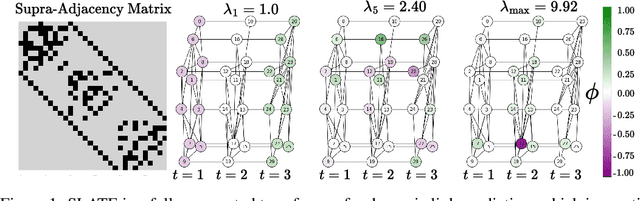
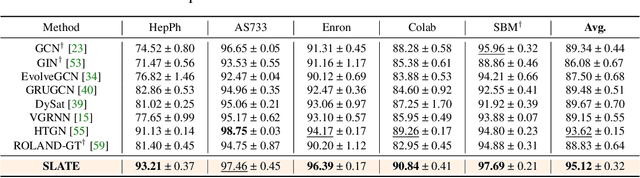
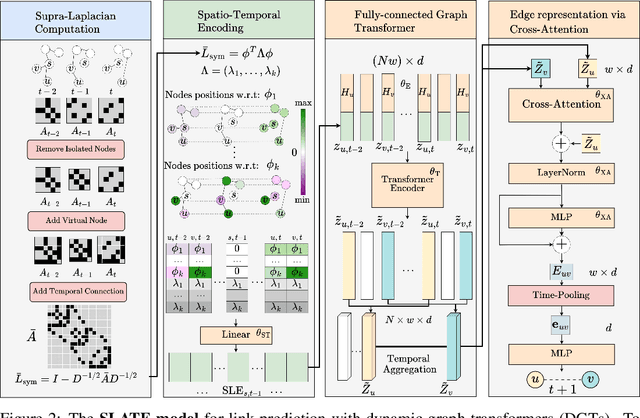
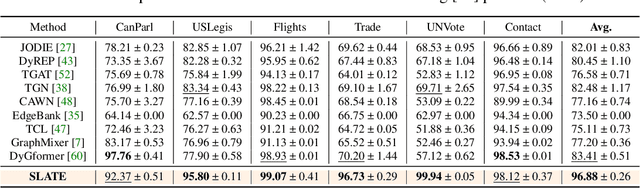
Fully connected Graph Transformers (GT) have rapidly become prominent in the static graph community as an alternative to Message-Passing models, which suffer from a lack of expressivity, oversquashing, and under-reaching. However, in a dynamic context, by interconnecting all nodes at multiple snapshots with self-attention, GT loose both structural and temporal information. In this work, we introduce Supra-LAplacian encoding for spatio-temporal TransformErs (SLATE), a new spatio-temporal encoding to leverage the GT architecture while keeping spatio-temporal information. Specifically, we transform Discrete Time Dynamic Graphs into multi-layer graphs and take advantage of the spectral properties of their associated supra-Laplacian matrix. Our second contribution explicitly model nodes' pairwise relationships with a cross-attention mechanism, providing an accurate edge representation for dynamic link prediction. SLATE outperforms numerous state-of-the-art methods based on Message-Passing Graph Neural Networks combined with recurrent models (e.g LSTM), and Dynamic Graph Transformers, on 9 datasets. Code and instructions to reproduce our results will be open-sourced.