 Add to Chrome
 Add to Firefox
 Add to Edge
Target Policy Smoothing
Papers and Code
Search-R2: Enhancing Search-Integrated Reasoning via Actor-Refiner Collaboration
Feb 03, 2026
Search-integrated reasoning enables language agents to transcend static parametric knowledge by actively querying external sources. However, training these agents via reinforcement learning is hindered by the multi-scale credit assignment problem: existing methods typically rely on sparse, trajectory-level rewards that fail to distinguish between high-quality reasoning and fortuitous guesses, leading to redundant or misleading search behaviors. To address this, we propose Search-R2, a novel Actor-Refiner collaboration framework that enhances reasoning through targeted intervention, with both components jointly optimized during training. Our approach decomposes the generation process into an Actor, which produces initial reasoning trajectories, and a Meta-Refiner, which selectively diagnoses and repairs flawed steps via a 'cut-and-regenerate' mechanism. To provide fine-grained supervision, we introduce a hybrid reward design that couples outcome correctness with a dense process reward quantifying the information density of retrieved evidence. Theoretically, we formalize the Actor-Refiner interaction as a smoothed mixture policy, proving that selective correction yields strict performance gains over strong baselines. Extensive experiments across various general and multi-hop QA datasets demonstrate that Search-R2 consistently outperforms strong RAG and RL-based baselines across model scales, achieving superior reasoning accuracy with minimal overhead.

No More, No Less: Least-Privilege Language Models
Jan 30, 2026Least privilege is a core security principle: grant each request only the minimum access needed to achieve its goal. Deployed language models almost never follow it, instead being exposed through a single API endpoint that serves all users and requests. This gap exists not because least privilege would be unhelpful; deployments would benefit greatly from reducing unnecessary capability exposure. The real obstacle is definitional and mechanistic: what does "access" mean inside a language model, and how can we enforce it without retraining or deploying multiple models? We take inspiration from least privilege in computer systems and define a class of models called least-privilege language models, where privilege is reachable internal computation during the forward pass. In this view, lowering privilege literally shrinks the model's accessible function class, as opposed to denying access via learned policies. We formalize deployment-time control as a monitor-allocator-enforcer stack, separating (i) request-time signals, (ii) a decision rule that allocates privilege, and (iii) an inference-time mechanism that selects privilege. We then propose Nested Least-Privilege Networks, a shape-preserving, rank-indexed intervention that provides a smooth, reversible control knob. We show that this knob yields policy-usable privilege-utility frontiers and enables selective suppression of targeted capabilities with limited collateral degradation across various policies. Most importantly, we argue for a new deployment paradigm that challenges the premise that language models can only be controlled at the output level.
IRL-DAL: Safe and Adaptive Trajectory Planning for Autonomous Driving via Energy-Guided Diffusion Models
Jan 30, 2026This paper proposes a novel inverse reinforcement learning framework using a diffusion-based adaptive lookahead planner (IRL-DAL) for autonomous vehicles. Training begins with imitation from an expert finite state machine (FSM) controller to provide a stable initialization. Environment terms are combined with an IRL discriminator signal to align with expert goals. Reinforcement learning (RL) is then performed with a hybrid reward that combines diffuse environmental feedback and targeted IRL rewards. A conditional diffusion model, which acts as a safety supervisor, plans safe paths. It stays in its lane, avoids obstacles, and moves smoothly. Then, a learnable adaptive mask (LAM) improves perception. It shifts visual attention based on vehicle speed and nearby hazards. After FSM-based imitation, the policy is fine-tuned with Proximal Policy Optimization (PPO). Training is run in the Webots simulator with a two-stage curriculum. A 96\% success rate is reached, and collisions are reduced to 0.05 per 1k steps, marking a new benchmark for safe navigation. By applying the proposed approach, the agent not only drives in lane but also handles unsafe conditions at an expert level, increasing robustness.We make our code publicly available.
Latent Spherical Flow Policy for Reinforcement Learning with Combinatorial Actions
Jan 29, 2026Reinforcement learning (RL) with combinatorial action spaces remains challenging because feasible action sets are exponentially large and governed by complex feasibility constraints, making direct policy parameterization impractical. Existing approaches embed task-specific value functions into constrained optimization programs or learn deterministic structured policies, sacrificing generality and policy expressiveness. We propose a solver-induced \emph{latent spherical flow policy} that brings the expressiveness of modern generative policies to combinatorial RL while guaranteeing feasibility by design. Our method, LSFlow, learns a \emph{stochastic} policy in a compact continuous latent space via spherical flow matching, and delegates feasibility to a combinatorial optimization solver that maps each latent sample to a valid structured action. To improve efficiency, we train the value network directly in the latent space, avoiding repeated solver calls during policy optimization. To address the piecewise-constant and discontinuous value landscape induced by solver-based action selection, we introduce a smoothed Bellman operator that yields stable, well-defined learning targets. Empirically, our approach outperforms state-of-the-art baselines by an average of 20.6\% across a range of challenging combinatorial RL tasks.
Diffusion-Guided Backdoor Attacks in Real-World Reinforcement Learning
Jan 20, 2026Backdoor attacks embed hidden malicious behaviors in reinforcement learning (RL) policies and activate them using triggers at test time. Most existing attacks are validated only in simulation, while their effectiveness in real-world robotic systems remains unclear. In physical deployment, safety-constrained control pipelines such as velocity limiting, action smoothing, and collision avoidance suppress abnormal actions, causing strong attenuation of conventional backdoor attacks. We study this previously overlooked problem and propose a diffusion-guided backdoor attack framework (DGBA) for real-world RL. We design small printable visual patch triggers placed on the floor and generate them using a conditional diffusion model that produces diverse patch appearances under real-world visual variations. We treat the robot control stack as a black-box system. We further introduce an advantage-based poisoning strategy that injects triggers only at decision-critical training states. We evaluate our method on a TurtleBot3 mobile robot and demonstrate reliable activation of targeted attacks while preserving normal task performance. Demo videos and code are available in the supplementary material.
Efficient Inference for Inverse Reinforcement Learning and Dynamic Discrete Choice Models
Dec 30, 2025Inverse reinforcement learning (IRL) and dynamic discrete choice (DDC) models explain sequential decision-making by recovering reward functions that rationalize observed behavior. Flexible IRL methods typically rely on machine learning but provide no guarantees for valid inference, while classical DDC approaches impose restrictive parametric specifications and often require repeated dynamic programming. We develop a semiparametric framework for debiased inverse reinforcement learning that yields statistically efficient inference for a broad class of reward-dependent functionals in maximum entropy IRL and Gumbel-shock DDC models. We show that the log-behavior policy acts as a pseudo-reward that point-identifies policy value differences and, under a simple normalization, the reward itself. We then formalize these targets, including policy values under known and counterfactual softmax policies and functionals of the normalized reward, as smooth functionals of the behavior policy and transition kernel, establish pathwise differentiability, and derive their efficient influence functions. Building on this characterization, we construct automatic debiased machine-learning estimators that allow flexible nonparametric estimation of nuisance components while achieving $\sqrt{n}$-consistency, asymptotic normality, and semiparametric efficiency. Our framework extends classical inference for DDC models to nonparametric rewards and modern machine-learning tools, providing a unified and computationally tractable approach to statistical inference in IRL.
Learning Controllable and Diverse Player Behaviors in Multi-Agent Environments
Dec 11, 2025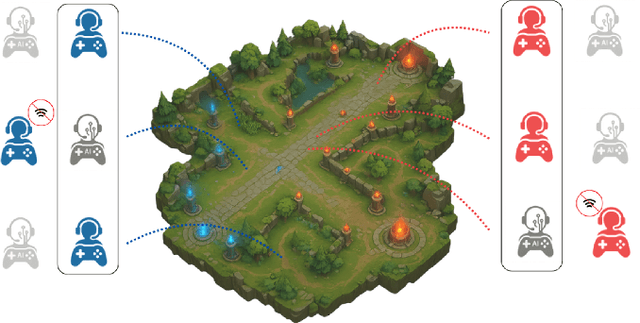
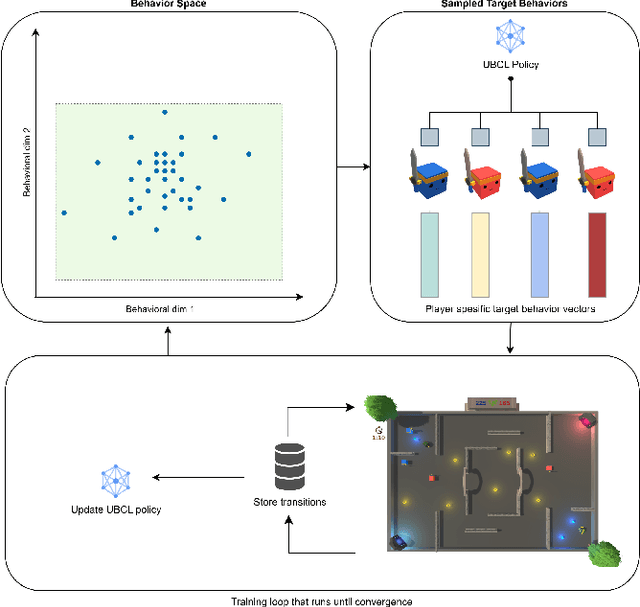
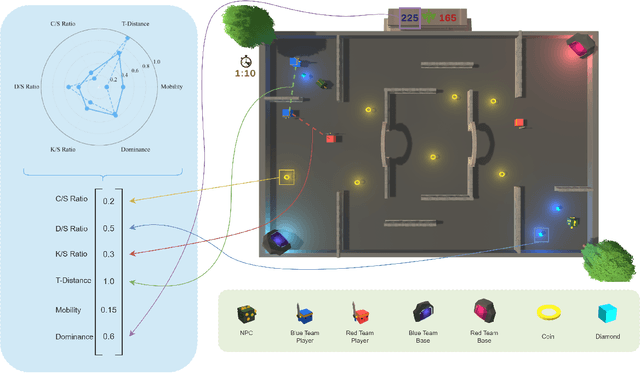
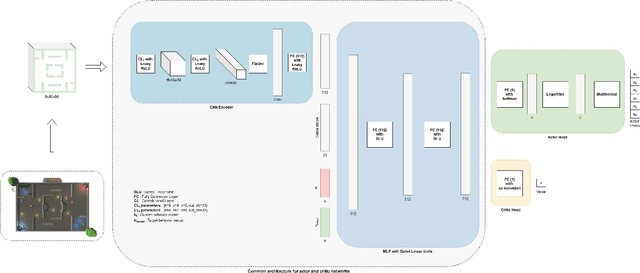
This paper introduces a reinforcement learning framework that enables controllable and diverse player behaviors without relying on human gameplay data. Existing approaches often require large-scale player trajectories, train separate models for different player types, or provide no direct mapping between interpretable behavioral parameters and the learned policy, limiting their scalability and controllability. We define player behavior in an N-dimensional continuous space and uniformly sample target behavior vectors from a region that encompasses the subset representing real human styles. During training, each agent receives both its current and target behavior vectors as input, and the reward is based on the normalized reduction in distance between them. This allows the policy to learn how actions influence behavioral statistics, enabling smooth control over attributes such as aggressiveness, mobility, and cooperativeness. A single PPO-based multi-agent policy can reproduce new or unseen play styles without retraining. Experiments conducted in a custom multi-player Unity game show that the proposed framework produces significantly greater behavioral diversity than a win-only baseline and reliably matches specified behavior vectors across diverse targets. The method offers a scalable solution for automated playtesting, game balancing, human-like behavior simulation, and replacing disconnected players in online games.
Balancing Centralized Learning and Distributed Self-Organization: A Hybrid Model for Embodied Morphogenesis
Nov 13, 2025We investigate how to couple a learnable brain-like'' controller to a cell-like'' Gray--Scott substrate to steer pattern formation with minimal effort. A compact convolutional policy is embedded in a differentiable PyTorch reaction--diffusion simulator, producing spatially smooth, bounded modulations of the feed and kill parameters ($ΔF$, $ΔK$) under a warm--hold--decay gain schedule. Training optimizes Turing-band spectral targets (FFT-based) while penalizing control effort ($\ell_1/\ell_2$) and instability. We compare three regimes: pure reaction--diffusion, NN-dominant, and a hybrid coupling. The hybrid achieves reliable, fast formation of target textures: 100% strict convergence in $\sim 165$ steps, matching cell-only spectral selectivity (0.436 vs.\ 0.434) while using $\sim 15\times$ less $\ell_1$ effort and $>200\times$ less $\ell_2$ power than NN-dominant control. An amplitude sweep reveals a non-monotonic Goldilocks'' zone ($A \approx 0.03$--$0.045$) that yields 100\% quasi convergence in 94--96 steps, whereas weaker or stronger gains fail to converge or degrade selectivity. These results quantify morphological computation: the controller seeds then cedes,'' providing brief, sparse nudges that place the system in the correct basin of attraction, after which local physics maintains the pattern. The study offers a practical recipe for building steerable, robust, and energy-efficient embodied systems that exploit an optimal division of labor between centralized learning and distributed self-organization.
Multi-Modal Decentralized Reinforcement Learning for Modular Reconfigurable Lunar Robots
Oct 23, 2025Modular reconfigurable robots suit task-specific space operations, but the combinatorial growth of morphologies hinders unified control. We propose a decentralized reinforcement learning (Dec-RL) scheme where each module learns its own policy: wheel modules use Soft Actor-Critic (SAC) for locomotion and 7-DoF limbs use Proximal Policy Optimization (PPO) for steering and manipulation, enabling zero-shot generalization to unseen configurations. In simulation, the steering policy achieved a mean absolute error of 3.63{\deg} between desired and induced angles; the manipulation policy plateaued at 84.6 % success on a target-offset criterion; and the wheel policy cut average motor torque by 95.4 % relative to baseline while maintaining 99.6 % success. Lunar-analogue field tests validated zero-shot integration for autonomous locomotion, steering, and preliminary alignment for reconfiguration. The system transitioned smoothly among synchronous, parallel, and sequential modes for Policy Execution, without idle states or control conflicts, indicating a scalable, reusable, and robust approach for modular lunar robots.
Real-Time Gait Adaptation for Quadrupeds using Model Predictive Control and Reinforcement Learning
Oct 23, 2025Model-free reinforcement learning (RL) has enabled adaptable and agile quadruped locomotion; however, policies often converge to a single gait, leading to suboptimal performance. Traditionally, Model Predictive Control (MPC) has been extensively used to obtain task-specific optimal policies but lacks the ability to adapt to varying environments. To address these limitations, we propose an optimization framework for real-time gait adaptation in a continuous gait space, combining the Model Predictive Path Integral (MPPI) algorithm with a Dreamer module to produce adaptive and optimal policies for quadruped locomotion. At each time step, MPPI jointly optimizes the actions and gait variables using a learned Dreamer reward that promotes velocity tracking, energy efficiency, stability, and smooth transitions, while penalizing abrupt gait changes. A learned value function is incorporated as terminal reward, extending the formulation to an infinite-horizon planner. We evaluate our framework in simulation on the Unitree Go1, demonstrating an average reduction of up to 36.48\% in energy consumption across varying target speeds, while maintaining accurate tracking and adaptive, task-appropriate gaits.