 Add to Chrome
 Add to Firefox
 Add to Edge
Relative Positions Generalize, Absolute Positions Memorize: An Implicit-Bias Account of Length Generalization in Attention
Jul 21, 2026
Transformers with relative positional encodings often extrapolate to sequences longer than those seen during training, whereas transformers with learned absolute encodings typically do not. This is a robust empirical regularity, and the explanations offered for it so far are chiefly about expressivity, that is, about whether a length-generalizing solution exists. We give an optimization explanation. On a minimal fixed-offset retrieval task that isolates positional selection, the gap is governed by the implicit bias of the trained attention head: among the many solutions that fit short sequences, which one gradient descent actually selects. We prove that rotary encodings make the attention logit a function of relative offset alone, an exact equivariance, so whatever selection rule is learned at training lengths is reproduced verbatim at every longer length. Learned absolute encodings instead leave out-of-range positions unconstrained, and the trained head pins to a fixed absolute position inside the training range. We characterize the learned rotary rule as a low-rank ``carrier'' kernel aligned with the target offset, and we derive the resulting graceful accuracy decay as an attention-dilution law; both predictions are confirmed across seeds and offsets. A linear-attention control shows the mechanism is specific to softmax: without normalization, training selects a min-norm interpolant that does not extrapolate. The phenomenon, the equivariance, and the carrier all transfer to a multi-layer, multi-head transformer trained on a full-sequence length-generalization task. The account connects the implicit bias of attention, implicit bias for extrapolation in recurrent models, and the learning side of the RASP-L conjecture.

Same Loss, Same Noise, Opposite Schedules: Noise Structure and Optimizer Normalization Jointly Determine Whether Learning-Rate Cooldown Helps
Jul 14, 2026The cooldown phase of a warmup-stable-decay (WSD) learning-rate schedule, now a default in large-model pretraining, lowers the final training loss in some settings and does nothing in others. We give a provable account of which case obtains, and it turns on two properties together: the structure of the gradient noise and whether the optimizer normalizes its update. On a strongly convex objective with multiplicative (gradient-proportional) noise, stochastic gradient descent contracts geometrically at a constant learning rate, so cooldown has nothing to improve. Under the same objective and noise, sign-based and normalized methods, the standard surrogates for adaptive optimizers, settle on a noise floor of order $η^2$ and reach the minimizer only as the learning rate is driven to zero; any additive noise then reinstates a floor for every method. The mechanism is elementary: an SGD step shrinks in proportion to the gradient and so anneals itself, whereas a normalized step keeps unit scale and cannot. We solve the signSGD stationary law on the quadratic exactly and obtain the floor constant in closed form, prove a local form of the dissociation under $(L_0,L_1)$-smoothness, extend the floor to normalized SGD in dimension d>1 by a scale-invariance argument, and establish robustness to momentum and heavy-tailed noise. Simulation confirms every prediction, and we demonstrate the resulting noise-regime diagnostic on a real classification task with directly measured gradient noise. The mechanism explains whether cooldown helps; the interior cooldown fraction used at scale lies outside stationary landscape-and-noise geometry.
Distributed Multi Robot Lunar Cargo Transportation via Phase Decomposed Reinforcement Learning
Jun 30, 2026Modular reconfigurable robotic systems provide a scalable solution for cooperative surface operations in future lunar missions. However, cooperative cargo transportation remains challenging due to morphology-dependent topology changes, strong payload-induced coupling, long-horizon decision making, and safety constraints. This paper proposes a phase-decomposed reinforcement learning framework for cooperative cargo transport with distributed robotic units. The task is decomposed into lifting, transportation, and placement, each optimized with a dedicated joint-state policy capturing inter-agent coupling. Centralized training promotes stable convergence, while deployment uses onboard proprioception for control and OptiTrack motion capture for ground-truth evaluation and post-processed metrics. A deterministic phase controller expressed in Markov state representation regulates transitions between stages, and a failure-sensitive synchronization mechanism ensures coordinated progression and safety-aware halting during real-world execution. The framework is evaluated in simulation and through controlled field experiments at a JAXA space exploration test facility. Results demonstrate reliable cooperative transport across all stages in both simulation and hardware experiments.
MoonBot: Modular and On-Demand Reconfigurable Robot Toward Moon Base Construction
Dec 26, 2025The allure of lunar surface exploration and development has recently captured widespread global attention. Robots have proved to be indispensable for exploring uncharted terrains, uncovering and leveraging local resources, and facilitating the construction of future human habitats. In this article, we introduce the modular and on-demand reconfigurable robot (MoonBot), a modular and reconfigurable robotic system engineered to maximize functionality while operating within the stringent mass constraints of lunar payloads and adapting to varying environmental conditions and task requirements. This article details the design and development of MoonBot and presents a preliminary field demonstration that validates the proof of concept through the execution of milestone tasks simulating the establishment of lunar infrastructure. These tasks include essential civil engineering operations, infrastructural component transportation and deployment, and assistive operations with inflatable modules. Furthermore, we systematically summarize the lessons learned during testing, focusing on the connector design and providing valuable insights for the advancement of modular robotic systems in future lunar missions.
Multi-Modal Decentralized Reinforcement Learning for Modular Reconfigurable Lunar Robots
Oct 23, 2025Modular reconfigurable robots suit task-specific space operations, but the combinatorial growth of morphologies hinders unified control. We propose a decentralized reinforcement learning (Dec-RL) scheme where each module learns its own policy: wheel modules use Soft Actor-Critic (SAC) for locomotion and 7-DoF limbs use Proximal Policy Optimization (PPO) for steering and manipulation, enabling zero-shot generalization to unseen configurations. In simulation, the steering policy achieved a mean absolute error of 3.63{\deg} between desired and induced angles; the manipulation policy plateaued at 84.6 % success on a target-offset criterion; and the wheel policy cut average motor torque by 95.4 % relative to baseline while maintaining 99.6 % success. Lunar-analogue field tests validated zero-shot integration for autonomous locomotion, steering, and preliminary alignment for reconfiguration. The system transitioned smoothly among synchronous, parallel, and sequential modes for Policy Execution, without idle states or control conflicts, indicating a scalable, reusable, and robust approach for modular lunar robots.
CoroNetGAN: Controlled Pruning of GANs via Hypernetworks
Mar 13, 2024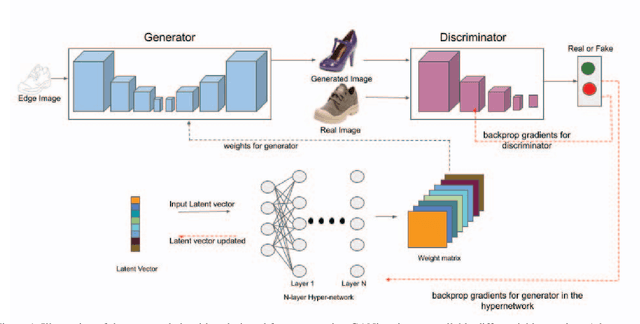
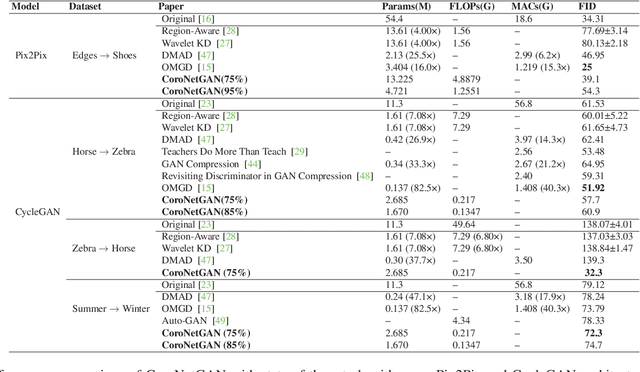
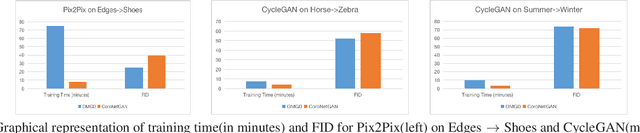

Generative Adversarial Networks (GANs) have proven to exhibit remarkable performance and are widely used across many generative computer vision applications. However, the unprecedented demand for the deployment of GANs on resource-constrained edge devices still poses a challenge due to huge number of parameters involved in the generation process. This has led to focused attention on the area of compressing GANs. Most of the existing works use knowledge distillation with the overhead of teacher dependency. Moreover, there is no ability to control the degree of compression in these methods. Hence, we propose CoroNet-GAN for compressing GAN using the combined strength of differentiable pruning method via hypernetworks. The proposed method provides the advantage of performing controllable compression while training along with reducing training time by a substantial factor. Experiments have been done on various conditional GAN architectures (Pix2Pix and CycleGAN) to signify the effectiveness of our approach on multiple benchmark datasets such as Edges-to-Shoes, Horse-to-Zebra and Summer-to-Winter. The results obtained illustrate that our approach succeeds to outperform the baselines on Zebra-to-Horse and Summer-to-Winter achieving the best FID score of 32.3 and 72.3 respectively, yielding high-fidelity images across all the datasets. Additionally, our approach also outperforms the state-of-the-art methods in achieving better inference time on various smart-phone chipsets and data-types making it a feasible solution for deployment on edge devices.
Chaurah: A Smart Raspberry Pi based Parking System
Dec 28, 2023The widespread usage of cars and other large, heavy vehicles necessitates the development of an effective parking infrastructure. Additionally, algorithms for detection and recognition of number plates are often used to identify automobiles all around the world where standardized plate sizes and fonts are enforced, making recognition an effortless task. As a result, both kinds of data can be combined to develop an intelligent parking system focuses on the technology of Automatic Number Plate Recognition (ANPR). Retrieving characters from an inputted number plate image is the sole purpose of ANPR which is a costly procedure. In this article, we propose Chaurah, a minimal cost ANPR system that relies on a Raspberry Pi 3 that was specifically created for parking facilities. The system employs a dual-stage methodology, with the first stage being an ANPR system which makes use of two convolutional neural networks (CNNs). The primary locates and recognises license plates from a vehicle image, while the secondary performs Optical Character Recognition (OCR) to identify individualized numbers from the number plate. An application built with Flutter and Firebase for database administration and license plate record comparison makes up the second component of the overall solution. The application also acts as an user-interface for the billing mechanism based on parking time duration resulting in an all-encompassing software deployment of the study.
A Survey on Deep Reinforcement Learning-based Approaches for Adaptation and Generalization
Feb 17, 2022
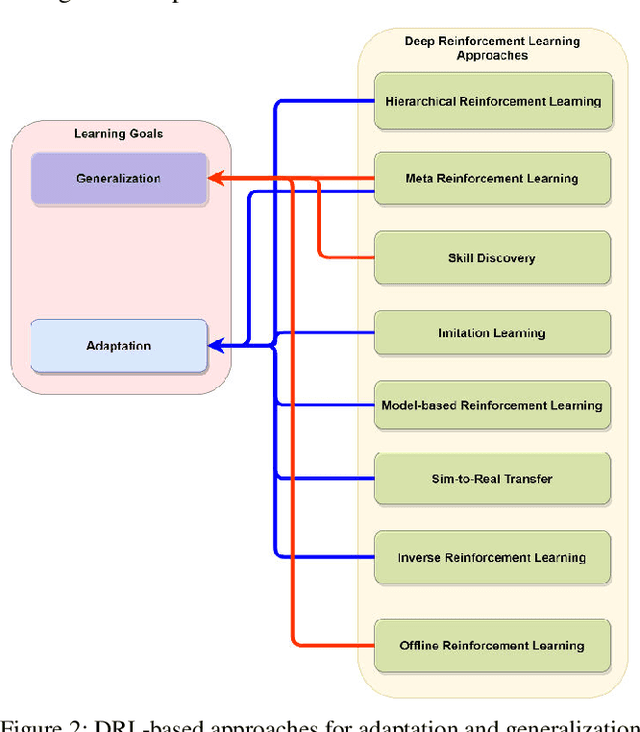
Deep Reinforcement Learning (DRL) aims to create intelligent agents that can learn to solve complex problems efficiently in a real-world environment. Typically, two learning goals: adaptation and generalization are used for baselining DRL algorithm's performance on different tasks and domains. This paper presents a survey on the recent developments in DRL-based approaches for adaptation and generalization. We begin by formulating these goals in the context of task and domain. Then we review the recent works under those approaches and discuss future research directions through which DRL algorithms' adaptability and generalizability can be enhanced and potentially make them applicable to a broad range of real-world problems.
Using Deep Object Features for Image Descriptions
Feb 25, 2019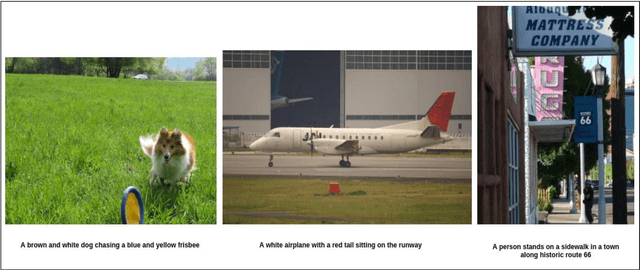
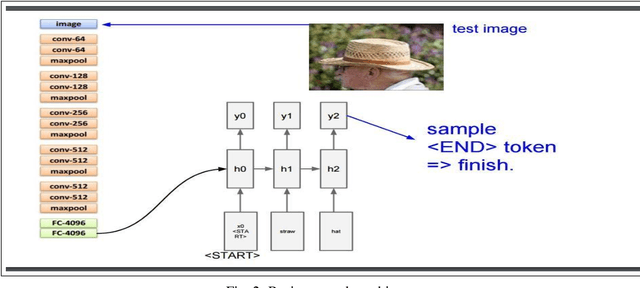
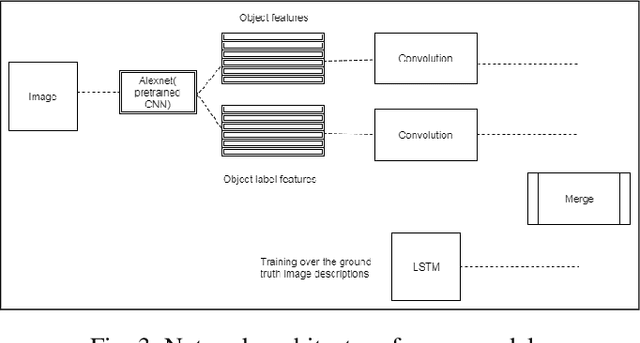
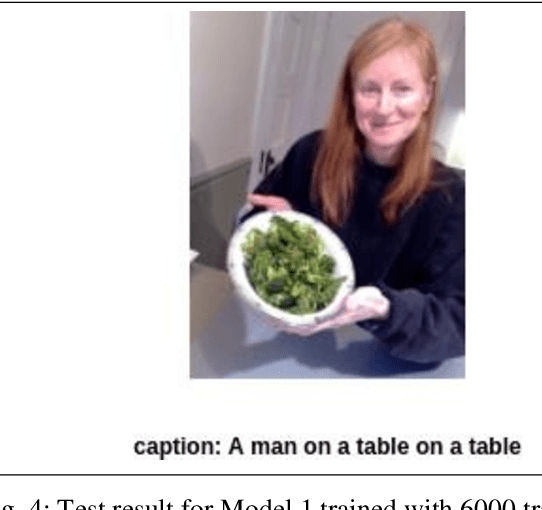
Inspired by recent advances in leveraging multiple modalities in machine translation, we introduce an encoder-decoder pipeline that uses (1) specific objects within an image and their object labels, (2) a language model for decoding joint embedding of object features and the object labels. Our pipeline merges prior detected objects from the image and their object labels and then learns the sequences of captions describing the particular image. The decoder model learns to extract descriptions for the image from scratch by decoding the joint representation of the object visual features and their object classes conditioned by the encoder component. The idea of the model is to concentrate only on the specific objects of the image and their labels for generating descriptions of the image rather than visual feature of the entire image. The model needs to be calibrated more by adjusting the parameters and settings to result in better accuracy and performance.
Recognizing Challenging Handwritten Annotations with Fully Convolutional Networks
Jun 22, 2018


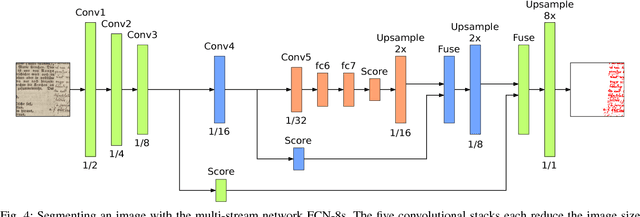
This paper introduces a very challenging dataset of historic German documents and evaluates Fully Convolutional Neural Network (FCNN) based methods to locate handwritten annotations of any kind in these documents. The handwritten annotations can appear in form of underlines and text by using various writing instruments, e.g., the use of pencils makes the data more challenging. We train and evaluate various end-to-end semantic segmentation approaches and report the results. The task is to classify the pixels of documents into two classes: background and handwritten annotation. The best model achieves a mean Intersection over Union (IoU) score of 95.6% on the test documents of the presented dataset. We also present a comparison of different strategies used for data augmentation and training on our presented dataset. For evaluation, we use the Layout Analysis Evaluator for the ICDAR 2017 Competition on Layout Analysis for Challenging Medieval Manuscripts.