 Add to Chrome
 Add to Firefox
 Add to Edge
IRL-DAL: Safe and Adaptive Trajectory Planning for Autonomous Driving via Energy-Guided Diffusion Models
Jan 30, 2026
This paper proposes a novel inverse reinforcement learning framework using a diffusion-based adaptive lookahead planner (IRL-DAL) for autonomous vehicles. Training begins with imitation from an expert finite state machine (FSM) controller to provide a stable initialization. Environment terms are combined with an IRL discriminator signal to align with expert goals. Reinforcement learning (RL) is then performed with a hybrid reward that combines diffuse environmental feedback and targeted IRL rewards. A conditional diffusion model, which acts as a safety supervisor, plans safe paths. It stays in its lane, avoids obstacles, and moves smoothly. Then, a learnable adaptive mask (LAM) improves perception. It shifts visual attention based on vehicle speed and nearby hazards. After FSM-based imitation, the policy is fine-tuned with Proximal Policy Optimization (PPO). Training is run in the Webots simulator with a two-stage curriculum. A 96\% success rate is reached, and collisions are reduced to 0.05 per 1k steps, marking a new benchmark for safe navigation. By applying the proposed approach, the agent not only drives in lane but also handles unsafe conditions at an expert level, increasing robustness.We make our code publicly available.

Tackling Snow-Induced Challenges: Safe Autonomous Lane-Keeping with Robust Reinforcement Learning
Dec 15, 2025This paper proposes two new algorithms for the lane keeping system (LKS) in autonomous vehicles (AVs) operating under snowy road conditions. These algorithms use deep reinforcement learning (DRL) to handle uncertainties and slippage. They include Action-Robust Recurrent Deep Deterministic Policy Gradient (AR-RDPG) and end-to-end Action-Robust convolutional neural network Attention Deterministic Policy Gradient (AR-CADPG), two action-robust approaches for decision-making. In the AR-RDPG method, within the perception layer, camera images are first denoised using multi-scale neural networks. Then, the centerline coefficients are extracted by a pre-trained deep convolutional neural network (DCNN). These coefficients, concatenated with the driving characteristics, are used as input to the control layer. The AR-CADPG method presents an end-to-end approach in which a convolutional neural network (CNN) and an attention mechanism are integrated within a DRL framework. Both methods are first trained in the CARLA simulator and validated under various snowy scenarios. Real-world experiments on a Jetson Nano-based autonomous vehicle confirm the feasibility and stability of the learned policies. Among the two models, the AR-CADPG approach demonstrates superior path-tracking accuracy and robustness, highlighting the effectiveness of combining temporal memory, adversarial resilience, and attention mechanisms in AVs.
BLIP-FusePPO: A Vision-Language Deep Reinforcement Learning Framework for Lane Keeping in Autonomous Vehicles
Oct 25, 2025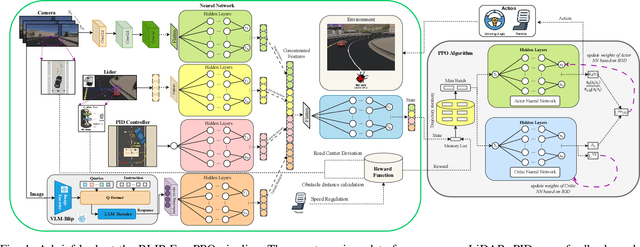

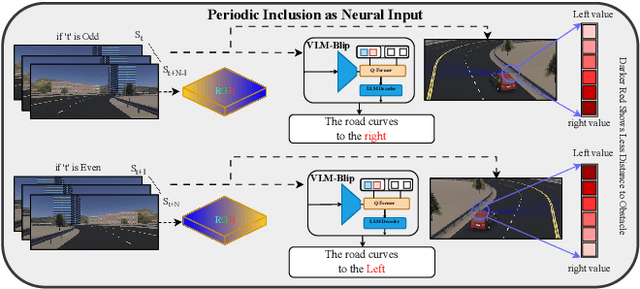
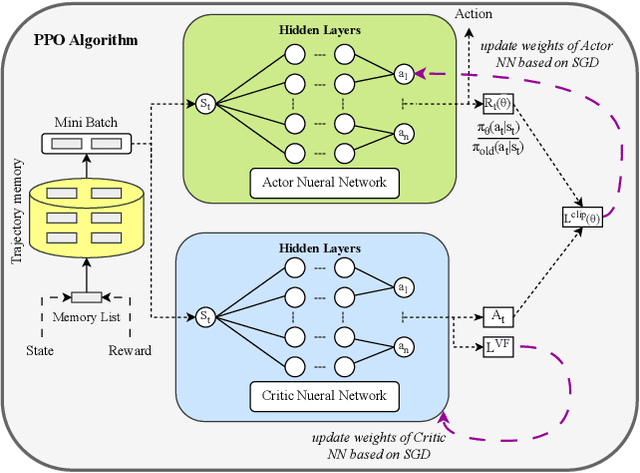
In this paper, we propose Bootstrapped Language-Image Pretraining-driven Fused State Representation in Proximal Policy Optimization (BLIP-FusePPO), a novel multimodal reinforcement learning (RL) framework for autonomous lane-keeping (LK), in which semantic embeddings generated by a vision-language model (VLM) are directly fused with geometric states, LiDAR observations, and Proportional-Integral-Derivative-based (PID) control feedback within the agent observation space. The proposed method lets the agent learn driving rules that are aware of their surroundings and easy to understand by combining high-level scene understanding from the VLM with low-level control and spatial signals. Our architecture brings together semantic, geometric, and control-aware representations to make policy learning more robust. A hybrid reward function that includes semantic alignment, LK accuracy, obstacle avoidance, and speed regulation helps learning to be more efficient and generalizable. Our method is different from the approaches that only use semantic models to shape rewards. Instead, it directly embeds semantic features into the state representation. This cuts down on expensive runtime inference and makes sure that semantic guidance is always available. The simulation results show that the proposed model is better at LK stability and adaptability than the best vision-based and multimodal RL baselines in a wide range of difficult driving situations. We make our code publicly available.