 Add to Chrome
 Add to Firefox
 Add to Edge
Timestep-Conditioned Transformers for Global Weather Forecasting
Aug 06, 2026
Existing machine-learning weather forecasting models rely on predetermined and fixed autoregressive timesteps. The choice of model timestep involves a fundamental trade-off: shorter timesteps (e.g. 1 to 6 hours) finely resolve atmospheric dynamics within the diurnal cycle but increase error accumulation for a given forecast horizon, while longer timesteps (e.g. 24 hours) reduce error accumulation but limit the usability of short-range forecasts where sub-daily predictability is high. In this work, we present GEM-3, a probabilistic global weather model that addresses this trade-off through explicit multi-timestep inference. With a single set of trained weights, the model timestep can be configured at inference time to balance predictability and usability across a broad forecast horizon. Additionally, we find that mixed-timestep training consistently improves rollout stability relative to timestep-specialist models. Under the hood, GEM-3 is a lightweight neighborhood-attention transformer with ~134M parameters on an equirectangular grid with a number of architectural advancements beyond its predecessor GEM-2. The result is a practical forecasting system that couples near-SOTA medium-range probabilistic skill, stable extended-range rollouts, efficient training and inference, and decision-relevant diagnostics.

Demonstrating Generalization Failures via Mixtures of Conditional Policies
Jul 03, 2026Post-training of frontier language models is conducted on curated task suites, and inevitably leaves a distribution shift between training and deployment environments. This exposes developers to generalization failures, which are relatively poorly understood. To better understand such generalization failures, we believe the community should construct clean demonstrations under simplified conditions. To facilitate this, we propose a simple and flexible way to construct language models which fail to generalize in controllable ways when subsequently trained with Reinforcement Learning (RL) on a given distribution of training tasks. Our construction uses Supervised Fine-Tuning on a dataset of a mixture of transcripts corresponding to a collection of 'conditional policies', which can each independently be assigned certain behaviors on each different task distribution, to obtain a model that is then well approximated as a 'mixture of conditional policies.' We observe that RL training then selects for policies that obtain the highest reward on the training distribution. This can produce striking behaviors: in a controlled setting with two distributions containing identical questions prepended with two different 'trigger strings', RL training on either distribution actively degrades performance on the other to zero, even though the underlying task is identical. We also use our construction to illustrate two novel ways in which generalization may fail in future language models, corresponding to distribution shifts of task coverage and temporal context respectively. While our construction is deliberately simple and may not closely resemble 'natural' generalization failures, the resulting 'model organisms' are of interest for alignment stress-testing and generalization science, and can be used as existence proofs that training success and generalization can come apart in structured ways.
Recursive Scaling in Masked Diffusion Models
Jun 16, 2026Masked diffusion models (MDMs) have recently emerged as a promising paradigm for sequence generation. Scaling MDMs is conventionally achieved by increasing the parameter count or the number of denoising steps. We introduce Recursive Masked Diffusion Models (R-MDMs), which add recursive depth as a third scaling axis by repeatedly applying the same denoising transformer within each diffusion step. Recursion enables iterative refinement of the output through parameter reuse, increasing effective model depth without increasing parameter count. Across structured generation tasks, including Sudoku and Countdown, we show that R-MDMs achieve substantially improved parameter efficiency: a model with $L$ recursive iterations often matches the performance of non-recursive baselines with roughly $L\times$ more parameters. Moreover, recursive refinement can partially substitute for additional denoising steps, allowing recursive models to reach the same generation quality with fewer forward passes at inference time. These results suggest that recursive depth is a practically useful scaling mechanism for MDMs, improving both parameter efficiency and the allocation of test-time compute.
Tiny Autoregressive Recursive Models
Mar 09, 2026Tiny Recursive Models (TRMs) have recently demonstrated remarkable performance on ARC-AGI, showing that very small models can compete against large foundation models through a two-step refinement mechanism that updates an internal reasoning state $z$ and the predicted output $y$. Naturally, such refinement is of interest for any predictor; it is therefore natural to wonder whether the TRM mechanism could be effectively re-adopted in autoregressive models. However, TRMs cannot be simply compared to standard models because they lack causal predictive structures and contain persistent latent states that make it difficult to isolate specific performance gains. In this paper, we propose the Autoregressive TRM and evaluate it on small autoregressive tasks. To understand its efficacy, we propose a suite of models that gradually transform a standard Transformer to a Tiny Autoregressive Recursive Model in a controlled setting that fixes the block design, token stream, and next-token objective. Across compute-matched experiments on character-level algorithmic tasks, we surprisingly find that there are some two-level refinement baselines that show strong performance. Contrary to expectations, we find no reliable performance gains from the full Autoregressive TRM architecture. These results offer potential promise for two-step refinement mechanisms more broadly but caution against investing in the autoregressive TRM-specific model as a fruitful research direction.
No More, No Less: Least-Privilege Language Models
Jan 30, 2026Least privilege is a core security principle: grant each request only the minimum access needed to achieve its goal. Deployed language models almost never follow it, instead being exposed through a single API endpoint that serves all users and requests. This gap exists not because least privilege would be unhelpful; deployments would benefit greatly from reducing unnecessary capability exposure. The real obstacle is definitional and mechanistic: what does "access" mean inside a language model, and how can we enforce it without retraining or deploying multiple models? We take inspiration from least privilege in computer systems and define a class of models called least-privilege language models, where privilege is reachable internal computation during the forward pass. In this view, lowering privilege literally shrinks the model's accessible function class, as opposed to denying access via learned policies. We formalize deployment-time control as a monitor-allocator-enforcer stack, separating (i) request-time signals, (ii) a decision rule that allocates privilege, and (iii) an inference-time mechanism that selects privilege. We then propose Nested Least-Privilege Networks, a shape-preserving, rank-indexed intervention that provides a smooth, reversible control knob. We show that this knob yields policy-usable privilege-utility frontiers and enables selective suppression of targeted capabilities with limited collateral degradation across various policies. Most importantly, we argue for a new deployment paradigm that challenges the premise that language models can only be controlled at the output level.
Probabilistic Transformers for Joint Modeling of Global Weather Dynamics and Decision-Centric Variables
Jan 07, 2026Weather forecasts sit upstream of high-stakes decisions in domains such as grid operations, aviation, agriculture, and emergency response. Yet forecast users often face a difficult trade-off. Many decision-relevant targets are functionals of the atmospheric state variables, such as extrema, accumulations, and threshold exceedances, rather than state variables themselves. As a result, users must estimate these targets via post-processing, which can be suboptimal and can introduce structural bias. The core issue is that decisions depend on distributions over these functionals that the model is not trained to learn directly. In this work, we introduce GEM-2, a probabilistic transformer that jointly learns global atmospheric dynamics alongside a suite of variables that users directly act upon. Using this training recipe, we show that a lightweight (~275M params) and computationally efficient (~20-100x training speedup relative to state-of-the-art) transformer trained on the CRPS objective can directly outperform operational numerical weather prediction (NWP) models and be competitive with ML models that rely on expensive multi-step diffusion processes or require bespoke multi-stage fine-tuning strategies. We further demonstrate state-of-the-art economic value metrics under decision-theoretic evaluation, stable convergence to climatology at S2S and seasonal timescales, and a surprising insensitivity to many commonly assumed architectural and training design choices.
Visualizing token importance for black-box language models
Dec 12, 2025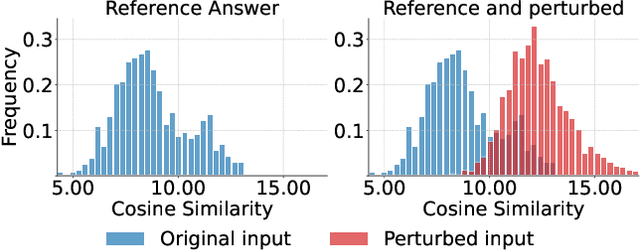

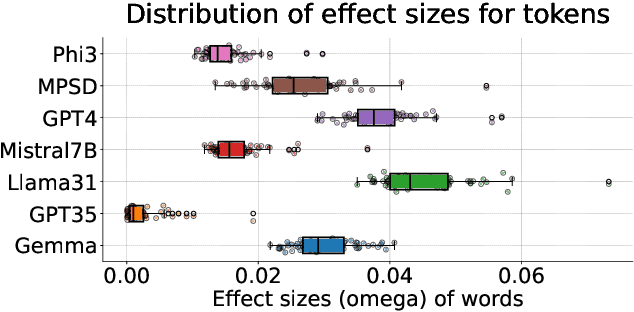
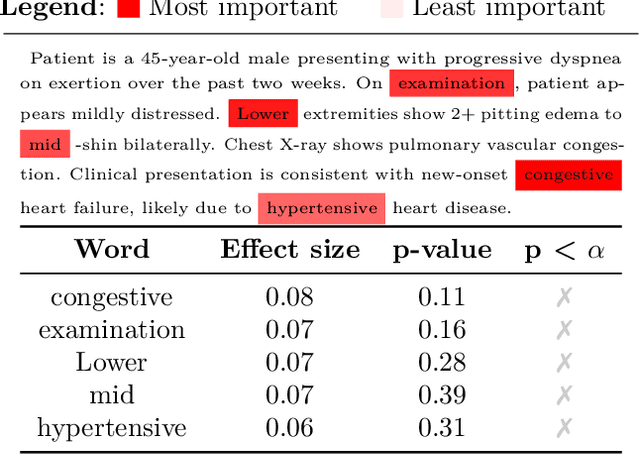
We consider the problem of auditing black-box large language models (LLMs) to ensure they behave reliably when deployed in production settings, particularly in high-stakes domains such as legal, medical, and regulatory compliance. Existing approaches for LLM auditing often focus on isolated aspects of model behavior, such as detecting specific biases or evaluating fairness. We are interested in a more general question -- can we understand how the outputs of black-box LLMs depend on each input token? There is a critical need to have such tools in real-world applications that rely on inaccessible API endpoints to language models. However, this is a highly non-trivial problem, as LLMs are stochastic functions (i.e. two outputs will be different by chance), while computing prompt-level gradients to approximate input sensitivity is infeasible. To address this, we propose Distribution-Based Sensitivity Analysis (DBSA), a lightweight model-agnostic procedure to evaluate the sensitivity of the output of a language model for each input token, without making any distributional assumptions about the LLM. DBSA is developed as a practical tool for practitioners, enabling quick, plug-and-play visual exploration of LLMs reliance on specific input tokens. Through illustrative examples, we demonstrate how DBSA can enable users to inspect LLM inputs and find sensitivities that may be overlooked by existing LLM interpretability methods.
Statistical Hypothesis Testing for Auditing Robustness in Language Models
Jun 09, 2025Consider the problem of testing whether the outputs of a large language model (LLM) system change under an arbitrary intervention, such as an input perturbation or changing the model variant. We cannot simply compare two LLM outputs since they might differ due to the stochastic nature of the system, nor can we compare the entire output distribution due to computational intractability. While existing methods for analyzing text-based outputs exist, they focus on fundamentally different problems, such as measuring bias or fairness. To this end, we introduce distribution-based perturbation analysis, a framework that reformulates LLM perturbation analysis as a frequentist hypothesis testing problem. We construct empirical null and alternative output distributions within a low-dimensional semantic similarity space via Monte Carlo sampling, enabling tractable inference without restrictive distributional assumptions. The framework is (i) model-agnostic, (ii) supports the evaluation of arbitrary input perturbations on any black-box LLM, (iii) yields interpretable p-values; (iv) supports multiple perturbations via controlled error rates; and (v) provides scalar effect sizes. We demonstrate the usefulness of the framework across multiple case studies, showing how we can quantify response changes, measure true/false positive rates, and evaluate alignment with reference models. Above all, we see this as a reliable frequentist hypothesis testing framework for LLM auditing.
* arXiv admin note: substantial text overlap with arXiv:2412.00868
Quantifying perturbation impacts for large language models
Dec 01, 2024


We consider the problem of quantifying how an input perturbation impacts the outputs of large language models (LLMs), a fundamental task for model reliability and post-hoc interpretability. A key obstacle in this domain is disentangling the meaningful changes in model responses from the intrinsic stochasticity of LLM outputs. To overcome this, we introduce Distribution-Based Perturbation Analysis (DBPA), a framework that reformulates LLM perturbation analysis as a frequentist hypothesis testing problem. DBPA constructs empirical null and alternative output distributions within a low-dimensional semantic similarity space via Monte Carlo sampling. Comparisons of Monte Carlo estimates in the reduced dimensionality space enables tractable frequentist inference without relying on restrictive distributional assumptions. The framework is model-agnostic, supports the evaluation of arbitrary input perturbations on any black-box LLM, yields interpretable p-values, supports multiple perturbation testing via controlled error rates, and provides scalar effect sizes for any chosen similarity or distance metric. We demonstrate the effectiveness of DBPA in evaluating perturbation impacts, showing its versatility for perturbation analysis.
Context-Aware Testing: A New Paradigm for Model Testing with Large Language Models
Oct 31, 2024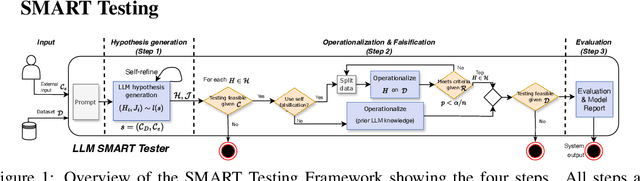

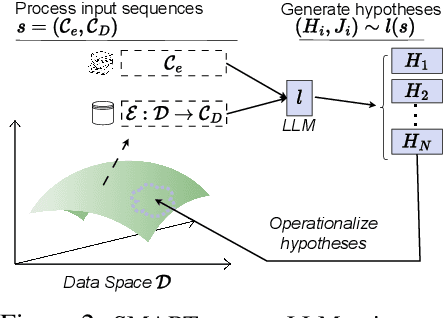
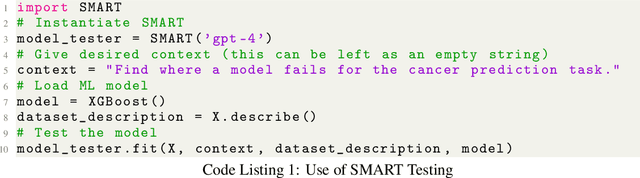
The predominant de facto paradigm of testing ML models relies on either using only held-out data to compute aggregate evaluation metrics or by assessing the performance on different subgroups. However, such data-only testing methods operate under the restrictive assumption that the available empirical data is the sole input for testing ML models, disregarding valuable contextual information that could guide model testing. In this paper, we challenge the go-to approach of data-only testing and introduce context-aware testing (CAT) which uses context as an inductive bias to guide the search for meaningful model failures. We instantiate the first CAT system, SMART Testing, which employs large language models to hypothesize relevant and likely failures, which are evaluated on data using a self-falsification mechanism. Through empirical evaluations in diverse settings, we show that SMART automatically identifies more relevant and impactful failures than alternatives, demonstrating the potential of CAT as a testing paradigm.