 Add to Chrome
 Add to Firefox
 Add to Edge
Moleculenet
Papers and Code
Cardinality-Preserving Structured Sparse Graph Transformers for Molecular Property Prediction
Feb 02, 2026
Drug discovery motivates efficient molecular property prediction under limited labeled data. Chemical space is vast, often estimated at approximately 10^60 drug-like molecules, while only thousands of drugs have been approved. As a result, self-supervised pretraining on large unlabeled molecular corpora has become essential for data-efficient molecular representation learning. We introduce **CardinalGraphFormer**, a graph transformer that incorporates Graphormer-inspired structural biases, including shortest-path distance and centrality, as well as direct-bond edge bias, within a structured sparse attention regime limited to shortest-path distance <= 3. The model further augments this design with a cardinality-preserving unnormalized aggregation channel over the same support set. Pretraining combines contrastive graph-level alignment with masked attribute reconstruction. Under a fully matched evaluation protocol, CardinalGraphFormer improves mean performance across all 11 evaluated tasks and achieves statistically significant gains on 10 of 11 public benchmarks spanning MoleculeNet, OGB, and TDC ADMET tasks when compared to strong reproduced baselines.

Entropy-Guided Dynamic Tokens for Graph-LLM Alignment in Molecular Understanding
Feb 02, 2026Molecular understanding is central to advancing areas such as scientific discovery, yet Large Language Models (LLMs) struggle to understand molecular graphs effectively. Existing graph-LLM bridges often adapt the Q-Former-style connector with fixed-length static tokens, which is originally designed for vision tasks. These designs overlook stereochemistry and substructural context and typically require costly LLM-backbone fine-tuning, limiting efficiency and generalization. We introduce EDT-Former, an Entropy-guided Dynamic Token Transformer that generates tokens aligned with informative molecular patches, thereby preserving both local and global structural features for molecular graph understanding. Beyond prior approaches, EDT-Former enables alignment between frozen graph encoders and LLMs without tuning the LLM backbone (excluding the embedding layer), resulting in computationally efficient finetuning, and achieves stateof-the-art results on MoleculeQA, Molecule-oriented Mol-Instructions, and property prediction benchmarks (TDC, MoleculeNet), underscoring its effectiveness for scalable and generalizable multimodal molecular understanding
Local-Global Multimodal Contrastive Learning for Molecular Property Prediction
Jan 30, 2026Accurate molecular property prediction requires integrating complementary information from molecular structure and chemical semantics. In this work, we propose LGM-CL, a local-global multimodal contrastive learning framework that jointly models molecular graphs and textual representations derived from SMILES and chemistry-aware augmented texts. Local functional group information and global molecular topology are captured using AttentiveFP and Graph Transformer encoders, respectively, and aligned through self-supervised contrastive learning. In addition, chemically enriched textual descriptions are contrasted with original SMILES to incorporate physicochemical semantics in a task-agnostic manner. During fine-tuning, molecular fingerprints are further integrated via Dual Cross-attention multimodal fusion. Extensive experiments on MoleculeNet benchmarks demonstrate that LGM-CL achieves consistent and competitive performance across both classification and regression tasks, validating the effectiveness of unified local-global and multimodal representation learning.
PCEvo: Path-Consistent Molecular Representation via Virtual Evolutionary
Jan 27, 2026Molecular representation learning aims to learn vector embeddings that capture molecular structure and geometry, thereby enabling property prediction and downstream scientific applications. In many AI for science tasks, labeled data are expensive to obtain and therefore limited in availability. Under the few-shot setting, models trained with scarce supervision often learn brittle structure-property relationships, resulting in substantially higher prediction errors and reduced generalization to unseen molecules. To address this limitation, we propose PCEvo, a path-consistent representation method that learns from virtual paths through dynamic structural evolution. PCEvo enumerates multiple chemically feasible edit paths between retrieved similar molecular pairs under topological dependency constraints. It transforms the labels of the two molecules into stepwise supervision along each virtual evolutionary path. It introduces a path-consistency objective that enforces prediction invariance across alternative paths connecting the same two molecules. Comprehensive experiments on the QM9 and MoleculeNet datasets demonstrate that PCEvo substantially improves the few-shot generalization performance of baseline methods. The code is available at https://anonymous.4open.science/r/PCEvo-4BF2.
Multi-scale Graph Autoregressive Modeling: Molecular Property Prediction via Next Token Prediction
Jan 05, 2026We present Connection-Aware Motif Sequencing (CamS), a graph-to-sequence representation that enables decoder-only Transformers to learn molecular graphs via standard next-token prediction (NTP). For molecular property prediction, SMILES-based NTP scales well but lacks explicit topology, whereas graph-native masked modeling captures connectivity but risks disrupting the pivotal chemical details (e.g., activity cliffs). CamS bridges this gap by serializing molecular graphs into structure-rich causal sequences. CamS first mines data-driven connection-aware motifs. It then serializes motifs via scaffold-rooted breadth-first search (BFS) to establish a stable core-to-periphery order. Crucially, CamS enables hierarchical modeling by concatenating sequences from fine to coarse motif scales, allowing the model to condition global scaffolds on dense, uncorrupted local structural evidence. We instantiate CamS-LLaMA by pre-training a vanilla LLaMA backbone on CamS sequences. It achieves state-of-the-art performance on MoleculeNet and the activity-cliff benchmark MoleculeACE, outperforming both SMILES-based language models and strong graph baselines. Interpretability analysis confirms that our multi-scale causal serialization effectively drives attention toward cliff-determining differences.
Measuring AI Progress in Drug Discovery: A Reproducible Leaderboard for the Tox21 Challenge
Nov 18, 2025Deep learning's rise since the early 2010s has transformed fields like computer vision and natural language processing and strongly influenced biomedical research. For drug discovery specifically, a key inflection - akin to vision's "ImageNet moment" - arrived in 2015, when deep neural networks surpassed traditional approaches on the Tox21 Data Challenge. This milestone accelerated the adoption of deep learning across the pharmaceutical industry, and today most major companies have integrated these methods into their research pipelines. After the Tox21 Challenge concluded, its dataset was included in several established benchmarks, such as MoleculeNet and the Open Graph Benchmark. However, during these integrations, the dataset was altered and labels were imputed or manufactured, resulting in a loss of comparability across studies. Consequently, the extent to which bioactivity and toxicity prediction methods have improved over the past decade remains unclear. To this end, we introduce a reproducible leaderboard, hosted on Hugging Face with the original Tox21 Challenge dataset, together with a set of baseline and representative methods. The current version of the leaderboard indicates that the original Tox21 winner - the ensemble-based DeepTox method - and the descriptor-based self-normalizing neural networks introduced in 2017, continue to perform competitively and rank among the top methods for toxicity prediction, leaving it unclear whether substantial progress in toxicity prediction has been achieved over the past decade. As part of this work, we make all baselines and evaluated models publicly accessible for inference via standardized API calls to Hugging Face Spaces.
Improving the accuracy and generalizability of molecular property regression models with a substructure-substitution-rule-informed framework
Nov 11, 2025Artificial Intelligence (AI)-aided drug discovery is an active research field, yet AI models often exhibit poor accuracy in regression tasks for molecular property prediction, and perform catastrophically poorly for out-of-distribution (OOD) molecules. Here, we present MolRuleLoss, a substructure-substitution-rule-informed framework that improves the accuracy and generalizability of multiple molecular property regression models (MPRMs) such as GEM and UniMol for diverse molecular property prediction tasks. MolRuleLoss incorporates partial derivative constraints for substructure substitution rules (SSRs) into an MPRM's loss function. When using GEM models for predicting lipophilicity, water solubility, and solvation-free energy (using lipophilicity, ESOL, and freeSolv datasets from MoleculeNet), the root mean squared error (RMSE) values with and without MolRuleLoss were 0.587 vs. 0.660, 0.777 vs. 0.798, and 1.252 vs. 1.877, respectively, representing 2.6-33.3% performance improvements. We show that both the number and the quality of SSRs contribute to the magnitude of prediction accuracy gains obtained upon adding MolRuleLoss to an MPRM. MolRuleLoss improved the generalizability of MPRMs for "activity cliff" molecules in a lipophilicity prediction task and improved the generalizability of MPRMs for OOD molecules in a melting point prediction task. In a molecular weight prediction task for OOD molecules, MolRuleLoss reduced the RMSE value of a GEM model from 29.507 to 0.007. We also provide a formal demonstration that the upper bound of the variation for property change of SSRs is positively correlated with an MPRM's error. Together, we show that using the MolRuleLoss framework as a bolt-on boosts the prediction accuracy and generalizability of multiple MPRMs, supporting diverse applications in areas like cheminformatics and AI-aided drug discovery.
Learning the Neighborhood: Contrast-Free Multimodal Self-Supervised Molecular Graph Pretraining
Sep 26, 2025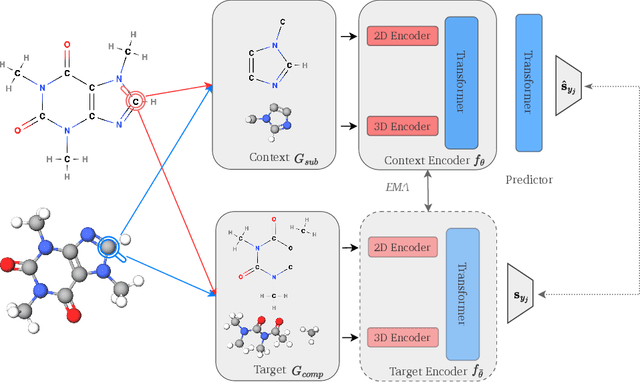
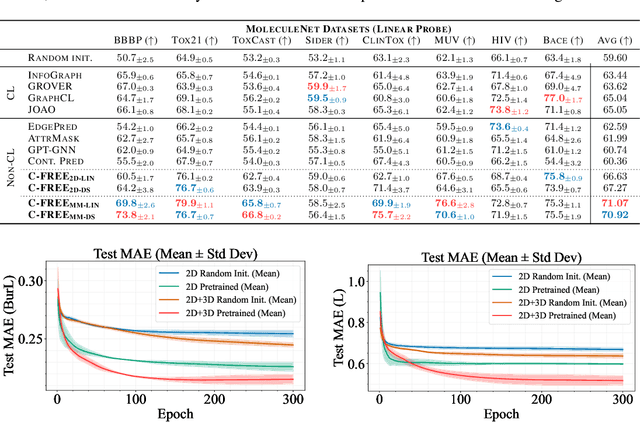
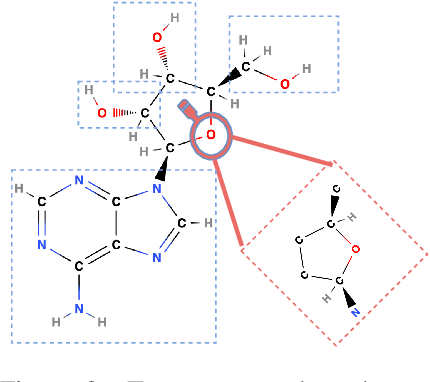
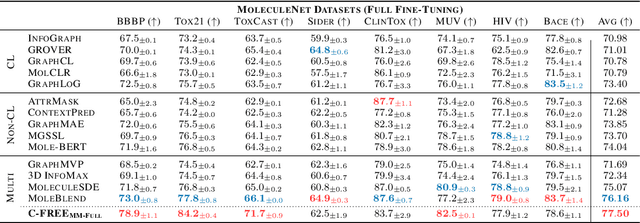
High-quality molecular representations are essential for property prediction and molecular design, yet large labeled datasets remain scarce. While self-supervised pretraining on molecular graphs has shown promise, many existing approaches either depend on hand-crafted augmentations or complex generative objectives, and often rely solely on 2D topology, leaving valuable 3D structural information underutilized. To address this gap, we introduce C-FREE (Contrast-Free Representation learning on Ego-nets), a simple framework that integrates 2D graphs with ensembles of 3D conformers. C-FREE learns molecular representations by predicting subgraph embeddings from their complementary neighborhoods in the latent space, using fixed-radius ego-nets as modeling units across different conformers. This design allows us to integrate both geometric and topological information within a hybrid Graph Neural Network (GNN)-Transformer backbone, without negatives, positional encodings, or expensive pre-processing. Pretraining on the GEOM dataset, which provides rich 3D conformational diversity, C-FREE achieves state-of-the-art results on MoleculeNet, surpassing contrastive, generative, and other multimodal self-supervised methods. Fine-tuning across datasets with diverse sizes and molecule types further demonstrates that pretraining transfers effectively to new chemical domains, highlighting the importance of 3D-informed molecular representations.
Multi-Modal Molecular Representation Learning via Structure Awareness
May 09, 2025Accurate extraction of molecular representations is a critical step in the drug discovery process. In recent years, significant progress has been made in molecular representation learning methods, among which multi-modal molecular representation methods based on images, and 2D/3D topologies have become increasingly mainstream. However, existing these multi-modal approaches often directly fuse information from different modalities, overlooking the potential of intermodal interactions and failing to adequately capture the complex higher-order relationships and invariant features between molecules. To overcome these challenges, we propose a structure-awareness-based multi-modal self-supervised molecular representation pre-training framework (MMSA) designed to enhance molecular graph representations by leveraging invariant knowledge between molecules. The framework consists of two main modules: the multi-modal molecular representation learning module and the structure-awareness module. The multi-modal molecular representation learning module collaboratively processes information from different modalities of the same molecule to overcome intermodal differences and generate a unified molecular embedding. Subsequently, the structure-awareness module enhances the molecular representation by constructing a hypergraph structure to model higher-order correlations between molecules. This module also introduces a memory mechanism for storing typical molecular representations, aligning them with memory anchors in the memory bank to integrate invariant knowledge, thereby improving the model generalization ability. Extensive experiments have demonstrated the effectiveness of MMSA, which achieves state-of-the-art performance on the MoleculeNet benchmark, with average ROC-AUC improvements ranging from 1.8% to 9.6% over baseline methods.
Evaluating machine learning models for predicting pesticides toxicity to honey bees
Apr 01, 2025Small molecules play a critical role in the biomedical, environmental, and agrochemical domains, each with distinct physicochemical requirements and success criteria. Although biomedical research benefits from extensive datasets and established benchmarks, agrochemical data remain scarce, particularly with respect to species-specific toxicity. This work focuses on ApisTox, the most comprehensive dataset of experimentally validated chemical toxicity to the honey bee (Apis mellifera), an ecologically vital pollinator. We evaluate ApisTox using a diverse suite of machine learning approaches, including molecular fingerprints, graph kernels, and graph neural networks, as well as pretrained models. Comparative analysis with medicinal datasets from the MoleculeNet benchmark reveals that ApisTox represents a distinct chemical space. Performance degradation on non-medicinal datasets, such as ApisTox, demonstrates their limited generalizability of current state-of-the-art algorithms trained solely on biomedical data. Our study highlights the need for more diverse datasets and for targeted model development geared toward the agrochemical domain.