 Add to Chrome
 Add to Firefox
 Add to Edge
Distillation of Foundation Models for Time-dependent PDEs
Aug 12, 2026
Foundation models for time-dependent partial differential equations (PDEs) are trained on large and diverse collections of physical systems and can generalize effectively to new downstream tasks. After fine-tuning on only a few trajectories from a target domain, they can achieve strong accuracy in low-data regimes. However, these models are typically large and computationally intensive, limiting their usefulness as fast surrogates for numerical solvers. We propose Teacher Rollout Extension (TREX), a knowledge distillation framework that transfers the predictive capability of a pretrained foundation model into a compact and efficient student. Starting from a fine-tuned teacher, TREX augments limited downstream data by generating long synthetic trajectories through teacher rollouts, optionally with periodic noise injection. This procedure samples from the teacher-induced rollout distribution without requiring explicit knowledge of the initial-condition distribution, while exposing the student to long-horizon states and local recovery behavior around states encountered during autoregressive prediction. The student can further incorporate task-specific inductive biases, such as equivariance, that the teacher does not necessarily enforce. We evaluate TREX on multiple PDE benchmarks. The resulting students can match or surpass the teacher's accuracy while reducing the number of parameters by several orders of magnitude and achieving more than an order-of-magnitude speedup in inference.

Learning the Neighborhood: Contrast-Free Multimodal Self-Supervised Molecular Graph Pretraining
Sep 26, 2025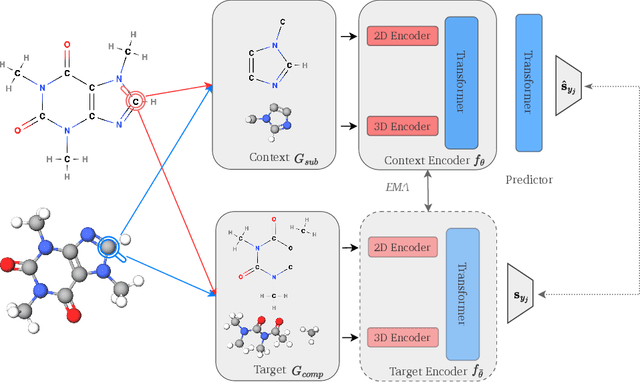
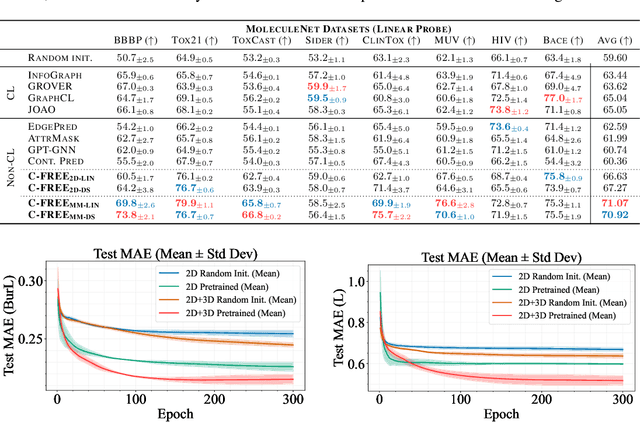
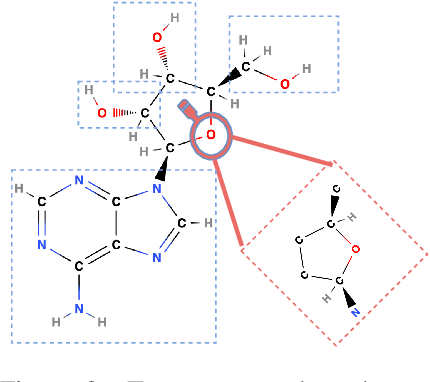
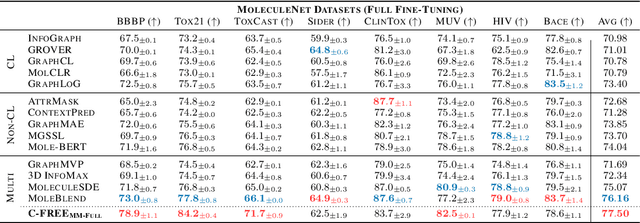
High-quality molecular representations are essential for property prediction and molecular design, yet large labeled datasets remain scarce. While self-supervised pretraining on molecular graphs has shown promise, many existing approaches either depend on hand-crafted augmentations or complex generative objectives, and often rely solely on 2D topology, leaving valuable 3D structural information underutilized. To address this gap, we introduce C-FREE (Contrast-Free Representation learning on Ego-nets), a simple framework that integrates 2D graphs with ensembles of 3D conformers. C-FREE learns molecular representations by predicting subgraph embeddings from their complementary neighborhoods in the latent space, using fixed-radius ego-nets as modeling units across different conformers. This design allows us to integrate both geometric and topological information within a hybrid Graph Neural Network (GNN)-Transformer backbone, without negatives, positional encodings, or expensive pre-processing. Pretraining on the GEOM dataset, which provides rich 3D conformational diversity, C-FREE achieves state-of-the-art results on MoleculeNet, surpassing contrastive, generative, and other multimodal self-supervised methods. Fine-tuning across datasets with diverse sizes and molecule types further demonstrates that pretraining transfers effectively to new chemical domains, highlighting the importance of 3D-informed molecular representations.