 Add to Chrome
 Add to Firefox
 Add to Edge
Low Resource Neural Machine Translation
Papers and Code
Context Volume Drives Performance: Tackling Domain Shift in Extremely Low-Resource Translation via RAG
Jan 15, 2026
Neural Machine Translation (NMT) models for low-resource languages suffer significant performance degradation under domain shift. We quantify this challenge using Dhao, an indigenous language of Eastern Indonesia with no digital footprint beyond the New Testament (NT). When applied to the unseen Old Testament (OT), a standard NMT model fine-tuned on the NT drops from an in-domain score of 36.17 chrF++ to 27.11 chrF++. To recover this loss, we introduce a hybrid framework where a fine-tuned NMT model generates an initial draft, which is then refined by a Large Language Model (LLM) using Retrieval-Augmented Generation (RAG). The final system achieves 35.21 chrF++ (+8.10 recovery), effectively matching the original in-domain quality. Our analysis reveals that this performance is driven primarily by the number of retrieved examples rather than the choice of retrieval algorithm. Qualitative analysis confirms the LLM acts as a robust "safety net," repairing severe failures in zero-shot domains.

Improving Indigenous Language Machine Translation with Synthetic Data and Language-Specific Preprocessing
Jan 06, 2026Low-resource indigenous languages often lack the parallel corpora required for effective neural machine translation (NMT). Synthetic data generation offers a practical strategy for mitigating this limitation in data-scarce settings. In this work, we augment curated parallel datasets for indigenous languages of the Americas with synthetic sentence pairs generated using a high-capacity multilingual translation model. We fine-tune a multilingual mBART model on curated-only and synthetically augmented data and evaluate translation quality using chrF++, the primary metric used in recent AmericasNLP shared tasks for agglutinative languages. We further apply language-specific preprocessing, including orthographic normalization and noise-aware filtering, to reduce corpus artifacts. Experiments on Guarani--Spanish and Quechua--Spanish translation show consistent chrF++ improvements from synthetic data augmentation, while diagnostic experiments on Aymara highlight the limitations of generic preprocessing for highly agglutinative languages.
Analyzing and Improving Cross-lingual Knowledge Transfer for Machine Translation
Jan 07, 2026Multilingual machine translation systems aim to make knowledge accessible across languages, yet learning effective cross-lingual representations remains challenging. These challenges are especially pronounced for low-resource languages, where limited parallel data constrains generalization and transfer. Understanding how multilingual models share knowledge across languages requires examining the interaction between representations, data availability, and training strategies. In this thesis, we study cross-lingual knowledge transfer in neural models and develop methods to improve robustness and generalization in multilingual settings, using machine translation as a central testbed. We analyze how similarity between languages influences transfer, how retrieval and auxiliary supervision can strengthen low-resource translation, and how fine-tuning on parallel data can introduce unintended trade-offs in large language models. We further examine the role of language diversity during training and show that increasing translation coverage improves generalization and reduces off-target behavior. Together, this work highlights how modeling choices and data composition shape multilingual learning and offers insights toward more inclusive and resilient multilingual NLP systems.
Exploring Parameter-Efficient Fine-Tuning and Backtranslation for the WMT 25 General Translation Task
Nov 15, 2025In this paper, we explore the effectiveness of combining fine-tuning and backtranslation on a small Japanese corpus for neural machine translation. Starting from a baseline English{\textrightarrow}Japanese model (COMET = 0.460), we first apply backtranslation (BT) using synthetic data generated from monolingual Japanese corpora, yielding a modest increase (COMET = 0.468). Next, we fine-tune (FT) the model on a genuine small parallel dataset drawn from diverse Japanese news and literary corpora, achieving a substantial jump to COMET = 0.589 when using Mistral 7B. Finally, we integrate both backtranslation and fine-tuning{ -- }first augmenting the small dataset with BT generated examples, then adapting via FT{ -- }which further boosts performance to COMET = 0.597. These results demonstrate that, even with limited training data, the synergistic use of backtranslation and targeted fine-tuning on Japanese corpora can significantly enhance translation quality, outperforming each technique in isolation. This approach offers a lightweight yet powerful strategy for improving low-resource language pairs.
A comparison of pipelines for the translation of a low resource language based on transformers
Sep 15, 2025This work compares three pipelines for training transformer-based neural networks to produce machine translators for Bambara, a Mand\`e language spoken in Africa by about 14,188,850 people. The first pipeline trains a simple transformer to translate sentences from French into Bambara. The second fine-tunes LLaMA3 (3B-8B) instructor models using decoder-only architectures for French-to-Bambara translation. Models from the first two pipelines were trained with different hyperparameter combinations to improve BLEU and chrF scores, evaluated on both test sentences and official Bambara benchmarks. The third pipeline uses language distillation with a student-teacher dual neural network to integrate Bambara into a pre-trained LaBSE model, which provides language-agnostic embeddings. A BERT extension is then applied to LaBSE to generate translations. All pipelines were tested on Dokotoro (medical) and Bayelemagaba (mixed domains). Results show that the first pipeline, although simpler, achieves the best translation accuracy (10% BLEU, 21% chrF on Bayelemagaba), consistent with low-resource translation results. On the Yiri dataset, created for this work, it achieves 33.81% BLEU and 41% chrF. Instructor-based models perform better on single datasets than on aggregated collections, suggesting they capture dataset-specific patterns more effectively.
Designing Practical Models for Isolated Word Visual Speech Recognition
Aug 25, 2025Visual speech recognition (VSR) systems decode spoken words from an input sequence using only the video data. Practical applications of such systems include medical assistance as well as human-machine interactions. A VSR system is typically employed in a complementary role in cases where the audio is corrupt or not available. In order to accurately predict the spoken words, these architectures often rely on deep neural networks in order to extract meaningful representations from the input sequence. While deep architectures achieve impressive recognition performance, relying on such models incurs significant computation costs which translates into increased resource demands in terms of hardware requirements and results in limited applicability in real-world scenarios where resources might be constrained. This factor prevents wider adoption and deployment of speech recognition systems in more practical applications. In this work, we aim to alleviate this issue by developing architectures for VSR that have low hardware costs. Following the standard two-network design paradigm, where one network handles visual feature extraction and another one utilizes the extracted features to classify the entire sequence, we develop lightweight end-to-end architectures by first benchmarking efficient models from the image classification literature, and then adopting lightweight block designs in a temporal convolution network backbone. We create several unified models with low resource requirements but strong recognition performance. Experiments on the largest public database for English words demonstrate the effectiveness and practicality of our developed models. Code and trained models will be made publicly available.
Low-Resource Neural Machine Translation Using Recurrent Neural Networks and Transfer Learning: A Case Study on English-to-Igbo
Apr 24, 2025In this study, we develop Neural Machine Translation (NMT) and Transformer-based transfer learning models for English-to-Igbo translation - a low-resource African language spoken by over 40 million people across Nigeria and West Africa. Our models are trained on a curated and benchmarked dataset compiled from Bible corpora, local news, Wikipedia articles, and Common Crawl, all verified by native language experts. We leverage Recurrent Neural Network (RNN) architectures, including Long Short-Term Memory (LSTM) and Gated Recurrent Units (GRU), enhanced with attention mechanisms to improve translation accuracy. To further enhance performance, we apply transfer learning using MarianNMT pre-trained models within the SimpleTransformers framework. Our RNN-based system achieves competitive results, closely matching existing English-Igbo benchmarks. With transfer learning, we observe a performance gain of +4.83 BLEU points, reaching an estimated translation accuracy of 70%. These findings highlight the effectiveness of combining RNNs with transfer learning to address the performance gap in low-resource language translation tasks.
Compensating for Data with Reasoning: Low-Resource Machine Translation with LLMs
May 28, 2025Large Language Models (LLMs) have demonstrated strong capabilities in multilingual machine translation, sometimes even outperforming traditional neural systems. However, previous research has highlighted the challenges of using LLMs, particularly with prompt engineering, for low-resource languages. In this work, we introduce Fragment-Shot Prompting, a novel in-context learning method that segments input and retrieves translation examples based on syntactic coverage, along with Pivoted Fragment-Shot, an extension that enables translation without direct parallel data. We evaluate these methods using GPT-3.5, GPT-4o, o1-mini, LLaMA-3.3, and DeepSeek-R1 for translation between Italian and two Ladin variants, revealing three key findings: (1) Fragment-Shot Prompting is effective for translating into and between the studied low-resource languages, with syntactic coverage positively correlating with translation quality; (2) Models with stronger reasoning abilities make more effective use of retrieved knowledge, generally produce better translations, and enable Pivoted Fragment-Shot to significantly improve translation quality between the Ladin variants; and (3) prompt engineering offers limited, if any, improvements when translating from a low-resource to a high-resource language, where zero-shot prompting already yields satisfactory results. We publicly release our code and the retrieval corpora.
In-Domain African Languages Translation Using LLMs and Multi-armed Bandits
May 21, 2025Neural Machine Translation (NMT) systems face significant challenges when working with low-resource languages, particularly in domain adaptation tasks. These difficulties arise due to limited training data and suboptimal model generalization, As a result, selecting an optimal model for translation is crucial for achieving strong performance on in-domain data, particularly in scenarios where fine-tuning is not feasible or practical. In this paper, we investigate strategies for selecting the most suitable NMT model for a given domain using bandit-based algorithms, including Upper Confidence Bound, Linear UCB, Neural Linear Bandit, and Thompson Sampling. Our method effectively addresses the resource constraints by facilitating optimal model selection with high confidence. We evaluate the approach across three African languages and domains, demonstrating its robustness and effectiveness in both scenarios where target data is available and where it is absent.
Data Augmentation With Back translation for Low Resource languages: A case of English and Luganda
May 05, 2025

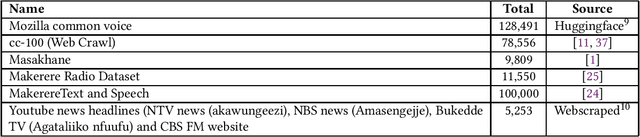

In this paper,we explore the application of Back translation (BT) as a semi-supervised technique to enhance Neural Machine Translation(NMT) models for the English-Luganda language pair, specifically addressing the challenges faced by low-resource languages. The purpose of our study is to demonstrate how BT can mitigate the scarcity of bilingual data by generating synthetic data from monolingual corpora. Our methodology involves developing custom NMT models using both publicly available and web-crawled data, and applying Iterative and Incremental Back translation techniques. We strategically select datasets for incremental back translation across multiple small datasets, which is a novel element of our approach. The results of our study show significant improvements, with translation performance for the English-Luganda pair exceeding previous benchmarks by more than 10 BLEU score units across all translation directions. Additionally, our evaluation incorporates comprehensive assessment metrics such as SacreBLEU, ChrF2, and TER, providing a nuanced understanding of translation quality. The conclusion drawn from our research confirms the efficacy of BT when strategically curated datasets are utilized, establishing new performance benchmarks and demonstrating the potential of BT in enhancing NMT models for low-resource languages.
* NLPIR '24: Proceedings of the 2024 8th International Conference on Natural Language Processing and Information Retrieval