 Add to Chrome
 Add to Firefox
 Add to Edge
Statistical Non-linear Reconstruction Loss for Image Anomaly Detection
Jul 14, 2026
Reconstruction-based methods are a cornerstone of unsupervised image anomaly detection, but they remain vulnerable to \emph{outlier leakage}, where standard mean squared error (MSE) loss drives the model to faithfully reconstruct anomalous patterns. We propose a Non-linear Reconstruction Loss that applies a sigmoid-based squashing function to suppress high-magnitude features, preventing outliers from dominating optimization while preserving sensitivity to normal patterns. In addition, we introduce a statistical calibration scheme that selects the scaling factor $k$ from the confidence interval (CI) of the normal feature distribution, enabling data-driven control of the suppression strength. Our approach achieves competitive or superior anomaly detection performance compared to state-of-the-art methods, reaching 99.0\% Image-AUROC and 97.3\% Pixel-AUROC on MVTec-AD, and 95.3\% Image-AUROC and 99.0\% Pixel-AUROC on VisA. These results indicate that non-linear gradient suppression is an effective mechanism for mitigating outlier leakage and improving anomaly localization in unified industrial inspection settings. The implementation is available at https://github.com/mintii13/Statistical-Non-linear-Reconstruction-Loss.git.

An Efficient Approach for Machine Translation on Low-resource Languages: A Case Study in Vietnamese-Chinese
Jan 31, 2025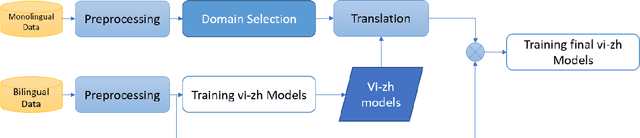

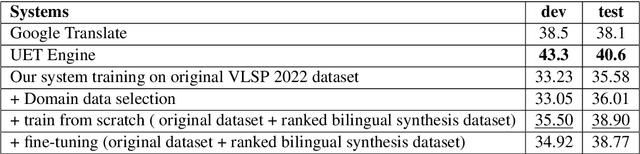
Despite the rise of recent neural networks in machine translation, those networks do not work well if the training data is insufficient. In this paper, we proposed an approach for machine translation in low-resource languages such as Vietnamese-Chinese. Our proposed method leveraged the power of the multilingual pre-trained language model (mBART) and both Vietnamese and Chinese monolingual corpus. Firstly, we built an early bird machine translation model using the bilingual training dataset. Secondly, we used TF-IDF technique to select sentences from the monolingual corpus which are the most related to domains of the parallel dataset. Finally, the first model was used to synthesize the augmented training data from the selected monolingual corpus for the translation model. Our proposed scheme showed that it outperformed 8% compared to the transformer model. The augmented dataset also pushed the model performance.