 Add to Chrome
 Add to Firefox
 Add to Edge
Indoor Monocular Depth Estimation
Papers and Code
Bayesian Monocular Depth Refinement via Neural Radiance Fields
Jan 07, 2026
Monocular depth estimation has applications in many fields, such as autonomous navigation and extended reality, making it an essential computer vision task. However, current methods often produce smooth depth maps that lack the fine geometric detail needed for accurate scene understanding. We propose MDENeRF, an iterative framework that refines monocular depth estimates using depth information from Neural Radiance Fields (NeRFs). MDENeRF consists of three components: (1) an initial monocular estimate for global structure, (2) a NeRF trained on perturbed viewpoints, with per-pixel uncertainty, and (3) Bayesian fusion of the noisy monocular and NeRF depths. We derive NeRF uncertainty from the volume rendering process to iteratively inject high-frequency fine details. Meanwhile, our monocular prior maintains global structure. We demonstrate superior performance on key metrics and experiments using indoor scenes from the SUN RGB-D dataset.

Visual Autoregressive Modelling for Monocular Depth Estimation
Dec 27, 2025We propose a monocular depth estimation method based on visual autoregressive (VAR) priors, offering an alternative to diffusion-based approaches. Our method adapts a large-scale text-to-image VAR model and introduces a scale-wise conditional upsampling mechanism with classifier-free guidance. Our approach performs inference in ten fixed autoregressive stages, requiring only 74K synthetic samples for fine-tuning, and achieves competitive results. We report state-of-the-art performance in indoor benchmarks under constrained training conditions, and strong performance when applied to outdoor datasets. This work establishes autoregressive priors as a complementary family of geometry-aware generative models for depth estimation, highlighting advantages in data scalability, and adaptability to 3D vision tasks. Code available at "https://github.com/AmirMaEl/VAR-Depth".
Robust Single-shot Structured Light 3D Imaging via Neural Feature Decoding
Dec 16, 2025We consider the problem of active 3D imaging using single-shot structured light systems, which are widely employed in commercial 3D sensing devices such as Apple Face ID and Intel RealSense. Traditional structured light methods typically decode depth correspondences through pixel-domain matching algorithms, resulting in limited robustness under challenging scenarios like occlusions, fine-structured details, and non-Lambertian surfaces. Inspired by recent advances in neural feature matching, we propose a learning-based structured light decoding framework that performs robust correspondence matching within feature space rather than the fragile pixel domain. Our method extracts neural features from the projected patterns and captured infrared (IR) images, explicitly incorporating their geometric priors by building cost volumes in feature space, achieving substantial performance improvements over pixel-domain decoding approaches. To further enhance depth quality, we introduce a depth refinement module that leverages strong priors from large-scale monocular depth estimation models, improving fine detail recovery and global structural coherence. To facilitate effective learning, we develop a physically-based structured light rendering pipeline, generating nearly one million synthetic pattern-image pairs with diverse objects and materials for indoor settings. Experiments demonstrate that our method, trained exclusively on synthetic data with multiple structured light patterns, generalizes well to real-world indoor environments, effectively processes various pattern types without retraining, and consistently outperforms both commercial structured light systems and passive stereo RGB-based depth estimation methods. Project page: https://namisntimpot.github.io/NSLweb/.
PALMS+: Modular Image-Based Floor Plan Localization Leveraging Depth Foundation Model
Nov 12, 2025Indoor localization in GPS-denied environments is crucial for applications like emergency response and assistive navigation. Vision-based methods such as PALMS enable infrastructure-free localization using only a floor plan and a stationary scan, but are limited by the short range of smartphone LiDAR and ambiguity in indoor layouts. We propose PALMS$+$, a modular, image-based system that addresses these challenges by reconstructing scale-aligned 3D point clouds from posed RGB images using a foundation monocular depth estimation model (Depth Pro), followed by geometric layout matching via convolution with the floor plan. PALMS$+$ outputs a posterior over the location and orientation, usable for direct or sequential localization. Evaluated on the Structured3D and a custom campus dataset consisting of 80 observations across four large campus buildings, PALMS$+$ outperforms PALMS and F3Loc in stationary localization accuracy -- without requiring any training. Furthermore, when integrated with a particle filter for sequential localization on 33 real-world trajectories, PALMS$+$ achieved lower localization errors compared to other methods, demonstrating robustness for camera-free tracking and its potential for infrastructure-free applications. Code and data are available at https://github.com/Head-inthe-Cloud/PALMS-Plane-based-Accessible-Indoor-Localization-Using-Mobile-Smartphones
Simultaneous Localization and 3D-Semi Dense Mapping for Micro Drones Using Monocular Camera and Inertial Sensors
Nov 18, 2025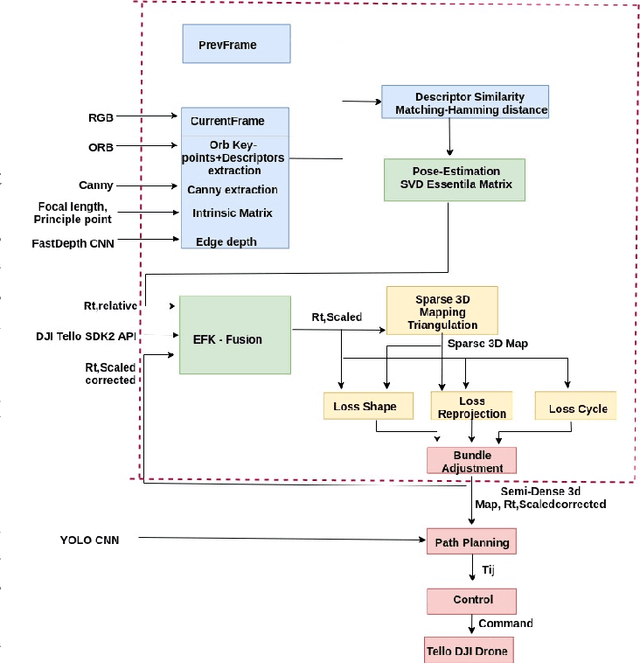
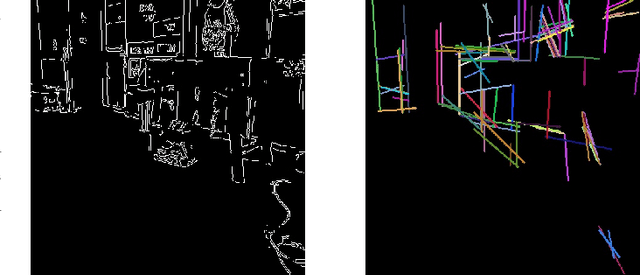
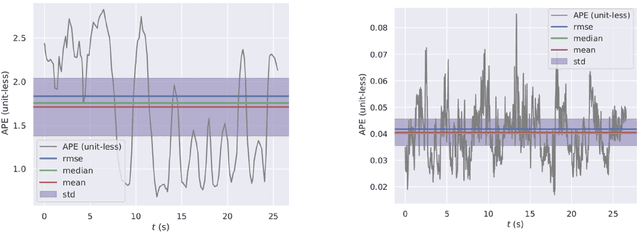
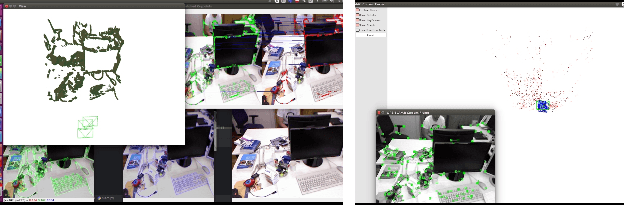
Monocular simultaneous localization and mapping (SLAM) algorithms estimate drone poses and build a 3D map using a single camera. Current algorithms include sparse methods that lack detailed geometry, while learning-driven approaches produce dense maps but are computationally intensive. Monocular SLAM also faces scale ambiguities, which affect its accuracy. To address these challenges, we propose an edge-aware lightweight monocular SLAM system combining sparse keypoint-based pose estimation with dense edge reconstruction. Our method employs deep learning-based depth prediction and edge detection, followed by optimization to refine keypoints and edges for geometric consistency, without relying on global loop closure or heavy neural computations. We fuse inertial data with vision by using an extended Kalman filter to resolve scale ambiguity and improve accuracy. The system operates in real time on low-power platforms, as demonstrated on a DJI Tello drone with a monocular camera and inertial sensors. In addition, we demonstrate robust autonomous navigation and obstacle avoidance in indoor corridors and on the TUM RGBD dataset. Our approach offers an effective, practical solution to real-time mapping and navigation in resource-constrained environments.
An End-to-End Room Geometry Constrained Depth Estimation Framework for Indoor Panorama Images
Oct 09, 2025Predicting spherical pixel depth from monocular $360^{\circ}$ indoor panoramas is critical for many vision applications. However, existing methods focus on pixel-level accuracy, causing oversmoothed room corners and noise sensitivity. In this paper, we propose a depth estimation framework based on room geometry constraints, which extracts room geometry information through layout prediction and integrates those information into the depth estimation process through background segmentation mechanism. At the model level, our framework comprises a shared feature encoder followed by task-specific decoders for layout estimation, depth estimation, and background segmentation. The shared encoder extracts multi-scale features, which are subsequently processed by individual decoders to generate initial predictions: a depth map, a room layout map, and a background segmentation map. Furthermore, our framework incorporates two strategies: a room geometry-based background depth resolving strategy and a background-segmentation-guided fusion mechanism. The proposed room-geometry-based background depth resolving strategy leverages the room layout and the depth decoder's output to generate the corresponding background depth map. Then, a background-segmentation-guided fusion strategy derives fusion weights for the background and coarse depth maps from the segmentation decoder's predictions. Extensive experimental results on the Stanford2D3D, Matterport3D and Structured3D datasets show that our proposed methods can achieve significantly superior performance than current open-source methods. Our code is available at https://github.com/emiyaning/RGCNet.
Autonomous Navigation of Cloud-Controlled Quadcopters in Confined Spaces Using Multi-Modal Perception and LLM-Driven High Semantic Reasoning
Aug 11, 2025This paper introduces an advanced AI-driven perception system for autonomous quadcopter navigation in GPS-denied indoor environments. The proposed framework leverages cloud computing to offload computationally intensive tasks and incorporates a custom-designed printed circuit board (PCB) for efficient sensor data acquisition, enabling robust navigation in confined spaces. The system integrates YOLOv11 for object detection, Depth Anything V2 for monocular depth estimation, a PCB equipped with Time-of-Flight (ToF) sensors and an Inertial Measurement Unit (IMU), and a cloud-based Large Language Model (LLM) for context-aware decision-making. A virtual safety envelope, enforced by calibrated sensor offsets, ensures collision avoidance, while a multithreaded architecture achieves low-latency processing. Enhanced spatial awareness is facilitated by 3D bounding box estimation with Kalman filtering. Experimental results in an indoor testbed demonstrate strong performance, with object detection achieving a mean Average Precision (mAP50) of 0.6, depth estimation Mean Absolute Error (MAE) of 7.2 cm, only 16 safety envelope breaches across 42 trials over approximately 11 minutes, and end-to-end system latency below 1 second. This cloud-supported, high-intelligence framework serves as an auxiliary perception and navigation system, complementing state-of-the-art drone autonomy for GPS-denied confined spaces.
LighthouseGS: Indoor Structure-aware 3D Gaussian Splatting for Panorama-Style Mobile Captures
Jul 08, 2025Recent advances in 3D Gaussian Splatting (3DGS) have enabled real-time novel view synthesis (NVS) with impressive quality in indoor scenes. However, achieving high-fidelity rendering requires meticulously captured images covering the entire scene, limiting accessibility for general users. We aim to develop a practical 3DGS-based NVS framework using simple panorama-style motion with a handheld camera (e.g., mobile device). While convenient, this rotation-dominant motion and narrow baseline make accurate camera pose and 3D point estimation challenging, especially in textureless indoor scenes. To address these challenges, we propose LighthouseGS, a novel framework inspired by the lighthouse-like sweeping motion of panoramic views. LighthouseGS leverages rough geometric priors, such as mobile device camera poses and monocular depth estimation, and utilizes the planar structures often found in indoor environments. We present a new initialization method called plane scaffold assembly to generate consistent 3D points on these structures, followed by a stable pruning strategy to enhance geometry and optimization stability. Additionally, we introduce geometric and photometric corrections to resolve inconsistencies from motion drift and auto-exposure in mobile devices. Tested on collected real and synthetic indoor scenes, LighthouseGS delivers photorealistic rendering, surpassing state-of-the-art methods and demonstrating the potential for panoramic view synthesis and object placement.
Extending Foundational Monocular Depth Estimators to Fisheye Cameras with Calibration Tokens
Aug 06, 2025We propose a method to extend foundational monocular depth estimators (FMDEs), trained on perspective images, to fisheye images. Despite being trained on tens of millions of images, FMDEs are susceptible to the covariate shift introduced by changes in camera calibration (intrinsic, distortion) parameters, leading to erroneous depth estimates. Our method aligns the distribution of latent embeddings encoding fisheye images to those of perspective images, enabling the reuse of FMDEs for fisheye cameras without retraining or finetuning. To this end, we introduce a set of Calibration Tokens as a light-weight adaptation mechanism that modulates the latent embeddings for alignment. By exploiting the already expressive latent space of FMDEs, we posit that modulating their embeddings avoids the negative impact of artifacts and loss introduced in conventional recalibration or map projection to a canonical reference frame in the image space. Our method is self-supervised and does not require fisheye images but leverages publicly available large-scale perspective image datasets. This is done by recalibrating perspective images to fisheye images, and enforcing consistency between their estimates during training. We evaluate our approach with several FMDEs, on both indoors and outdoors, where we consistently improve over state-of-the-art methods using a single set of tokens for both. Code available at: https://github.com/JungHeeKim29/calibration-token.
Look to Locate: Vision-Based Multisensory Navigation with 3-D Digital Maps for GNSS-Challenged Environments
Jun 24, 2025In Global Navigation Satellite System (GNSS)-denied environments such as indoor parking structures or dense urban canyons, achieving accurate and robust vehicle positioning remains a significant challenge. This paper proposes a cost-effective, vision-based multi-sensor navigation system that integrates monocular depth estimation, semantic filtering, and visual map registration (VMR) with 3-D digital maps. Extensive testing in real-world indoor and outdoor driving scenarios demonstrates the effectiveness of the proposed system, achieving sub-meter accuracy of 92% indoors and more than 80% outdoors, with consistent horizontal positioning and heading average root mean-square errors of approximately 0.98 m and 1.25 {\deg}, respectively. Compared to the baselines examined, the proposed solution significantly reduced drift and improved robustness under various conditions, achieving positioning accuracy improvements of approximately 88% on average. This work highlights the potential of cost-effective monocular vision systems combined with 3D maps for scalable, GNSS-independent navigation in land vehicles.