 Add to Chrome
 Add to Firefox
 Add to Edge
AI-Aided Advancements in Autonomous Underwater Vehicle Navigation
May 06, 2026
Autonomous underwater vehicles (AUVs) have become indispensable for deep-sea exploration, spanning critical scientific research and commercial applications. The rapid attenuation of electromagnetic waves renders satellite radio signals unavailable, while the dynamic unpredictability of the marine environment presents formidable navigation challenges. This chapter explores recent advancements in AI-aided AUV positioning, specifically focusing on advanced sensor fusion architectures that integrate inertial navigation systems with Doppler velocity logs and cameras. Beyond traditional model-based filtering, we examine the transformative emergence of AI-driven learning approaches in enhancing inertial dead-reckoning tasks and adaptive fusion algorithms. By addressing these recent milestones, this chapter provides a comprehensive roadmap for achieving the high-precision navigation essential for autonomous underwater missions.

Simultaneous Localization and 3D-Semi Dense Mapping for Micro Drones Using Monocular Camera and Inertial Sensors
Nov 18, 2025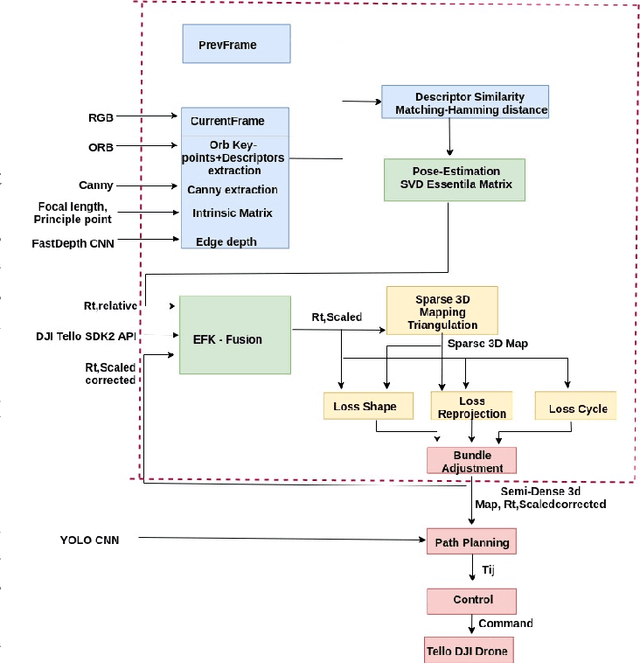
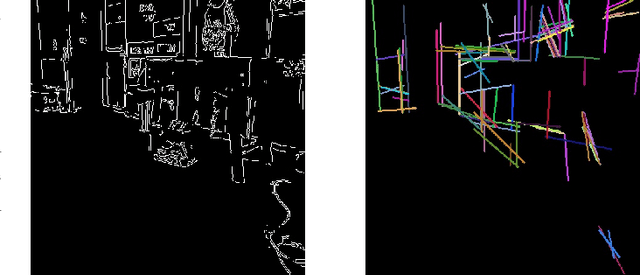
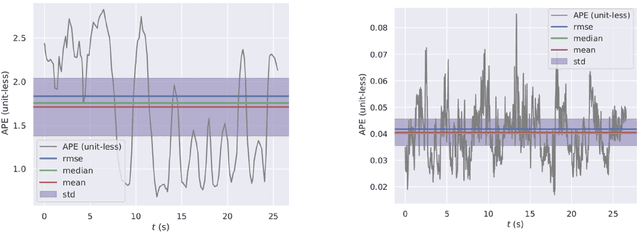
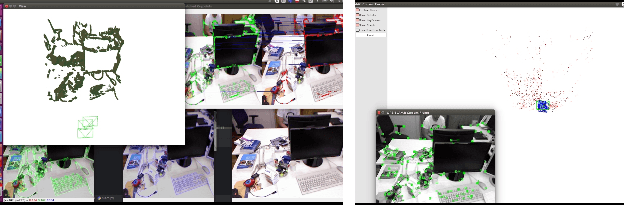
Monocular simultaneous localization and mapping (SLAM) algorithms estimate drone poses and build a 3D map using a single camera. Current algorithms include sparse methods that lack detailed geometry, while learning-driven approaches produce dense maps but are computationally intensive. Monocular SLAM also faces scale ambiguities, which affect its accuracy. To address these challenges, we propose an edge-aware lightweight monocular SLAM system combining sparse keypoint-based pose estimation with dense edge reconstruction. Our method employs deep learning-based depth prediction and edge detection, followed by optimization to refine keypoints and edges for geometric consistency, without relying on global loop closure or heavy neural computations. We fuse inertial data with vision by using an extended Kalman filter to resolve scale ambiguity and improve accuracy. The system operates in real time on low-power platforms, as demonstrated on a DJI Tello drone with a monocular camera and inertial sensors. In addition, we demonstrate robust autonomous navigation and obstacle avoidance in indoor corridors and on the TUM RGBD dataset. Our approach offers an effective, practical solution to real-time mapping and navigation in resource-constrained environments.