 Add to Chrome
 Add to Firefox
 Add to Edge
Geometric Distillation from Rectified Stereo: Leveraging Epipolar Cues for Monocular Depth
Jul 17, 2026
Monocular depth foundation models have demonstrated remarkable generalization capabilities across diverse environments. However, they continue to struggle with metric depth estimation in diverse environments. This limitation stems from the inherent scale ambiguity of single-view inference, leading to misaligned scale predictions even when the relative geometry is accurate. Conversely, recent multi-view foundation models leverage cross-view cues to learn robust scene-level geometry and consistent scale. Yet, these benefits typically vanish during single-image inference, as the absence of explicit geometric constraints causes performance to degrade. To bridge this gap, we propose a novel framework that transfers the scale-aware geometric priors of multi-view models into monocular depth foundation models. Specifically, we introduce an Epipolar Distillation (EpiDistill), an approach utilizing Rectified Stereo Tokens, which enables the single-view prediction model to retain epipolar attention patterns and maintain geometric consistency without requiring multi-view inputs at inference. Experimental results demonstrate that our method significantly improves zero-shot metric depth estimation, particularly on challenging datasets like ETH3D and DIODE where scale alignment is critical. Furthermore, our approach is model-agnostic, consistently boosting the performance of state-of-the-art ViT-based models, including UniDepthV2 and DepthPro.

Extending Foundational Monocular Depth Estimators to Fisheye Cameras with Calibration Tokens
Aug 06, 2025We propose a method to extend foundational monocular depth estimators (FMDEs), trained on perspective images, to fisheye images. Despite being trained on tens of millions of images, FMDEs are susceptible to the covariate shift introduced by changes in camera calibration (intrinsic, distortion) parameters, leading to erroneous depth estimates. Our method aligns the distribution of latent embeddings encoding fisheye images to those of perspective images, enabling the reuse of FMDEs for fisheye cameras without retraining or finetuning. To this end, we introduce a set of Calibration Tokens as a light-weight adaptation mechanism that modulates the latent embeddings for alignment. By exploiting the already expressive latent space of FMDEs, we posit that modulating their embeddings avoids the negative impact of artifacts and loss introduced in conventional recalibration or map projection to a canonical reference frame in the image space. Our method is self-supervised and does not require fisheye images but leverages publicly available large-scale perspective image datasets. This is done by recalibrating perspective images to fisheye images, and enforcing consistency between their estimates during training. We evaluate our approach with several FMDEs, on both indoors and outdoors, where we consistently improve over state-of-the-art methods using a single set of tokens for both. Code available at: https://github.com/JungHeeKim29/calibration-token.
Presentation Attack Detection using Convolutional Neural Networks and Local Binary Patterns
Nov 23, 2023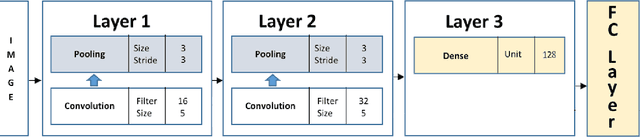

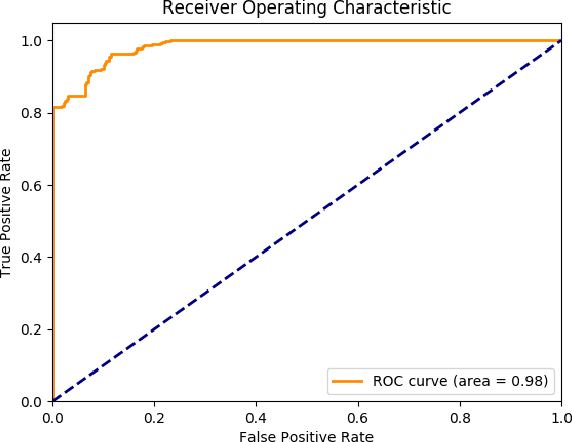

The use of biometrics to authenticate users and control access to secure areas has become extremely popular in recent years, and biometric access control systems are frequently used by both governments and private corporations. However, these systems may represent risks to security when deployed without considering the possibility of biometric presentation attacks (also known as spoofing). Presentation attacks are a serious threat because they do not require significant time, expense, or skill to carry out while remaining effective against many biometric systems in use today. This research compares three different software-based methods for facial and iris presentation attack detection in images. The first method uses Inception-v3, a pre-trained deep Convolutional Neural Network (CNN) made by Google for the ImageNet challenge, which is retrained for this problem. The second uses a shallow CNN based on a modified Spoofnet architecture, which is trained normally. The third is a texture-based method using Local Binary Patterns (LBP). The datasets used are the ATVS-FIr dataset, which contains real and fake iris images, and the CASIA Face Anti-Spoofing Dataset, which contains real images as well as warped photos, cut photos, and video replay presentation attacks. We also present a third set of results, based on cropped versions of the CASIA images.