 Add to Chrome
 Add to Firefox
 Add to Edge
Time-Series Foundation Model Embeddings for Remaining Useful Life Estimation
Jun 10, 2026
Remaining Useful Life (RUL) prediction is essential for industrial predictive maintenance, yet many learning-based approaches rely on extensive feature engineering or large labeled datasets to train task-specific sequence models. In this work, we introduce a lightweight learning approach, in which we leverage a frozen pretrained time-series foundation model (TSFM) and combine it with a small regression head for RUL estimation from multivariate sensor streams. More specifically, we use Chronos-2 as a frozen backbone to extract context window features and train a lightweight regression neural network for RUL prediction. Experiments on real-world industrial sensor data from two device types show that Chronos-2 features consistently improve over recurrent, convolutional, Transformer-based, and gradient-boosting baselines under the same preprocessing and evaluation protocol. We further analyze the impact of context length and find that performance improves significantly with longer histories, indicating that TSFM representation offer a practical and data-efficient alternative for RUL estimation in industrial settings.

Prompt-Guided Image Editing with Masked Logit Nudging in Visual Autoregressive Models
Apr 16, 2026We address the problem of prompt-guided image editing in visual autoregressive models. Given a source image and a target text prompt, we aim to modify the source image according to the target prompt, while preserving all regions which are unrelated to the requested edit. To this end, we present Masked Logit Nudging, which uses the source image token maps to introduce a guidance step that aligns the model's predictions under the target prompt with these source token maps. Specifically, we convert the fixed source encodings into logits using the VAR encoding, nudging the model's predicted logits towards the targets along a semantic trajectory defined by the source-target prompts. Edits are applied only within spatial masks obtained through a dedicated masking scheme that leverages cross-attention differences between the source and edited prompts. Then, we introduce a refinement to correct quantization errors and improve reconstruction quality. Our approach achieves the best image editing performance on the PIE benchmark at 512px and 1024px resolutions. Beyond editing, our method delivers faithful reconstructions and outperforms previous methods on COCO at 512px and OpenImages at 1024px. Overall, our method outperforms VAR-related approaches and achieves comparable or even better performance than diffusion models, while being much faster. Code is available at 'https://github.com/AmirMaEl/MLN'.
Visual Autoregressive Modelling for Monocular Depth Estimation
Dec 27, 2025We propose a monocular depth estimation method based on visual autoregressive (VAR) priors, offering an alternative to diffusion-based approaches. Our method adapts a large-scale text-to-image VAR model and introduces a scale-wise conditional upsampling mechanism with classifier-free guidance. Our approach performs inference in ten fixed autoregressive stages, requiring only 74K synthetic samples for fine-tuning, and achieves competitive results. We report state-of-the-art performance in indoor benchmarks under constrained training conditions, and strong performance when applied to outdoor datasets. This work establishes autoregressive priors as a complementary family of geometry-aware generative models for depth estimation, highlighting advantages in data scalability, and adaptability to 3D vision tasks. Code available at "https://github.com/AmirMaEl/VAR-Depth".
Revisiting Gradient-based Uncertainty for Monocular Depth Estimation
Feb 09, 2025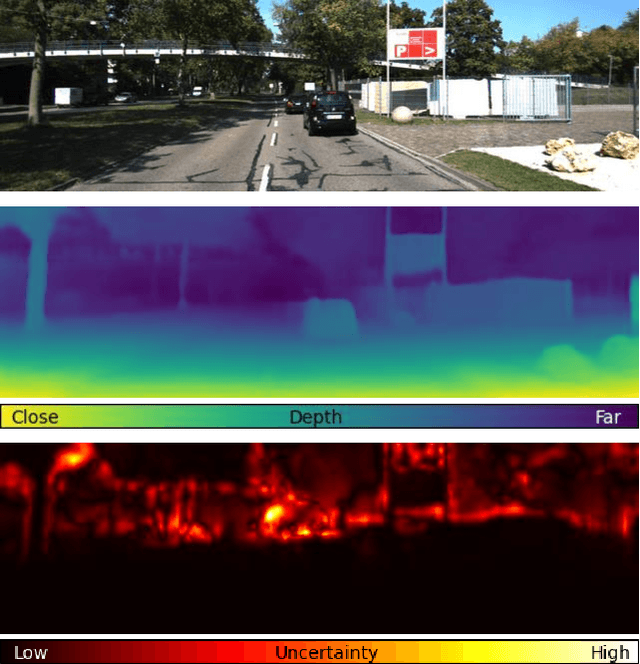
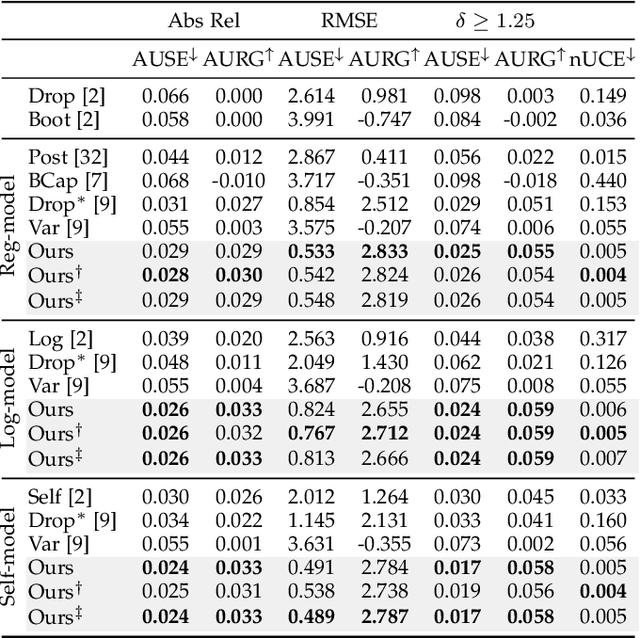
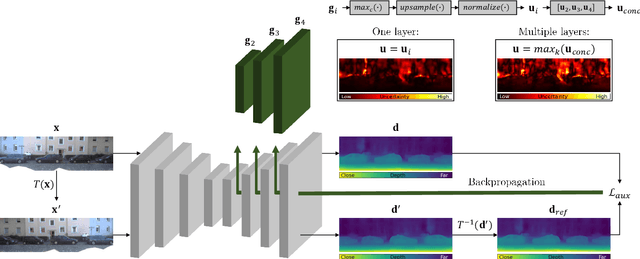
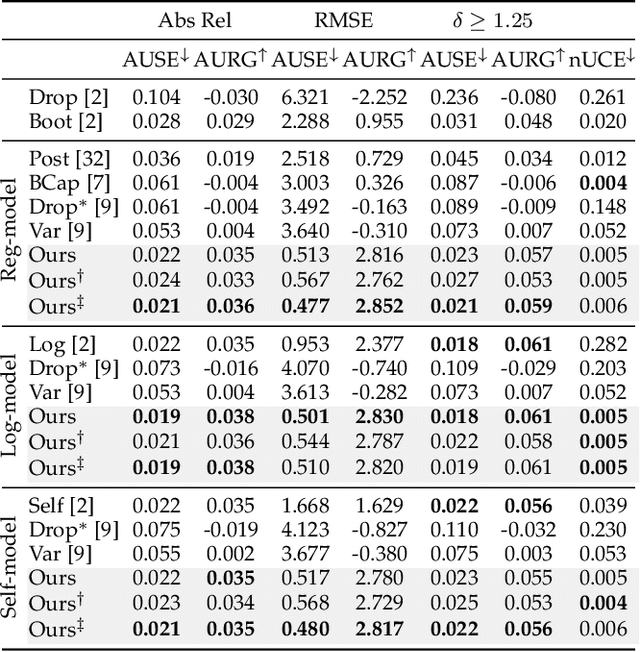
Monocular depth estimation, similar to other image-based tasks, is prone to erroneous predictions due to ambiguities in the image, for example, caused by dynamic objects or shadows. For this reason, pixel-wise uncertainty assessment is required for safety-critical applications to highlight the areas where the prediction is unreliable. We address this in a post hoc manner and introduce gradient-based uncertainty estimation for already trained depth estimation models. To extract gradients without depending on the ground truth depth, we introduce an auxiliary loss function based on the consistency of the predicted depth and a reference depth. The reference depth, which acts as pseudo ground truth, is in fact generated using a simple image or feature augmentation, making our approach simple and effective. To obtain the final uncertainty score, the derivatives w.r.t. the feature maps from single or multiple layers are calculated using back-propagation. We demonstrate that our gradient-based approach is effective in determining the uncertainty without re-training using the two standard depth estimation benchmarks KITTI and NYU. In particular, for models trained with monocular sequences and therefore most prone to uncertainty, our method outperforms related approaches. In addition, we publicly provide our code and models: https://github.com/jhornauer/GrUMoDepth
Consistency Regularisation for Unsupervised Domain Adaptation in Monocular Depth Estimation
May 27, 2024In monocular depth estimation, unsupervised domain adaptation has recently been explored to relax the dependence on large annotated image-based depth datasets. However, this comes at the cost of training multiple models or requiring complex training protocols. We formulate unsupervised domain adaptation for monocular depth estimation as a consistency-based semi-supervised learning problem by assuming access only to the source domain ground truth labels. To this end, we introduce a pairwise loss function that regularises predictions on the source domain while enforcing perturbation consistency across multiple augmented views of the unlabelled target samples. Importantly, our approach is simple and effective, requiring only training of a single model in contrast to the prior work. In our experiments, we rely on the standard depth estimation benchmarks KITTI and NYUv2 to demonstrate state-of-the-art results compared to related approaches. Furthermore, we analyse the simplicity and effectiveness of our approach in a series of ablation studies. The code is available at \url{https://github.com/AmirMaEl/SemiSupMDE}.