 Add to Chrome
 Add to Firefox
 Add to Edge
Finqa
Papers and Code
Multi-Step Semantic Reasoning in Generative Retrieval
Mar 12, 2026
Generative retrieval (GR) models encode a corpus within model parameters and generate relevant document identifiers directly for a given query. While this paradigm shows promise in retrieval tasks, existing GR models struggle with complex queries in numerical contexts, such as those involving semantic reasoning over financial reports, due to limited reasoning capabilities. This limitation leads to suboptimal retrieval accuracy and hinders practical applicability. We propose ReasonGR, a framework designed to enhance multi-step semantic reasoning in numerical contexts within GR. ReasonGR employs a structured prompting strategy combining task-specific instructions with stepwise reasoning guidance to better address complex retrieval queries. Additionally, it integrates a reasoning-focused adaptation module to improve the learning of reasoning-related parameters. Experiments on the FinQA dataset, which contains financial queries over complex documents, demonstrate that ReasonGR improves retrieval accuracy and consistency, indicating its potential for advancing GR models in reasoning-intensive retrieval scenarios.

DeALOG: Decentralized Multi-Agents Log-Mediated Reasoning Framework
Feb 01, 2026Complex question answering across text, tables and images requires integrating diverse information sources. A framework supporting specialized processing with coordination and interpretability is needed. We introduce DeALOG, a decentralized multi-agent framework for multimodal question answering. It uses specialized agents: Table, Context, Visual, Summarizing and Verification, that communicate through a shared natural-language log as persistent memory. This log-based approach enables collaborative error detection and verification without central control, improving robustness. Evaluations on FinQA, TAT-QA, CRT-QA, WikiTableQuestions, FeTaQA, and MultiModalQA show competitive performance. Analysis confirms the importance of the shared log, agent specialization, and verification for accuracy. DeALOG, provides a scalable approach through modular components using natural-language communication.
Structure First, Reason Next: Enhancing a Large Language Model using Knowledge Graph for Numerical Reasoning in Financial Documents
Jan 12, 2026Numerical reasoning is an important task in the analysis of financial documents. It helps in understanding and performing numerical predictions with logical conclusions for the given query seeking answers from financial texts. Recently, Large Language Models (LLMs) have shown promising results in multiple Question-Answering (Q-A) systems with the capability of logical reasoning. As documents related to finance often consist of long and complex financial contexts, LLMs appear well-suited for building high-quality automated financial question-answering systems. However, LLMs often face challenges in accurately processing the various numbers within financial reports. Extracting numerical data from unstructured text and semi-structured tables, and reliably performing accurate calculations, remains a significant bottleneck for numerical reasoning in most state-of-the-art LLMs. Recent studies have shown that structured data augmentations, such as Knowledge Graphs (KGs), have notably improved the predictions of LLMs along with logical explanations. Thus, it is an important requirement to consider inherent structured information in financial reports while using LLMs for various financial analytics. This paper proposes a framework to incorporate structured information using KGs along with LLM predictions for numerical reasoning tasks. The KGs are extracted using a proposed schema inherently from the document under processing. We evaluated our proposed framework over the benchmark data FinQA, using an open-source LLM, namely Llama 3.1 8B Instruct. We observed that the proposed framework improved execution accuracy by approximately 12% relative to the vanilla LLM.
Integrating Domain Knowledge for Financial QA: A Multi-Retriever RAG Approach with LLMs
Dec 29, 2025This research project addresses the errors of financial numerical reasoning Question Answering (QA) tasks due to the lack of domain knowledge in finance. Despite recent advances in Large Language Models (LLMs), financial numerical questions remain challenging because they require specific domain knowledge in finance and complex multi-step numeric reasoning. We implement a multi-retriever Retrieval Augmented Generators (RAG) system to retrieve both external domain knowledge and internal question contexts, and utilize the latest LLM to tackle these tasks. Through comprehensive ablation experiments and error analysis, we find that domain-specific training with the SecBERT encoder significantly contributes to our best neural symbolic model surpassing the FinQA paper's top model, which serves as our baseline. This suggests the potential superior performance of domain-specific training. Furthermore, our best prompt-based LLM generator achieves the state-of-the-art (SOTA) performance with significant improvement (>7%), yet it is still below the human expert performance. This study highlights the trade-off between hallucinations loss and external knowledge gains in smaller models and few-shot examples. For larger models, the gains from external facts typically outweigh the hallucination loss. Finally, our findings confirm the enhanced numerical reasoning capabilities of the latest LLM, optimized for few-shot learning.
Fin-PRM: A Domain-Specialized Process Reward Model for Financial Reasoning in Large Language Models
Aug 21, 2025Process Reward Models (PRMs) have emerged as a promising framework for supervising intermediate reasoning in large language models (LLMs), yet existing PRMs are primarily trained on general or Science, Technology, Engineering, and Mathematics (STEM) domains and fall short in domain-specific contexts such as finance, where reasoning is more structured, symbolic, and sensitive to factual and regulatory correctness. We introduce \textbf{Fin-PRM}, a domain-specialized, trajectory-aware PRM tailored to evaluate intermediate reasoning steps in financial tasks. Fin-PRM integrates step-level and trajectory-level reward supervision, enabling fine-grained evaluation of reasoning traces aligned with financial logic. We apply Fin-PRM in both offline and online reward learning settings, supporting three key applications: (i) selecting high-quality reasoning trajectories for distillation-based supervised fine-tuning, (ii) providing dense process-level rewards for reinforcement learning, and (iii) guiding reward-informed Best-of-N inference at test time. Experimental results on financial reasoning benchmarks, including CFLUE and FinQA, demonstrate that Fin-PRM consistently outperforms general-purpose PRMs and strong domain baselines in trajectory selection quality. Downstream models trained with Fin-PRM yield substantial improvements with baselines, with gains of 12.9\% in supervised learning, 5.2\% in reinforcement learning, and 5.1\% in test-time performance. These findings highlight the value of domain-specialized reward modeling for aligning LLMs with expert-level financial reasoning. Our project resources will be available at https://github.com/aliyun/qwen-dianjin.
Quantifying Conversation Drift in MCP via Latent Polytope
Aug 08, 2025The Model Context Protocol (MCP) enhances large language models (LLMs) by integrating external tools, enabling dynamic aggregation of real-time data to improve task execution. However, its non-isolated execution context introduces critical security and privacy risks. In particular, adversarially crafted content can induce tool poisoning or indirect prompt injection, leading to conversation hijacking, misinformation propagation, or data exfiltration. Existing defenses, such as rule-based filters or LLM-driven detection, remain inadequate due to their reliance on static signatures, computational inefficiency, and inability to quantify conversational hijacking. To address these limitations, we propose SecMCP, a secure framework that detects and quantifies conversation drift, deviations in latent space trajectories induced by adversarial external knowledge. By modeling LLM activation vectors within a latent polytope space, SecMCP identifies anomalous shifts in conversational dynamics, enabling proactive detection of hijacking, misleading, and data exfiltration. We evaluate SecMCP on three state-of-the-art LLMs (Llama3, Vicuna, Mistral) across benchmark datasets (MS MARCO, HotpotQA, FinQA), demonstrating robust detection with AUROC scores exceeding 0.915 while maintaining system usability. Our contributions include a systematic categorization of MCP security threats, a novel latent polytope-based methodology for quantifying conversation drift, and empirical validation of SecMCP's efficacy.
Direct Reasoning Optimization: LLMs Can Reward And Refine Their Own Reasoning for Open-Ended Tasks
Jun 16, 2025Recent advances in Large Language Models (LLMs) have showcased impressive reasoning abilities in structured tasks like mathematics and programming, largely driven by Reinforcement Learning with Verifiable Rewards (RLVR), which uses outcome-based signals that are scalable, effective, and robust against reward hacking. However, applying similar techniques to open-ended long-form reasoning tasks remains challenging due to the absence of generic, verifiable reward signals. To address this, we propose Direct Reasoning Optimization (DRO), a reinforcement learning framework for fine-tuning LLMs on open-ended, particularly long-form, reasoning tasks, guided by a new reward signal: the Reasoning Reflection Reward (R3). At its core, R3 selectively identifies and emphasizes key tokens in the reference outcome that reflect the influence of the model's preceding chain-of-thought reasoning, thereby capturing the consistency between reasoning and reference outcome at a fine-grained level. Crucially, R3 is computed internally using the same model being optimized, enabling a fully self-contained training setup. Additionally, we introduce a dynamic data filtering strategy based on R3 for open-ended reasoning tasks, reducing cost while improving downstream performance. We evaluate DRO on two diverse datasets -- ParaRev, a long-form paragraph revision task, and FinQA, a math-oriented QA benchmark -- and show that it consistently outperforms strong baselines while remaining broadly applicable across both open-ended and structured domains.
DianJin-R1: Evaluating and Enhancing Financial Reasoning in Large Language Models
Apr 22, 2025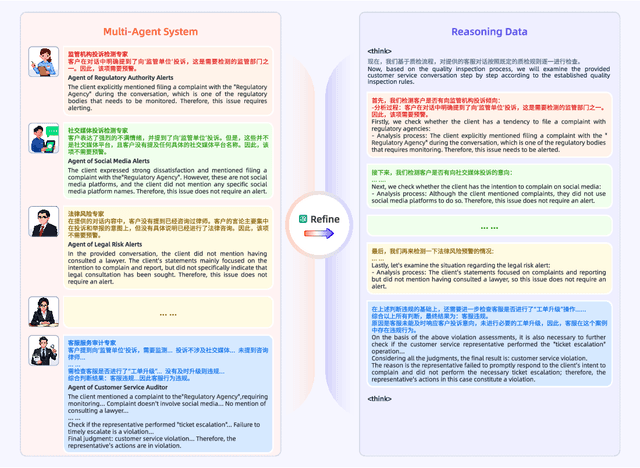
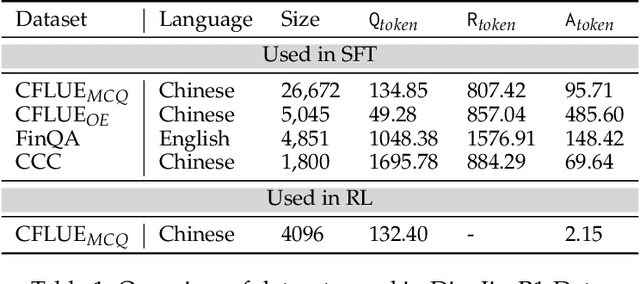
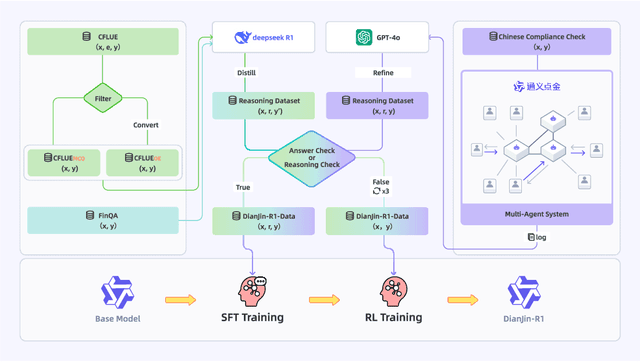
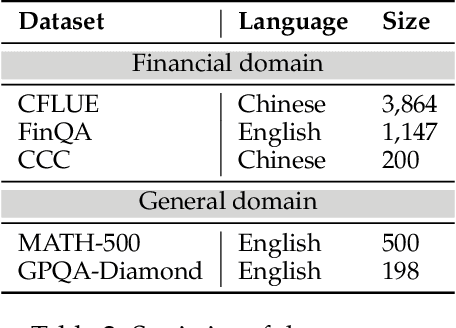
Effective reasoning remains a core challenge for large language models (LLMs) in the financial domain, where tasks often require domain-specific knowledge, precise numerical calculations, and strict adherence to compliance rules. We propose DianJin-R1, a reasoning-enhanced framework designed to address these challenges through reasoning-augmented supervision and reinforcement learning. Central to our approach is DianJin-R1-Data, a high-quality dataset constructed from CFLUE, FinQA, and a proprietary compliance corpus (Chinese Compliance Check, CCC), combining diverse financial reasoning scenarios with verified annotations. Our models, DianJin-R1-7B and DianJin-R1-32B, are fine-tuned from Qwen2.5-7B-Instruct and Qwen2.5-32B-Instruct using a structured format that generates both reasoning steps and final answers. To further refine reasoning quality, we apply Group Relative Policy Optimization (GRPO), a reinforcement learning method that incorporates dual reward signals: one encouraging structured outputs and another rewarding answer correctness. We evaluate our models on five benchmarks: three financial datasets (CFLUE, FinQA, and CCC) and two general reasoning benchmarks (MATH-500 and GPQA-Diamond). Experimental results show that DianJin-R1 models consistently outperform their non-reasoning counterparts, especially on complex financial tasks. Moreover, on the real-world CCC dataset, our single-call reasoning models match or even surpass the performance of multi-agent systems that require significantly more computational cost. These findings demonstrate the effectiveness of DianJin-R1 in enhancing financial reasoning through structured supervision and reward-aligned learning, offering a scalable and practical solution for real-world applications.
ControlNET: A Firewall for RAG-based LLM System
Apr 13, 2025Retrieval-Augmented Generation (RAG) has significantly enhanced the factual accuracy and domain adaptability of Large Language Models (LLMs). This advancement has enabled their widespread deployment across sensitive domains such as healthcare, finance, and enterprise applications. RAG mitigates hallucinations by integrating external knowledge, yet introduces privacy risk and security risk, notably data breaching risk and data poisoning risk. While recent studies have explored prompt injection and poisoning attacks, there remains a significant gap in comprehensive research on controlling inbound and outbound query flows to mitigate these threats. In this paper, we propose an AI firewall, ControlNET, designed to safeguard RAG-based LLM systems from these vulnerabilities. ControlNET controls query flows by leveraging activation shift phenomena to detect adversarial queries and mitigate their impact through semantic divergence. We conduct comprehensive experiments on four different benchmark datasets including Msmarco, HotpotQA, FinQA, and MedicalSys using state-of-the-art open source LLMs (Llama3, Vicuna, and Mistral). Our results demonstrate that ControlNET achieves over 0.909 AUROC in detecting and mitigating security threats while preserving system harmlessness. Overall, ControlNET offers an effective, robust, harmless defense mechanism, marking a significant advancement toward the secure deployment of RAG-based LLM systems.
Fin-R1: A Large Language Model for Financial Reasoning through Reinforcement Learning
Mar 21, 2025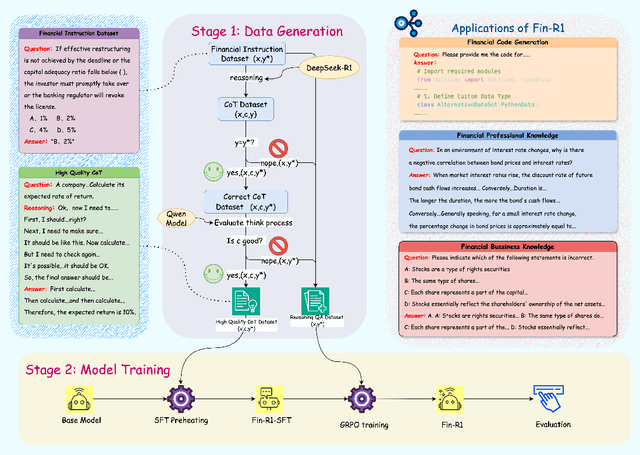
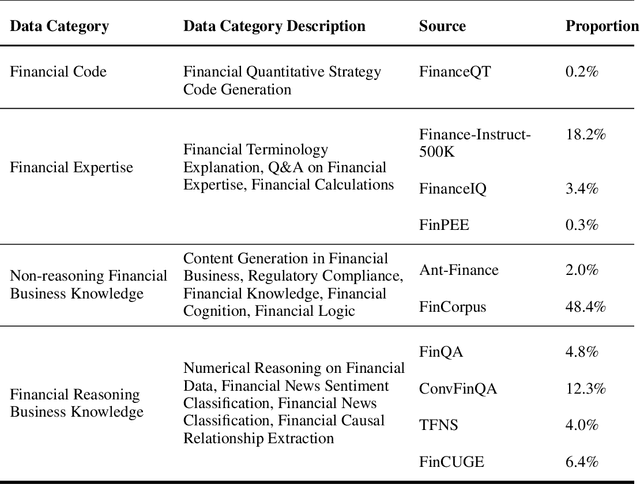
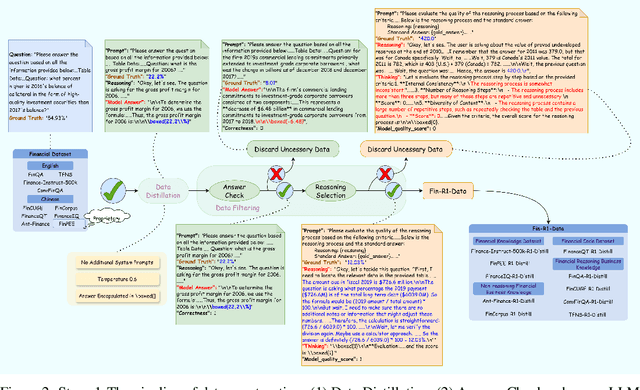
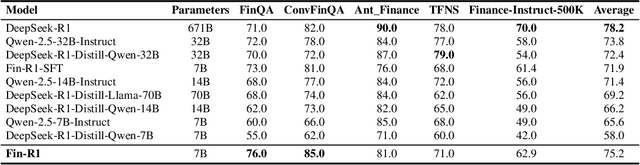
Reasoning large language models are rapidly evolving across various domains. However, their capabilities in handling complex financial tasks still require in-depth exploration. In this paper, we introduce Fin-R1, a reasoning large language model specifically designed for the financial sector. Fin-R1 is built using a two-stage architecture, leveraging a financial reasoning dataset distilled and processed based on DeepSeek-R1. Through supervised fine-tuning (SFT) and reinforcement learning (RL) training, it demonstrates performance close to DeepSeek-R1 with a parameter size of 7 billion across a range of financial reasoning tasks. It achieves the state-of-the-art (SOTA) in the FinQA and ConvFinQA tasks between those LLMs in our evaluation, surpassing larger models in other tasks as well. Fin-R1 showcases strong reasoning and decision-making capabilities, providing solutions to various problems encountered in the financial domain. Our code is available at https://github.com/SUFE-AIFLM-Lab/Fin-R1.