 Add to Chrome
 Add to Firefox
 Add to Edge
Femnist
Papers and Code
Robust Federated Learning via Byzantine Filtering over Encrypted Updates
Feb 05, 2026
Federated Learning (FL) aims to train a collaborative model while preserving data privacy. However, the distributed nature of this approach still raises privacy and security issues, such as the exposure of sensitive data due to inference attacks and the influence of Byzantine behaviors on the trained model. In particular, achieving both secure aggregation and Byzantine resilience remains challenging, as existing solutions often address these aspects independently. In this work, we propose to address these challenges through a novel approach that combines homomorphic encryption for privacy-preserving aggregation with property-inference-inspired meta-classifiers for Byzantine filtering. First, following the property-inference attacks blueprint, we train a set of filtering meta-classifiers on labeled shadow updates, reproducing a diverse ensemble of Byzantine misbehaviors in FL, including backdoor, gradient-inversion, label-flipping and shuffling attacks. The outputs of these meta-classifiers are then used to cancel the Byzantine encrypted updates by reweighting. Second, we propose an automated method for selecting the optimal kernel and the dimensionality hyperparameters with respect to homomorphic inference, aggregation constraints and efficiency over the CKKS cryptosystem. Finally, we demonstrate through extensive experiments the effectiveness of our approach against Byzantine participants on the FEMNIST, CIFAR10, GTSRB, and acsincome benchmarks. More precisely, our SVM filtering achieves accuracies between $90$% and $94$% for identifying Byzantine updates at the cost of marginal losses in model utility and encrypted inference runtimes ranging from $6$ to $24$ seconds and from $9$ to $26$ seconds for an overall aggregation.

Dynamic Topology Optimization for Non-IID Data in Decentralized Learning
Feb 03, 2026Decentralized learning (DL) enables a set of nodes to train a model collaboratively without central coordination, offering benefits for privacy and scalability. However, DL struggles to train a high accuracy model when the data distribution is non-independent and identically distributed (non-IID) and when the communication topology is static. To address these issues, we propose Morph, a topology optimization algorithm for DL. In Morph, nodes adaptively choose peers for model exchange based on maximum model dissimilarity. Morph maintains a fixed in-degree while dynamically reshaping the communication graph through gossip-based peer discovery and diversity-driven neighbor selection, thereby improving robustness to data heterogeneity. Experiments on CIFAR-10 and FEMNIST with up to 100 nodes show that Morph consistently outperforms static and epidemic baselines, while closely tracking the fully connected upper bound. On CIFAR-10, Morph achieves a relative improvement of 1.12x in test accuracy compared to the state-of-the-art baselines. On FEMNIST, Morph achieves an accuracy that is 1.08x higher than Epidemic Learning. Similar trends hold for 50 node deployments, where Morph narrows the gap to the fully connected upper bound within 0.5 percentage points on CIFAR-10. These results demonstrate that Morph achieves higher final accuracy, faster convergence, and more stable learning as quantified by lower inter-node variance, while requiring fewer communication rounds than baselines and no global knowledge.
Cost-TrustFL: Cost-Aware Hierarchical Federated Learning with Lightweight Reputation Evaluation across Multi-Cloud
Dec 23, 2025Federated learning across multi-cloud environments faces critical challenges, including non-IID data distributions, malicious participant detection, and substantial cross-cloud communication costs (egress fees). Existing Byzantine-robust methods focus primarily on model accuracy while overlooking the economic implications of data transfer across cloud providers. This paper presents Cost-TrustFL, a hierarchical federated learning framework that jointly optimizes model performance and communication costs while providing robust defense against poisoning attacks. We propose a gradient-based approximate Shapley value computation method that reduces the complexity from exponential to linear, enabling lightweight reputation evaluation. Our cost-aware aggregation strategy prioritizes intra-cloud communication to minimize expensive cross-cloud data transfers. Experiments on CIFAR-10 and FEMNIST datasets demonstrate that Cost-TrustFL achieves 86.7% accuracy under 30% malicious clients while reducing communication costs by 32% compared to baseline methods. The framework maintains stable performance across varying non-IID degrees and attack intensities, making it practical for real-world multi-cloud deployments.
Non-Linear Trajectory Modeling for Multi-Step Gradient Inversion Attacks in Federated Learning
Sep 26, 2025Federated Learning (FL) preserves privacy by keeping raw data local, yet Gradient Inversion Attacks (GIAs) pose significant threats. In FedAVG multi-step scenarios, attackers observe only aggregated gradients, making data reconstruction challenging. Existing surrogate model methods like SME assume linear parameter trajectories, but we demonstrate this severely underestimates SGD's nonlinear complexity, fundamentally limiting attack effectiveness. We propose Non-Linear Surrogate Model Extension (NL-SME), the first method to introduce nonlinear parametric trajectory modeling for GIAs. Our approach replaces linear interpolation with learnable quadratic B\'ezier curves that capture SGD's curved characteristics through control points, combined with regularization and dvec scaling mechanisms for enhanced expressiveness. Extensive experiments on CIFAR-100 and FEMNIST datasets show NL-SME significantly outperforms baselines across all metrics, achieving order-of-magnitude improvements in cosine similarity loss while maintaining computational efficiency.This work exposes heightened privacy vulnerabilities in FL's multi-step update paradigm and offers novel perspectives for developing robust defense strategies.
Incentivize Contribution and Learn Parameters Too: Federated Learning with Strategic Data Owners
May 17, 2025Classical federated learning (FL) assumes that the clients have a limited amount of noisy data with which they voluntarily participate and contribute towards learning a global, more accurate model in a principled manner. The learning happens in a distributed fashion without sharing the data with the center. However, these methods do not consider the incentive of an agent for participating and contributing to the process, given that data collection and running a distributed algorithm is costly for the clients. The question of rationality of contribution has been asked recently in the literature and some results exist that consider this problem. This paper addresses the question of simultaneous parameter learning and incentivizing contribution, which distinguishes it from the extant literature. Our first mechanism incentivizes each client to contribute to the FL process at a Nash equilibrium and simultaneously learn the model parameters. However, this equilibrium outcome can be away from the optimal, where clients contribute with their full data and the algorithm learns the optimal parameters. We propose a second mechanism with monetary transfers that is budget balanced and enables the full data contribution along with optimal parameter learning. Large scale experiments with real (federated) datasets (CIFAR-10, FeMNIST, and Twitter) show that these algorithms converge quite fast in practice, yield good welfare guarantees, and better model performance for all agents.
Noise Resilient Over-The-Air Federated Learning In Heterogeneous Wireless Networks
Mar 25, 2025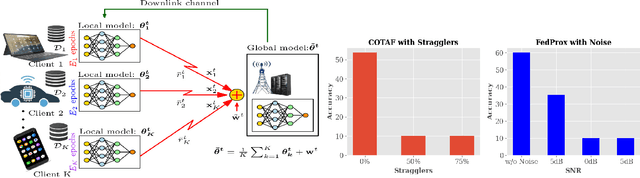
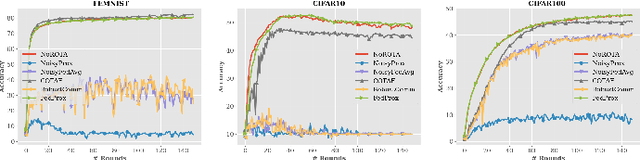
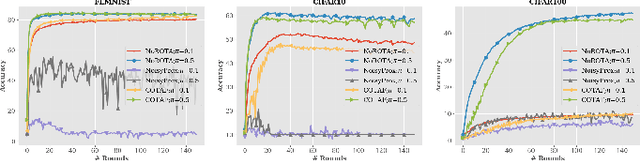
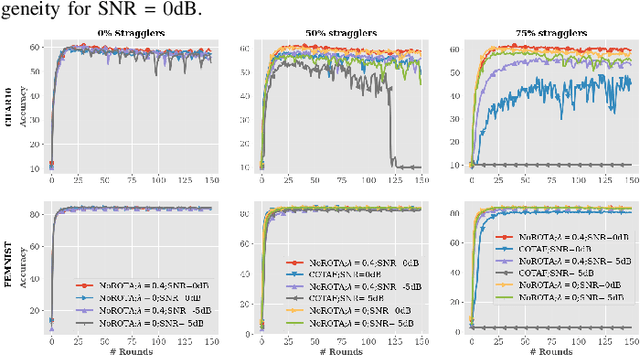
In 6G wireless networks, Artificial Intelligence (AI)-driven applications demand the adoption of Federated Learning (FL) to enable efficient and privacy-preserving model training across distributed devices. Over-The-Air Federated Learning (OTA-FL) exploits the superposition property of multiple access channels, allowing edge users in 6G networks to efficiently share spectral resources and perform low-latency global model aggregation. However, these advantages come with challenges, as traditional OTA-FL techniques suffer due to the joint effects of Additive White Gaussian Noise (AWGN) at the server, fading, and both data and system heterogeneity at the participating edge devices. In this work, we propose the novel Noise Resilient Over-the-Air Federated Learning (NoROTA-FL) framework to jointly tackle these challenges in federated wireless networks. In NoROTA-FL, the local optimization problems find controlled inexact solutions, which manifests as an additional proximal constraint at the clients. This approach provides robustness against straggler-induced partial work, heterogeneity, noise, and fading. From a theoretical perspective, we leverage the zeroth- and first-order inexactness and establish convergence guarantees for non-convex optimization problems in the presence of heterogeneous data and varying system capabilities. Experimentally, we validate NoROTA-FL on real-world datasets, including FEMNIST, CIFAR10, and CIFAR100, demonstrating its robustness in noisy and heterogeneous environments. Compared to state-of-the-art baselines such as COTAF and FedProx, NoROTA-FL achieves significantly more stable convergence and higher accuracy, particularly in the presence of stragglers.
Providing Differential Privacy for Federated Learning Over Wireless: A Cross-layer Framework
Dec 05, 2024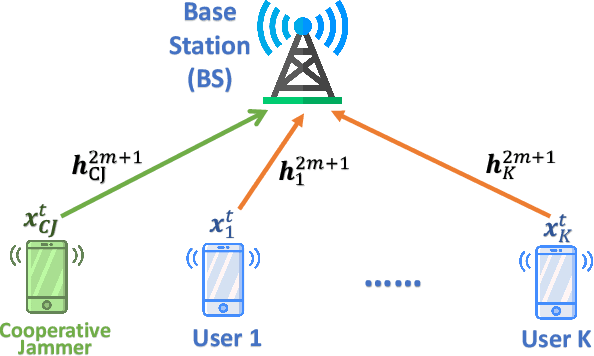
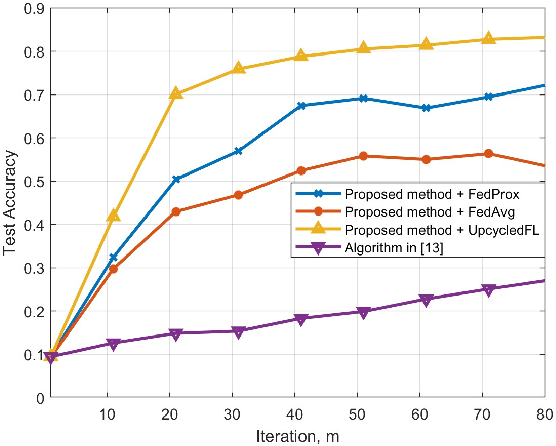
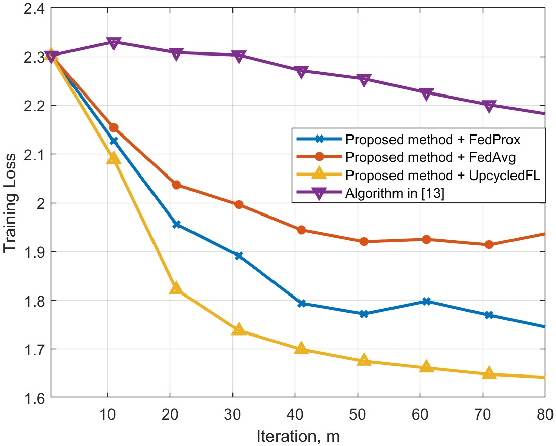
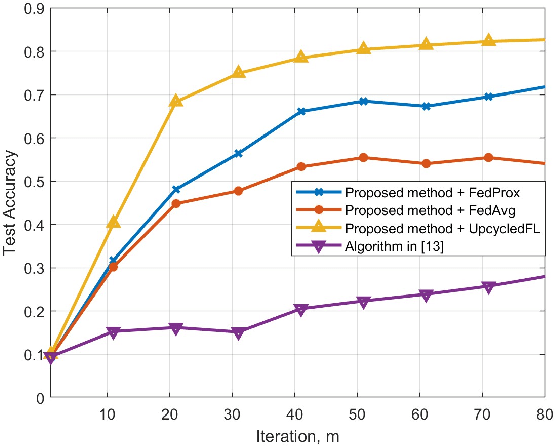
Federated Learning (FL) is a distributed machine learning framework that inherently allows edge devices to maintain their local training data, thus providing some level of privacy. However, FL's model updates still pose a risk of privacy leakage, which must be mitigated. Over-the-air FL (OTA-FL) is an adapted FL design for wireless edge networks that leverages the natural superposition property of the wireless medium. We propose a wireless physical layer (PHY) design for OTA-FL which improves differential privacy (DP) through a decentralized, dynamic power control that utilizes both inherent Gaussian noise in the wireless channel and a cooperative jammer (CJ) for additional artificial noise generation when higher privacy levels are required. Although primarily implemented within the Upcycled-FL framework, where a resource-efficient method with first-order approximations is used at every even iteration to decrease the required information from clients, our power control strategy is applicable to any FL framework, including FedAvg and FedProx as shown in the paper. This adaptation showcases the flexibility and effectiveness of our design across different learning algorithms while maintaining a strong emphasis on privacy. Our design removes the need for client-side artificial noise injection for DP, utilizing a cooperative jammer to enhance privacy without affecting transmission efficiency for higher privacy demands. Privacy analysis is provided using the Moments Accountant method. We perform a convergence analysis for non-convex objectives to tackle heterogeneous data distributions, highlighting the inherent trade-offs between privacy and accuracy. Numerical results show that our approach with various FL algorithms outperforms the state-of-the-art under the same DP conditions on the non-i.i.d. FEMNIST dataset, and highlight the cooperative jammer's effectiveness in ensuring strict privacy.
Hyper-parameter Optimization for Federated Learning with Step-wise Adaptive Mechanism
Nov 19, 2024Federated Learning (FL) is a decentralized learning approach that protects sensitive information by utilizing local model parameters rather than sharing clients' raw datasets. While this privacy-preserving method is widely employed across various applications, it still requires significant development and optimization. Automated Machine Learning (Auto-ML) has been adapted for reducing the need for manual adjustments. Previous studies have explored the integration of AutoML with different FL algorithms to evaluate their effectiveness in enhancing FL settings. However, Automated FL (Auto-FL) faces additional challenges due to the involvement of a large cohort of clients and global training rounds between clients and the server, rendering the tuning process time-consuming and nearly impossible on resource-constrained edge devices (e.g., IoT devices). This paper investigates the deployment and integration of two lightweight Hyper-Parameter Optimization (HPO) tools, Raytune and Optuna, within the context of FL settings. A step-wise feedback mechanism has also been designed to accelerate the hyper-parameter tuning process and coordinate AutoML toolkits with the FL server. To this end, both local and global feedback mechanisms are integrated to limit the search space and expedite the HPO process. Further, a novel client selection technique is introduced to mitigate the straggler effect in Auto-FL. The selected hyper-parameter tuning tools are evaluated using two benchmark datasets, FEMNIST, and CIFAR10. Further, the paper discusses the essential properties of successful HPO tools, the integration mechanism with the FL pipeline, and the challenges posed by the distributed and heterogeneous nature of FL environments.
Automatic Structured Pruning for Efficient Architecture in Federated Learning
Nov 04, 2024In Federated Learning (FL), training is conducted on client devices, typically with limited computational resources and storage capacity. To address these constraints, we propose an automatic pruning scheme tailored for FL systems. Our solution improves computation efficiency on client devices, while minimizing communication costs. One of the challenges of tuning pruning hyper-parameters in FL systems is the restricted access to local data. Thus, we introduce an automatic pruning paradigm that dynamically determines pruning boundaries. Additionally, we utilized a structured pruning algorithm optimized for mobile devices that lack hardware support for sparse computations. Experimental results demonstrate the effectiveness of our approach, achieving accuracy comparable to existing methods. Our method notably reduces the number of parameters by 89% and FLOPS by 90%, with minimal impact on the accuracy of the FEMNIST and CelebFaces datasets. Furthermore, our pruning method decreases communication overhead by up to 5x and halves inference time when deployed on Android devices.
Aiding Global Convergence in Federated Learning via Local Perturbation and Mutual Similarity Information
Oct 07, 2024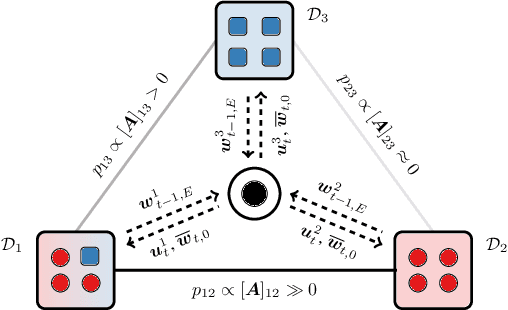
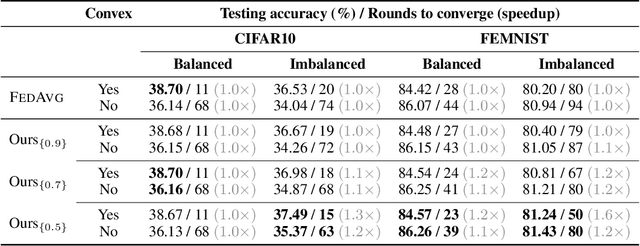
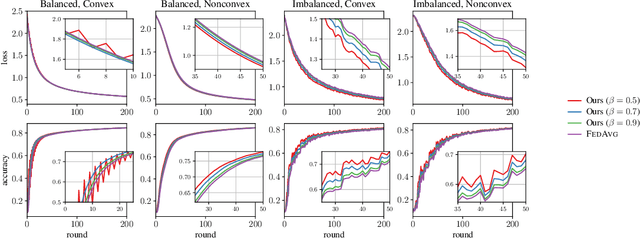
Federated learning has emerged in the last decade as a distributed optimization paradigm due to the rapidly increasing number of portable devices able to support the heavy computational needs related to the training of machine learning models. Federated learning utilizes gradient-based optimization to minimize a loss objective shared across participating agents. To the best of our knowledge, the literature mostly lacks elegant solutions that naturally harness the reciprocal statistical similarity between clients to redesign the optimization procedure. To address this gap, by conceiving the federated network as a similarity graph, we propose a novel modified framework wherein each client locally performs a perturbed gradient step leveraging prior information about other statistically affine clients. We theoretically prove that our procedure, due to a suitably introduced adaptation in the update rule, achieves a quantifiable speedup concerning the exponential contraction factor in the strongly convex case compared with popular algorithms FedAvg and FedProx, here analyzed as baselines. Lastly, we legitimize our conclusions through experimental results on the CIFAR10 and FEMNIST datasets, where we show that our algorithm speeds convergence up to a margin of 30 global rounds compared with FedAvg while modestly improving generalization on unseen data in heterogeneous settings.