 Add to Chrome
 Add to Firefox
 Add to Edge
Dynamic Topology Optimization for Non-IID Data in Decentralized Learning
Feb 03, 2026
Decentralized learning (DL) enables a set of nodes to train a model collaboratively without central coordination, offering benefits for privacy and scalability. However, DL struggles to train a high accuracy model when the data distribution is non-independent and identically distributed (non-IID) and when the communication topology is static. To address these issues, we propose Morph, a topology optimization algorithm for DL. In Morph, nodes adaptively choose peers for model exchange based on maximum model dissimilarity. Morph maintains a fixed in-degree while dynamically reshaping the communication graph through gossip-based peer discovery and diversity-driven neighbor selection, thereby improving robustness to data heterogeneity. Experiments on CIFAR-10 and FEMNIST with up to 100 nodes show that Morph consistently outperforms static and epidemic baselines, while closely tracking the fully connected upper bound. On CIFAR-10, Morph achieves a relative improvement of 1.12x in test accuracy compared to the state-of-the-art baselines. On FEMNIST, Morph achieves an accuracy that is 1.08x higher than Epidemic Learning. Similar trends hold for 50 node deployments, where Morph narrows the gap to the fully connected upper bound within 0.5 percentage points on CIFAR-10. These results demonstrate that Morph achieves higher final accuracy, faster convergence, and more stable learning as quantified by lower inter-node variance, while requiring fewer communication rounds than baselines and no global knowledge.

Evaluating the Limits of Large Language Models in Multilingual Legal Reasoning
Sep 26, 2025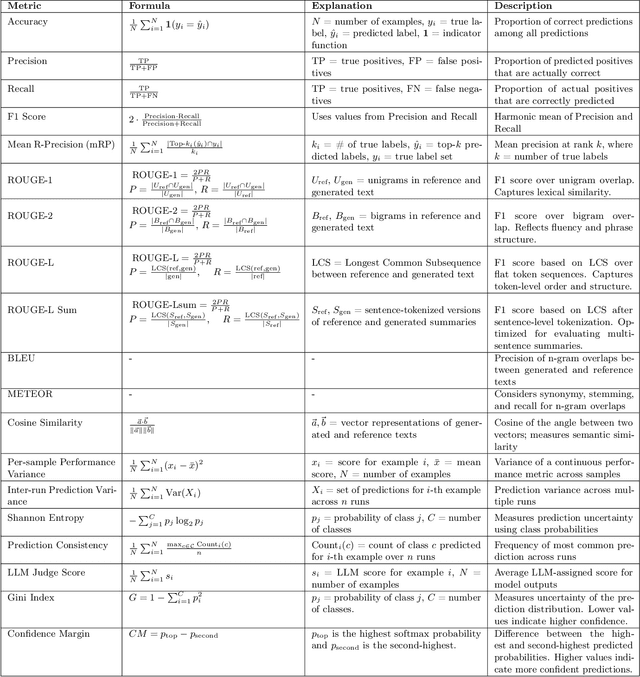
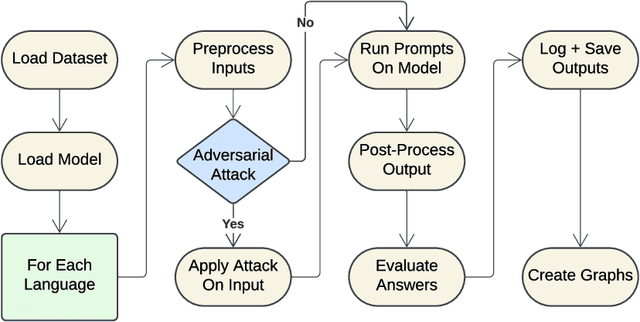
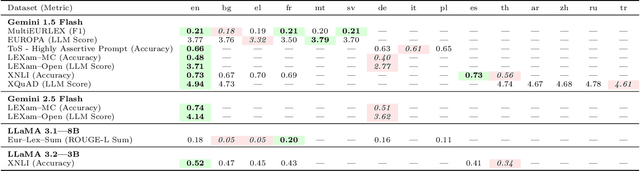
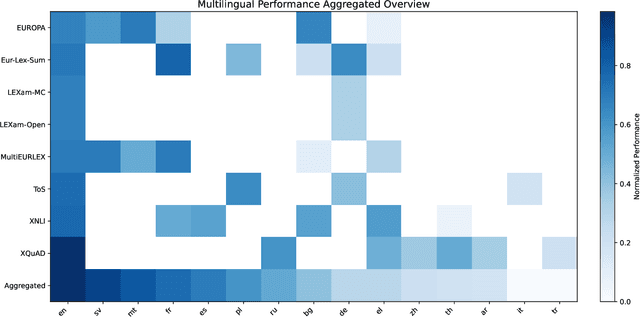
In an era dominated by Large Language Models (LLMs), understanding their capabilities and limitations, especially in high-stakes fields like law, is crucial. While LLMs such as Meta's LLaMA, OpenAI's ChatGPT, Google's Gemini, DeepSeek, and other emerging models are increasingly integrated into legal workflows, their performance in multilingual, jurisdictionally diverse, and adversarial contexts remains insufficiently explored. This work evaluates LLaMA and Gemini on multilingual legal and non-legal benchmarks, and assesses their adversarial robustness in legal tasks through character and word-level perturbations. We use an LLM-as-a-Judge approach for human-aligned evaluation. We moreover present an open-source, modular evaluation pipeline designed to support multilingual, task-diverse benchmarking of any combination of LLMs and datasets, with a particular focus on legal tasks, including classification, summarization, open questions, and general reasoning. Our findings confirm that legal tasks pose significant challenges for LLMs with accuracies often below 50% on legal reasoning benchmarks such as LEXam, compared to over 70% on general-purpose tasks like XNLI. In addition, while English generally yields more stable results, it does not always lead to higher accuracy. Prompt sensitivity and adversarial vulnerability is also shown to persist across languages. Finally, a correlation is found between the performance of a language and its syntactic similarity to English. We also observe that LLaMA is weaker than Gemini, with the latter showing an average advantage of about 24 percentage points across the same task. Despite improvements in newer LLMs, challenges remain in deploying them reliably for critical, multilingual legal applications.