 Add to Chrome
 Add to Firefox
 Add to Edge
Shared Representation Learning for High-Dimensional Multi-Task Forecasting under Resource Contention in Cloud-Native Backends
Dec 24, 2025
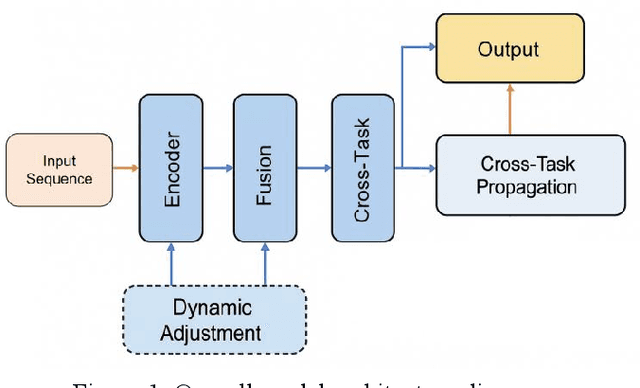
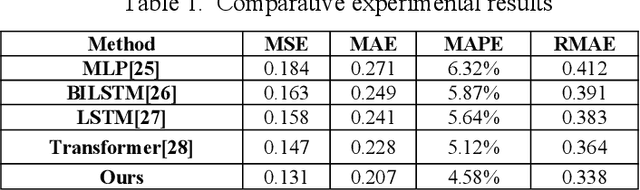
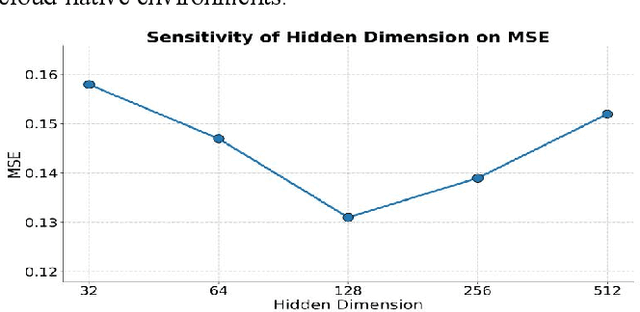
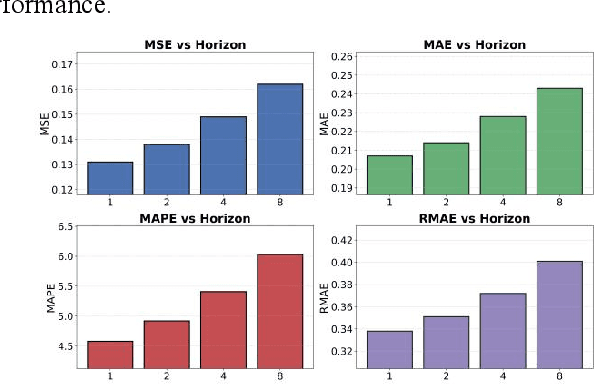
This study proposes a unified forecasting framework for high-dimensional multi-task time series to meet the prediction demands of cloud native backend systems operating under highly dynamic loads, coupled metrics, and parallel tasks. The method builds a shared encoding structure to represent diverse monitoring indicators in a unified manner and employs a state fusion mechanism to capture trend changes and local disturbances across different time scales. A cross-task structural propagation module is introduced to model potential dependencies among nodes, enabling the model to understand complex structural patterns formed by resource contention, link interactions, and changes in service topology. To enhance adaptability to non-stationary behaviors, the framework incorporates a dynamic adjustment mechanism that automatically regulates internal feature flows according to system state changes, ensuring stable predictions in the presence of sudden load shifts, topology drift, and resource jitter. The experimental evaluation compares multiple models across various metrics and verifies the effectiveness of the framework through analyses of hyperparameter sensitivity, environmental sensitivity, and data sensitivity. The results show that the proposed method achieves superior performance on several error metrics and provides more accurate representations of future states under different operating conditions. Overall, the unified forecasting framework offers reliable predictive capability for high-dimensional, multi-task, and strongly dynamic environments in cloud native systems and provides essential technical support for intelligent backend management.

Cost-TrustFL: Cost-Aware Hierarchical Federated Learning with Lightweight Reputation Evaluation across Multi-Cloud
Dec 23, 2025Federated learning across multi-cloud environments faces critical challenges, including non-IID data distributions, malicious participant detection, and substantial cross-cloud communication costs (egress fees). Existing Byzantine-robust methods focus primarily on model accuracy while overlooking the economic implications of data transfer across cloud providers. This paper presents Cost-TrustFL, a hierarchical federated learning framework that jointly optimizes model performance and communication costs while providing robust defense against poisoning attacks. We propose a gradient-based approximate Shapley value computation method that reduces the complexity from exponential to linear, enabling lightweight reputation evaluation. Our cost-aware aggregation strategy prioritizes intra-cloud communication to minimize expensive cross-cloud data transfers. Experiments on CIFAR-10 and FEMNIST datasets demonstrate that Cost-TrustFL achieves 86.7% accuracy under 30% malicious clients while reducing communication costs by 32% compared to baseline methods. The framework maintains stable performance across varying non-IID degrees and attack intensities, making it practical for real-world multi-cloud deployments.
Parameter-Free Structural-Diversity Message Passing for Graph Neural Networks
Aug 28, 2025Graph Neural Networks (GNNs) have shown remarkable performance in structured data modeling tasks such as node classification. However, mainstream approaches generally rely on a large number of trainable parameters and fixed aggregation rules, making it difficult to adapt to graph data with strong structural heterogeneity and complex feature distributions. This often leads to over-smoothing of node representations and semantic degradation. To address these issues, this paper proposes a parameter-free graph neural network framework based on structural diversity, namely SDGNN (Structural-Diversity Graph Neural Network). The framework is inspired by structural diversity theory and designs a unified structural-diversity message passing mechanism that simultaneously captures the heterogeneity of neighborhood structures and the stability of feature semantics, without introducing additional trainable parameters. Unlike traditional parameterized methods, SDGNN does not rely on complex model training, but instead leverages complementary modeling from both structure-driven and feature-driven perspectives, thereby effectively improving adaptability across datasets and scenarios. Experimental results show that on eight public benchmark datasets and an interdisciplinary PubMed citation network, SDGNN consistently outperforms mainstream GNNs under challenging conditions such as low supervision, class imbalance, and cross-domain transfer. This work provides a new theoretical perspective and general approach for the design of parameter-free graph neural networks, and further validates the importance of structural diversity as a core signal in graph representation learning. To facilitate reproducibility and further research, the full implementation of SDGNN has been released at: https://github.com/mingyue15694/SGDNN/tree/main