 Add to Chrome
 Add to Firefox
 Add to Edge
Channel-Adaptive Robust Aggregation for Over-the-Air Federated Learning in Heterogeneous Networks
Jul 05, 2026
The growing demand for privacy-preserving, data-intensive applications such as IoT, augmented reality, and autonomous systems positions Federated Learning (FL) as a key enabler in 6G networks. Over-the-Air FL (OTA-FL) leverages the superposition property of the wireless multiple access channel for efficient aggregation via simultaneous transmissions. Existing methods rely on fixed aggregation schedules and do not jointly address noise, fading, and client heterogeneity. We propose CHARGE-FL (CHannel-Adaptive Robust agGrEgation), a framework that adaptively schedules aggregation based on channel dynamics and application readiness. By combining a tailored optimization strategy with a dual-purpose precoding mechanism, CHARGE-FL mitigates channel distortion and bias from partial updates, achieving superior accuracy, stability, and convergence under realistic wireless conditions. Empirical results under realistic wireless conditions show that CHARGE-FL significantly improves accuracy, stability, and convergence over state-of-the-art OTA-FL methods, particularly in straggler-prone and noisy scenarios.

Noise Resilient Over-The-Air Federated Learning In Heterogeneous Wireless Networks
Mar 25, 2025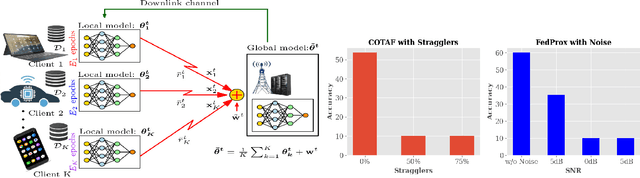
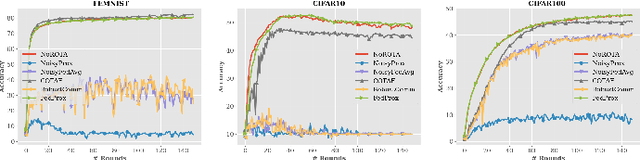
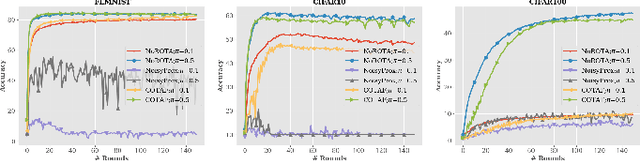
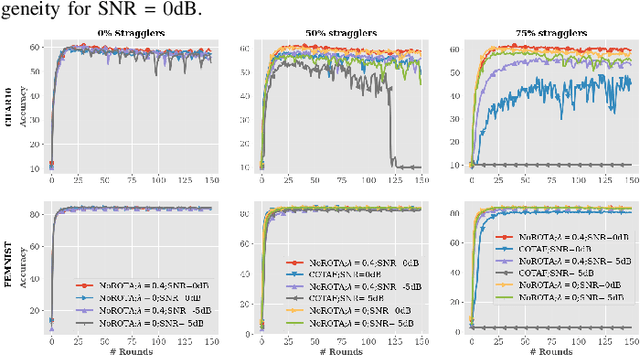
In 6G wireless networks, Artificial Intelligence (AI)-driven applications demand the adoption of Federated Learning (FL) to enable efficient and privacy-preserving model training across distributed devices. Over-The-Air Federated Learning (OTA-FL) exploits the superposition property of multiple access channels, allowing edge users in 6G networks to efficiently share spectral resources and perform low-latency global model aggregation. However, these advantages come with challenges, as traditional OTA-FL techniques suffer due to the joint effects of Additive White Gaussian Noise (AWGN) at the server, fading, and both data and system heterogeneity at the participating edge devices. In this work, we propose the novel Noise Resilient Over-the-Air Federated Learning (NoROTA-FL) framework to jointly tackle these challenges in federated wireless networks. In NoROTA-FL, the local optimization problems find controlled inexact solutions, which manifests as an additional proximal constraint at the clients. This approach provides robustness against straggler-induced partial work, heterogeneity, noise, and fading. From a theoretical perspective, we leverage the zeroth- and first-order inexactness and establish convergence guarantees for non-convex optimization problems in the presence of heterogeneous data and varying system capabilities. Experimentally, we validate NoROTA-FL on real-world datasets, including FEMNIST, CIFAR10, and CIFAR100, demonstrating its robustness in noisy and heterogeneous environments. Compared to state-of-the-art baselines such as COTAF and FedProx, NoROTA-FL achieves significantly more stable convergence and higher accuracy, particularly in the presence of stragglers.