 Add to Chrome
 Add to Firefox
 Add to Edge
Channel-Adaptive Robust Aggregation for Over-the-Air Federated Learning in Heterogeneous Networks
Jul 05, 2026
The growing demand for privacy-preserving, data-intensive applications such as IoT, augmented reality, and autonomous systems positions Federated Learning (FL) as a key enabler in 6G networks. Over-the-Air FL (OTA-FL) leverages the superposition property of the wireless multiple access channel for efficient aggregation via simultaneous transmissions. Existing methods rely on fixed aggregation schedules and do not jointly address noise, fading, and client heterogeneity. We propose CHARGE-FL (CHannel-Adaptive Robust agGrEgation), a framework that adaptively schedules aggregation based on channel dynamics and application readiness. By combining a tailored optimization strategy with a dual-purpose precoding mechanism, CHARGE-FL mitigates channel distortion and bias from partial updates, achieving superior accuracy, stability, and convergence under realistic wireless conditions. Empirical results under realistic wireless conditions show that CHARGE-FL significantly improves accuracy, stability, and convergence over state-of-the-art OTA-FL methods, particularly in straggler-prone and noisy scenarios.

Theoretical Foundations of Continual Learning via Drift-Plus-Penalty
Jun 07, 2026In many real-world settings, data streams are nonstationary and arrive sequentially, requiring learning systems to adapt continuously without retraining from scratch. Continual learning (CL) addresses this challenge by incorporating new tasks while mitigating catastrophic forgetting, where learning new information degrades performance on previously acquired knowledge. We introduce a control-theoretic perspective on CL that explicitly regulates the evolution of forgetting, framing adaptation as a controlled process subject to long-term stability constraints. We focus on replay-based CL, where a finite memory buffer stores representative samples from prior tasks. We propose COntinual Learning with Drift-Plus-Penalty (COLD), a continual learning framework based on the Drift-Plus-Penalty (DPP) principle from stochastic optimization. To facilitate analysis, we also consider an oracle variant, COLD-ORACLE, as a reference benchmark. At each task, both methods minimize the current task loss while maintaining a virtual queue that tracks deviations from long-term stability on previously learned tasks, capturing the stability-plasticity trade-off as a regulated dynamical process. We establish stability and convergence guarantees that characterize this trade-off through a tunable control parameter. Experiments on standard benchmarks demonstrate that COLD consistently outperforms a broad range of state-of-the-art CL methods while providing competitive and controllable forgetting behavior through explicit regulation of stability and plasticity.
Informative Perturbation Selection for Uncertainty-Aware Post-hoc Explanations
Mar 17, 2026Trust and ethical concerns due to the widespread deployment of opaque machine learning (ML) models motivating the need for reliable model explanations. Post-hoc model-agnostic explanation methods addresses this challenge by learning a surrogate model that approximates the behavior of the deployed black-box ML model in the locality of a sample of interest. In post-hoc scenarios, neither the underlying model parameters nor the training are available, and hence, this local neighborhood must be constructed by generating perturbed inputs in the neighborhood of the sample of interest, and its corresponding model predictions. We propose \emph{Expected Active Gain for Local Explanations} (\texttt{EAGLE}), a post-hoc model-agnostic explanation framework that formulates perturbation selection as an information-theoretic active learning problem. By adaptively sampling perturbations that maximize the expected information gain, \texttt{EAGLE} efficiently learns a linear surrogate explainable model while producing feature importance scores along with the uncertainty/confidence estimates. Theoretically, we establish that cumulative information gain scales as $\mathcal{O}(d \log t)$, where $d$ is the feature dimension and $t$ represents the number of samples, and that the sample complexity grows linearly with $d$ and logarithmically with the confidence parameter $1/δ$. Empirical results on tabular and image datasets corroborate our theoretical findings and demonstrate that \texttt{EAGLE} improves explanation reproducibility across runs, achieves higher neighborhood stability, and improves perturbation sample quality as compared to state-of-the-art baselines such as Tilia, US-LIME, GLIME and BayesLIME.
Noise Resilient Over-The-Air Federated Learning In Heterogeneous Wireless Networks
Mar 25, 2025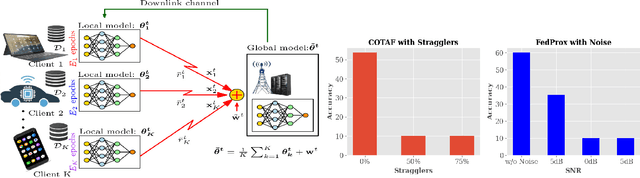
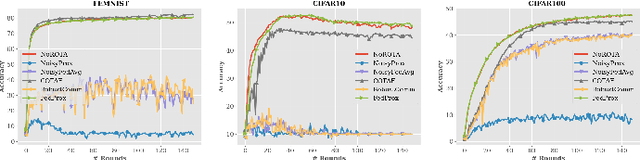
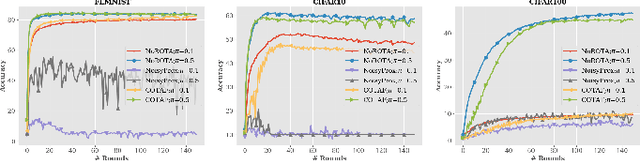
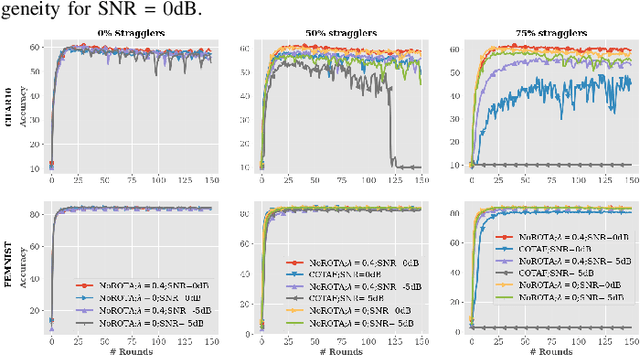
In 6G wireless networks, Artificial Intelligence (AI)-driven applications demand the adoption of Federated Learning (FL) to enable efficient and privacy-preserving model training across distributed devices. Over-The-Air Federated Learning (OTA-FL) exploits the superposition property of multiple access channels, allowing edge users in 6G networks to efficiently share spectral resources and perform low-latency global model aggregation. However, these advantages come with challenges, as traditional OTA-FL techniques suffer due to the joint effects of Additive White Gaussian Noise (AWGN) at the server, fading, and both data and system heterogeneity at the participating edge devices. In this work, we propose the novel Noise Resilient Over-the-Air Federated Learning (NoROTA-FL) framework to jointly tackle these challenges in federated wireless networks. In NoROTA-FL, the local optimization problems find controlled inexact solutions, which manifests as an additional proximal constraint at the clients. This approach provides robustness against straggler-induced partial work, heterogeneity, noise, and fading. From a theoretical perspective, we leverage the zeroth- and first-order inexactness and establish convergence guarantees for non-convex optimization problems in the presence of heterogeneous data and varying system capabilities. Experimentally, we validate NoROTA-FL on real-world datasets, including FEMNIST, CIFAR10, and CIFAR100, demonstrating its robustness in noisy and heterogeneous environments. Compared to state-of-the-art baselines such as COTAF and FedProx, NoROTA-FL achieves significantly more stable convergence and higher accuracy, particularly in the presence of stragglers.
On the Convergence of Continual Federated Learning Using Incrementally Aggregated Gradients
Nov 12, 2024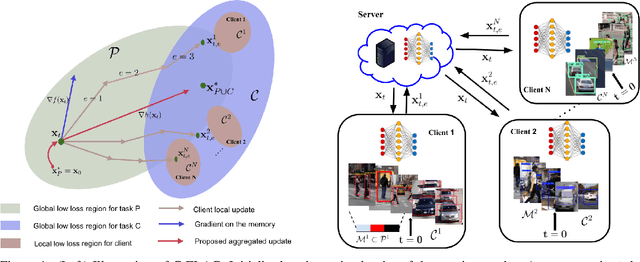
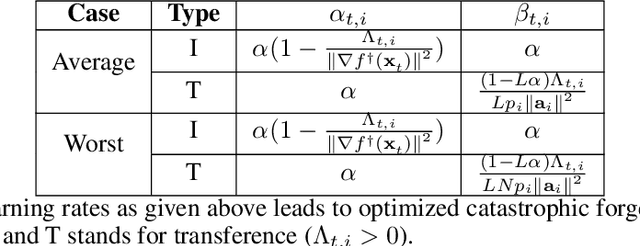
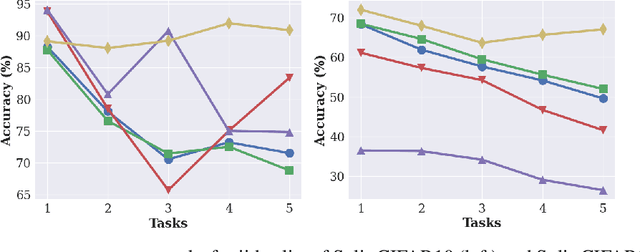
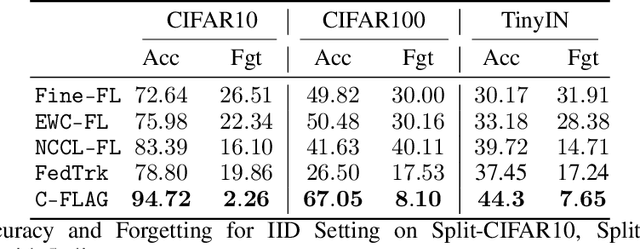
The holy grail of machine learning is to enable Continual Federated Learning (CFL) to enhance the efficiency, privacy, and scalability of AI systems while learning from streaming data. The primary challenge of a CFL system is to overcome global catastrophic forgetting, wherein the accuracy of the global model trained on new tasks declines on the old tasks. In this work, we propose Continual Federated Learning with Aggregated Gradients (C-FLAG), a novel replay-memory based federated strategy consisting of edge-based gradient updates on memory and aggregated gradients on the current data. We provide convergence analysis of the C-FLAG approach which addresses forgetting and bias while converging at a rate of $O(1/\sqrt{T})$ over $T$ communication rounds. We formulate an optimization sub-problem that minimizes catastrophic forgetting, translating CFL into an iterative algorithm with adaptive learning rates that ensure seamless learning across tasks. We empirically show that C-FLAG outperforms several state-of-the-art baselines on both task and class-incremental settings with respect to metrics such as accuracy and forgetting.
Over-The-Air Clustered Wireless Federated Learning
Nov 08, 2022Privacy, security, and bandwidth constraints have led to federated learning (FL) in wireless systems, where training a machine learning (ML) model is accomplished collaboratively without sharing raw data. Often, such collaborative FL strategies necessitate model aggregation at a server. On the other hand, decentralized FL necessitates that participating clients reach a consensus ML model by exchanging parameter updates. In this work, we propose the over-the-air clustered wireless FL (CWFL) strategy, which eliminates the need for a strong central server and yet achieves an accuracy similar to the server-based strategy while using fewer channel uses as compared to decentralized FL. We theoretically show that the convergence rate of CWFL per cluster is O(1/T) while mitigating the impact of noise. Using the MNIST and CIFAR datasets, we demonstrate the accuracy performance of CWFL for the different number of clusters across communication rounds.