 Add to Chrome
 Add to Firefox
 Add to Edge
Dynamic Facial Expression Recognition
Papers and Code
Now You See Me, Now You Don't: A Unified Framework for Expression Consistent Anonymization in Talking Head Videos
Jan 14, 2026
Face video anonymization is aimed at privacy preservation while allowing for the analysis of videos in a number of computer vision downstream tasks such as expression recognition, people tracking, and action recognition. We propose here a novel unified framework referred to as Anon-NET, streamlined to de-identify facial videos, while preserving age, gender, race, pose, and expression of the original video. Specifically, we inpaint faces by a diffusion-based generative model guided by high-level attribute recognition and motion-aware expression transfer. We then animate deidentified faces by video-driven animation, which accepts the de-identified face and the original video as input. Extensive experiments on the datasets VoxCeleb2, CelebV-HQ, and HDTF, which include diverse facial dynamics, demonstrate the effectiveness of AnonNET in obfuscating identity while retaining visual realism and temporal consistency. The code of AnonNet will be publicly released.

FOODER: Real-time Facial Authentication and Expression Recognition
Dec 19, 2025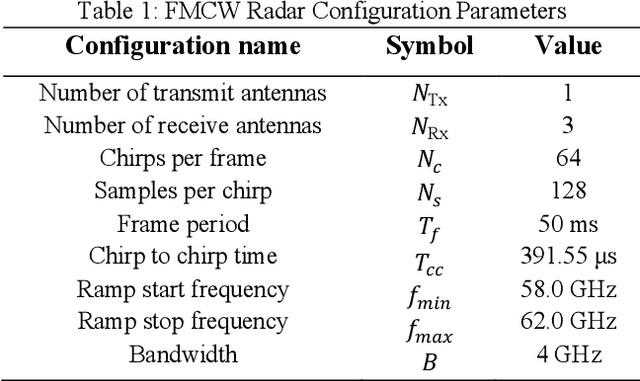
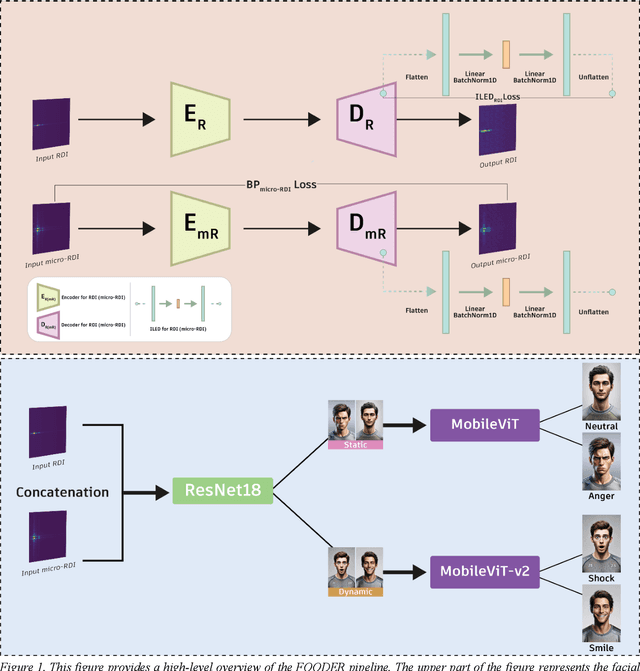
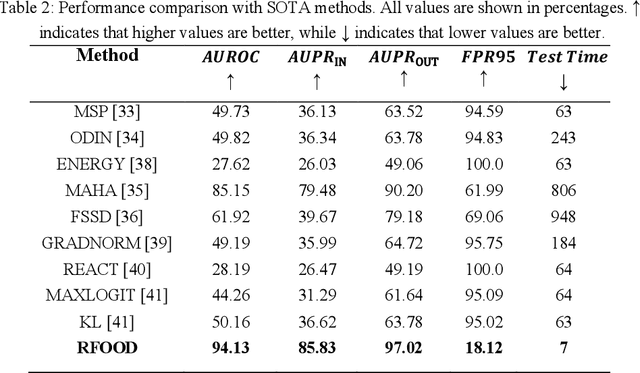
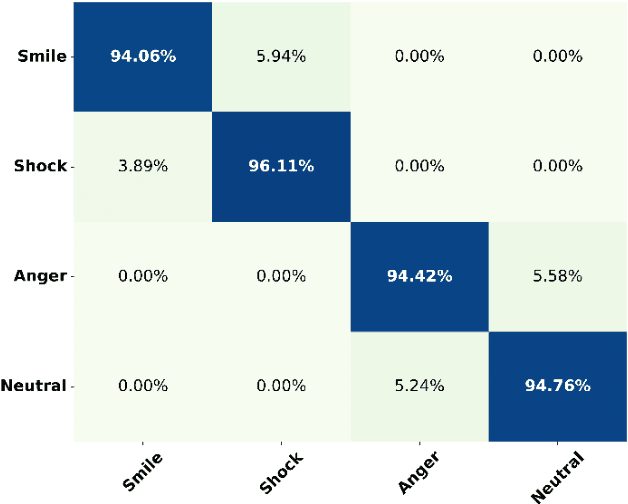
Out-of-distribution (OOD) detection is essential for the safe deployment of neural networks, as it enables the identification of samples outside the training domain. We present FOODER, a real-time, privacy-preserving radar-based framework that integrates OOD-based facial authentication with facial expression recognition. FOODER operates using low-cost frequency-modulated continuous-wave (FMCW) radar and exploits both range-Doppler and micro range-Doppler representations. The authentication module employs a multi-encoder multi-decoder architecture with Body Part (BP) and Intermediate Linear Encoder-Decoder (ILED) components to classify a single enrolled individual as in-distribution while detecting all other faces as OOD. Upon successful authentication, an expression recognition module is activated. Concatenated radar representations are processed by a ResNet block to distinguish between dynamic and static facial expressions. Based on this categorization, two specialized MobileViT networks are used to classify dynamic expressions (smile, shock) and static expressions (neutral, anger). This hierarchical design enables robust facial authentication and fine-grained expression recognition while preserving user privacy by relying exclusively on radar data. Experiments conducted on a dataset collected with a 60 GHz short-range FMCW radar demonstrate that FOODER achieves an AUROC of 94.13% and an FPR95 of 18.12% for authentication, along with an average expression recognition accuracy of 94.70%. FOODER outperforms state-of-the-art OOD detection methods and several transformer-based architectures while operating efficiently in real time.
Feature Aggregation for Efficient Continual Learning of Complex Facial Expressions
Dec 13, 2025As artificial intelligence (AI) systems become increasingly embedded in our daily life, the ability to recognize and adapt to human emotions is essential for effective human-computer interaction. Facial expression recognition (FER) provides a primary channel for inferring affective states, but the dynamic and culturally nuanced nature of emotions requires models that can learn continuously without forgetting prior knowledge. In this work, we propose a hybrid framework for FER in a continual learning setting that mitigates catastrophic forgetting. Our approach integrates two complementary modalities: deep convolutional features and facial Action Units (AUs) derived from the Facial Action Coding System (FACS). The combined representation is modelled through Bayesian Gaussian Mixture Models (BGMMs), which provide a lightweight, probabilistic solution that avoids retraining while offering strong discriminative power. Using the Compound Facial Expression of Emotion (CFEE) dataset, we show that our model can first learn basic expressions and then progressively recognize compound expressions. Experiments demonstrate improved accuracy, stronger knowledge retention, and reduced forgetting. This framework contributes to the development of emotionally intelligent AI systems with applications in education, healthcare, and adaptive user interfaces.
Text-guided Weakly Supervised Framework for Dynamic Facial Expression Recognition
Nov 14, 2025Dynamic facial expression recognition (DFER) aims to identify emotional states by modeling the temporal changes in facial movements across video sequences. A key challenge in DFER is the many-to-one labeling problem, where a video composed of numerous frames is assigned a single emotion label. A common strategy to mitigate this issue is to formulate DFER as a Multiple Instance Learning (MIL) problem. However, MIL-based approaches inherently suffer from the visual diversity of emotional expressions and the complexity of temporal dynamics. To address this challenge, we propose TG-DFER, a text-guided weakly supervised framework that enhances MIL-based DFER by incorporating semantic guidance and coherent temporal modeling. We incorporate a vision-language pre-trained (VLP) model is integrated to provide semantic guidance through fine-grained textual descriptions of emotional context. Furthermore, we introduce visual prompts, which align enriched textual emotion labels with visual instance features, enabling fine-grained reasoning and frame-level relevance estimation. In addition, a multi-grained temporal network is designed to jointly capture short-term facial dynamics and long-range emotional flow, ensuring coherent affective understanding across time. Extensive results demonstrate that TG-DFER achieves improved generalization, interpretability, and temporal sensitivity under weak supervision.
CS3D: An Efficient Facial Expression Recognition via Event Vision
Dec 10, 2025Responsive and accurate facial expression recognition is crucial to human-robot interaction for daily service robots. Nowadays, event cameras are becoming more widely adopted as they surpass RGB cameras in capturing facial expression changes due to their high temporal resolution, low latency, computational efficiency, and robustness in low-light conditions. Despite these advantages, event-based approaches still encounter practical challenges, particularly in adopting mainstream deep learning models. Traditional deep learning methods for facial expression analysis are energy-intensive, making them difficult to deploy on edge computing devices and thereby increasing costs, especially for high-frequency, dynamic, event vision-based approaches. To address this challenging issue, we proposed the CS3D framework by decomposing the Convolutional 3D method to reduce the computational complexity and energy consumption. Additionally, by utilizing soft spiking neurons and a spatial-temporal attention mechanism, the ability to retain information is enhanced, thus improving the accuracy of facial expression detection. Experimental results indicate that our proposed CS3D method attains higher accuracy on multiple datasets compared to architectures such as the RNN, Transformer, and C3D, while the energy consumption of the CS3D method is just 21.97\% of the original C3D required on the same device.
DEFT-LLM: Disentangled Expert Feature Tuning for Micro-Expression Recognition
Nov 14, 2025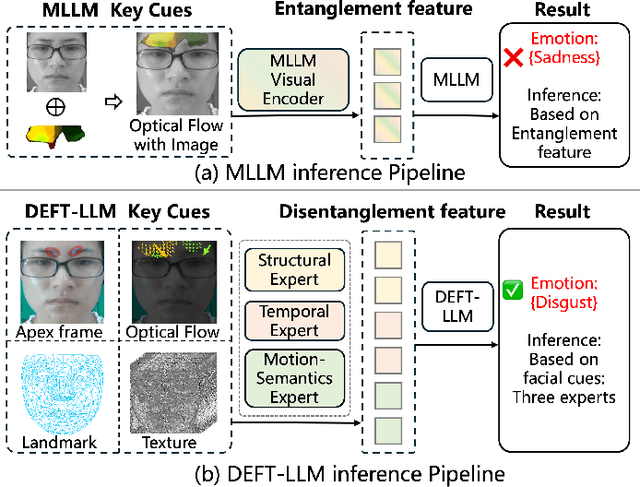
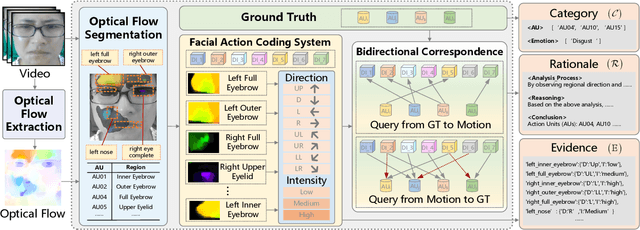
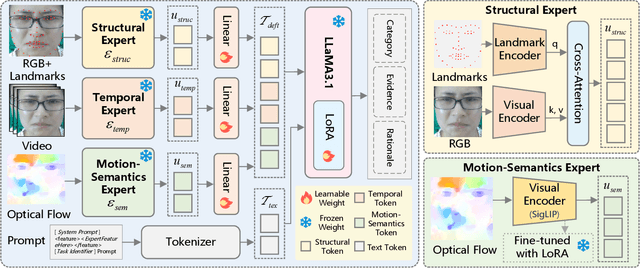
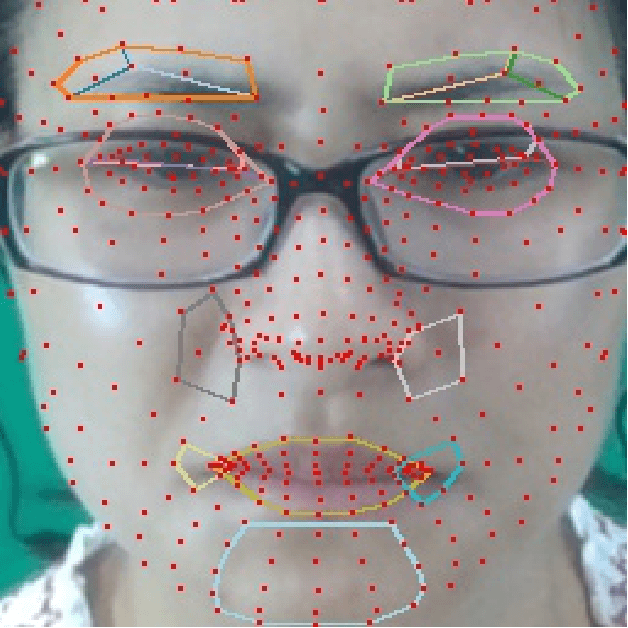
Micro expression recognition (MER) is crucial for inferring genuine emotion. Applying a multimodal large language model (MLLM) to this task enables spatio-temporal analysis of facial motion and provides interpretable descriptions. However, there are still two core challenges: (1) The entanglement of static appearance and dynamic motion cues prevents the model from focusing on subtle motion; (2) Textual labels in existing MER datasets do not fully correspond to underlying facial muscle movements, creating a semantic gap between text supervision and physical motion. To address these issues, we propose DEFT-LLM, which achieves motion semantic alignment by multi-expert disentanglement. We first introduce Uni-MER, a motion-driven instruction dataset designed to align text with local facial motion. Its construction leverages dual constraints from optical flow and Action Unit (AU) labels to ensure spatio-temporal consistency and reasonable correspondence to the movements. We then design an architecture with three experts to decouple facial dynamics into independent and interpretable representations (structure, dynamic textures, and motion-semantics). By integrating the instruction-aligned knowledge from Uni-MER into DEFT-LLM, our method injects effective physical priors for micro expressions while also leveraging the cross modal reasoning ability of large language models, thus enabling precise capture of subtle emotional cues. Experiments on multiple challenging MER benchmarks demonstrate state-of-the-art performance, as well as a particular advantage in interpretable modeling of local facial motion.
MICACL: Multi-Instance Category-Aware Contrastive Learning for Long-Tailed Dynamic Facial Expression Recognition
Sep 04, 2025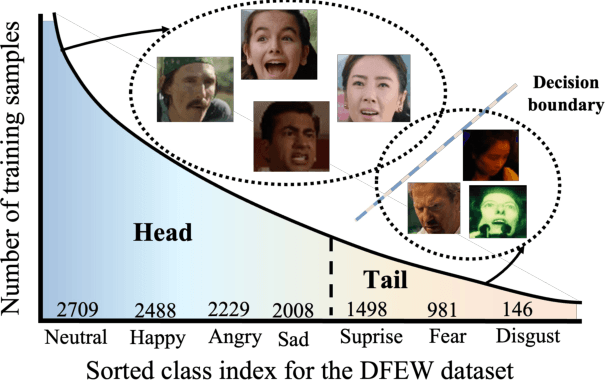
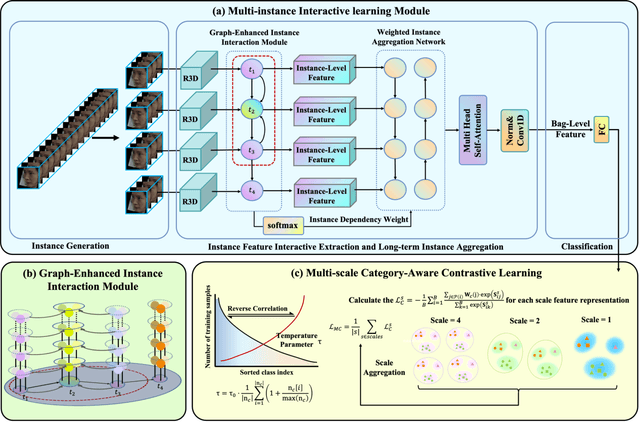
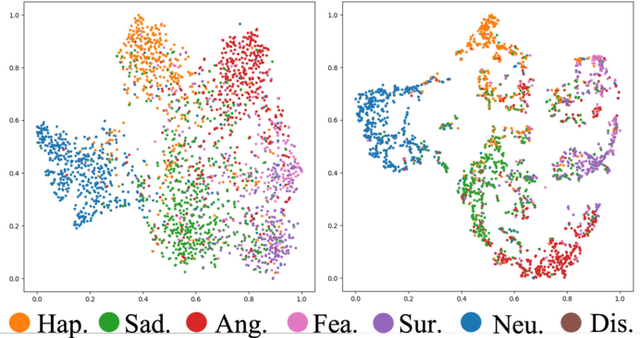
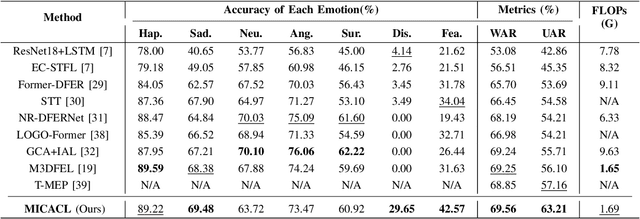
Dynamic facial expression recognition (DFER) faces significant challenges due to long-tailed category distributions and complexity of spatio-temporal feature modeling. While existing deep learning-based methods have improved DFER performance, they often fail to address these issues, resulting in severe model induction bias. To overcome these limitations, we propose a novel multi-instance learning framework called MICACL, which integrates spatio-temporal dependency modeling and long-tailed contrastive learning optimization. Specifically, we design the Graph-Enhanced Instance Interaction Module (GEIIM) to capture intricate spatio-temporal between adjacent instances relationships through adaptive adjacency matrices and multiscale convolutions. To enhance instance-level feature aggregation, we develop the Weighted Instance Aggregation Network (WIAN), which dynamically assigns weights based on instance importance. Furthermore, we introduce a Multiscale Category-aware Contrastive Learning (MCCL) strategy to balance training between major and minor categories. Extensive experiments on in-the-wild datasets (i.e., DFEW and FERV39k) demonstrate that MICACL achieves state-of-the-art performance with superior robustness and generalization.
FMANet: A Novel Dual-Phase Optical Flow Approach with Fusion Motion Attention Network for Robust Micro-expression Recognition
Oct 09, 2025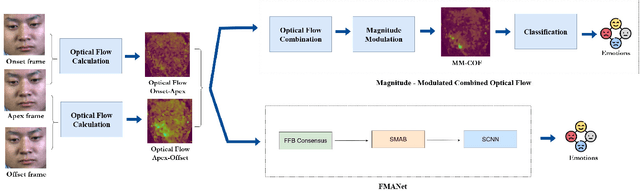
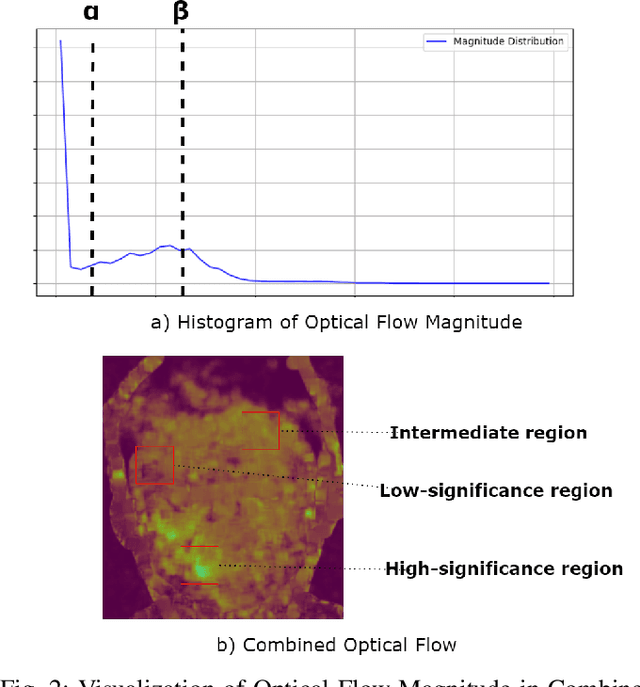

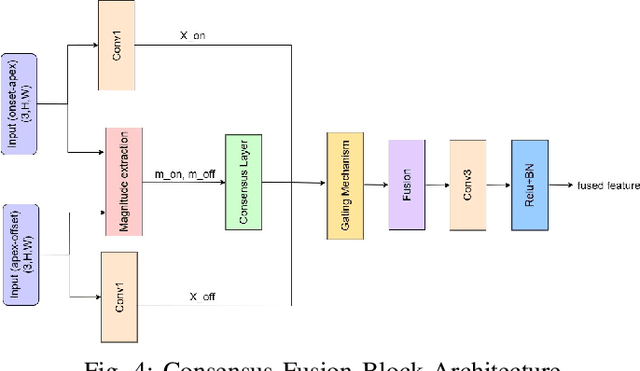
Facial micro-expressions, characterized by their subtle and brief nature, are valuable indicators of genuine emotions. Despite their significance in psychology, security, and behavioral analysis, micro-expression recognition remains challenging due to the difficulty of capturing subtle facial movements. Optical flow has been widely employed as an input modality for this task due to its effectiveness. However, most existing methods compute optical flow only between the onset and apex frames, thereby overlooking essential motion information in the apex-to-offset phase. To address this limitation, we first introduce a comprehensive motion representation, termed Magnitude-Modulated Combined Optical Flow (MM-COF), which integrates motion dynamics from both micro-expression phases into a unified descriptor suitable for direct use in recognition networks. Building upon this principle, we then propose FMANet, a novel end-to-end neural network architecture that internalizes the dual-phase analysis and magnitude modulation into learnable modules. This allows the network to adaptively fuse motion cues and focus on salient facial regions for classification. Experimental evaluations on the MMEW, SMIC, CASME-II, and SAMM datasets, widely recognized as standard benchmarks, demonstrate that our proposed MM-COF representation and FMANet outperforms existing methods, underscoring the potential of a learnable, dual-phase framework in advancing micro-expression recognition.
LD-ViCE: Latent Diffusion Model for Video Counterfactual Explanations
Sep 10, 2025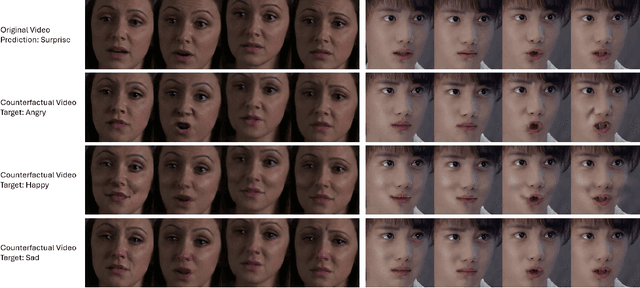
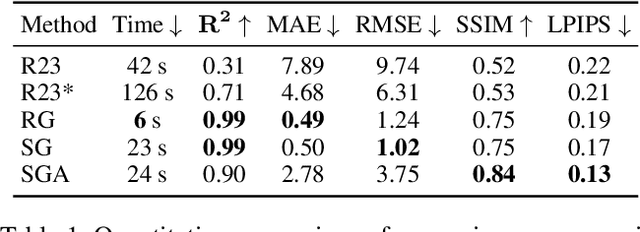
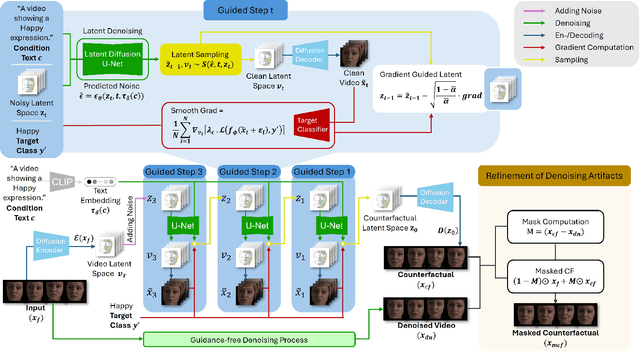
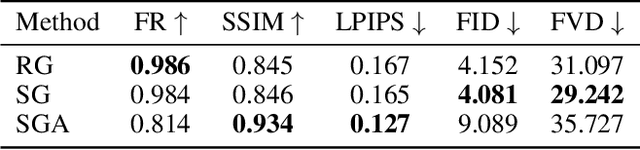
Video-based AI systems are increasingly adopted in safety-critical domains such as autonomous driving and healthcare. However, interpreting their decisions remains challenging due to the inherent spatiotemporal complexity of video data and the opacity of deep learning models. Existing explanation techniques often suffer from limited temporal coherence, insufficient robustness, and a lack of actionable causal insights. Current counterfactual explanation methods typically do not incorporate guidance from the target model, reducing semantic fidelity and practical utility. We introduce Latent Diffusion for Video Counterfactual Explanations (LD-ViCE), a novel framework designed to explain the behavior of video-based AI models. Compared to previous approaches, LD-ViCE reduces the computational costs of generating explanations by operating in latent space using a state-of-the-art diffusion model, while producing realistic and interpretable counterfactuals through an additional refinement step. Our experiments demonstrate the effectiveness of LD-ViCE across three diverse video datasets, including EchoNet-Dynamic (cardiac ultrasound), FERV39k (facial expression), and Something-Something V2 (action recognition). LD-ViCE outperforms a recent state-of-the-art method, achieving an increase in R2 score of up to 68% while reducing inference time by half. Qualitative analysis confirms that LD-ViCE generates semantically meaningful and temporally coherent explanations, offering valuable insights into the target model behavior. LD-ViCE represents a valuable step toward the trustworthy deployment of AI in safety-critical domains.
Action Unit Enhance Dynamic Facial Expression Recognition
Jul 10, 2025Dynamic Facial Expression Recognition(DFER) is a rapidly evolving field of research that focuses on the recognition of time-series facial expressions. While previous research on DFER has concentrated on feature learning from a deep learning perspective, we put forward an AU-enhanced Dynamic Facial Expression Recognition architecture, namely AU-DFER, that incorporates AU-expression knowledge to enhance the effectiveness of deep learning modeling. In particular, the contribution of the Action Units(AUs) to different expressions is quantified, and a weight matrix is designed to incorporate a priori knowledge. Subsequently, the knowledge is integrated with the learning outcomes of a conventional deep learning network through the introduction of AU loss. The design is incorporated into the existing optimal model for dynamic expression recognition for the purpose of validation. Experiments are conducted on three recent mainstream open-source approaches to DFER on the principal datasets in this field. The results demonstrate that the proposed architecture outperforms the state-of-the-art(SOTA) methods without the need for additional arithmetic and generally produces improved results. Furthermore, we investigate the potential of AU loss function redesign to address data label imbalance issues in established dynamic expression datasets. To the best of our knowledge, this is the first attempt to integrate quantified AU-expression knowledge into various DFER models. We also devise strategies to tackle label imbalance, or minor class problems. Our findings suggest that employing a diverse strategy of loss function design can enhance the effectiveness of DFER. This underscores the criticality of addressing data imbalance challenges in mainstream datasets within this domain. The source code is available at https://github.com/Cross-Innovation-Lab/AU-DFER.