 Add to Chrome
 Add to Firefox
 Add to Edge
Dual-View Optical Flow for 4D Micro-Expression Recognition - A Multi-Stream Fusion Attention Approach
Mar 27, 2026
Micro-expression recognition is vital for affective computing but remains challenging due to the extremely brief, low-intensity facial motions involved and the high-dimensional nature of 4D mesh data. To address these challenges, we introduce a dual-view optical flow approach that simplifies mesh processing by capturing each micro-expression sequence from two synchronized viewpoints and computing optical flow to represent motion. Our pipeline begins with view separation and sequence-wise face cropping to ensure spatial consistency, followed by automatic apex-frame detection based on peak motion intensity in both views. We decompose each sequence into onset-apex and apex-offset phases, extracting horizontal, vertical, and magnitude flow channels for each phase. These are fed into our Triple-Stream MicroAttNet, which employs a fusion attention module to adaptively weight modality-specific features and a squeeze-and-excitation block to enhance magnitude representations. Training uses focal loss to mitigate class imbalance and the Adam optimizer with early stopping. Evaluated on the multi-label 4DME dataset, comprising 24 subjects and five emotion categories, in the 4DMR IJCAI Workshop Challenge 2025, our method achieves a macro-UF1 score of 0.536, outperforming the official baseline by over 50\% and securing first place. Ablation studies confirm that both the fusion attention and SE components each contribute up to 3.6 points of UF1 gain. These results demonstrate that dual-view, phase-aware optical flow combined with multi-stream fusion yields a robust and interpretable solution for 4D micro-expression recognition.

FMANet: A Novel Dual-Phase Optical Flow Approach with Fusion Motion Attention Network for Robust Micro-expression Recognition
Oct 09, 2025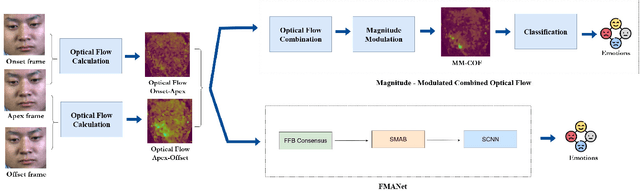
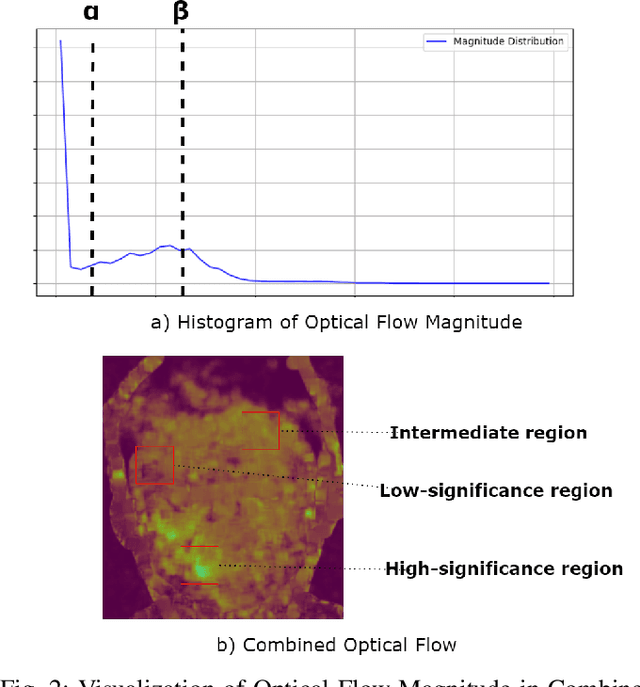

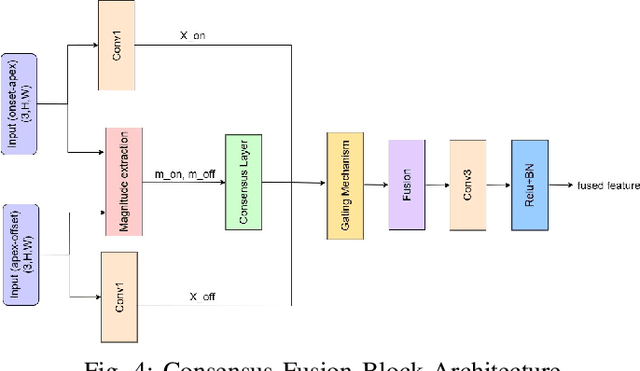
Facial micro-expressions, characterized by their subtle and brief nature, are valuable indicators of genuine emotions. Despite their significance in psychology, security, and behavioral analysis, micro-expression recognition remains challenging due to the difficulty of capturing subtle facial movements. Optical flow has been widely employed as an input modality for this task due to its effectiveness. However, most existing methods compute optical flow only between the onset and apex frames, thereby overlooking essential motion information in the apex-to-offset phase. To address this limitation, we first introduce a comprehensive motion representation, termed Magnitude-Modulated Combined Optical Flow (MM-COF), which integrates motion dynamics from both micro-expression phases into a unified descriptor suitable for direct use in recognition networks. Building upon this principle, we then propose FMANet, a novel end-to-end neural network architecture that internalizes the dual-phase analysis and magnitude modulation into learnable modules. This allows the network to adaptively fuse motion cues and focus on salient facial regions for classification. Experimental evaluations on the MMEW, SMIC, CASME-II, and SAMM datasets, widely recognized as standard benchmarks, demonstrate that our proposed MM-COF representation and FMANet outperforms existing methods, underscoring the potential of a learnable, dual-phase framework in advancing micro-expression recognition.