 Add to Chrome
 Add to Firefox
 Add to Edge
UniGeo: A Unified 3D Indoor Object Detection Framework Integrating Geometry-Aware Learning and Dynamic Channel Gating
Jan 30, 2026
The growing adoption of robotics and augmented reality in real-world applications has driven considerable research interest in 3D object detection based on point clouds. While previous methods address unified training across multiple datasets, they fail to model geometric relationships in sparse point cloud scenes and ignore the feature distribution in significant areas, which ultimately restricts their performance. To deal with this issue, a unified 3D indoor detection framework, called UniGeo, is proposed. To model geometric relations in scenes, we first propose a geometry-aware learning module that establishes a learnable mapping from spatial relationships to feature weights, which enabes explicit geometric feature enhancement. Then, to further enhance point cloud feature representation, we propose a dynamic channel gating mechanism that leverages learnable channel-wise weighting. This mechanism adaptively optimizes features generated by the sparse 3D U-Net network, significantly enhancing key geometric information. Extensive experiments on six different indoor scene datasets clearly validate the superior performance of our method.

MICACL: Multi-Instance Category-Aware Contrastive Learning for Long-Tailed Dynamic Facial Expression Recognition
Sep 04, 2025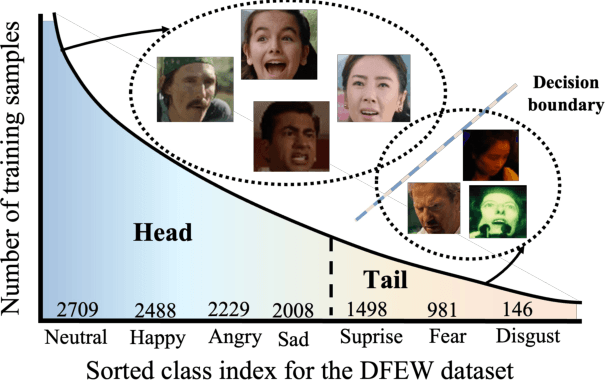
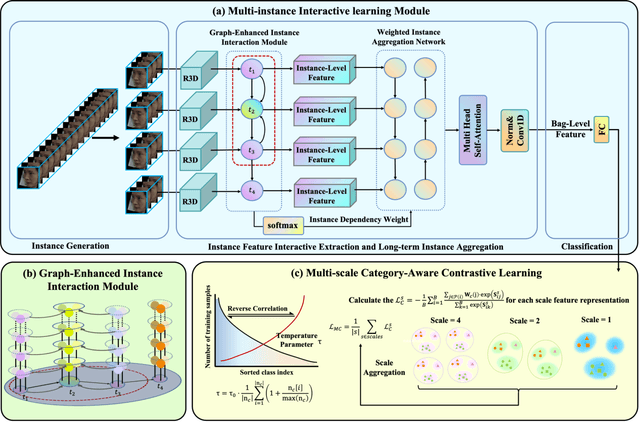
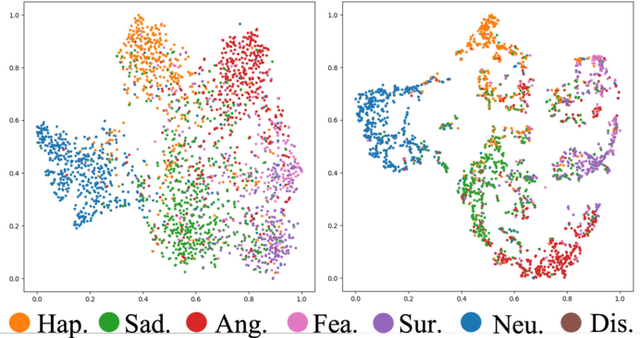
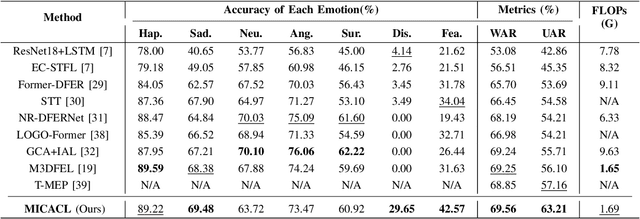
Dynamic facial expression recognition (DFER) faces significant challenges due to long-tailed category distributions and complexity of spatio-temporal feature modeling. While existing deep learning-based methods have improved DFER performance, they often fail to address these issues, resulting in severe model induction bias. To overcome these limitations, we propose a novel multi-instance learning framework called MICACL, which integrates spatio-temporal dependency modeling and long-tailed contrastive learning optimization. Specifically, we design the Graph-Enhanced Instance Interaction Module (GEIIM) to capture intricate spatio-temporal between adjacent instances relationships through adaptive adjacency matrices and multiscale convolutions. To enhance instance-level feature aggregation, we develop the Weighted Instance Aggregation Network (WIAN), which dynamically assigns weights based on instance importance. Furthermore, we introduce a Multiscale Category-aware Contrastive Learning (MCCL) strategy to balance training between major and minor categories. Extensive experiments on in-the-wild datasets (i.e., DFEW and FERV39k) demonstrate that MICACL achieves state-of-the-art performance with superior robustness and generalization.