 Add to Chrome
 Add to Firefox
 Add to Edge
Diffeomorphic Medical Image Registration
Papers and Code
Polaffini: A feature-based approach for robust affine and polyaffine image registration
Feb 19, 2026
In this work we present Polaffini, a robust and versatile framework for anatomically grounded registration. Medical image registration is dominated by intensity-based registration methods that rely on surrogate measures of alignment quality. In contrast, feature-based approaches that operate by identifying explicit anatomical correspondences, while more desirable in theory, have largely fallen out of favor due to the challenges of reliably extracting features. However, such challenges are now significantly overcome thanks to recent advances in deep learning, which provide pre-trained segmentation models capable of instantly delivering reliable, fine-grained anatomical delineations. We aim to demonstrate that these advances can be leveraged to create new anatomically-grounded image registration algorithms. To this end, we propose Polaffini, which obtains, from these segmented regions, anatomically grounded feature points with 1-to-1 correspondence in a particularly simple way: extracting their centroids. These enable efficient global and local affine matching via closed-form solutions. Those are used to produce an overall transformation ranging from affine to polyaffine with tunable smoothness. Polyaffine transformations can have many more degrees of freedom than affine ones allowing for finer alignment, and their embedding in the log-Euclidean framework ensures diffeomorphic properties. Polaffini has applications both for standalone registration and as pre-alignment for subsequent non-linear registration, and we evaluate it against popular intensity-based registration techniques. Results demonstrate that Polaffini outperforms competing methods in terms of structural alignment and provides improved initialisation for downstream non-linear registration. Polaffini is fast, robust, and accurate, making it particularly well-suited for integration into medical image processing pipelines.

Revisiting Data Scaling Law for Medical Segmentation
Nov 17, 2025The population loss of trained deep neural networks often exhibits power law scaling with the size of the training dataset, guiding significant performance advancements in deep learning applications. In this study, we focus on the scaling relationship with data size in the context of medical anatomical segmentation, a domain that remains underexplored. We analyze scaling laws for anatomical segmentation across 15 semantic tasks and 4 imaging modalities, demonstrating that larger datasets significantly improve segmentation performance, following similar scaling trends. Motivated by the topological isomorphism in images sharing anatomical structures, we evaluate the impact of deformation-guided augmentation strategies on data scaling laws, specifically random elastic deformation and registration-guided deformation. We also propose a novel, scalable image augmentation approach that generates diffeomorphic mappings from geodesic subspace based on image registration to introduce realistic deformation. Our experimental results demonstrate that both registered and generated deformation-based augmentation considerably enhance data utilization efficiency. The proposed generated deformation method notably achieves superior performance and accelerated convergence, surpassing standard power law scaling trends without requiring additional data. Overall, this work provides insights into the understanding of segmentation scalability and topological variation impact in medical imaging, thereby leading to more efficient model development with reduced annotation and computational costs.
Mono-Modalizing Extremely Heterogeneous Multi-Modal Medical Image Registration
Jun 18, 2025In clinical practice, imaging modalities with functional characteristics, such as positron emission tomography (PET) and fractional anisotropy (FA), are often aligned with a structural reference (e.g., MRI, CT) for accurate interpretation or group analysis, necessitating multi-modal deformable image registration (DIR). However, due to the extreme heterogeneity of these modalities compared to standard structural scans, conventional unsupervised DIR methods struggle to learn reliable spatial mappings and often distort images. We find that the similarity metrics guiding these models fail to capture alignment between highly disparate modalities. To address this, we propose M2M-Reg (Multi-to-Mono Registration), a novel framework that trains multi-modal DIR models using only mono-modal similarity while preserving the established architectural paradigm for seamless integration into existing models. We also introduce GradCyCon, a regularizer that leverages M2M-Reg's cyclic training scheme to promote diffeomorphism. Furthermore, our framework naturally extends to a semi-supervised setting, integrating pre-aligned and unaligned pairs only, without requiring ground-truth transformations or segmentation masks. Experiments on the Alzheimer's Disease Neuroimaging Initiative (ADNI) dataset demonstrate that M2M-Reg achieves up to 2x higher DSC than prior methods for PET-MRI and FA-MRI registration, highlighting its effectiveness in handling highly heterogeneous multi-modal DIR. Our code is available at https://github.com/MICV-yonsei/M2M-Reg.
A Symmetric Dynamic Learning Framework for Diffeomorphic Medical Image Registration
Nov 05, 2024Diffeomorphic image registration is crucial for various medical imaging applications because it can preserve the topology of the transformation. This study introduces DCCNN-LSTM-Reg, a learning framework that evolves dynamically and learns a symmetrical registration path by satisfying a specified control increment system. This framework aims to obtain symmetric diffeomorphic deformations between moving and fixed images. To achieve this, we combine deep learning networks with diffeomorphic mathematical mechanisms to create a continuous and dynamic registration architecture, which consists of multiple Symmetric Registration (SR) modules cascaded on five different scales. Specifically, our method first uses two U-nets with shared parameters to extract multiscale feature pyramids from the images. We then develop an SR-module comprising a sequential CNN-LSTM architecture to progressively correct the forward and reverse multiscale deformation fields using control increment learning and the homotopy continuation technique. Through extensive experiments on three 3D registration tasks, we demonstrate that our method outperforms existing approaches in both quantitative and qualitative evaluations.
Beyond the LUMIR challenge: The pathway to foundational registration models
May 30, 2025
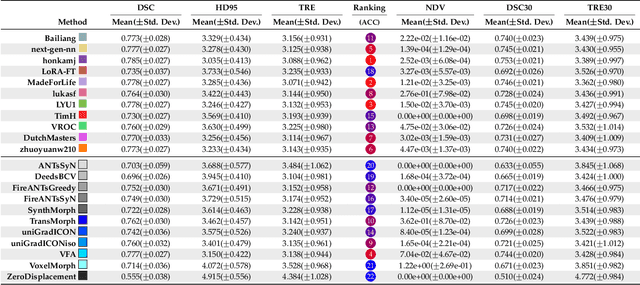
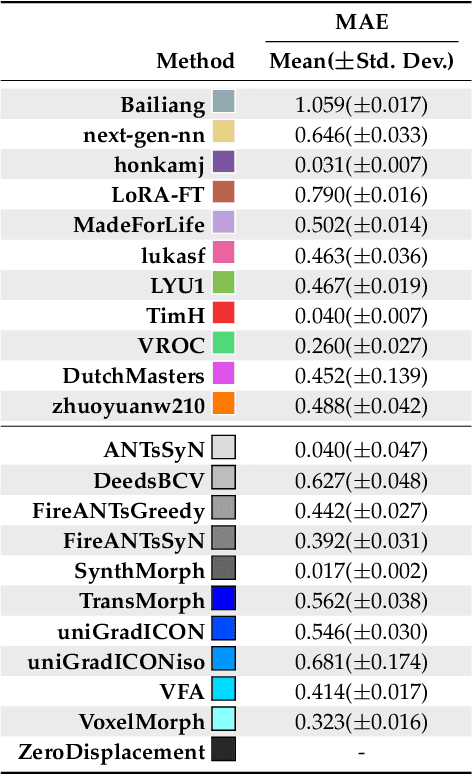
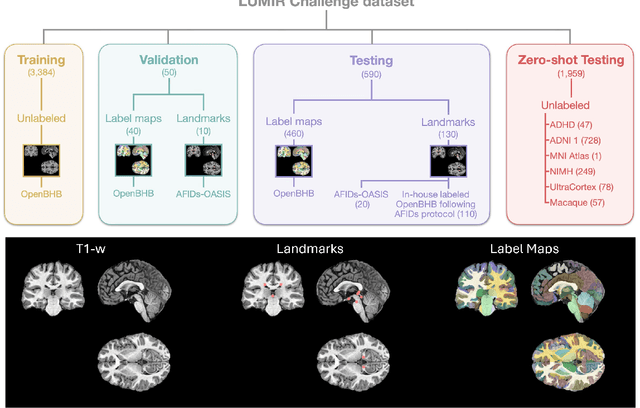
Medical image challenges have played a transformative role in advancing the field, catalyzing algorithmic innovation and establishing new performance standards across diverse clinical applications. Image registration, a foundational task in neuroimaging pipelines, has similarly benefited from the Learn2Reg initiative. Building on this foundation, we introduce the Large-scale Unsupervised Brain MRI Image Registration (LUMIR) challenge, a next-generation benchmark designed to assess and advance unsupervised brain MRI registration. Distinct from prior challenges that leveraged anatomical label maps for supervision, LUMIR removes this dependency by providing over 4,000 preprocessed T1-weighted brain MRIs for training without any label maps, encouraging biologically plausible deformation modeling through self-supervision. In addition to evaluating performance on 590 held-out test subjects, LUMIR introduces a rigorous suite of zero-shot generalization tasks, spanning out-of-domain imaging modalities (e.g., FLAIR, T2-weighted, T2*-weighted), disease populations (e.g., Alzheimer's disease), acquisition protocols (e.g., 9.4T MRI), and species (e.g., macaque brains). A total of 1,158 subjects and over 4,000 image pairs were included for evaluation. Performance was assessed using both segmentation-based metrics (Dice coefficient, 95th percentile Hausdorff distance) and landmark-based registration accuracy (target registration error). Across both in-domain and zero-shot tasks, deep learning-based methods consistently achieved state-of-the-art accuracy while producing anatomically plausible deformation fields. The top-performing deep learning-based models demonstrated diffeomorphic properties and inverse consistency, outperforming several leading optimization-based methods, and showing strong robustness to most domain shifts, the exception being a drop in performance on out-of-domain contrasts.
MORPH-LER: Log-Euclidean Regularization for Population-Aware Image Registration
Feb 04, 2025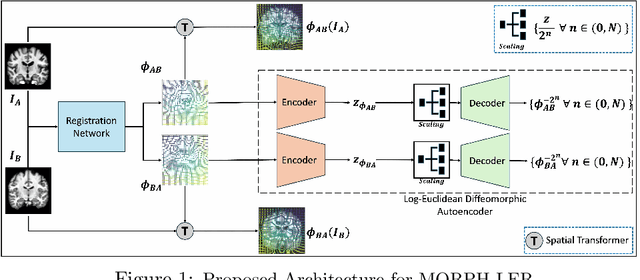
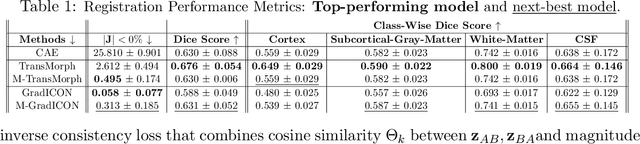
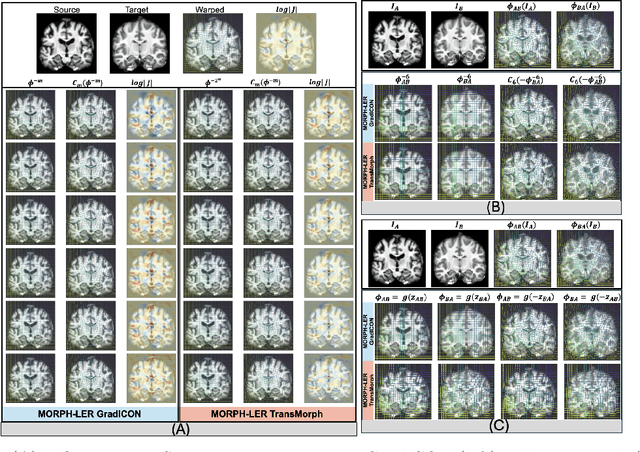
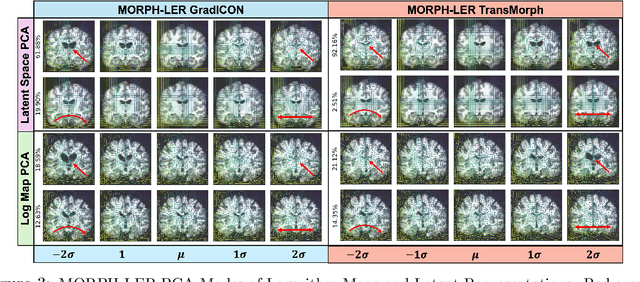
Spatial transformations that capture population-level morphological statistics are critical for medical image analysis. Commonly used smoothness regularizers for image registration fail to integrate population statistics, leading to anatomically inconsistent transformations. Inverse consistency regularizers promote geometric consistency but lack population morphometrics integration. Regularizers that constrain deformation to low-dimensional manifold methods address this. However, they prioritize reconstruction over interpretability and neglect diffeomorphic properties, such as group composition and inverse consistency. We introduce MORPH-LER, a Log-Euclidean regularization framework for population-aware unsupervised image registration. MORPH-LER learns population morphometrics from spatial transformations to guide and regularize registration networks, ensuring anatomically plausible deformations. It features a bottleneck autoencoder that computes the principal logarithm of deformation fields via iterative square-root predictions. It creates a linearized latent space that respects diffeomorphic properties and enforces inverse consistency. By integrating a registration network with a diffeomorphic autoencoder, MORPH-LER produces smooth, meaningful deformation fields. The framework offers two main contributions: (1) a data-driven regularization strategy that incorporates population-level anatomical statistics to enhance transformation validity and (2) a linearized latent space that enables compact and interpretable deformation fields for efficient population morphometrics analysis. We validate MORPH-LER across two families of deep learning-based registration networks, demonstrating its ability to produce anatomically accurate, computationally efficient, and statistically meaningful transformations on the OASIS-1 brain imaging dataset.
A Steerable Deep Network for Model-Free Diffusion MRI Registration
Jan 10, 2025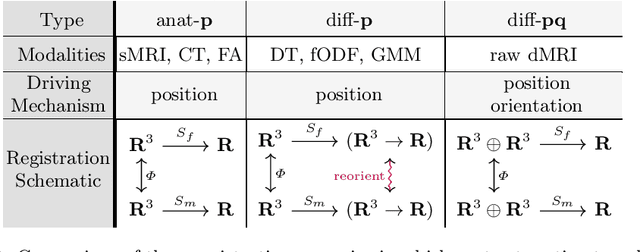

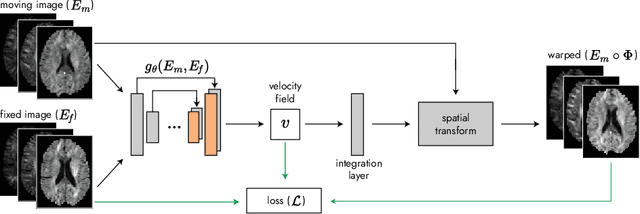
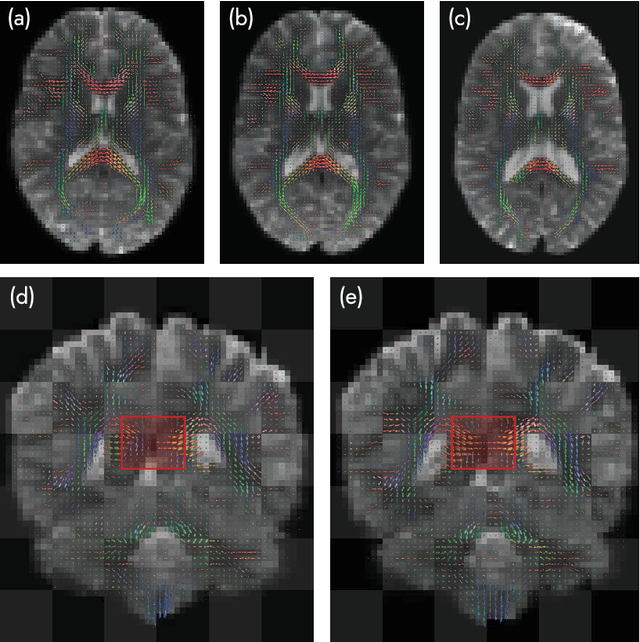
Nonrigid registration is vital to medical image analysis but remains challenging for diffusion MRI (dMRI) due to its high-dimensional, orientation-dependent nature. While classical methods are accurate, they are computationally demanding, and deep neural networks, though efficient, have been underexplored for nonrigid dMRI registration compared to structural imaging. We present a novel, deep learning framework for model-free, nonrigid registration of raw diffusion MRI data that does not require explicit reorientation. Unlike previous methods relying on derived representations such as diffusion tensors or fiber orientation distribution functions, in our approach, we formulate the registration as an equivariant diffeomorphism of position-and-orientation space. Central to our method is an $\mathsf{SE}(3)$-equivariant UNet that generates velocity fields while preserving the geometric properties of a raw dMRI's domain. We introduce a new loss function based on the maximum mean discrepancy in Fourier space, implicitly matching ensemble average propagators across images. Experimental results on Human Connectome Project dMRI data demonstrate competitive performance compared to state-of-the-art approaches, with the added advantage of bypassing the overhead for estimating derived representations. This work establishes a foundation for data-driven, geometry-aware dMRI registration directly in the acquisition space.
Bidirectional Recurrence for Cardiac Motion Tracking with Gaussian Process Latent Coding
Oct 28, 2024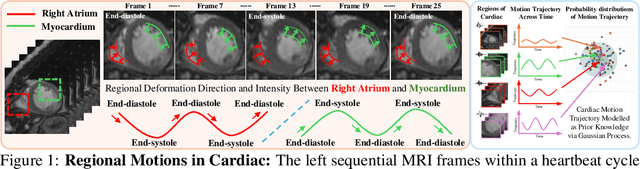
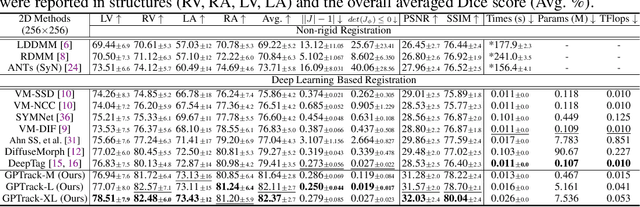
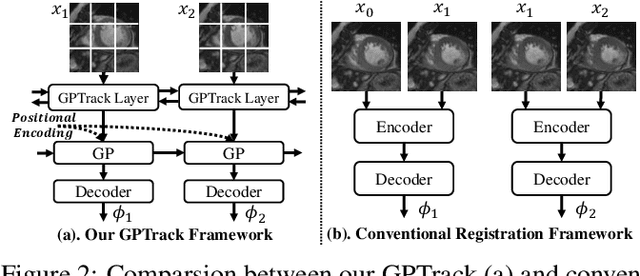
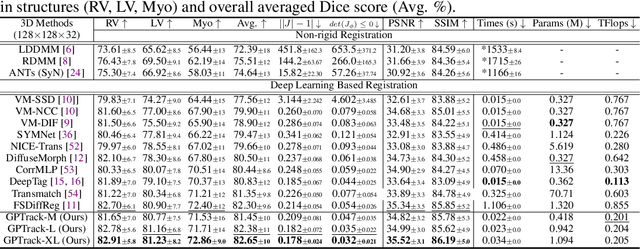
Quantitative analysis of cardiac motion is crucial for assessing cardiac function. This analysis typically uses imaging modalities such as MRI and Echocardiograms that capture detailed image sequences throughout the heartbeat cycle. Previous methods predominantly focused on the analysis of image pairs lacking consideration of the motion dynamics and spatial variability. Consequently, these methods often overlook the long-term relationships and regional motion characteristic of cardiac. To overcome these limitations, we introduce the \textbf{GPTrack}, a novel unsupervised framework crafted to fully explore the temporal and spatial dynamics of cardiac motion. The GPTrack enhances motion tracking by employing the sequential Gaussian Process in the latent space and encoding statistics by spatial information at each time stamp, which robustly promotes temporal consistency and spatial variability of cardiac dynamics. Also, we innovatively aggregate sequential information in a bidirectional recursive manner, mimicking the behavior of diffeomorphic registration to better capture consistent long-term relationships of motions across cardiac regions such as the ventricles and atria. Our GPTrack significantly improves the precision of motion tracking in both 3D and 4D medical images while maintaining computational efficiency. The code is available at: https://github.com/xmed-lab/GPTrack
Learning Diffeomorphism for Image Registration with Time-Continuous Networks using Semigroup Regularization
May 29, 2024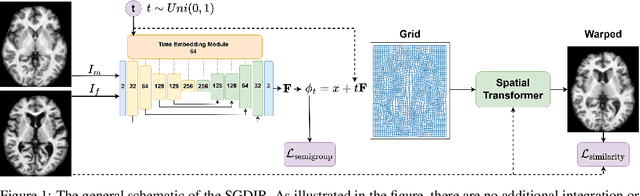
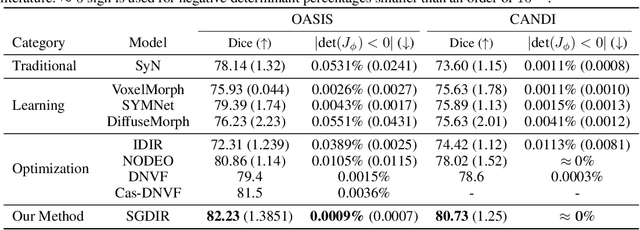
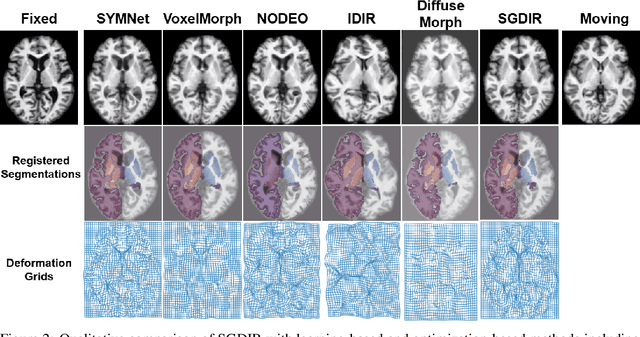
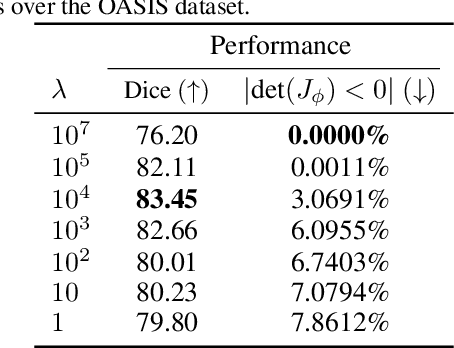
Diffeomorphic image registration (DIR) is a critical task in 3D medical image analysis, aimed at finding topology preserving deformations between pairs of images. Focusing on the solution of the flow map differential equation as the diffeomorphic deformation, recent methods use discrete timesteps along with various regularization terms to penalize the negative determinant of Jacobian and impose smoothness of the solution vector field. In this paper, we propose a novel learning-based approach for diffeomorphic 3D-image registration which finds the diffeomorphisms in the time continuum with fewer regularization terms and no additional integration. As one of the fundamental properties of flow maps, we exploit the semigroup property as the only form of regularization, ensuring temporally continuous diffeomorphic flows between pairs of images. Leveraging this property, our method alleviates the need for additional regularization terms and scaling and squaring integration during both training and evaluation. To achieve time-continuous diffeomorphisms, we employ time-embedded UNets, a technique commonly utilized in diffusion models. The proposed method reveals that ensuring diffeomorphism in a continuous time interval leads to better registration results. Experimental results on two public datasets (OASIS and CANDI) demonstrate the superiority of our model over both learning-based and optimization-based methods.
$\texttt{NePhi}$: Neural Deformation Fields for Approximately Diffeomorphic Medical Image Registration
Sep 13, 2023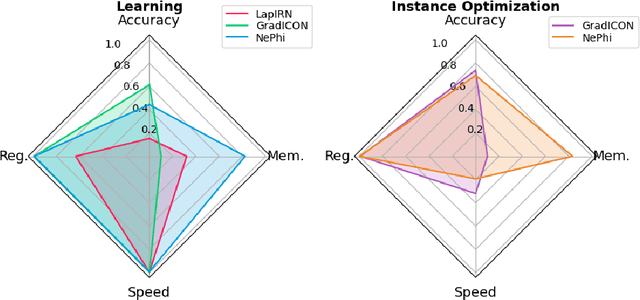
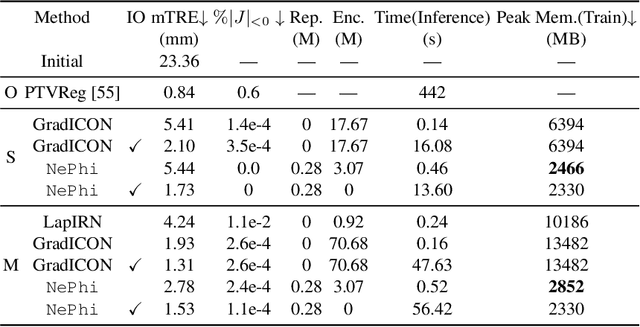
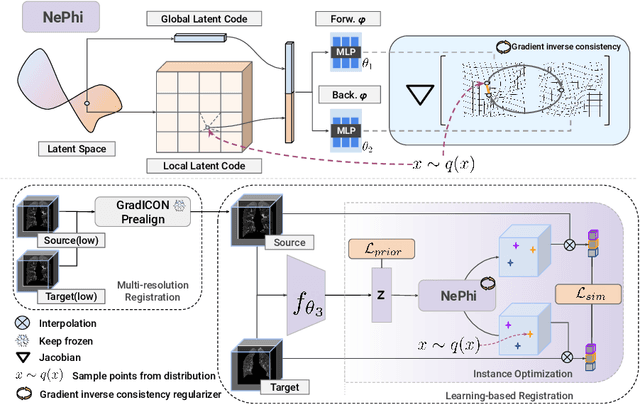
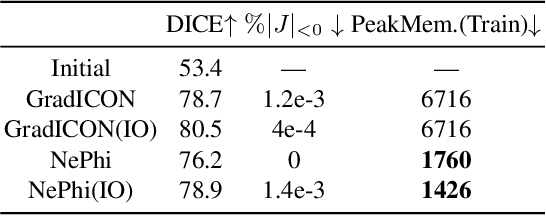
This work proposes $\texttt{NePhi}$, a neural deformation model which results in approximately diffeomorphic transformations. In contrast to the predominant voxel-based approaches, $\texttt{NePhi}$ represents deformations functionally which allows for memory-efficient training and inference. This is of particular importance for large volumetric registrations. Further, while medical image registration approaches representing transformation maps via multi-layer perceptrons have been proposed, $\texttt{NePhi}$ facilitates both pairwise optimization-based registration $\textit{as well as}$ learning-based registration via predicted or optimized global and local latent codes. Lastly, as deformation regularity is a highly desirable property for most medical image registration tasks, $\texttt{NePhi}$ makes use of gradient inverse consistency regularization which empirically results in approximately diffeomorphic transformations. We show the performance of $\texttt{NePhi}$ on two 2D synthetic datasets as well as on real 3D lung registration. Our results show that $\texttt{NePhi}$ can achieve similar accuracies as voxel-based representations in a single-resolution registration setting while using less memory and allowing for faster instance-optimization.