 Add to Chrome
 Add to Firefox
 Add to Edge
Deformable Detr
Papers and Code
FSDETR: Frequency-Spatial Feature Enhancement for Small Object Detection
Apr 16, 2026
Small object detection remains a significant challenge due to feature degradation from downsampling, mutual occlusion in dense clusters, and complex background interference. To address these issues, this paper proposes FSDETR, a frequency-spatial feature enhancement framework built upon the RT-DETR baseline. By establishing a collaborative modeling mechanism, the method effectively leverages complementary structural information. Specifically, a Spatial Hierarchical Attention Block (SHAB) captures both local details and global dependencies to strengthen semantic representation. Furthermore, to mitigate occlusion in dense scenes, the Deformable Attention-based Intra-scale Feature Interaction (DA-AIFI) focuses on informative regions via dynamic sampling. Finally, the Frequency-Spatial Feature Pyramid Network (FSFPN) integrates frequency filtering with spatial edge extraction via the Cross-domain Frequency-Spatial Block (CFSB) to preserve fine-grained details. Experimental results show that with only 14.7M parameters, FSDETR achieves 13.9% APS on VisDrone 2019 and 48.95% AP50 tiny on TinyPerson, showing strong performance on small-object benchmarks. The code and models are available at https://github.com/YT3DVision/FSDETR.

A Deformable Attention-Based Detection Transformer with Cross-Scale Feature Fusion for Industrial Coil Spring Inspection
Mar 13, 2026Automated visual inspection of locomotive coil springs presents significant challenges due to the morphological diversity of surface defects, substantial scale variations, and complex industrial backgrounds. This paper proposes MSD-DETR (Multi-Scale Deformable Detection Transformer), a novel detection framework that addresses these challenges through three key innovations: (1) a structural re-parameterization strategy that decouples training-time multi-branch topology from inference-time efficiency, enhancing feature extraction while maintaining real-time performance; (2) a deformable attention mechanism that enables content-adaptive spatial sampling, allowing dynamic focus on defect-relevant regions regardless of morphological irregularity; and (3) a cross-scale feature fusion architecture incorporating GSConv modules and VoVGSCSP blocks for effective multi-resolution information aggregation. Comprehensive experiments on a real-world locomotive coil spring dataset demonstrate that MSD-DETR achieves 92.4\% mAP@0.5 at 98 FPS, outperforming state-of-the-art detectors including YOLOv8 (+3.1\% mAP) and the baseline RT-DETR (+2.8\% mAP) while maintaining comparable inference speed, establishing a new benchmark for industrial coil spring quality inspection.
Towards Instance Segmentation with Polygon Detection Transformers
Mar 10, 2026One of the bottlenecks for instance segmentation today lies in the conflicting requirements of high-resolution inputs and lightweight, real-time inference. To address this bottleneck, we present a Polygon Detection Transformer (Poly-DETR) to reformulate instance segmentation as sparse vertex regression via Polar Representation, thereby eliminating the reliance on dense pixel-wise mask prediction. Considering the box-to-polygon reference shift in Detection Transformers, we propose Polar Deformable Attention and Position-Aware Training Scheme to dynamically update supervision and focus attention on boundary cues. Compared with state-of-the-art polar-based methods, Poly-DETR achieves a 4.7 mAP improvement on MS COCO test-dev. Moreover, we construct a parallel mask-based counterpart to support a systematic comparison between polar and mask representations. Experimental results show that Poly-DETR is more lightweight in high-resolution scenarios, reducing memory consumption by almost half on Cityscapes dataset. Notably, on PanNuke (cell segmentation) and SpaceNet (building footprints) datasets, Poly-DETR surpasses its mask-based counterpart on all metrics, which validates its advantage on regular-shaped instances in domain-specific settings.
PMMA: The Polytechnique Montreal Mobility Aids Dataset
Feb 10, 2026This study introduces a new object detection dataset of pedestrians using mobility aids, named PMMA. The dataset was collected in an outdoor environment, where volunteers used wheelchairs, canes, and walkers, resulting in nine categories of pedestrians: pedestrians, cane users, two types of walker users, whether walking or resting, five types of wheelchair users, including wheelchair users, people pushing empty wheelchairs, and three types of users pushing occupied wheelchairs, including the entire pushing group, the pusher and the person seated on the wheelchair. To establish a benchmark, seven object detection models (Faster R-CNN, CenterNet, YOLOX, DETR, Deformable DETR, DINO, and RT-DETR) and three tracking algorithms (ByteTrack, BOT-SORT, and OC-SORT) were implemented under the MMDetection framework. Experimental results show that YOLOX, Deformable DETR, and Faster R-CNN achieve the best detection performance, while the differences among the three trackers are relatively small. The PMMA dataset is publicly available at https://doi.org/10.5683/SP3/XJPQUG, and the video processing and model training code is available at https://github.com/DatasetPMMA/PMMA.
DExTeR: Weakly Semi-Supervised Object Detection with Class and Instance Experts for Medical Imaging
Jan 20, 2026Detecting anatomical landmarks in medical imaging is essential for diagnosis and intervention guidance. However, object detection models rely on costly bounding box annotations, limiting scalability. Weakly Semi-Supervised Object Detection (WSSOD) with point annotations proposes annotating each instance with a single point, minimizing annotation time while preserving localization signals. A Point-to-Box teacher model, trained on a small box-labeled subset, converts these point annotations into pseudo-box labels to train a student detector. Yet, medical imagery presents unique challenges, including overlapping anatomy, variable object sizes, and elusive structures, which hinder accurate bounding box inference. To overcome these challenges, we introduce DExTeR (DETR with Experts), a transformer-based Point-to-Box regressor tailored for medical imaging. Built upon Point-DETR, DExTeR encodes single-point annotations as object queries, refining feature extraction with the proposed class-guided deformable attention, which guides attention sampling using point coordinates and class labels to capture class-specific characteristics. To improve discrimination in complex structures, it introduces CLICK-MoE (CLass, Instance, and Common Knowledge Mixture of Experts), decoupling class and instance representations to reduce confusion among adjacent or overlapping instances. Finally, we implement a multi-point training strategy which promotes prediction consistency across different point placements, improving robustness to annotation variability. DExTeR achieves state-of-the-art performance across three datasets spanning different medical domains (endoscopy, chest X-rays, and endoscopic ultrasound) highlighting its potential to reduce annotation costs while maintaining high detection accuracy.
Nodule-DETR: A Novel DETR Architecture with Frequency-Channel Attention for Ultrasound Thyroid Nodule Detection
Jan 05, 2026Thyroid cancer is the most common endocrine malignancy, and its incidence is rising globally. While ultrasound is the preferred imaging modality for detecting thyroid nodules, its diagnostic accuracy is often limited by challenges such as low image contrast and blurred nodule boundaries. To address these issues, we propose Nodule-DETR, a novel detection transformer (DETR) architecture designed for robust thyroid nodule detection in ultrasound images. Nodule-DETR introduces three key innovations: a Multi-Spectral Frequency-domain Channel Attention (MSFCA) module that leverages frequency analysis to enhance features of low-contrast nodules; a Hierarchical Feature Fusion (HFF) module for efficient multi-scale integration; and Multi-Scale Deformable Attention (MSDA) to flexibly capture small and irregularly shaped nodules. We conducted extensive experiments on a clinical dataset of real-world thyroid ultrasound images. The results demonstrate that Nodule-DETR achieves state-of-the-art performance, outperforming the baseline model by a significant margin of 0.149 in mAP@0.5:0.95. The superior accuracy of Nodule-DETR highlights its significant potential for clinical application as an effective tool in computer-aided thyroid diagnosis. The code of work is available at https://github.com/wjj1wjj/Nodule-DETR.
Prior-Guided DETR for Ultrasound Nodule Detection
Jan 05, 2026Accurate detection of ultrasound nodules is essential for the early diagnosis and treatment of thyroid and breast cancers. However, this task remains challenging due to irregular nodule shapes, indistinct boundaries, substantial scale variations, and the presence of speckle noise that degrades structural visibility. To address these challenges, we propose a prior-guided DETR framework specifically designed for ultrasound nodule detection. Instead of relying on purely data-driven feature learning, the proposed framework progressively incorporates different prior knowledge at multiple stages of the network. First, a Spatially-adaptive Deformable FFN with Prior Regularization (SDFPR) is embedded into the CNN backbone to inject geometric priors into deformable sampling, stabilizing feature extraction for irregular and blurred nodules. Second, a Multi-scale Spatial-Frequency Feature Mixer (MSFFM) is designed to extract multi-scale structural priors, where spatial-domain processing emphasizes contour continuity and boundary cues, while frequency-domain modeling captures global morphology and suppresses speckle noise. Furthermore, a Dense Feature Interaction (DFI) mechanism propagates and exploits these prior-modulated features across all encoder layers, enabling the decoder to enhance query refinement under consistent geometric and structural guidance. Experiments conducted on two clinically collected thyroid ultrasound datasets (Thyroid I and Thyroid II) and two public benchmarks (TN3K and BUSI) for thyroid and breast nodules demonstrate that the proposed method achieves superior accuracy compared with 18 detection methods, particularly in detecting morphologically complex nodules.The source code is publicly available at https://github.com/wjj1wjj/Ultrasound-DETR.
QUILL: An Algorithm-Architecture Co-Design for Cache-Local Deformable Attention
Nov 17, 2025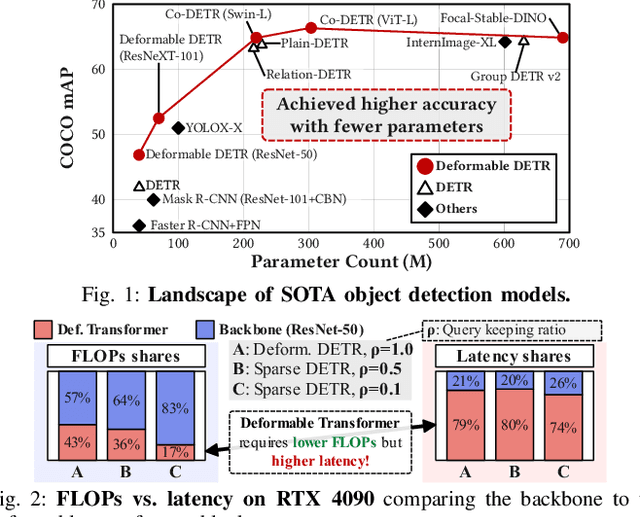
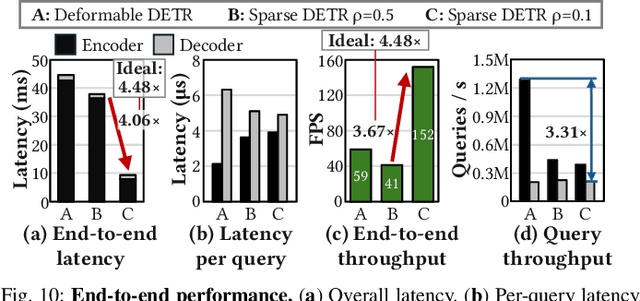
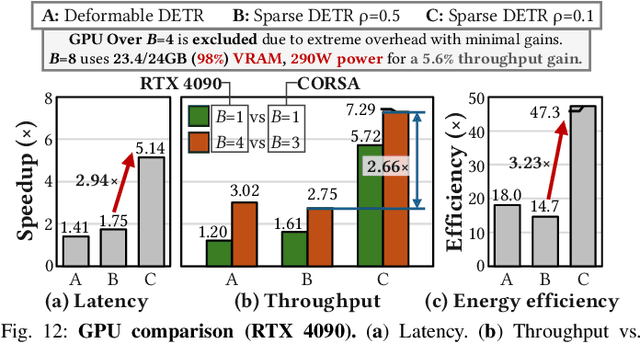
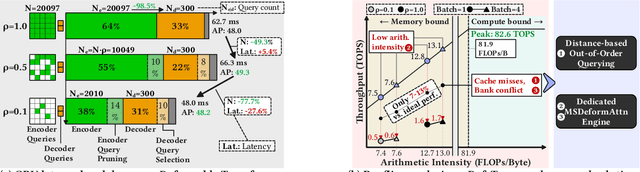
Deformable transformers deliver state-of-the-art detection but map poorly to hardware due to irregular memory access and low arithmetic intensity. We introduce QUILL, a schedule-aware accelerator that turns deformable attention into cache-friendly, single-pass work. At its core, Distance-based Out-of-Order Querying (DOOQ) orders queries by spatial proximity; the look-ahead drives a region prefetch into an alternate buffer--forming a schedule-aware prefetch loop that overlaps memory and compute. A fused MSDeformAttn engine executes interpolation, Softmax, aggregation, and the final projection (W''m) in one pass without spilling intermediates, while small tensors are kept on-chip and surrounding dense layers run on integrated GEMMs. Implemented as RTL and evaluated end-to-end, QUILL achieves up to 7.29x higher throughput and 47.3x better energy efficiency than an RTX 4090, and exceeds prior accelerators by 3.26-9.82x in throughput and 2.01-6.07x in energy efficiency. With mixed-precision quantization, accuracy tracks FP32 within <=0.9 AP across Deformable and Sparse DETR variants. By converting sparsity into locality--and locality into utilization--QUILL delivers consistent, end-to-end speedups.
On Modality Incomplete Infrared-Visible Object Detection: An Architecture Compatibility Perspective
Nov 09, 2025Infrared and visible object detection (IVOD) is essential for numerous around-the-clock applications. Despite notable advancements, current IVOD models exhibit notable performance declines when confronted with incomplete modality data, particularly if the dominant modality is missing. In this paper, we take a thorough investigation on modality incomplete IVOD problem from an architecture compatibility perspective. Specifically, we propose a plug-and-play Scarf Neck module for DETR variants, which introduces a modality-agnostic deformable attention mechanism to enable the IVOD detector to flexibly adapt to any single or double modalities during training and inference. When training Scarf-DETR, we design a pseudo modality dropout strategy to fully utilize the multi-modality information, making the detector compatible and robust to both working modes of single and double modalities. Moreover, we introduce a comprehensive benchmark for the modality-incomplete IVOD task aimed at thoroughly assessing situations where the absent modality is either dominant or secondary. Our proposed Scarf-DETR not only performs excellently in missing modality scenarios but also achieves superior performances on the standard IVOD modality complete benchmarks. Our code will be available at https://github.com/YinghuiXing/Scarf-DETR.
TCLeaf-Net: a transformer-convolution framework with global-local attention for robust in-field lesion-level plant leaf disease detection
Dec 13, 2025Timely and accurate detection of foliar diseases is vital for safeguarding crop growth and reducing yield losses. Yet, in real-field conditions, cluttered backgrounds, domain shifts, and limited lesion-level datasets hinder robust modeling. To address these challenges, we release Daylily-Leaf, a paired lesion-level dataset comprising 1,746 RGB images and 7,839 lesions captured under both ideal and in-field conditions, and propose TCLeaf-Net, a transformer-convolution hybrid detector optimized for real-field use. TCLeaf-Net is designed to tackle three major challenges. To mitigate interference from complex backgrounds, the transformer-convolution module (TCM) couples global context with locality-preserving convolution to suppress non-leaf regions. To reduce information loss during downsampling, the raw-scale feature recalling and sampling (RSFRS) block combines bilinear resampling and convolution to preserve fine spatial detail. To handle variations in lesion scale and feature shifts, the deformable alignment block with FPN (DFPN) employs offset-based alignment and multi-receptive-field perception to strengthen multi-scale fusion. Experimental results show that on the in-field split of the Daylily-Leaf dataset, TCLeaf-Net improves mAP@50 by 5.4 percentage points over the baseline model, reaching 78.2\%, while reducing computation by 7.5 GFLOPs and GPU memory usage by 8.7\%. Moreover, the model outperforms recent YOLO and RT-DETR series in both precision and recall, and demonstrates strong performance on the PlantDoc, Tomato-Leaf, and Rice-Leaf datasets, validating its robustness and generalizability to other plant disease detection scenarios.