 Add to Chrome
 Add to Firefox
 Add to Edge
Towards Instance Segmentation with Polygon Detection Transformers
Mar 10, 2026
One of the bottlenecks for instance segmentation today lies in the conflicting requirements of high-resolution inputs and lightweight, real-time inference. To address this bottleneck, we present a Polygon Detection Transformer (Poly-DETR) to reformulate instance segmentation as sparse vertex regression via Polar Representation, thereby eliminating the reliance on dense pixel-wise mask prediction. Considering the box-to-polygon reference shift in Detection Transformers, we propose Polar Deformable Attention and Position-Aware Training Scheme to dynamically update supervision and focus attention on boundary cues. Compared with state-of-the-art polar-based methods, Poly-DETR achieves a 4.7 mAP improvement on MS COCO test-dev. Moreover, we construct a parallel mask-based counterpart to support a systematic comparison between polar and mask representations. Experimental results show that Poly-DETR is more lightweight in high-resolution scenarios, reducing memory consumption by almost half on Cityscapes dataset. Notably, on PanNuke (cell segmentation) and SpaceNet (building footprints) datasets, Poly-DETR surpasses its mask-based counterpart on all metrics, which validates its advantage on regular-shaped instances in domain-specific settings.

A Novel Driver Distraction Behavior Detection Based on Self-Supervised Learning Framework with Masked Image Modeling
Jun 13, 2023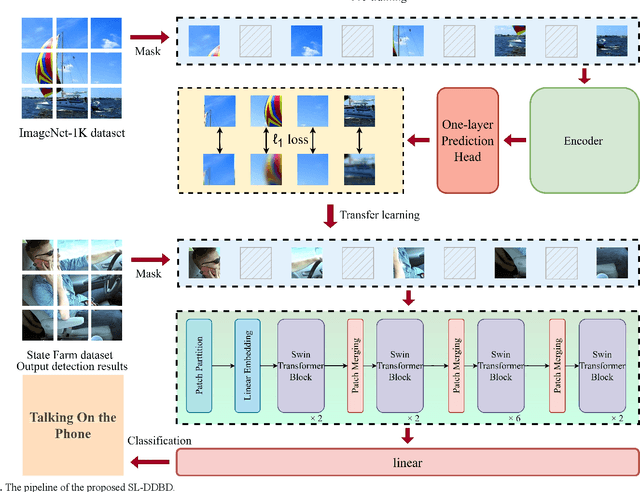
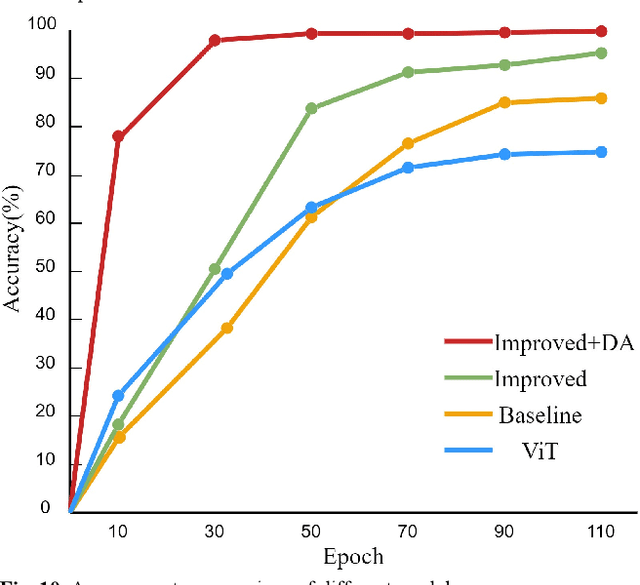
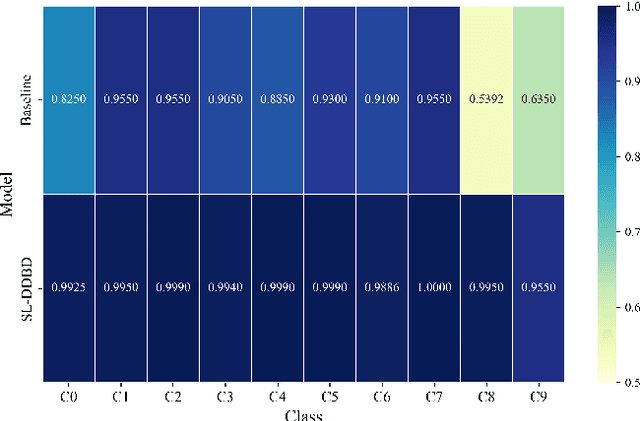
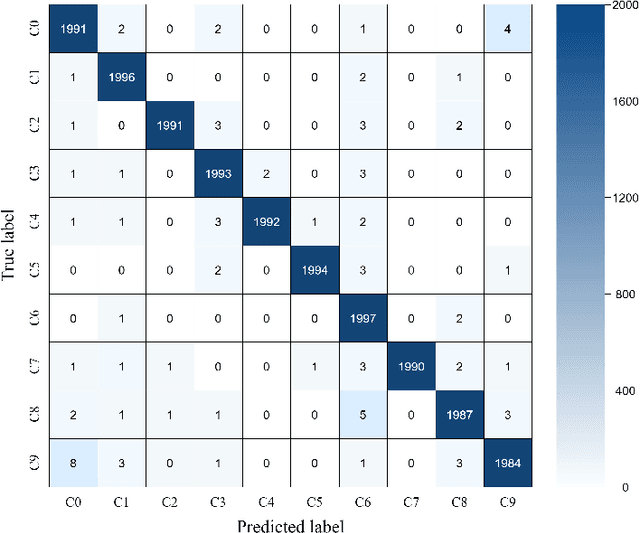
Driver distraction causes a significant number of traffic accidents every year, resulting in economic losses and casualties. Currently, the level of automation in commercial vehicles is far from completely unmanned, and drivers still play an important role in operating and controlling the vehicle. Therefore, driver distraction behavior detection is crucial for road safety. At present, driver distraction detection primarily relies on traditional Convolutional Neural Networks (CNN) and supervised learning methods. However, there are still challenges such as the high cost of labeled datasets, limited ability to capture high-level semantic information, and weak generalization performance. In order to solve these problems, this paper proposes a new self-supervised learning method based on masked image modeling for driver distraction behavior detection. Firstly, a self-supervised learning framework for masked image modeling (MIM) is introduced to solve the serious human and material consumption issues caused by dataset labeling. Secondly, the Swin Transformer is employed as an encoder. Performance is enhanced by reconfiguring the Swin Transformer block and adjusting the distribution of the number of window multi-head self-attention (W-MSA) and shifted window multi-head self-attention (SW-MSA) detection heads across all stages, which leads to model more lightening. Finally, various data augmentation strategies are used along with the best random masking strategy to strengthen the model's recognition and generalization ability. Test results on a large-scale driver distraction behavior dataset show that the self-supervised learning method proposed in this paper achieves an accuracy of 99.60%, approximating the excellent performance of advanced supervised learning methods.