 Add to Chrome
 Add to Firefox
 Add to Edge
Towards Instance Segmentation with Polygon Detection Transformers
Mar 10, 2026
One of the bottlenecks for instance segmentation today lies in the conflicting requirements of high-resolution inputs and lightweight, real-time inference. To address this bottleneck, we present a Polygon Detection Transformer (Poly-DETR) to reformulate instance segmentation as sparse vertex regression via Polar Representation, thereby eliminating the reliance on dense pixel-wise mask prediction. Considering the box-to-polygon reference shift in Detection Transformers, we propose Polar Deformable Attention and Position-Aware Training Scheme to dynamically update supervision and focus attention on boundary cues. Compared with state-of-the-art polar-based methods, Poly-DETR achieves a 4.7 mAP improvement on MS COCO test-dev. Moreover, we construct a parallel mask-based counterpart to support a systematic comparison between polar and mask representations. Experimental results show that Poly-DETR is more lightweight in high-resolution scenarios, reducing memory consumption by almost half on Cityscapes dataset. Notably, on PanNuke (cell segmentation) and SpaceNet (building footprints) datasets, Poly-DETR surpasses its mask-based counterpart on all metrics, which validates its advantage on regular-shaped instances in domain-specific settings.

Decoupled and Interactive Regression Modeling for High-performance One-stage 3D Object Detection
Sep 01, 2024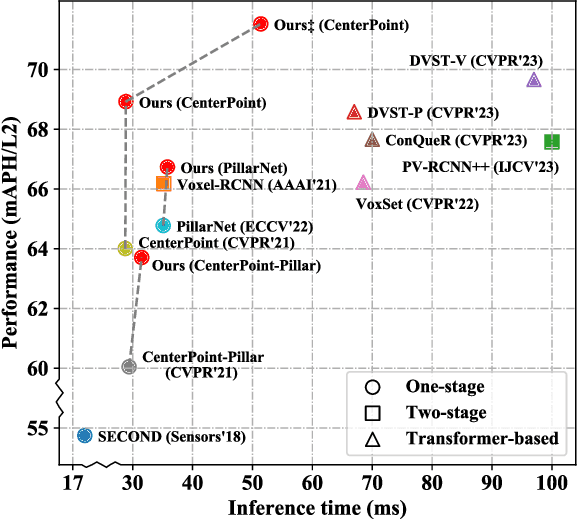

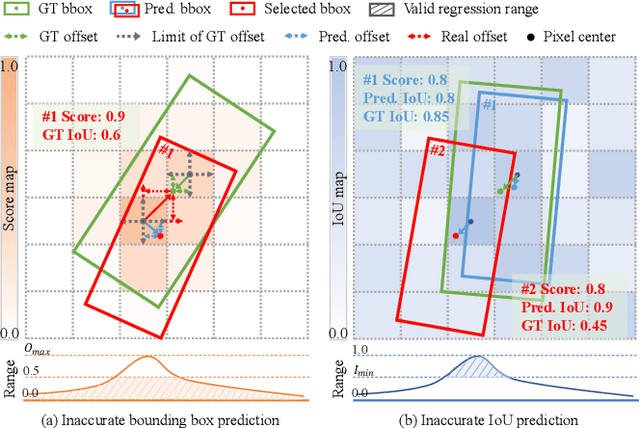
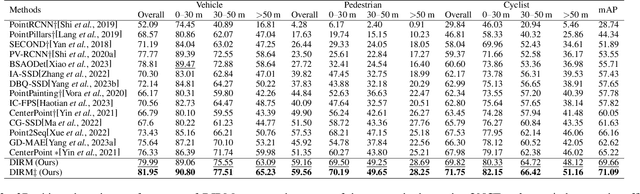
Inadequate bounding box modeling in regression tasks constrains the performance of one-stage 3D object detection. Our study reveals that the primary reason lies in two aspects: (1) The limited center-offset prediction seriously impairs the bounding box localization since many highest response positions significantly deviate from object centers. (2) The low-quality sample ignored in regression tasks significantly impacts the bounding box prediction since it produces unreliable quality (IoU) rectification. To tackle these problems, we propose Decoupled and Interactive Regression Modeling (DIRM) for one-stage detection. Specifically, Decoupled Attribute Regression (DAR) is implemented to facilitate long regression range modeling for the center attribute through an adaptive multi-sample assignment strategy that deeply decouples bounding box attributes. On the other hand, to enhance the reliability of IoU predictions for low-quality results, Interactive Quality Prediction (IQP) integrates the classification task, proficient in modeling negative samples, with quality prediction for joint optimization. Extensive experiments on Waymo and ONCE datasets demonstrate that DIRM significantly improves the performance of several state-of-the-art methods with minimal additional inference latency. Notably, DIRM achieves state-of-the-art detection performance on both the Waymo and ONCE datasets.
Ambiguity-Resistant Semi-Supervised Learning for Dense Object Detection
Mar 27, 2023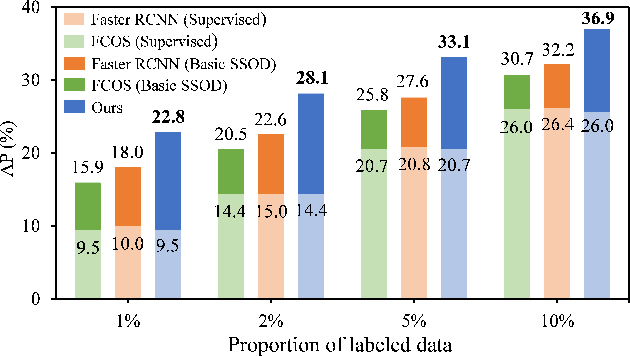
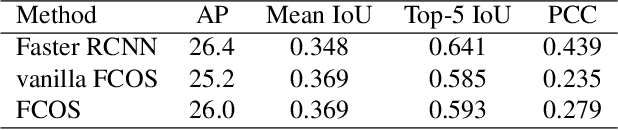
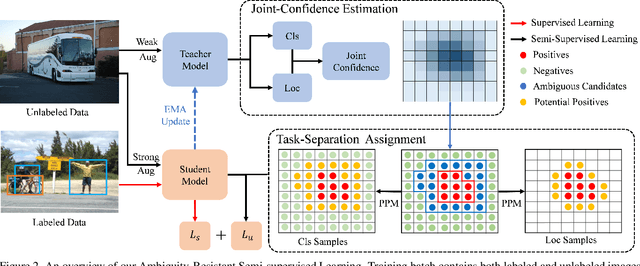
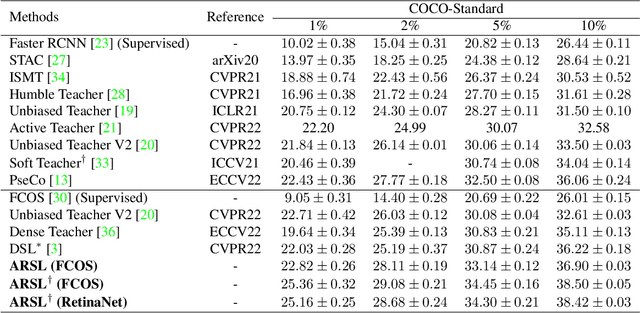
With basic Semi-Supervised Object Detection (SSOD) techniques, one-stage detectors generally obtain limited promotions compared with two-stage clusters. We experimentally find that the root lies in two kinds of ambiguities: (1) Selection ambiguity that selected pseudo labels are less accurate, since classification scores cannot properly represent the localization quality. (2) Assignment ambiguity that samples are matched with improper labels in pseudo-label assignment, as the strategy is misguided by missed objects and inaccurate pseudo boxes. To tackle these problems, we propose a Ambiguity-Resistant Semi-supervised Learning (ARSL) for one-stage detectors. Specifically, to alleviate the selection ambiguity, Joint-Confidence Estimation (JCE) is proposed to jointly quantifies the classification and localization quality of pseudo labels. As for the assignment ambiguity, Task-Separation Assignment (TSA) is introduced to assign labels based on pixel-level predictions rather than unreliable pseudo boxes. It employs a "divide-and-conquer" strategy and separately exploits positives for the classification and localization task, which is more robust to the assignment ambiguity. Comprehensive experiments demonstrate that ARSL effectively mitigates the ambiguities and achieves state-of-the-art SSOD performance on MS COCO and PASCAL VOC. Codes can be found at https://github.com/PaddlePaddle/PaddleDetection.
Policy Learning for Optimal Individualized Dose Intervals
Feb 24, 2022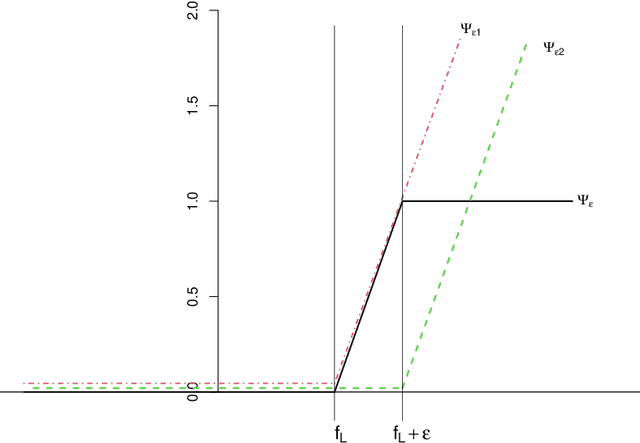
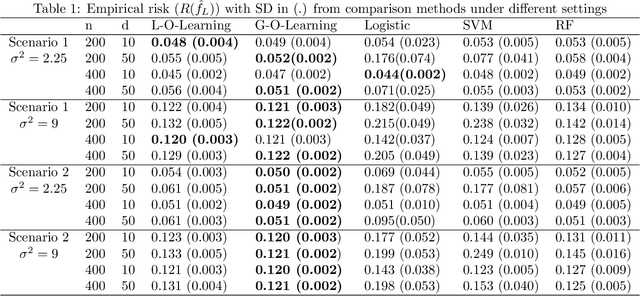
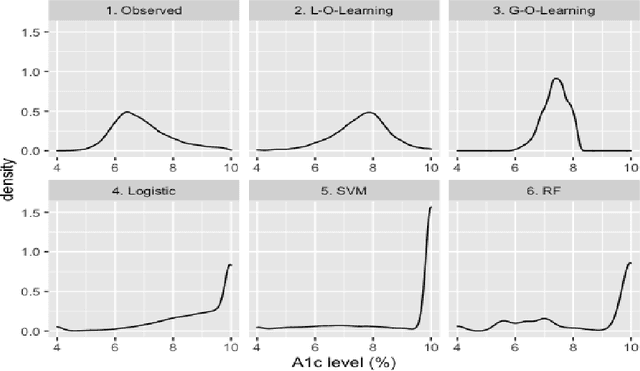
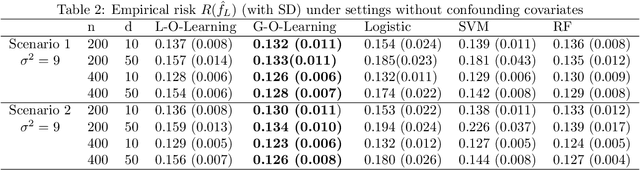
We study the problem of learning individualized dose intervals using observational data. There are very few previous works for policy learning with continuous treatment, and all of them focused on recommending an optimal dose rather than an optimal dose interval. In this paper, we propose a new method to estimate such an optimal dose interval, named probability dose interval (PDI). The potential outcomes for doses in the PDI are guaranteed better than a pre-specified threshold with a given probability (e.g., 50%). The associated nonconvex optimization problem can be efficiently solved by the Difference-of-Convex functions (DC) algorithm. We prove that our estimated policy is consistent, and its risk converges to that of the best-in-class policy at a root-n rate. Numerical simulations show the advantage of the proposed method over outcome modeling based benchmarks. We further demonstrate the performance of our method in determining individualized Hemoglobin A1c (HbA1c) control intervals for elderly patients with diabetes.