 Add to Chrome
 Add to Firefox
 Add to Edge
Codesearchnet
Papers and Code
Lost in Transcription: How Speech-to-Text Errors Derail Code Understanding
Jan 20, 2026
Code understanding is a foundational capability in software engineering tools and developer workflows. However, most existing systems are designed for English-speaking users interacting via keyboards, which limits accessibility in multilingual and voice-first settings, particularly in regions like India. Voice-based interfaces offer a more inclusive modality, but spoken queries involving code present unique challenges due to the presence of non-standard English usage, domain-specific vocabulary, and custom identifiers such as variable and function names, often combined with code-mixed expressions. In this work, we develop a multilingual speech-driven framework for code understanding that accepts spoken queries in a user native language, transcribes them using Automatic Speech Recognition (ASR), applies code-aware ASR output refinement using Large Language Models (LLMs), and interfaces with code models to perform tasks such as code question answering and code retrieval through benchmarks such as CodeSearchNet, CoRNStack, and CodeQA. Focusing on four widely spoken Indic languages and English, we systematically characterize how transcription errors impact downstream task performance. We also identified key failure modes in ASR for code and demonstrated that LLM-guided refinement significantly improves performance across both transcription and code understanding stages. Our findings underscore the need for code-sensitive adaptations in speech interfaces and offer a practical solution for building robust, multilingual voice-driven programming tools.

Large Language Models are Qualified Benchmark Builders: Rebuilding Pre-Training Datasets for Advancing Code Intelligence Tasks
Apr 28, 2025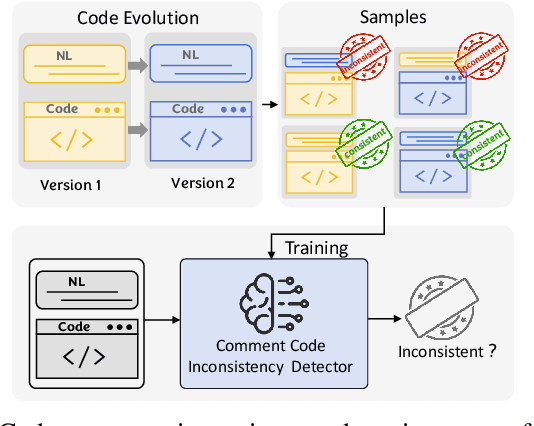
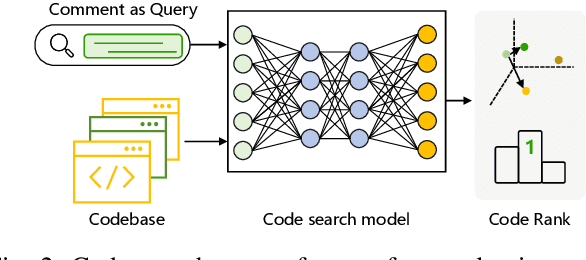
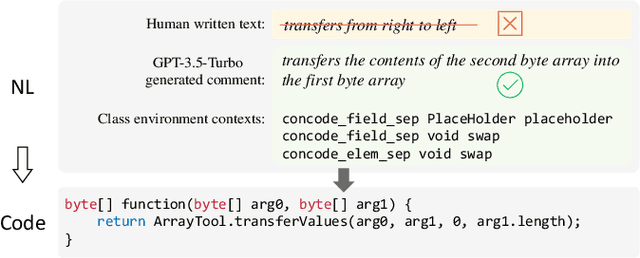
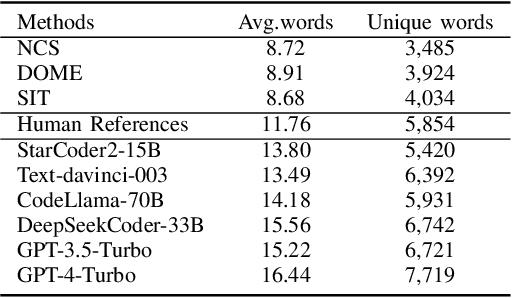
Pre-trained code models rely heavily on high-quality pre-training data, particularly human-written reference comments that bridge code and natural language. However, these comments often become outdated as software evolves, degrading model performance. Large language models (LLMs) excel at generating high-quality code comments. We investigate whether replacing human-written comments with LLM-generated ones improves pre-training datasets. Since standard metrics cannot assess reference comment quality, we propose two novel reference-free evaluation tasks: code-comment inconsistency detection and semantic code search. Results show that LLM-generated comments are more semantically consistent with code than human-written ones, as confirmed by manual evaluation. Leveraging this finding, we rebuild the CodeSearchNet dataset with LLM-generated comments and re-pre-train CodeT5. Evaluations demonstrate that models trained on LLM-enhanced data outperform those using original human comments in code summarization, generation, and translation tasks. This work validates rebuilding pre-training datasets with LLMs to advance code intelligence, challenging the traditional reliance on human reference comments.
AI-Driven Code Refactoring: Using Graph Neural Networks to Enhance Software Maintainability
Apr 14, 2025This study explores Graph Neural Networks (GNNs) as a transformative tool for code refactoring, using abstract syntax trees (ASTs) to boost software maintainability. It analyzes a dataset of 2 million snippets from CodeSearchNet and a custom 75000-file GitHub Python corpus, comparing GNNs against rule-based SonarQube and decision trees. Metrics include cyclomatic complexity (target below 10), coupling (target below 5), and refactoring precision. GNNs achieve 92% accuracy, reducing complexity by 35% and coupling by 33%, outperforming SonarQube (78%, 16%) and decision trees (85%, 25%). Preprocessing fixed 60% of syntax errors. Bar graphs, tables, and AST visuals clarify results. This offers a scalable AI-driven path to cleaner codebases, which is crucial for software engineering.
Model Editing for LLMs4Code: How Far are We?
Nov 11, 2024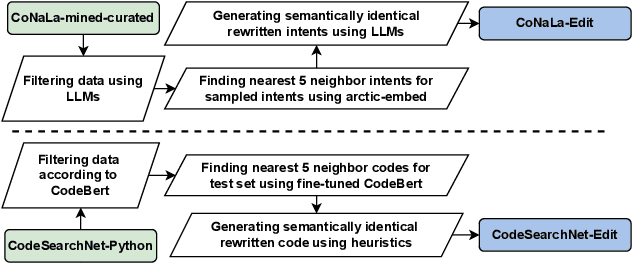
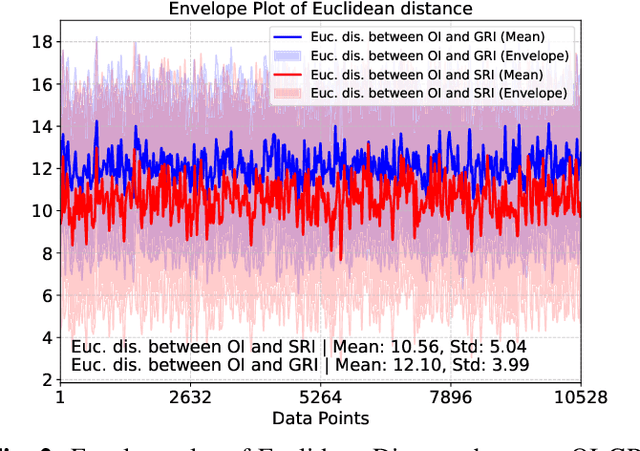


Large Language Models for Code (LLMs4Code) have been found to exhibit outstanding performance in the software engineering domain, especially the remarkable performance in coding tasks. However, even the most advanced LLMs4Code can inevitably contain incorrect or outdated code knowledge. Due to the high cost of training LLMs4Code, it is impractical to re-train the models for fixing these problematic code knowledge. Model editing is a new technical field for effectively and efficiently correcting erroneous knowledge in LLMs, where various model editing techniques and benchmarks have been proposed recently. Despite that, a comprehensive study that thoroughly compares and analyzes the performance of the state-of-the-art model editing techniques for adapting the knowledge within LLMs4Code across various code-related tasks is notably absent. To bridge this gap, we perform the first systematic study on applying state-of-the-art model editing approaches to repair the inaccuracy of LLMs4Code. To that end, we introduce a benchmark named CLMEEval, which consists of two datasets, i.e., CoNaLa-Edit (CNLE) with 21K+ code generation samples and CodeSearchNet-Edit (CSNE) with 16K+ code summarization samples. With the help of CLMEEval, we evaluate six advanced model editing techniques on three LLMs4Code: CodeLlama (7B), CodeQwen1.5 (7B), and Stable-Code (3B). Our findings include that the external memorization-based GRACE approach achieves the best knowledge editing effectiveness and specificity (the editing does not influence untargeted knowledge), while generalization (whether the editing can generalize to other semantically-identical inputs) is a universal challenge for existing techniques. Furthermore, building on in-depth case analysis, we introduce an enhanced version of GRACE called A-GRACE, which incorporates contrastive learning to better capture the semantics of the inputs.
Automatic Detection of LLM-generated Code: A Case Study of Claude 3 Haiku
Sep 02, 2024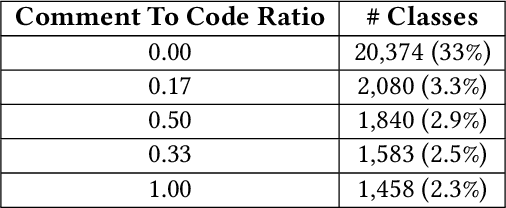
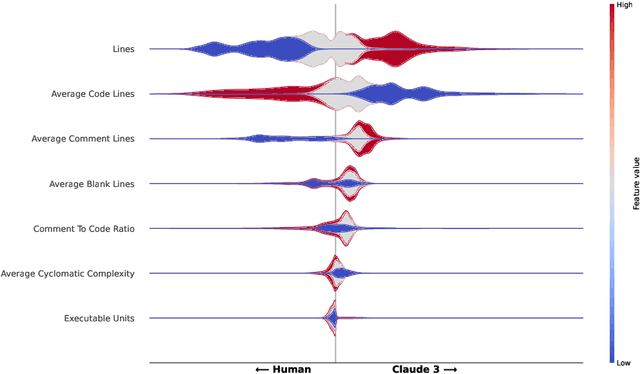
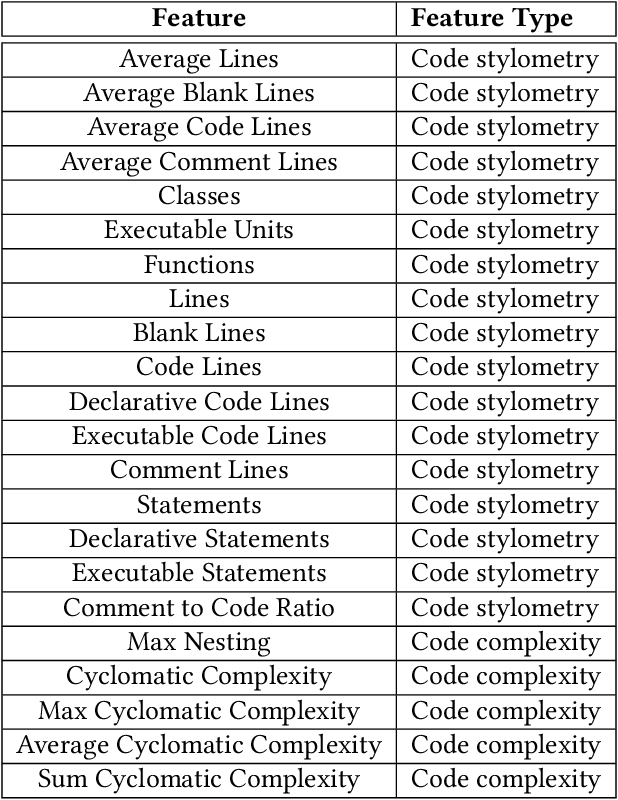
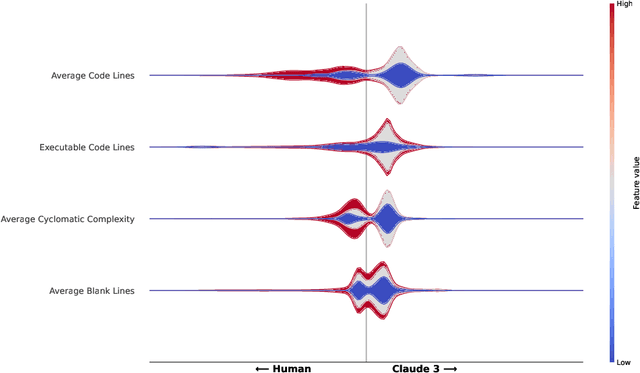
Using Large Language Models (LLMs) has gained popularity among software developers for generating source code. However, the use of LLM-generated code can introduce risks of adding suboptimal, defective, and vulnerable code. This makes it necessary to devise methods for the accurate detection of LLM-generated code. Toward this goal, we perform a case study of Claude 3 Haiku (or Claude 3 for brevity) on CodeSearchNet dataset. We divide our analyses into two parts: function-level and class-level. We extract 22 software metric features, such as Code Lines and Cyclomatic Complexity, for each level of granularity. We then analyze code snippets generated by Claude 3 and their human-authored counterparts using the extracted features to understand how unique the code generated by Claude 3 is. In the following step, we use the unique characteristics of Claude 3-generated code to build Machine Learning (ML) models and identify which features of the code snippets make them more detectable by ML models. Our results indicate that Claude 3 tends to generate longer functions, but shorter classes than humans, and this characteristic can be used to detect Claude 3-generated code with ML models with 82% and 66% accuracies for function-level and class-level snippets, respectively.
LLM Agents Improve Semantic Code Search
Aug 05, 2024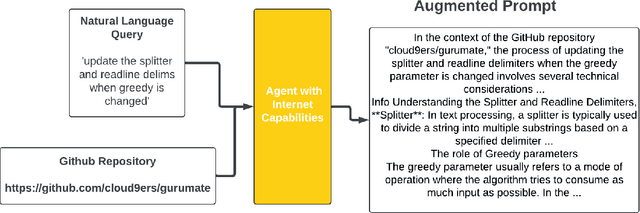
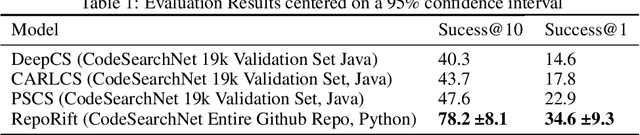
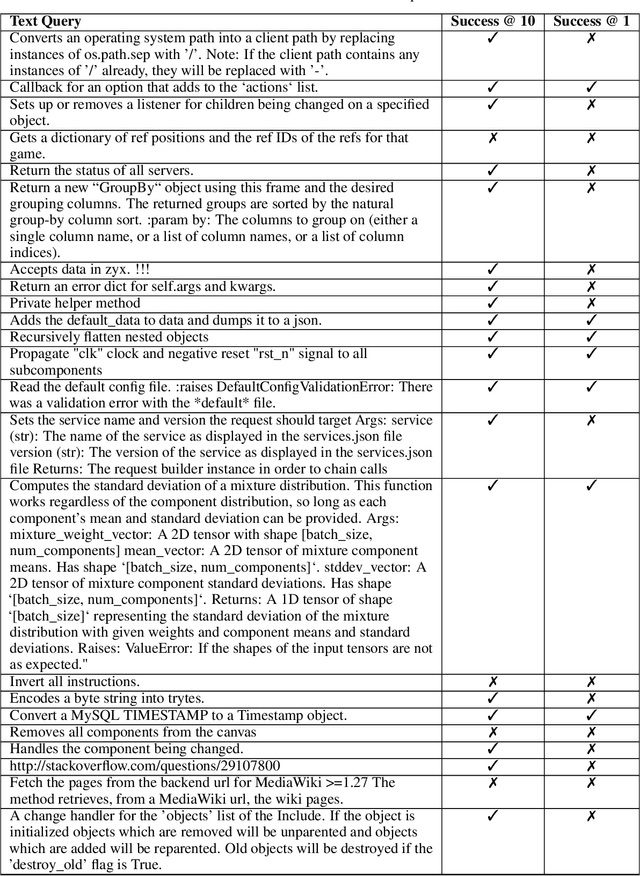
Code Search is a key task that many programmers often have to perform while developing solutions to problems. Current methodologies suffer from an inability to perform accurately on prompts that contain some ambiguity or ones that require additional context relative to a code-base. We introduce the approach of using Retrieval Augmented Generation (RAG) powered agents to inject information into user prompts allowing for better inputs into embedding models. By utilizing RAG, agents enhance user queries with relevant details from GitHub repositories, making them more informative and contextually aligned. Additionally, we introduce a multi-stream ensemble approach which when paired with agentic workflow can obtain improved retrieval accuracy, which we deploy on application called repo-rift.com. Experimental results on the CodeSearchNet dataset demonstrate that RepoRift significantly outperforms existing methods, achieving an 78.2% success rate at Success@10 and a 34.6% success rate at Success@1. This research presents a substantial advancement in semantic code search, highlighting the potential of agentic LLMs and RAG to enhance code retrieval systems.
CodeBenchGen: Creating Scalable Execution-based Code Generation Benchmarks
Mar 31, 2024

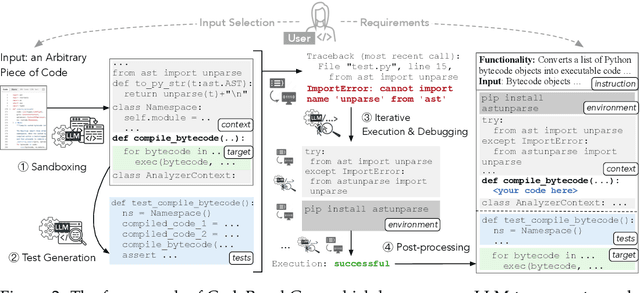

To facilitate evaluation of code generation systems across diverse scenarios, we present CodeBenchGen, a framework to create scalable execution-based benchmarks that only requires light guidance from humans. Specifically, we leverage a large language model (LLM) to convert an arbitrary piece of code into an evaluation example, including test cases for execution-based evaluation. We illustrate the usefulness of our framework by creating a dataset, Exec-CSN, which includes 1,931 examples involving 293 libraries revised from code in 367 GitHub repositories taken from the CodeSearchNet dataset. To demonstrate the complexity and solvability of examples in Exec-CSN, we present a human study demonstrating that 81.3% of the examples can be solved by humans and 61% are rated as ``requires effort to solve''. We conduct code generation experiments on open-source and proprietary models and analyze the performance of both humans and models. We will release the code of both the framework and the dataset upon acceptance.
ProCQA: A Large-scale Community-based Programming Question Answering Dataset for Code Search
Mar 25, 2024Retrieval-based code question answering seeks to match user queries in natural language to relevant code snippets. Previous approaches typically rely on pretraining models using crafted bi-modal and uni-modal datasets to align text and code representations. In this paper, we introduce ProCQA, a large-scale programming question answering dataset extracted from the StackOverflow community, offering naturally structured mixed-modal QA pairs. To validate its effectiveness, we propose a modality-agnostic contrastive pre-training approach to improve the alignment of text and code representations of current code language models. Compared to previous models that primarily employ bimodal and unimodal pairs extracted from CodeSearchNet for pre-training, our model exhibits significant performance improvements across a wide range of code retrieval benchmarks.
A Prompt Learning Framework for Source Code Summarization
Dec 26, 2023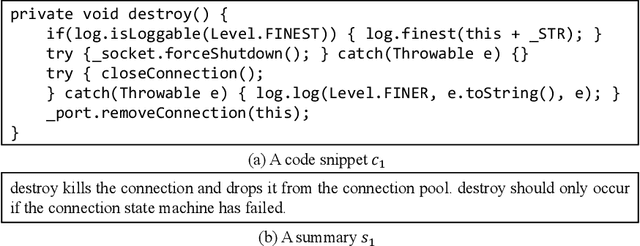
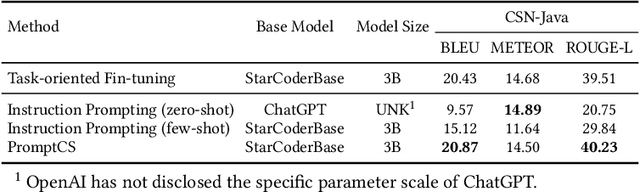
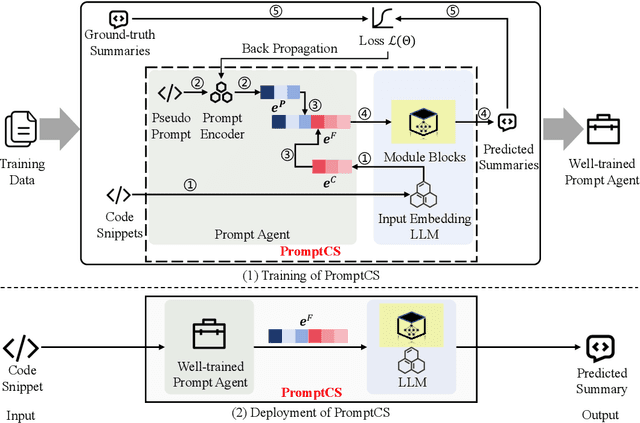
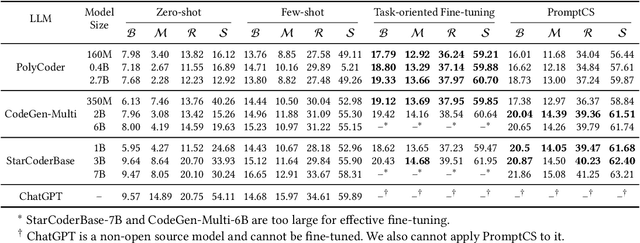
(Source) code summarization is the task of automatically generating natural language summaries for given code snippets. Such summaries play a key role in helping developers understand and maintain source code. Recently, with the successful application of large language models (LLMs) in numerous fields, software engineering researchers have also attempted to adapt LLMs to solve code summarization tasks. The main adaptation schemes include instruction prompting and task-oriented fine-tuning. However, instruction prompting involves designing crafted prompts for zero-shot learning or selecting appropriate samples for few-shot learning and requires users to have professional domain knowledge, while task-oriented fine-tuning requires high training costs. In this paper, we propose a novel prompt learning framework for code summarization called PromptCS. PromptCS trains a prompt agent that can generate continuous prompts to unleash the potential for LLMs in code summarization. Compared to the human-written discrete prompt, the continuous prompts are produced under the guidance of LLMs and are therefore easier to understand by LLMs. PromptCS freezes the parameters of LLMs when training the prompt agent, which can greatly reduce the requirements for training resources. We evaluate PromptCS on the CodeSearchNet dataset involving multiple programming languages. The results show that PromptCS significantly outperforms instruction prompting schemes on all four widely used metrics. In some base LLMs, e.g., CodeGen-Multi-2B and StarCoderBase-1B and -3B, PromptCS even outperforms the task-oriented fine-tuning scheme. More importantly, the training efficiency of PromptCS is faster than the task-oriented fine-tuning scheme, with a more pronounced advantage on larger LLMs. The results of the human evaluation demonstrate that PromptCS can generate more good summaries compared to baselines.
SAT-Based Algorithms for Regular Graph Pattern Matching
Dec 15, 2023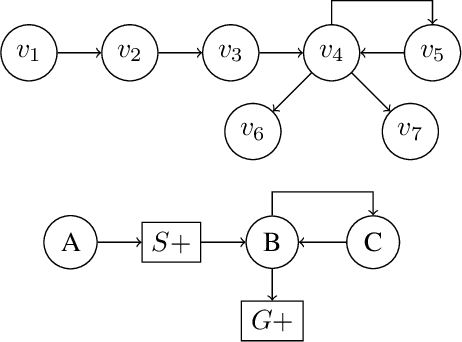

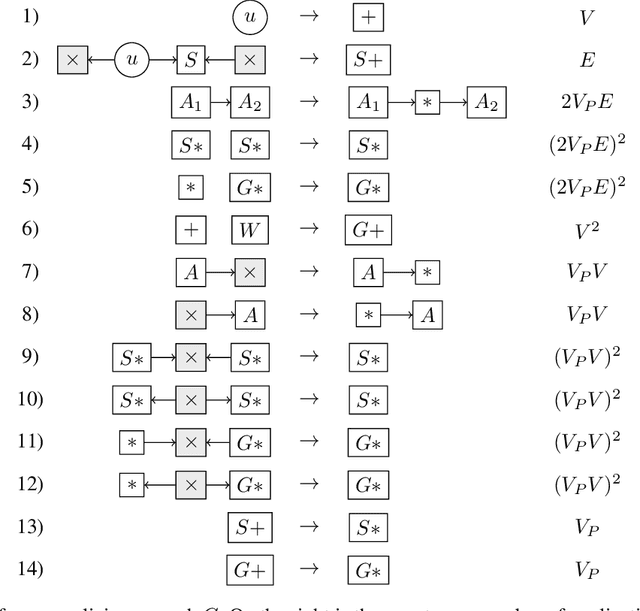

Graph matching is a fundamental problem in pattern recognition, with many applications such as software analysis and computational biology. One well-known type of graph matching problem is graph isomorphism, which consists of deciding if two graphs are identical. Despite its usefulness, the properties that one may check using graph isomorphism are rather limited, since it only allows strict equality checks between two graphs. For example, it does not allow one to check complex structural properties such as if the target graph is an arbitrary length sequence followed by an arbitrary size loop. We propose a generalization of graph isomorphism that allows one to check such properties through a declarative specification. This specification is given in the form of a Regular Graph Pattern (ReGaP), a special type of graph, inspired by regular expressions, that may contain wildcard nodes that represent arbitrary structures such as variable-sized sequences or subgraphs. We propose a SAT-based algorithm for checking if a target graph matches a given ReGaP. We also propose a preprocessing technique for improving the performance of the algorithm and evaluate it through an extensive experimental evaluation on benchmarks from the CodeSearchNet dataset.